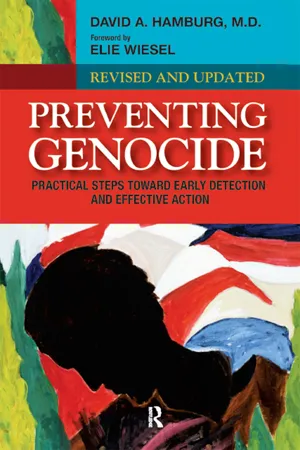
eBook - ePub
Preventing Genocide
Practical Steps Toward Early Detection and Effective Action
- 352 pages
- English
- ePUB (mobile friendly)
- Available on iOS & Android
eBook - ePub
Preventing Genocide
Practical Steps Toward Early Detection and Effective Action
About this book
Genocide has been called 'a problem from hell' and despite vehement declarations of 'never again' it's a problem that continues to plague the world. From the beginning of history to the most recent massacres in Bosnia, Rwanda, and Darfur, genocide defies resolution. And given today's worldwide access to highly lethal weapons and advanced communications technology facilitating incitement to hate, we can expect to see this problem grow. It is often claimed that genocide occurs without warning, taking both local and global communities by surprise. Yet, as David Hamburg convincingly shows, we have had long-term advance knowledge of most modern genocides dating back to the early 20th century Armenian tragedy in Turkey and before. In this book, Dr. Hamburg applies a groundbreaking new perspective-the medical model of prevention-to the scourge of genocide in the world. Preventing genocide is not only possible, Dr Hamburg contends, but essential given its high cost in lives, human rights, and international security. Here he maps out numerous practical steps to recognise genocidal conflicts early and stem their tides of violence before they become acute. He also outlines several institutions in place and programs underway at the UN, EU, and NATO devoted to preventing future genocides before they erupt. He draws lessons both from missed opportunities and successful experiences and makes many constructive suggestions about strengthening international institutions, governments, and NGOs for this purpose.
Information
PART I
NATURE AND SEVERITY OF THE PROBLEM
CHAPTER 1

Prevention of Genocide
Overview
Many consider genocide a modern invention. Far from it. Genocides have been recorded throughout history, often with approval by those chronicling a “victory” of their particular tribe or nation. The number of victims might have been smaller in earlier times and the technology used against them cruder, but there is no question that intensive efforts to obliterate ethnic or religious groups and their cultures have occurred repeatedly—that is, genocide.
Given this dreadful history, it would be plausible to suppose that modern ingenuity, with all its scientific strengths, would have sought and found ways to prevent genocide in the twenty-first century. Not so. Today the mass murders in Darfur drag on, with more than 200,000 dead from attacks, an equal number dead from conditions the attacks created, and more than 2.5 million internally displaced persons and refugees.
These figures do not convey the reality of the situation: strafed and burned villages; wells stuffed with the collected parts of mutilated corpses; brutal, premeditated rapes accompanied by racial insults; and then—if and when the victims (mostly women and children) can reach some place of uncertain refuge—overcrowding, malnutrition, disease, and threat of further attacks and rapes. In a land where seasonal variations put agriculture on a tight time schedule and where changing climate has shrunk the amount of productive soil and grazing land available to a growing population, fields have been left unsown and unprepared for future sowing. Atrocities and war, fed by cynically calculated government incitement to “racial” hatred, make most commerce, education, and medical care impossible. Militia service has become an attractive career for young men, especially when peaceful opportunities are lacking. Revenge is satisfying, looting means instant wealth, and fear of retaliation (strengthened by hardening attitudes on all sides) makes both rebels and government-backed forces reluctant to lay down easily available arms—often supplied by great powers, especially China. All this creates a self-perpetuating cycle of conflict that has spread in a growing bloody pool of abuse throughout the region.
The Darfur rebellion that began in 2003 and the massacres that followed (now almost universally acknowledged as genocide) could not have surprised international observers. They are essentially a replay in the west of the twenty-year rebellion of “African” groups in Sudan’s largely Christian south against the repressive monopoly of political and economic power by the Muslim central government in Khartoum. This central government, a legacy of colonial rule, has identified itself as “Arab” and has flirted with both Arab nationalism and Islamic terrorism to consolidate its power. Sudanese president Omar Hassan al-Bashir responded to the southern rebellion with the same tactics he would later use in Darfur—incitement to ethnic (and, in southern Sudan, religious) hatred, use of brutal unofficial militias to carry out a scorched-earth policy of ethnic cleansing, repopulation with favored ethnic groups, as well as divide-and-rule tactics and many unkept promises directed at both rebels and concerned observers outside his borders. As is the case with Darfur today, international concern was high about the southern rebellion. In the United States alone, beginning as early as 1989, ex-president Jimmy Carter used his good offices in a number of efforts to facilitate peace between the government of Sudan and the southern rebels. (His Carter Center also provided humanitarian assistance.) As they did later in Darfur, Christian evangelical groups made vigorous efforts to rescue and relieve victims of the struggle and brought pressure on Congress and the president to take action. Their success was evident in President George W. Bush’s appointment of Senator John Danforth as U.S. mediator for peace in Sudan. But before long he was gone from the Bush administration.
When southern rebel victories, growing dissatisfaction in other regions of Sudan, the desire to capitalize on recently found oil reserves, and strong if uncoordinated international pressure finally forced Khartoum to negotiate an agreement with the south, al-Bashir exploited the differences and jealousies that divided both his international and internal opponents to ensure that the final accord did not include sharing power with marginalized and disgruntled “African” groups in Sudan’s west (i.e., Darfur) and north. The Comprehensive Peace Agreement (CPA), signed in January 2005, explicitly stated that it could not be reopened. Like the later peace settlement for Darfur, it was an agreement between only two parties, the ruling National Congress Party (NCP) and the rebel Sudan People’s Liberation Movement/Army (SPLM/A), but it locked in allocations of power sharing that affected the whole country. This left other regions of Sudan disaffected, and many decided that the only way of asserting their own rights was the way the SPLM/A had chosen—armed rebellion. So more rebel groups emerged. For its part, Khartoum intended to implement only those CPA provisions it could not defer or avoid, unless implementation suited its own purposes. By playing on their divisions, the NCP immobilized the international community just as it would do later in Darfur and carried out only selected elements of the CPA but blocked any fundamental change in the way it ruled Sudan. At the same time it encouraged conditions that created chaos among the southern ex-rebels. Sudan has reportedly backed incursions against the SPLA by the vicious Ugandan Lord’s Resistance Army (LRA), and the Darfur Peace Agreement, signed on May 5, 2006, itself created a situation that weakened the CPA.
The unscrupulous Sudanese president has evidently learned more from experience than his opponents have. Analysts have pointed out that al-Bashir is consistent in responding only to pressure that is resolute, concerted, and costly to him and to his party. Yet the Darfur rebels continue to fragment, only to end up isolated, co-opted, and/or marginalized by Khartoum. The African Union (AU) has seen its individual members bullied and cajoled almost to the point of allowing Sudan to take its chairmanship. The rest of the international community has been distracted and divided by its other interests.
The United States, with its attention and resources focused on Iraq, perceives Sudan as too useful an ally in getting intelligence on terrorists to be alienated completely. It is also nervous about joining too closely with the Europeans, who are enthusiastic about endorsing the use of the International Criminal Court (ICC), which is anathema to Bush foreign policy. One can only hope that this will change with leadership changes in the UK, in France, and later in the United States.
China’s characteristically amoral foreign policy is manifested in its tender solicitude for Sudan’s oil and trade. It also wants to gain influence throughout the developing world by promoting its image as an indulgent uncle who will not ask unwelcome questions about human rights abuses committed by the governments with which it conducts business. And most nations, even those that nominally accept a nation’s “responsibility to protect” its own citizens, tend to become very cautious when that principle is actually used to trump the venerated principle of “national sovereignty.” Khartoum has skillfully used this disunity to resist effective international monitoring and peacekeeping in Sudan, despite thoughtful efforts by the dedicated and high-caliber diplomats Jan Eliasson (for the UN) and Salim Salim (for the AU) and by the gifted UN Secretaries-General Kofi Annan and Ban Ki-moon. It will be a terribly difficult job to build international unity and resolve to stop the bloodshed and heal the wounds of Darfur; if and when that can be achieved, the costs will be very high, far higher than if early preventive action had been applied. The near impossibility of stopping an ongoing genocide is vividly and grotesquely illustrated by the Darfur experience. It should provide all democratic societies and, indeed, the international community with a powerful stimulus to turn toward prevention.
Sudan has long held the spotlight of international attention, but several other countries—notably Burma and Zimbabwe—stand precariously on the brink of mass murder. Both are catastrophes foreshadowed by severe governmental repression, flagrant and growing abuse of human rights, and hate speech—especially incitement by despotic leaders against vulnerable groups blamed for the country’s troubles. So atrocities in various forms that lead to mass violence, even genocide, have not gone away, and given the worldwide spread of highly lethal weapons, as well as today’s enhanced capacity for destructive communication, we can expect to see more genocides.
Until now very little work has been done on the prevention of genocide, especially when prevention means stopping a problem before it becomes murderous. The time has come to draw together the world’s knowledge pertinent to this subject and to stimulate worldwide reflection, discussion, research, and education on prevention of genocide.
The complaint that no one can predict genocide, or even identify it until it is at least halfway through its bloody course, is both an unsubstantiated shibboleth and a convenient way to sidestep responsibility. In fact, time after time—as in the case of Darfur—the approach of genocide has been discernible decades before its arrival. These years must not be wasted. They must be used for prevention—before massive bloodshed occurs, not after. But how?
Worldwide concern to avoid the recurrence of an eminently preventable and highly contagious disaster cries out for establishment of strong focal units within major international institutions that will assemble from around the world the knowledge and skill of many professions, disciplines, and nations. They will develop and make public ways to recognize emerging intergroup tensions that are likely to lead to violent abuses. Action must not wait until it can be determined whether a particular threat of impending violence will lead to genocide or to some other atrocity—any hint of mass violence. Action must be taken to prevent a lesser atrocity than genocide, not only because it is an atrocity (and that in itself is a sufficient reason) but also because unresolved hatred and emerging violence in a society can grow into recurrent massacres, even war or genocide, destruction on a vast and hideous scale. Thus it is necessary for strong democracies and humane organizations to reach out proactively to nations in trouble and help them to avoid descent down the slippery slope to mass violence. The international community needs to have information ready at hand about practical measures for prevention that follows the public health model—an approach that uses empirical research to identify high-risk factors and apply a wide array of strategies, tools, and practices for preventing violent outbreaks of all kinds.
Such prevention involves identifying an ailing nation’s specific problem(s) and employing evidence-based responses toward resolving them. Some measures, such as early, skillful, and respectful preventive diplomacy, can quickly show beneficial results, just as expert care of a sprained ankle results in rapid healing and prevents an injury from getting worse. Longer-term measures, especially helping a troubled nation build a democratic, equitable, socioeconomic infrastructure, take longer to apply and even longer to show results, but the effects are likely to be lasting and pervasive, just as promoting a healthy lifestyle and environment can achieve much better health for a society that is accustomed to health-damaging habits such as cigarette smoking. This book considers such measures and recommends that they could best be developed, analyzed, disseminated, and applied through the help of two centers in large international organizations for the prevention of genocide. These centers are now coming into existence, bringing the promise of a critical mass of knowledge, skill, and best practices for prevention in focal points of high leverage for accomplishment.
The first third of the book deals with how genocides come about and considers some recurring twists and turns in the paths to genocide throughout the nineteenth, twentieth, and twenty-first centuries. The second part deals with pillars of prevention: elements of human societies that have strong preventive potential for mass violence of all kinds. These pillars, if adequately built, can greatly reduce the risk of genocide, war, and atrocity behavior. The third part of the book deals with who can do what to build and maintain such pillars: organizations and institutions that are already doing good work in this area and could do much more. Since international cooperation is essential for genocide prevention, I describe four institutions that have already shown considerable promise and try to look ahead toward fulfillment of their potential in the future, including their stimulating effect on international institutions all over the world.
As its subject demands, this book is highly interdisciplinary and international in scope, and its conclusions rely on strong links between research and policy. These conclusions have already stimulated highly significant changes in two of the world’s great international institutions, the United Nations and the European Union (EU). I had the privilege of chairing for each of them a committee reporting at the highest level: to Kofi Annan, then Secretary-General of the United Nations, now to his successor Ban Ki-moon; and to Javier Solana for the European Union. There has been an ongoing interplay between these activities and the preparation of the book. I think this interplay was helpful to all concerned; it was certainly stimulating in my work on the book.
The special qualities of the book include
• examination of different categories of prevention to show how they put out small fires before they become conflagrations and, beyond that, help in resolving the root causes of conflict before they reach the level of recurrent and expanding violence. This is far more effective than reacting to crises after much blood has been shed, many lives lost, revenge motives aroused, and reconciliation made very difficult;
• use of case histories of actual genocides that occurred in different cultures, times, and localities to illustrate how preventive measures at an early stage might have averted the genocide, and, in the genocide’s later phases, how opportunities were missed for effective action to contain and cut short a deadly situation;
• identification of warning signals of impending violent conflict—signals that are invariably evident years, even decades, before actual mass violence begins—and their importance to national and international bodies in developing, institutionalizing, and sharing an armamentarium of responses to which these signals can be firmly linked and employed as appropriate;
• analysis of the particular assets and limitations of specific international and regional organizations—both government and civil society—in carrying out the work of prevention;
• recommendation to establish collaborative centers for the prevention of genocide in appropriate regional and international bodies, with key functions of these centers dedicated to the service of effective prevention.
The Case for Prevention
Recent research has documented that all the genocides of the twentieth century were clearly visible years in advance, but largely dismissed, even denied, by the international community until mass killing was well under way. The paths of genocide-prone behavior are clear; we are learning how to provide help and apply pressure at strategic points along those paths to prevent it. Yet international leaders, confronted with impending genocide, still fail to devise policy alternatives to large-scale military action. Military action is extremely difficult, expensive, distasteful, politically unpopular, and costly of human life. So, genocide-prone behavior continues to be condoned, even as it is verbally deplored.
Yet unchecked genocide is catastrophic for all concerned. Once in progress, Hitler’s Final Solution was ended only after years of global carnage that devastated much of Europe and brought down upon Germany pervasive destruction ...
Table of contents
- Cover Page
- Title Page
- Copyright Page
- Dedication
- Contents
- Foreword
- Introduction
- Acknowledgments
- Credits
- Part I Nature and Severity of the Problem
- Part II Pillars of Prevention: Strategies, Tools, and Practices
- Part III Institutions and Organizations: Who Can Do What?
- Part IV Conclusion
- Notes
- Bibliography
- Index
- About the Author
Trusted by 375,005 students
Access to over 1.5 million titles for a fair monthly price.
Study more efficiently using our study tools.
Frequently asked questions
Yes, you can cancel anytime from the Subscription tab in your account settings on the Perlego website. Your subscription will stay active until the end of your current billing period. Learn how to cancel your subscription
No, books cannot be downloaded as external files, such as PDFs, for use outside of Perlego. However, you can download books within the Perlego app for offline reading on mobile or tablet. Learn how to download books offline
Perlego offers two plans: Essential and Complete
- Essential is ideal for learners and professionals who enjoy exploring a wide range of subjects. Access the Essential Library with 800,000+ trusted titles and best-sellers across business, personal growth, and the humanities. Includes unlimited reading time and Standard Read Aloud voice.
- Complete: Perfect for advanced learners and researchers needing full, unrestricted access. Unlock 1.5M+ books across hundreds of subjects, including academic and specialized titles. The Complete Plan also includes advanced features like Premium Read Aloud and Research Assistant.
We are an online textbook subscription service, where you can get access to an entire online library for less than the price of a single book per month. With over 1.5 million books across 990+ topics, we’ve got you covered! Learn about our mission
Look out for the read-aloud symbol on your next book to see if you can listen to it. The read-aloud tool reads text aloud for you, highlighting the text as it is being read. You can pause it, speed it up and slow it down. Learn more about Read Aloud
Yes! You can use the Perlego app on both iOS and Android devices to read anytime, anywhere — even offline. Perfect for commutes or when you’re on the go.
Please note we cannot support devices running on iOS 13 and Android 7 or earlier. Learn more about using the app
Please note we cannot support devices running on iOS 13 and Android 7 or earlier. Learn more about using the app
Yes, you can access Preventing Genocide by David A. Hamburg,Elie Wiesel in PDF and/or ePUB format, as well as other popular books in Politics & International Relations & Genocide & War Crimes. We have over 1.5 million books available in our catalogue for you to explore.