- 192 pages
- English
- ePUB (mobile friendly)
- Available on iOS & Android
eBook - ePub
About this book
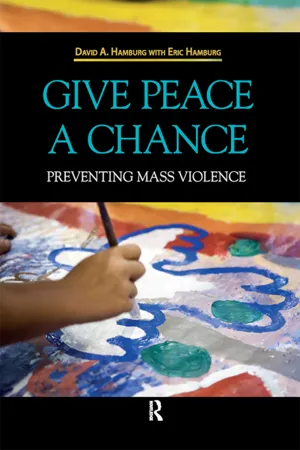
In Give Peace a Chance, the distinguished Dr. Hamburg teams up with his filmmaker son to tell the story of selected significant peace achievements over the past 25 years. Including lessons from personal experience, pithy quotes from interviews with international dignitaries, and the insights of a documentary sensibility, this book reflects upon striking moments in peace history and inflects them with the perspective of preventive medicine. From Jane Goodall's rainforest research station, to a hostage taking in Eastern Africa, to the Reagan-Gorbachev post-summit epiphany in Reykjavik, the Hamburgs take us there. They then distill the wisdom of these and many other encounters into an essential "six pillars of prevention"-education, early action, democracy building, socioeconomic development, human rights, and arms control. These six pillars are essential not only to reflections upon the past, but to future prospects emerging from recent challenges to peace-the Arab Spring, the violent repression in Syria, and the brewing faceoff with Iran. Features of this engaging text: Combines personal experience(including involvement in a hostage rescue mission) with ongoing research in a variety of areas over 50+ years. Includes feature quotes and vignettes from international figures including Kofi Annan, Sam Nunn, and Hillary Clinton, among many others. Builds upon six key pillars of prevention: education, early warning, democracy, development, human rights, and arms control. Concludes with prescriptions for peace action in four key areas: the US and Western democracies, the UN, the EU, and NATO. Offers carefully selected Recommended Readings for every chapter. See Stanford University's website for twenty-nine videotaped interviews with world leaders in the prevention of mass violence at http://lib.stanford.edu/preventing-genocide/list-interviews
Information
ONE

PERSONAL EXPERIENCES AS PATHWAYS TO PEACE
Immersed in stress research since 1948, I began to realize more and more that stress responses were a kind of mobilization for action—but without producing action, in most contemporary circumstances. The energy metabolism of stress, cardiovascular responses to stress, and the role of various hormones in stress—all pointed in the direction of the body’s getting ready for some intensive exertion. This anticipatory mobilization must have served adaptive functions over a very long period of time, under the conditions in which we evolved. Over millions of years, the human organism and its predecessors must have been able to take actions that would prepare them to do whatever was necessary to survive, but in contemporary circumstances stress does not often lead to intense exertion. To dig into this more deeply, I and other researchers in the field studied the brain and hormones in clinical and experimental conditions, focusing especially on the adrenal cortex.
FROM STRESS RESEARCH TO HUMAN AGGRESSION
The people we were studying in the 1950s and beyond were, for the most part, in sedentary situations and, for that matter, largely lived sedentary lives. In just a moment of evolutionary history—two hundred years of time since the Industrial Revolution—the human way of life changed drastically as compared with the millions of years in which we’ve evolved. The human experience probably carried over these stress responses from an earlier time based on genetic predispositions shaped by cultural changes. So the old responses in alarming situations might no longer be adaptive. In fact, that view became a general orientation of ours, certainly about aggressive behavior. Much of what was adaptive earlier was no longer adaptive in contemporary circumstances and might well have influences on today’s diseases. That led me and my colleagues to get directly into some evolutionary studies and ultimately took us on quite an intellectual as well as physical journey.
PIONEERS IN THE STUDY OF HUMAN EVOLUTION
This field has gone far beyond where it was in the beginning because genetics, then incipient, has made fantastic progress. I have always felt deeply grateful to my original mentor in genetics, Tracy Sonneborn, and to my long-term colleague, another great pioneer in modern genetics, Joshua Lederberg. Our research group was able to show major genetically determined variations in the way individuals processed the stress-related hormones. Jack Barchas and Roland Ciaranello pursued this line of inquiry very effectively. They both became leaders in neuroscience and psychiatry. Genetics has become very important in the stress field and in psychiatry generally at the present time.
On the evolutionary side—closely related to genetics in fundamental terms—we wanted to understand how human stress responses evolved. In 1956, I got a letter out of the blue, inviting me to spend a year at the then-new Center for Advanced Study in Behavioral Sciences. It brought together fifty distinguished scientists and scholars from ten to twelve fields each year at Stanford (though it was then a fully independent institution). Each person was free to pursue his or her own scholarship in any way. It was a unique opportunity. The first or second day I was there, a wiry fellow appeared at the door and introduced himself. His name was Sherwood Washburn, and he was one of the great pioneers in the modern study of human evolution. So there began a multiyear collaborative review of the research literature on many facets of human evolution bearing on stress and aggression as well as attachment and child development. That eventually led me to go to Africa. I went multiple times in the late 1960s and up to 1975, each time taking a family member with me and working with Stanford students in the field research unit we had established. Washburn had begun the new wave of primate studies in the natural habitat, just a few years earlier (in the early 1950s). I got interested in whether it would be possible to learn about chimpanzees in the natural habitat because of their very close biological relationship to humans. The new work in genetics was showing that 98 percent of the genes of chimpanzees and humans were identical.
In 1959, I sought to establish a research unit in the chimpanzee natural habitat, but it was very difficult because my best opportunity was in the Congo, and violence there blew up at the time of independence. About a year later, in 1960, Professor Clark Howell, a distinguished archaeologist, told me he was aware of my search for a young zoologist or medical missionary and had a good lead. Louis Leakey told me that he had started a young woman named Jane Goodall on studies just a few months before in Tanzania, on the other side of Lake Tanganyika from Congo. She was trying to get chimps accustomed to humans so that close-range observation would be possible. So I started corresponding with her. Then she came for a visit to the United States, and we became friends. She and her husband, a great photographer, Hugo von Lawick, had a treasure trove of film, even from an early point, of chimpanzees in their natural habitat.
After several years of intensive research at the National Institutes of Health, I moved to Stanford in 1961. I recruited into the department people with backgrounds in genetics and biochemistry and evolution, bringing the different disciplines together. Stanford had a lot of land, and the administration generously gave me about twenty acres set aside to build a seminatural laboratory for chimpanzees. They could live in groups, each consisting of several acres. But we knew very little about how they lived in their natural habitat. What’s a day in the life of a chimp? Nobody knew at the time.
When I first went to Africa in the 1960s, Goodall was about to leave. She had finished the work for which she could get her PhD at Cambridge University, and it didn’t seem a practical proposition to stay. Von Lawick needed to do filming elsewhere on other subjects. But it was clear that they really wanted to stay, though they had little support for doing it. So I offered to try to get funding and some organizational (especially academic) support and make a relationship with the Tanzanian government that would give them an official blessing. They were delighted to have this opportunity, and so we made a substantial research station out of it; it was a wonderful collaboration that lasted the better part of a decade. Over time, we were able to get graduate students and postdoctoral fellows and remarkable undergraduates in human biology, so at any given time we had twenty or so people working there from Stanford, from Cambridge University in England, and from Tanzania. It was international and interdisciplinary. The methods became much more systematic and, to the extent possible, quantitative observations of the behavior of chimps in their natural habitat moved from studying a single community to studying two adjacent communities so the interaction between the communities could be clarified. That turned out to be extremely illuminating because of the violence between different communities that was discovered.
At the seminatural laboratory at Stanford, we wanted to be able, for example, to train the chimps to hold out their arms to have blood drawn, which it’s possible to do. Training in behavioral science methods was emphasized, with the excellent leadership of Helena Kraemer. So we had the seminatural laboratory at Stanford and the natural habitat studies. People went back and forth, students working first at one place, then the other. There are different things you can do in a laboratory than in a natural habitat. Each has its own limitations, each its own strengths. It was unique in the world at that time. It came to an end with a hostage episode in 1975. Now let me sketch this bizarre episode.
A LIFE-CHANGING EXPERIENCE
On May 19, 1975, I received many urgent messages in California that four of my students had disappeared in Africa. There were calls from the State Department, the press, families, and others. All we knew was that about forty heavily armed men had come in off Lake Tanganyika into our camp on the lakeshore on the night of May 19, 1975, taken four people, and disappeared on the lake. A few shots were heard, and nobody had any idea what had really happened. Were they killed and dumped in the lake? Who was it? Who took them? What was it about? We knew nothing.
So I decided I immediately would go over there and see if there was anything I could do, even though I hadn’t the foggiest idea of what. We were all quite scared. It was just a bizarre experience, the kind of thing that you may read about but that doesn’t happen to “real” people.
It was some days before we found out that these were rebels against the government of Mobutu Sese Seko, the longtime dictator in Congo. These rebels lived very high in almost impenetrable mountains, perhaps nine thousand feet in elevation, rising dramatically out of Lake Tanganyika on the other side of the shore from our camp. They sent a letter of demands to President Julius Nyerere of Tanzania. They had taken these young people and were holding them hostage. The point was that they earlier had a secret supply line for a thousand miles from the Indian Ocean at Dar es Salaam, the capital of Tanzania, across Tanzania to Lake Tanganyika. That supply line had been shut down by Nyerere, the leader of a very poor and well-meaning country, in a trade deal with Mobutu, who was blessed with valued resources but not with any sense of decency. They were furious with Nyerere. We were pawns in an African political conflict. We were meant to bring pressure on Nyerere. We were somehow supposed to get their people back who were operating the supply line and get the supply line reopened. But that proved to be impossible.
So we set out to do whatever we could: first of all to find out who had taken our students, and then to make contact with the hostage-takers. How to do that? Eventually we made contact and then looked to see if we had any conceivable negotiating leverage. We did this mostly in very remote areas and with some cloak-and-dagger experiences. It became possible to figure out different strands of negotiating possibilities, and that led, over a period of a couple of months, to three of the students being freed. But they were still holding the fourth student, and they conveyed their intent to kill him if necessary for political purposes. Then President Nyerere helped us. That was absolutely vital and a vivid lesson in the value of benign leadership.
These people believed that the ends justified the means, and they committed many human rights violations in the process. Because they wanted some recognition, I was able to use this as bargaining leverage: making clear that I could not endorse them in any way, but letting them explain their outlook to the world. With difficult negotiations, they agreed. In due course, they were persuaded by other incentives to release the remaining three hostages. But I knew that they were not to be trusted and that they would in fact try to trick us.
We devised a very complicated mid-lake fail-safe transfer, which failed because Mobutu had located our group and set up heavily armed gunboats in the lake. So it was Mobutu who blocked off the transfer this time, not the rebels against him. The only option that remained was to meet the hostage-takers on their beach at night. So under their guns, they released all but one of the hostages—a male student, Steve Smith. He was extremely vulnerable for political reasons.
The only way to free this student was to involve President Nyerere. As luck would have it, his official Tanzanian representative (an anti-American bureaucrat) went out of town, so the American ambassador made an urgent plea for a meeting with Nyerere, which was readily granted. The Tanzanian representative had proved to be a real obstacle who misled us into believing that Nyerere would be of no help. The opposite was in fact true. Nyerere was determined to help free Steve if necessary and made necessary concessions—which were not made public—to these rebels.
When Steve was finally released, the students organized a reunion celebration that evening and gave me an “Honorary Degree in Contingency Planning” written on the only available piece of paper they had. I have many honorary degrees, but this one is the best and will always recall the courage, affection, and ingenuity of these students.
To conclude, after two and a half months, all four were free. It was a very important experience. It was the end of our work in Africa, and it certainly influenced the rest of my life. Those years were extremely stimulating and an opportunity to get some insights into human evolution. I wrote several papers with Washburn and Goodall and others, but more importantly, inspired students, some of whom are now professors at Harvard (Richard Wrangham), Michigan (Barbara Smuts), Duke (Anne Pusey), and elsewhere and are making important contributions to the field. So I view it as a fantastic set of dreams. I never dreamt of going to Africa in the first place. I never dreamt of doing primate research. I never dreamt of dealing with a hostage problem. But there it was.
Ambassador Beverly Carter challenged me, after that event, to think about using my capabilities in spheres beyond the university, particularly to relate the scientific and policy communities to address the dreadful problems of hatred, violence, ignorance, malnutrition, and disease that I experienced so vividly in the hostage crisis.
A few weeks before the hostage-taking, I had a tentative invitation to become president of the then-new Institute of Medicine, National Academy of Sciences. Or to put it another way, the search committee, looking for a president, wanted me to be the lead candidate. The academy is a very special place in the American and indeed world scientific community.
Yet at that pre-hostage moment, I felt I couldn’t leave Stanford; I couldn’t leave the work in Africa. I had developed a configuration of responsibilities that was unique to me, and I thought if I pulled out, it probably wouldn’t be sustained. In any case, I loved what I was doing. Our children with whom we have always been very close had grown up on the Stanford campus. I never envisioned leaving at all.
That offer was made early in May 1975. On May 19, the students were taken. Two and a half months later, it was over. When I got back to Dar es Salaam at the end of it, there was a letter from the president of the National Academy of Sciences that essentially said something to the effect that an experience such as this can be deep. It can affect your whole life. It can make you rethink what you want to do. So let us reconsider the Institute of Medicine.
Thus I was, in a way, a changed person, and from then on, both in that position and later at the Carnegie Corporation of New York, I was fundamentally trying to find ways to do something useful on these dreadful problems. Moving on to become president of the Institute of Medicine was one powerful way to address them at the level of policy. We were able to lay out a program for dealing with major issues, including diseases of poverty, primarily in developing countries, and created an international health program.
One further point on the life-changing influences: the courage and integrity of the student hostages (Emilie Bergman, Carrie Hunter, Steven Smith, and Barbara Smuts). Fortunately, they were allowed to stay together, and their mutual support was of inestimable value. Moreover, and deeply touching, they were convinced that I would immediately come to Africa and find some way to get them freed. While that was a hope-sustaining fantasy because I had so little preparation and so little leverage, it taught me an unforgettable lesson in human solidarity. The themes of this experience in Africa echo through the remainder of this book.
AN EVOLUTIONARY PERSPECTIVE: INSIGHTS FROM OUR WORK IN AFRICA
My initial focus in our Laboratory of Stress and Conflict at Stanford was on individual and small group levels. It then expanded to include the community and then larger intergroup and international conflict. So, over a period of decades, it was possible to develop an unusually broad view of human conflict and its resolution.
From an evolutionary point of view, I had done research and field work and come to the conclusion that group membership is fundamental to survival. It is so important for humans to identify with a valued group that we sometimes end up justifying our worst atrocities in the name of loyalty to that group. “Holy wars” begin from this point of view.

David Hamburg with the four hostage students and Professor Don Kennedy. October 2011 at Stanford.
Many people have a vaguely formulated assumption that the genetic heritage of human nature makes mass killing inevitable. It is a matter of great importance whether human nature inevitably leads to catastrophe. Therefore, it is vital to consider what we know about the elements of human nature that bear upon mass violence. If there are genetic tendencies of this sort built into our ancient heritage, then we must consider what else is built into that heritage pertinent to protecting against such violence, helping us to survive as a species. Therefore, we worked on elements of biobehavioral sciences that illuminate such questions.
Of special interest are our closest genetic relatives, chimpanzees, who share 98 percent of our genes. Their patterns of threat, attack, and submission are similar to some of the aggressive and conflict-resolution pat...
Table of contents
- Cover
- Title Page
- Copyright Page
- Table of Contents
- Preface and Acknowledgments
- An Invitation to Peace
- Chapter 1 Personal Experiences as Pathways to Peace
- PART I PILLARS OF PREVENTION
- PART II WHO CAN DO WHAT FOR PEACE?
- Notes
- Recommended Readings
- Index
- About the Authors
Trusted by 375,005 students
Access to over 1.5 million titles for a fair monthly price.
Study more efficiently using our study tools.
Frequently asked questions
Yes, you can cancel anytime from the Subscription tab in your account settings on the Perlego website. Your subscription will stay active until the end of your current billing period. Learn how to cancel your subscription
No, books cannot be downloaded as external files, such as PDFs, for use outside of Perlego. However, you can download books within the Perlego app for offline reading on mobile or tablet. Learn how to download books offline
Perlego offers two plans: Essential and Complete
- Essential is ideal for learners and professionals who enjoy exploring a wide range of subjects. Access the Essential Library with 800,000+ trusted titles and best-sellers across business, personal growth, and the humanities. Includes unlimited reading time and Standard Read Aloud voice.
- Complete: Perfect for advanced learners and researchers needing full, unrestricted access. Unlock 1.5M+ books across hundreds of subjects, including academic and specialized titles. The Complete Plan also includes advanced features like Premium Read Aloud and Research Assistant.
We are an online textbook subscription service, where you can get access to an entire online library for less than the price of a single book per month. With over 1.5 million books across 990+ topics, we’ve got you covered! Learn about our mission
Look out for the read-aloud symbol on your next book to see if you can listen to it. The read-aloud tool reads text aloud for you, highlighting the text as it is being read. You can pause it, speed it up and slow it down. Learn more about Read Aloud
Yes! You can use the Perlego app on both iOS and Android devices to read anytime, anywhere — even offline. Perfect for commutes or when you’re on the go.
Please note we cannot support devices running on iOS 13 and Android 7 or earlier. Learn more about using the app
Please note we cannot support devices running on iOS 13 and Android 7 or earlier. Learn more about using the app
Yes, you can access Give Peace a Chance by David A. Hamburg,Eric Hamburg in PDF and/or ePUB format, as well as other popular books in Politics & International Relations & Arms Control. We have over 1.5 million books available in our catalogue for you to explore.