- 400 pages
- English
- ePUB (mobile friendly)
- Available on iOS & Android
eBook - ePub
About this book
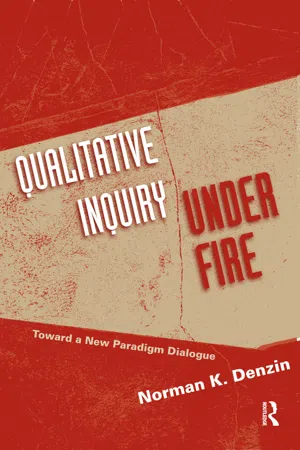
This collection of recent works by Norman K. Denzin provides a history of the field of qualitative inquiry over the past two decades. As perhaps the leading proponent of this style of research, Denzin has led the way toward more performative writing, toward conceptualizing research in terms of social justice, toward inclusion of indigenous voices, and toward new models of interpretation and representation. In these 13 essays—which originally appeared in a wide variety of sources and are edited and updated here—the author traces how these changes have transformed qualitative practice in recent years. In an era when qualitative inquiry is under fire from conservative governmental and academic bodies, he points the way toward the future, including a renewed dialogue on paradigmatic pluralism.
Information
PART ONE
Politics
Chapter 1

INTRODUCTION
Qualitative Inquiry as Social Justice
I believe the effort to redefine . . . [qualitative] research in terms of traditional positivist assumptions is part of a larger backlash against what neoconservatives see as the negative consequences of postmodernity. (HATCH 2006: 403)
What makes critical qualitative inquiry “critical” is its commitment to social justice for one’s own group and/or for other groups. (COLLINS 1998: XIV, PARAPHRASE)
Qualitative research exists in a time of global uncertainty. Around the globe governments are attempting to regulate scientific inquiry by defining what good science is. Conservative regimes are enforcing evidence, or scientifically based biomedical models of research (SBR). These regulatory activities raise fundamental philosophical, epistemological, political, and pedagogical issues for scholarship and freedom of speech in the academy. These threats constitute the conservative challenge to qualitative inquiry, the topic of this volume.
The chapters that follow were written over 15 years. They are inscribed in the politics of the recent past. They represent(ed) attempts to write the present, to get out from underneath the present, to look in the rearview mirror as the present flashes past. They travel across multiple terrains: interpretive work after 9/11/01, science under Bush, the politics of truth, the politics of inquiry, the art and politics of interpretation, reading and writing interpretation, social justice, emancipatory discourses, performance ethnography, pedagogy and politics, a performative social science, memory of the past in the present, Institutional Review Boards, indigenous ethics, and indigenous property rights. I end with a call for new paradigm dialogs, not paradigm wars.
Sometime during the last decade, critical qualitative inquiry in North America came of age, or more accurately moved through another historical phase.1 Out of the qualitative-quantitative paradigm wars of the 1980s there appeared, seemingly overnight, journals,2 handbooks,3 textbooks,4 dissertation awards,5 annual distinguished lectures,6 and scholarly associations.7 All these formations were dedicated to some version of qualitative inquiry (see Donmoyer 2006; Guba 1990a, b; Hatch 2006; Wright 2006). Scholars were in the midst of a social movement of sorts; a new field of inquiry, a new discourse had arrived, or so it seemed, and it flourished.
Qualitative researchers proudly took their place at the table. Students flocked to graduate programs for study and mentoring. Instruction in qualitative and mixed-methods models became commonplace. Now there were QUAN and QUAL programs (see Creswell 2007; Eisenhart 2006; Preissle 2006). Paradigm proliferation prevailed, a rainbow coalition of racialized, and queered post-isms, from feminism to structuralism, post-modernism, postcolonialism, poststructuralism, postpositivism, postscientism, Marxism, postconstructivism (Lather 2006a: 3207; Wright 2006).
All this took place within and against a complex historical field, a global war on terror, a third methodological movement (Clark and Scheurich 2008: 3673; Teddlie and Tashakkori 2003a: 9), the beginning or end of the Eighth Moment (Denzin and Lincoln 2005: 3).8 In the methodologically contested present, qualitative researchers confronted the scientific backlash associated with the evidence-based social movement connected in North American education with the No Child Left Behind legislation (see Hatch 2006).
In the paradigm wars of the 1980s, the very existence of qualitative research was at issue. In the new paradigm war “every overtly social-justice-oriented approach to research . . . is threatened with de-legitimization by the government-sanctioned, exclusivist assertion of positivism . . . as the ‘gold standard’ of educational research” (Wright 2006: 799–800).
METHODOLOGICAL FUNDAMENTALISM, FACTS ARE A NUISANCE9
In the U.S., primary resistance to qualitative inquiry grows out of neoconservative discourses and recent National Research Council (NRC) reports (see, for example, Feuer, Towne, and Shavelson 2002) that have appropriated neopositivist, evidence-based epistemologies.10 Extreme spokespersons in this movement assert that qualitative research is nonscientific, should not receive federal funds, and is of little value in the social policy arena (see Lincoln and Cannella 2004).
The methodological conservatism embedded in the educational initiatives of the Bush Administration have inscribed narrowly defined governmental regimes of truth. The new “gold standard” for producing knowledge that is worthwhile having is based on quantitative, experimental design studies (ibid.: 7).
In areas ranging from education and foreign policy to the environment, healthcare, stem-cell research, emergency contraception, water and air pollution, missile defense, and hurricane preparedness, the George W. Bush White House treated facts as a nuisance while displaying a willingness to manipulate, suppress, and misrepresent science and evidence (Kaplan 2004: 95). Thus, while they were raising the bar concerning the standards for conducting and evaluating educational research with one hand, for example, they were simultaneously moving to debunk these same standards in other areas with the other hand. This allowed them to have it both ways: Modern science cannot get us to where we want to be in our schools, and we will use the methods of science to prove the case! In the name of pseudo, fake, or junk science, this callous administration manufactures evidence to support its positions and policies or to debunk that which stands in its way.
For persons in the qualitative inquiry community, this methodological fundamentalism returns to a much discredited model of empirical inquiry (Lincoln and Cannella 2004: 7). The experimental quantitative model is ill-suited to “examining the complex and dynamic contexts of public education in its many forms, sites, and variations, especially considering the . . . subtle social difference produced by gender, race, ethnicity, linguistic status, or class. Indeed, multiple kinds of knowledge, produced by multiple epistemologies and methodologies are not only worth having but also demanded if policy, legislation, and practice are to be sensitive to social needs” (ibid.).
Clearly, the scientifically based research movement (SBR) initiated by the National Research Council (NRC), and the scandalous view of science under the Bush Administration, has created a new and hostile political environment for qualitative research. Connected to the No Child Left Behind Act of 2001(NCLB), SBR embodies a resurgent scientism (Maxwell 2004), a positivist, evidence-based epistemology. Researchers are encouraged to employ “rigorous, systematic, and objective methodology to obtain reliable and valid knowledge” (Ryan and Hood 2004: 80). The preferred methodology has well-defined causal models using independent and dependent variables. Causal models are examined in the context of randomized controlled experiments that allow replication and generalization (ibid.: 81).
Qualitative research is suspect under this framework. There are no well-defined variables, no hard evidence, no causal models, no random assignment to experimental groups. The epistemologies of critical race, queer, postcolonial, feminist, and postmodern theories are rendered useless, because they are not scientific (ibid.; St. Pierre 2004: 132).
CONTESTING MIXED-METHODS EXPERIMENTALISM
Howe (2004) observes that the NRC finds a place for qualitative methods in mixed-methods experimental designs. In such designs qualitative methods may be “employed either singly or in combination with quantitative methods, including the use randomized experimental designs (Howe 2004: 49; also Clark, Plano, and Creswell 2008; Hesse-Biber and Leavy 2008). Clark and colleagues define mixed methods research “as a design for collecting, analyzing, and mixing both quantitative and qualitative data in a study in order to understand a research problem” (2008: 364).11 Mixed methods are direct descendants of classical experimentalism and the triangulation movement of the 1970s (Denzin 1989). They presume a methodological hierarchy, with quantitative methods at the top, relegating qualitative methods to “a largely auxiliary role in pursuit of the technocratic aim of accumulating knowledge of ‘what works’” (Howe 2004: 53–54).
The incompatibility thesis disputes the key claim of the mixed-methods movement—namely, that methods and perspectives can be combined. This thesis recalls the paradigm wars of the 1980s and argues that “compatibility between quantitative and qualitative methods is impossible due to incompatibility of the paradigms that underlie the methods” (Teddlie and Tashakkori 2003a, b: 14–15). Others disagree with this conclusion, and some contend that the incompatibility thesis has been largely discredited, because researchers have demonstrated that it is possible to successfully use a mixed-methods approach.
There are several schools of thought on this thesis, including the four identified by Teddlie and Tashakkori (2003b)—that is, the complementary, single-paradigm, dialectical, and multiple-paradigm models. There is by no means consensus on these issues. Morse (2003) warns that ad hoc mixing of methods can be a serious threat to validity. Pragmatists and transformative emancipatory action researchers posit a dialectical model, working back and forth between varieties of tension points, such as etic-emic, value neutrality-value committed. Others deconstruct validity as an operative term (Guba and Lincoln 2005; Lather 1993). Hesse-Biber and Leavy’s (2008) emphasis on emergent methods pushes and blurs the methodological boundaries between quantitative and qualitative methods.12 Their model seeks to recover subjugated knowledge hidden from everyday view.
Under a multiple paradigm, mixed and emergent methods approach; a complex, interconnected family of terms, concepts, and assumptions come together. This merger disrupts and threatens the belief that reality in its complexities can ever be fully captured or faithfully represented. The goal of multiple, emergent, or critical triangulation is a fully grounded interpretive research project with an egalitarian base.
This hybrid model of mixed methods extends Richardson (2000), Saukko (2003), and Ellingson (2008), who argue that the central image for qualitative inquiry is not the triangle—as in triangulation; rather, the central image is the crystal, or the prism, structures that diffract, rather than refract, or reflect, vision. Mixed-genre texts, including performance texts, have more than three sides. Like crystals, or the pieces in a quilt, the mixed-genre text can assume an infinite variety of shapes, substances, and transmutations. A dialogic framework attunes the researcher to the many different voices at work in a concrete situation. The scholar seeks out and incorporates multiple points of view in the research performance. This expands the egalitarian base of the project and enhances commitment to take into account multiple perspectives (Saukko 2003: 29).
The traditional mixed-methods movement takes qualitative methods out of their natural home, which is within the critical, interpretive framework (Howe 2004: 54; but see Teddlie and Tashakkori 2003b: 15). It divides inquiry into dichotomous categories—exploration versus confirmation. Qualitative work is assigned to the first category, quantitative research to the second (ibid.). Like the classic experimental model, it excludes stakeholders from dialogue and active participation in the research process. This weakens its democratic and dialogical dimensions, and decreases the likelihood that the previously silenced voices will be heard (Howe 2004: 56–57).
Howe cautions that it is not just the “‘methodological fundamentalists’ who have bought into [this] approach. A sizeable number of rather influential . . . educational researchers . . . have also signed on. This might be a compromise to the current political climate; it might be a backlash against the perceived excesses of postmodernism; it might be both. It is an ominous development, whatever the explanation” (2004: 57). The hybrid, dialogical model, in contrast, directly confronts these criticisms.
PRAGMATIC AND DIDACTIC CRITICISMS OF QUALITATIVE INQUIRY
In addition to receiving criticisms from the SBR movement, qualitative researchers have also been criticized from within the larger qualitative community. Writing as pragmatists, Seale, Gobo, Gubrium, and Silverman contest what they regard as the excesses of an antimethodological, “anything goes,” romantic postmodernism that is associated with the more radical, branches of the qualitative inquiry movement (2004: 2). They assert that too often this approach produces “low-quality qualitative research and research results that are quite stereotypical and close to common sense (ibid.).
To counter these effects, they propose a practice-based, pragmatic approach and a situated methodology that rejects the antifoundational claim that there are only partial truths, that the dividing line between fact and fiction has broken down (ibid.: 3). They believe that this dividing line has not collapsed, that we should not accept stories if they do not accord with the best available facts (ibid.: 6).
Others criticize what they term the siege mentality within the qualitative inquiry community. They suggest that little is to be gained by identifying new enemies to attack. It is “unproductive and unethical to characterize in broad brush strokes those who are not on board in the QI arena as promoting conservative technologies of truth” (Schwandt 2006: 808). Rather than identifying enemies and attacking methodological fundamentalists, we should be developing activist agendas in neighboring disciplines, reforming the structures of graduate education, while endorsing “a conception of inquiry that is at once scientific and critical, rigorous and heterodox . . . thereby avoiding the extremes of an . . . endorsement of just-about-anything-goes pluralism” (ibid.: 809).
I am not sure what “just-about-anything-goes pluralism” means. Oddly, these pragmatic, procedural, and didactic arguments reproduce a variant of the evidence-based model and its criticisms of poststructural, performative sensibilities. They can be used by critics to provide additional support for the methodological marginalization of these sensibilities and practices.
FIGHTING BACK: EVOLVING CONFLUENCES
Scholars within the critical, qualitative research community are united on the following points. Opposition from the SBR and pragmatic camps has shaped an evolving set of confluences and understandings. “Bush Science” (Lather 2004: 19) and its experimental, evidence-based methodologies represent a racialized masculinist backlash to the proliferation of qualitative inquiry methods over the last two decades (ibid.). The movement endorses a narrow view of science (Maxwell 2004), celebrating a “neoclassical experimentalism that is a throwback to the Campbell-Stanley [1963] era and its dogmatic adherence to an exclusive reliance on quantitative methods” (Howe 2004: 42). There is “nostalgia for a simple and ordered universe of science that never...
Table of contents
- Cover
- Half Title
- Title Page
- Copyright Page
- Contents
- Acknowledgments
- PART ONE: POLITICS
- PART TWO: I NTERPRETATION
- PART THREE: PERFORMANCE AND PEDAGOGY
- PART FOUR: ETHICAL FUTURES
- Notes
- References
- Index
- About the Author
Trusted by 375,005 students
Access to over 1.5 million titles for a fair monthly price.
Study more efficiently using our study tools.
Frequently asked questions
Yes, you can cancel anytime from the Subscription tab in your account settings on the Perlego website. Your subscription will stay active until the end of your current billing period. Learn how to cancel your subscription
No, books cannot be downloaded as external files, such as PDFs, for use outside of Perlego. However, you can download books within the Perlego app for offline reading on mobile or tablet. Learn how to download books offline
Perlego offers two plans: Essential and Complete
- Essential is ideal for learners and professionals who enjoy exploring a wide range of subjects. Access the Essential Library with 800,000+ trusted titles and best-sellers across business, personal growth, and the humanities. Includes unlimited reading time and Standard Read Aloud voice.
- Complete: Perfect for advanced learners and researchers needing full, unrestricted access. Unlock 1.5M+ books across hundreds of subjects, including academic and specialized titles. The Complete Plan also includes advanced features like Premium Read Aloud and Research Assistant.
We are an online textbook subscription service, where you can get access to an entire online library for less than the price of a single book per month. With over 1.5 million books across 990+ topics, we’ve got you covered! Learn about our mission
Look out for the read-aloud symbol on your next book to see if you can listen to it. The read-aloud tool reads text aloud for you, highlighting the text as it is being read. You can pause it, speed it up and slow it down. Learn more about Read Aloud
Yes! You can use the Perlego app on both iOS and Android devices to read anytime, anywhere — even offline. Perfect for commutes or when you’re on the go.
Please note we cannot support devices running on iOS 13 and Android 7 or earlier. Learn more about using the app
Please note we cannot support devices running on iOS 13 and Android 7 or earlier. Learn more about using the app
Yes, you can access Qualitative Inquiry Under Fire by Norman K Denzin in PDF and/or ePUB format, as well as other popular books in Psychology & Research & Methodology in Psychology. We have over 1.5 million books available in our catalogue for you to explore.