- Responds to current issues, debates, and new social movements
- Reviews sociological theory from a contemporary perspective
- Reveals how the universal theorist and the era of rival schools has been replaced by networks of clustered debates that are relatively 'autonomous' and interdisciplinary
- Features updates and in-depth discussions of the newest clustered debates in social theory—intimacy, postcolonial nationalism, and the concept of 'the other'
- Challenges social scientists to renew their commitment to the important moral and political role social knowledge plays in public life
- English
- ePUB (mobile friendly)
- Available on iOS & Android
eBook - ePub
About this book
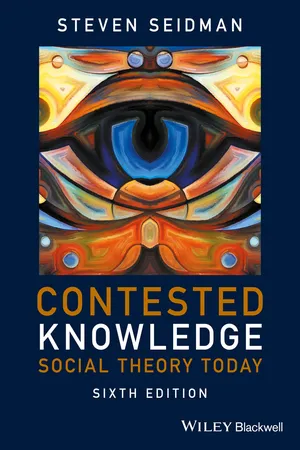
In the sixth edition of Contested Knowledge, social theorist Steven Seidman presents the latest topics in social theory and addresses the current shift of 'universalist theorists' to networks of clustered debates.
Information
Part I
The Rise of the Classical Tradition
| Introduction to Part I | |
| 1 | The Idea of a Science of Society: The Enlightenment and Auguste Comte |
| |
| 2 | The Revolutionary Theory of Karl Marx |
| |
| |
| |
| |
| 3 | The Promise of Sociology: Emile Durkheim |
| |
| |
| |
| 4 | The Ironic Social Theory of Max Weber |
| |
| |
| |
| |
| Afterword to Part I | |
Introduction to Part I
Every group and society seems to develop its own views of human behavior. Perhaps this reflects our reliance on planning rather than instinct to survive; or perhaps it's inherent in a species that uses language to think and communicate. In any event, we find that, throughout history, human association has been accompanied by ideas about human motivation, social interaction, and social order. However, not all societies have produced “social thought” or something like a deliberate and methodical effort to provide secular explanations of social life. Similarly, not all societies have created social institutions (e.g., universities, publishing companies, journals) and social roles (e.g., professors, social critics, and commentators) whose purpose is to analyze and debate the truthfulness of social ideas.
It is impossible to locate the origins of social thought. In many of the so‐called ancient civilizations (China, Egypt, Greco‐Roman), we observe diverse traditions of social thought. For example, in ancient Greece, Plato, Aristotle, and Thucydides crafted social analyses of war, the origins of the family and the state, and the relation between religion and the government. Aristotle's Politics offers a rich social account of the formation of different political systems and the interconnections between the individual, family, culture, and politics. Although thinkers like Plato and Aristotle were insightful about humanity and society, most historians do not credit them as founding figures of the social sciences.
What makes the social thought of premodern times different from social science? Perhaps it's that the social sciences hold different assumptions about the world and about social knowledge than do the traditions of premodern social thought. Ancient and Christian social thought often viewed the universe as an unchanging hierarchical order in which all beings, human and otherwise, had a more or less fixed and proper place and purpose. Premodern social thought often approached human behavior as part of a conception of the overall natural and moral structure of the universe. For example, Aristotle's social thought was less concerned with explaining social patterns such as the role of social class in shaping politics than with sketching an ideal society in the context of a comprehensive philosophy of life. Social science has abandoned the static, hierarchical world view of its Greek and Christian predecessors. Modern social scientists have, in the main, abandoned the effort to craft a comprehensive philosophy of life. Social science occupies a different world of ideas than premodern “Western” social thought.
In the next four chapters, we take a first glance at the world of modern social thinking. Eighteenth‐ and early‐nineteenth‐century Europe was the principal home for the birth of social science. Beginning with the ideas of the Enlightenment, we trace the development of modern social theory in the work of Auguste Comte, Karl Marx, Emile Durkheim, and Max Weber. These thinkers make up the core of what is considered the classical tradition of modern social theory.
1
The Idea of a Science of Society: The Enlightenment and Auguste Comte
Eighteenth‐century Europe gave rise to some remarkable social thinkers, including Voltaire, Hume, Adam Ferguson, Condorcet, Montesquieu, Adam Smith, and Mary Wollstonecraft. Although they wrote widely on philosophy, natural science, and literature, they produced an impressive body of social ideas. Of particular importance, Enlightenment social thinkers (Enlighteners) broke away from the Greek and Christian traditions of social thought. They pioneered a new science of society.
Although the Enlighteners took up the cause of science with the enthusiasm of crusaders, they were not its original creators. The great breakthroughs to a scientific world view occurred from the fifteenth through the seventeenth centuries, the result of the efforts of Copernicus, Kepler, Galileo, and Newton. From the perspective of that time period, the commitment to science amounted to a serious challenge to the prevailing Aristotelian–Christian world view. In early modern Europe, the universe was seen as a hierarchical order in which every being (human, animal, plant, spiritual) had a rightful place and purpose in a divinely created and ordered universe. The natural and social worlds were viewed as being spiritually infused with value, meaning, and purpose. By contrast, the scientific revolution conceived of the universe as a mechanical system composed of matter in motion that obeyed natural laws. Both divine purpose and human will became peripheral, indeed unnecessary, features of the scientific world view.
If the Enlighteners were not the creators of the scientific revolution, they were its great popularizers and propagandists. Through their writing and speeches, they proved indispensable in introducing science to educated Europeans. Moreover, they were themselves innovators, less in their efforts in the natural sciences than in the study of human behavior. They dismissed much of previous social thought as based on prejudice, opinion, revelation, philosophical reasoning, and tradition; true knowledge, they asserted, can only rest on the solid ground of fact and scientific method. Departing from views of society as a divine or natural order, the Enlighteners understood society as a “field” of individual interaction responsive to human intentions. The Enlighteners created a social world view that has become dominant in the modern West. At its core is the notion that humans create society; through our actions we shape a world of institutions which in turn shape us; the interplay between individuals and social institutions determines the history and future of humanity. The aim of a science of society is to reveal the common patterns of human association across different societies.
The Enlighteners championed the scientific world view, but only after they had altered it to suit their own purpose. Like many educated men and women of the time, they saw in the scientific world view a triumph of reason over prejudice. However, they were troubled by this revolution in thinking to the extent that science projected the universe as a purely materialistic, mechanical place with no room for freedom and morality. It was perhaps the genius of Montesquieu, Adam Smith, and Condorcet that they were able to wed science to a liberal humanistic world view. This was achieved by conceiving human history as a product of individual actions yet patterned in a law‐like way. Thus, in his great work The Spirit of the Laws, Montesquieu traced the variations in political systems to both natural and social factors such as geography, climate, and religion while claiming to demonstrate that this variation was limited by the constraints of human nature.1 Similarly, in his grand vision of history as the march of human progress, Condorcet believed that the drive to human freedom explains why some societies progress more quickly than others; at the same time, he believed that our common human nature creates important similarities between different societies.2
The thinkers of the Enlightenment aimed both to understand human behavior and to use science to promote freedom and progress. But, how can science be both a morally neutral instrument of knowledge and a vehicle of social progress? In a Sketch for a Historical Picture of the Progress of the Human Mind, Condorcet argued that the very nature of science – its reliance upon facts and observation, its openness to criticism and revision – promotes individualism, tolerance, equality, and democracy. Accordingly, he thought that the progress of science automatically translates into social progress. Today, in the aftermath of Nazism, Hiroshima, and widespread revelations about scientific torture and control through medicine and psychiatry, we would surely question whether science is necessarily wedded to liberal and humanistic values. Is it not possible that the Enlighteners read their own liberal values into science? Many Enlightenment thinkers held that, by discerning the laws of history, social science would have insight into the correct social norms and social policies. But how do we guard against the possibility that the so‐called objective laws of history might, in fact, be colored by the social values and interests of the scientist? If social knowledge is to guide social affairs, we need to be certain that our social ideas truly mirror the objective, not our subjective, world. But how can we be certain of this?
The social motivation of Enlightenment thinkers raises further suspicions that their scientific vision was not innocent of moral and political meanings. The figures of the Enlightenment lived in a period of social turmoil. European societies were divided between social groups that defended social hierarchy and the status quo (the church and landed aristocracy) and groups such as commercial entrepreneurs and peasants and laborers who struggled for freedom, equality, and democracy. The Enlighteners were mostly from socially privileged backgrounds (sons of nobility or parliamentarians) but were typically not members of the ruling clerical and aristocratic elite. Their livelihood was guaranteed neither by the ruling elite nor by an independent university system of the kind that developed in the twentieth century. As educated men with few social privileges, their sympathies generally were with those who wanted to bring about social change.
The Enlighteners were participants in the social struggles of the time. Their activities as polemicists and social critics carried serious risk, from fines and economic insecurity, to exile, imprisonment, even execution. Indeed, many of them wrote under assumed names, or penned essays in which the critical message was carefully camouflaged by humor or parody. Since they were typically not landowners or members of parliament, their battle site was culture. They fought against the beliefs and social norms that upheld a society organized around social hierarchy, intolerance, and inequality. In eighteenth‐century France, the struggle was primarily against the Catholic hierarchy. At one level, Enlightenment thinkers fought for freedoms relating to public expression, free speech, and tolerance of dissent. At another level, their battles were centered on the very issue of which beliefs, values, and social norms should prevail in society. In other words, the Enlighteners challenged the very basis of the landed aristocracy and church hierarchy by disputing the legitimacy of a society organized on the basis of a Christian religious culture. In this regard, they took up the cause of science as a key part of their struggle to shape the future of Europe and humanity.
In light of the breakthroughs to a scientific world view by their predecessors, it is hardly surprising that the Enlighteners seized on science as a vehicle to challenge the Christian culture. Through the persecution of Galileo and other innovators of science for heresy, the public associated science with social rebellion. Moreover, the scientific world view was interpreted by both the church and its detractors as a grave threat to the Christian cosmology. In a universe that was viewed as governed by mechanical laws, God was rendered as little more than a peripheral, detached observer. As the role of God in natural and human affairs was reduced to that of a spectator, the social role of the church would diminish accordingly.
The world view of science challenged the public authority of the church. Science projected a universe in which all beings were reducible to matter in motion; the only differences that counted were those related to shape, force, mass, or velocity. Fundamental Christian beliefs about the existence of spiritual beings and actions (e.g., angels or divine incarnations) and about the very notion of a human soul differentiating us from animals were placed in doubt. Similarly, to the extent that science assumed that true knowledge is based on observations, facts, and scientific method, Christian knowledge founded upon revelation, tradition, and the authority of the church was discredited. Finally, we should notice the close tie between the social values associated with modern Western science and those of the Enlighteners. For example, the Newtonian universe placed all beings on an equal footing; scientific knowledge itself was not an inherited right or gift but a product of education and effort; natural laws apply to all beings in ...
Table of contents
- Cover
- Title Page
- Table of Contents
- Preface
- Acknowledgments
- Introduction
- Part I: The Rise of the Classical Tradition
- Part II: Rethinking the Classical Tradition: American Sociology
- Part III: Rethinking the Classical Tradition: European Theory
- Part IV: Revisions and Revolts: The Postmodern Turn
- Part V: Revisions and Revolts: Identity Politics and Theory
- Part VI: Revisions and Revolts: Theories of World Order
- Part VII: The Rise of Postdisciplinary Theory
- Index
- End User License Agreement
Trusted by 375,005 students
Access to over 1.5 million titles for a fair monthly price.
Study more efficiently using our study tools.
Frequently asked questions
Yes, you can cancel anytime from the Subscription tab in your account settings on the Perlego website. Your subscription will stay active until the end of your current billing period. Learn how to cancel your subscription
No, books cannot be downloaded as external files, such as PDFs, for use outside of Perlego. However, you can download books within the Perlego app for offline reading on mobile or tablet. Learn how to download books offline
Perlego offers two plans: Essential and Complete
- Essential is ideal for learners and professionals who enjoy exploring a wide range of subjects. Access the Essential Library with 800,000+ trusted titles and best-sellers across business, personal growth, and the humanities. Includes unlimited reading time and Standard Read Aloud voice.
- Complete: Perfect for advanced learners and researchers needing full, unrestricted access. Unlock 1.5M+ books across hundreds of subjects, including academic and specialized titles. The Complete Plan also includes advanced features like Premium Read Aloud and Research Assistant.
We are an online textbook subscription service, where you can get access to an entire online library for less than the price of a single book per month. With over 1.5 million books across 990+ topics, we’ve got you covered! Learn about our mission
Look out for the read-aloud symbol on your next book to see if you can listen to it. The read-aloud tool reads text aloud for you, highlighting the text as it is being read. You can pause it, speed it up and slow it down. Learn more about Read Aloud
Yes! You can use the Perlego app on both iOS and Android devices to read anytime, anywhere — even offline. Perfect for commutes or when you’re on the go.
Please note we cannot support devices running on iOS 13 and Android 7 or earlier. Learn more about using the app
Please note we cannot support devices running on iOS 13 and Android 7 or earlier. Learn more about using the app
Yes, you can access Contested Knowledge by Steven Seidman in PDF and/or ePUB format, as well as other popular books in Social Sciences & Sociology. We have over 1.5 million books available in our catalogue for you to explore.