- 480 pages
- English
- ePUB (mobile friendly)
- Available on iOS & Android
eBook - ePub
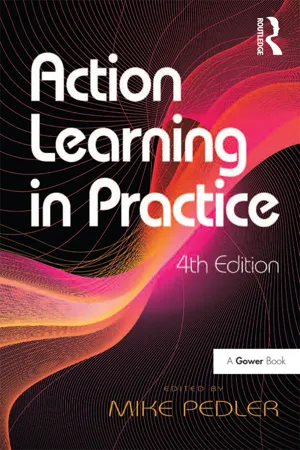
Action Learning in Practice
About this book
Previous editions of Action Learning in Practice established this authoritative overview of action learning around the world. Over the last decade the move towards action-based organizational learning and development has accelerated, and action learning is now an established part of the education and development mainstream in large and small organizations. Fully revised and updated, this fourth edition covers the origins of action learning with Reg Revans' ideas, and looks at their development and application today. Action learning is self-directed learning through tackling business and work problems with the support of peers and colleagues. A professional and diverse workforce, attracted, influenced and developed in this way is more able to deal effectively with the growing complexity and pressures of working life. As the limits of conventional training and development become more obvious, leaders are increasingly attracted to action-based approaches to learning when seeking better outcomes and returns on investment.
PART 1 Origins
Introduction to Part 1
When this book first appeared in 1983, Revans wrote this about himself and the origins of the idea:
Reg Revans has been writing about action learning since 1945 and practicing it since 1952; this work was totally disregarded in Britain save where it was held to ridicule by Social Science ‘experts’. After the first GEC programme in 1974/5 his ideas have been transformed by large numbers of original thinkers presenting his few simple and naïve facts in rich elaborations essential to commercial viability. Students interested in semantic equivocation are invited to compare the current literature on management development with any of his early papers. These are now being made available (The Origins and Growth of Action Learning, Chartwell-Bratt, 1982) by a number of top British executives who believe that an understanding of what Revans has so long been saying is vital to our economic recovery. (xvii)
The original thinkers who developed the practice of action learning on the basis of their experiences of the GEC programme are represented here by Bob Garratt The Power of Action Learning, David Casey Set Advising and David Pearce Getting Started.With Revans’ two chapters, Action Learning: Its Origins and Nature and The Enterprise as a Learning System, all appear here, as in previous editions, hardly altered from 1983. These first practitioners took the ‘naïve and simple facts’ of action learning and turned them into the practice recognizable today. The idea of the set, for example, later hailed by Revans as the ‘cutting edge of every action learning programme’, originates in David Casey’s early experiences as a schoolteacher. John Morris and Jean Lawrence, Minding our Ps & Qs and Continuity in Action Learning (which first appeared in the second 1991 Edition), are notable pioneers, especially in their application of action learning to the joint development Programmes at the Manchester Business School, which gave that establishment its celebrated ‘Manchester Method’ (Wilson 1992). Four of these remarkable people – Casey, Morris, Lawrence and Revans himself – have died since 2003.
The two remaining chapters were newly commissioned. Verna Willis’ Digging Deeper: Foundations of Revans’ Gold Standard of Action Learning provides a benchmark for the question ‘What is action learning?’ in reviewing the critical markers that characterize Revans’ vision. Yury Boshyk’s Ad Fontes – Reg Revans: some early sources of his personal growth and values helps with a sister question: ‘Where does action learning come from?’ This biographical account of Revans’ life to the age of 28 sheds new light on the thinking and values that go to make up the idea.
Reference
Wilson, J. F. (1992) The Manchester Experiment: A History of Manchester Business School 1965–1970, London: Paul Chapman.
Chapter 1
Action Learning: Its Origins and Nature
Written for the first edition of Action Learning in Practice in 1983, this has been the first chapter in all subsequent editions.
In 1971 action learning circumnavigated the globe; in the summer of that year I visited New York (to discuss the publication of Developing Effective Managers, where it had appeared), Dallas (where Southern Methodist University was initiating a programme), Sydney (to lay the foundations of future programmes), Singapore (where discussions about starting a programme continue), Delhi (now the headquarters of a programme run by the Government of India) and Cairo (to follow up the Nile Project).
In this chapter I try to explain what action learning may be, but this is not easy when those who read my lines have not tried action learning themselves. There is nothing in this chapter about what teachers of management ought to do about getting started, for that is dealt with by others. My only suggestion to those running the management schools is, over and above what they are already teaching, they should set out to contrive the conditions in which managers may learn, with and from each other, how to manage better in the course of their daily tasks.
Action learning takes so long to describe, so much longer to find interesting, and so much longer still to get started because it is so simple. As soon as it is presented as a form of learning by doing the dismissiveness pours forth. ‘Not unlike learning by doing? … But that’s precisely what everybody here has been up to for donkeys’ years! Anybody in management education can tell you that lectures and bookwork alone are not sufficient for developing people who have to take decisions in the real world. We all know that practise alone makes perfect, and ever since our first programmes were set up we’ve made all our students, however senior, do a lot of case studies. Some we fit into practical projects, and others do job rotation in their own firms. What’s more, all our staff have been managers themselves, averaging over ten years of business experience, so they can get in on local problems to write up as our own cases. Quite often the initiative for this comes from the firms down on the industrial estate; one man has a quality problem, another is trying to cut his stock levels, and they ask us if we’d like to help both them and our own students. So, what with one thing and another going on here, we don’t see what this excitement is about. Action learning? Learning by doing? What’s so new? And who wants another book about it?
We may all agree that learning by doing is, in many forms, nothing very new. It is one of the primary forces of evolution, and has accompanied mankind since long before our ancestors came down from the trees. Even the most primitive creatures must have learnt from their own experience, by carrying on with what they found good for them and by refraining from what they found to be harmful. The earliest living things, without any memory worth mentioning, also learnt by doing; if it was fatal to their life style they died, and if it was agreeable they flourished. Their behaviour was self-regulatory and its outcomes either ‘Yes’ or ‘No’. But, as evolution went forward and the brain developed, the results of more and more experiences were remembered and the organisms grew more and more discriminating: outcomes were no longer just black or white, life or death, go or no-go. They took on more subtle differences of interpretation, like ‘good’ or ‘bad’; ‘try again’ or ‘that’s enough for now’; ‘carry on by yourself’ or ‘ask someone to help you’. These experiences are enshrined in our proverbs: ‘The burned child dreads the fire’; ‘Once bitten, twice shy’; and (Proverbs ch. xiv, v. 6) expresses clearly the regenerative nature of learning, knowledge building upon knowledge in a true desire to learn: ‘A scorner seeketh wisdom and findeth it not: but knowledge is easy unto him that understandeth.’ Once the first point has been grasped the others readily follow: ‘Nothing succeeds like success’ is, perhaps, a more modern way of saying the same thing. Even the failure to learn has its aphorism: ‘There’s no fool like an old fool’ tells of those to whom experience means little, and who go on making the same mistakes at 70 that might have been excused at 17. With so much common testimony to learning by doing, therefore, what can be said for action learning that we find it necessary to keep on about it?
One reason is that it is a social process, whereby those who try it learn with and from each other. The burned child does not need to be told by its mother that it has been hurt, nor that the fire was the agent of pain. Action learning has a multiplying effect throughout the group or community of learners. But this effect has also long been known: ‘Iron sharpeneth iron; so a man sharpeneth the countenance of his friend’ (Proverbs ch. xxvii, v. 17) expresses well one aspect of action learning today. The best way to start on one’s really difficult problems is to go off and help somebody else with theirs. To be sure, the social strength of action learning (as I believe it to be) has a subtlety of its own: it is more than mutual growth or instruction, whereby each partner supplies the manifest deficiencies of the others with the knowledge or skill necessary to complete some collective mission. Lending a hand to the common cause may well be part of any action learning project – but it remains incidental, rather than central, to it. Nor is action learning the essence of the mutual improvement societies so morally essential to the Victorians and still, to some degree, the contract tacitly uniting all communities of scholars. We must applaud the free exchange of what is known between the experts who know it; the sophisticated approach of operational research, in which teams of scientists, engineers and mathematicians work together on the complexities of vast undertakings, such as international airports, new towns, atomic energy plants and so forth, demands that one professional shall learn with and from the other. Nevertheless, what they are doing, for all its intricate teamwork, may be far from action learning – and may even be flatly opposed to it. For in true action learning, it is not what a man already knows and tells that sharpens the countenance of his friend, but what he does not know and what his friend does not know either. It is recognized ignorance, not programmed knowledge, that is the key to action learning: men start to learn with and from each other only when they discover that no one knows the answer but all are obliged to find it.
In practice, we find small groups are more effective at learning than simple pairs, provided that every member can describe his need to learn to the others in his set. The explanation of our paradox – that the learning dynamic is the recognition of a common ignorance rather than of some collective superfluity of tradeable knowledge – is both simple and elusive. Action learning, as such, requires questions to be posed in conditions of ignorance, risk and confusion, when nobody knows what to do next; it is only marginally interested in finding the answers once those questions have been posed. For identifying the questions to ask is the task of the leader, or of the wise man; finding the answers to them is the business of the expert. It is a grave mistake to confuse these two roles, even if the same individual may, from time to time, occupy them both. But the true leader must always be more interested in what he cannot see in front of him, and this is the mark of the wise man; the expert’s job is to make the most of all that is to hand. To search out the meaning of the unseen is the role of action learning; to manipulate to advantage all that is discovered is the expression of programmed teaching. Action learning ensures that, before skills and other resources are brought to bear in conditions of ignorance, risk and confusion, some of the more fertile questions necessary to exploring those conditions have been identified: there is nothing so terrible in all human experience as a bad plan efficiently carried out, when immense technical resources are concentrated in solving the wrong problems. Hell has no senate more formidable than a conspiracy of shortsighted leaders and quickwitted experts. Action learning suggests that, only if a man, particularly the expert, can be persuaded to draw a map of his own ignorance, is he likely to develop his full potential. In an epoch of change, such as that in which the world now flounders, there is no handicap to exceed the misconception of past experience – particularly that on which present reputations are founded. The idolization of successes established in circumstances unlikely to recur may well guarantee one’s place in The Dictionary of National Biography, but it is of little help in the fugitive present; there are times when we do well to put our fame aside:
At the same time came the disciples unto Jesus, saying, Who is the greatest in the kingdom of heaven? And Jesus called a little child unto him, and set him in the midst of them and said, Verily I say unto you, Except ye be converted and become as little children, ye shall not enter into the kingdom of heaven. Whosoever therefore shall humble himself as this little child, the same is greatest in the kingdom of heaven.
(Matthew ch. xviii, v. 1)
In times such as now, it is as imperative to question the inheritance of the past as it is to speculate upon the uncertainties of the future. As indicated in the quotation above Jesus warns of the need to be converted, to become once more as little children, since there is little hope for those who cannot unclutter their memories of flattery and deceit. It is advice most worthy of attention among all peoples with such tremendous histories as the British, although its classical illustration is in the parable of David and Goliath (I Samuel ch. xvii); here the experts, the warriors of Israel, faced with an adversary unknown in their experience (an armoured giant), could do nothing. They could only imagine what they had been taught: a bigger and stronger Israelite was needed to crush Goliath. Since no such man existed they were facing disaster. But the little child, David, proved himself the greatest among them; he was a child who had no experience of armour and could see that the search for the bigger and stronger Israelite was misconceived, so that Goliath had to be dealt with in some other fashion. The way was therefore open for him to pose the key question: ‘Given that there is no man to throw at Goliath, how else do we kill him?’ It is a fair statement of action learning to paraphrase this question as: ‘Now all of us can see – even the experts, too – that our ideas simply do not work, what we need is to look for something that is quite new.’ No question was ever more important to the denizens of this Sceptred Isle; somebody should launch a campaign to change its patron saint to David from Saint George.
We must not give the impression that it is only traditionalists such as the soldiers who have trouble in changing their conceptions; on the contrary, many of the greatest inventions are the products of conflict, for then we are obliged to think to save our skins. Nor must we imagine that our (supposed) intellectual leaders will necessarily come up with the new ideas; for example, an extrapolation of the current unemployment figures recently made by some professor suggests that 90 per cent of the population will be out of work by the year 2000 – although he does not say how many of these will be professors. What can be done to deflect the course of history, so as to avert this terrible calamity with but one person out of ten in work? The academic seer, exactly like the Israelites, finds the answer in his own past experience: more education. At the very moment in which the country needs as many Davids as possible, to help the rest of us become again as little children and to enter the kingdoms of heaven of our choice, we are to be exposed still more mercilessly to the dialectic of scholars and the sophistry of books.
So far action learning has been presented merely as another interpretation of well-known historical events and biblical quotations. It is as old as humanity, illustrated in the Old Testament, justified in the New and implicit in classical philosophy. What, then, is original about it? Only, perhaps, its method. But, before we dismiss this as incidental, let us recall that every branch of achievement advances only as fast as its methods: without telescopes there could be no astronomy, without computers no space missions, without quarries and mines no walls, no houses, no tools and therefore not much else.
This relation of what can be done to the richness of the means of doing it is, of course, another statement of action learning itself, its specifically useful method is not only in making clear the need for more Davids, but in setting out to develop them. It may, in essence, be no more than learning by doing, but it is learning by posing fresh questions rather than copying what others have already shown to be useful – perhaps in conditions that are unlikely to recur. Most education, and practically all training, is concerned in passing on the secrets and the theories of yesterday; before anything can be taught, or before anybody can be instructed, a syllabus must be prepared out of what is already known and codifed. But if today is significantly different from yesterday, and tomorrow is likely to be very different from today, how shall we know what to teach? Does not the parable of David and Goliath justify this question? Action learning is not opposed to teaching the syllabus of yesterday, nor of last year, nor even of antiquity; action learning merely asks that, in addition to programmed instruction, the development of our new Davids will include the exploration of their own ignorance and the search for fresh questions leading out of it. Action learning is a method o...
Table of contents
- Cover Page
- Half Title page
- Title Page
- Copyright Page
- Contents
- List of Figures
- List of Tables
- Notes on Contributors
- Part 1 Origins
- Part 2 Varieties
- Part 3 Applications
- Part 4 Questions
- Introduction to Part 4
- Index
Trusted by 375,005 students
Access to over 1.5 million titles for a fair monthly price.
Study more efficiently using our study tools.
Frequently asked questions
Yes, you can cancel anytime from the Subscription tab in your account settings on the Perlego website. Your subscription will stay active until the end of your current billing period. Learn how to cancel your subscription
No, books cannot be downloaded as external files, such as PDFs, for use outside of Perlego. However, you can download books within the Perlego app for offline reading on mobile or tablet. Learn how to download books offline
Perlego offers two plans: Essential and Complete
- Essential is ideal for learners and professionals who enjoy exploring a wide range of subjects. Access the Essential Library with 800,000+ trusted titles and best-sellers across business, personal growth, and the humanities. Includes unlimited reading time and Standard Read Aloud voice.
- Complete: Perfect for advanced learners and researchers needing full, unrestricted access. Unlock 1.5M+ books across hundreds of subjects, including academic and specialized titles. The Complete Plan also includes advanced features like Premium Read Aloud and Research Assistant.
We are an online textbook subscription service, where you can get access to an entire online library for less than the price of a single book per month. With over 1.5 million books across 990+ topics, we’ve got you covered! Learn about our mission
Look out for the read-aloud symbol on your next book to see if you can listen to it. The read-aloud tool reads text aloud for you, highlighting the text as it is being read. You can pause it, speed it up and slow it down. Learn more about Read Aloud
Yes! You can use the Perlego app on both iOS and Android devices to read anytime, anywhere — even offline. Perfect for commutes or when you’re on the go.
Please note we cannot support devices running on iOS 13 and Android 7 or earlier. Learn more about using the app
Please note we cannot support devices running on iOS 13 and Android 7 or earlier. Learn more about using the app
Yes, you can access Action Learning in Practice by Mike Pedler in PDF and/or ePUB format, as well as other popular books in Business & Business General. We have over 1.5 million books available in our catalogue for you to explore.