eBook - ePub
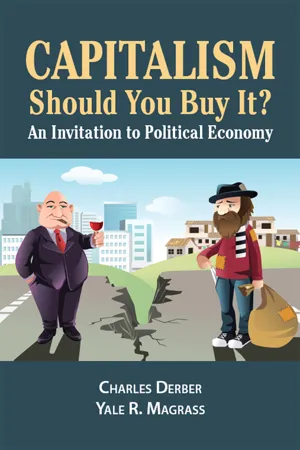
Capitalism: Should You Buy it?
An Invitation to Political Economy
- 316 pages
- English
- ePUB (mobile friendly)
- Available on iOS & Android
eBook - ePub
About this book
Before there was economics, there was political economy, an interdisciplinary adventure boldly and critically seeking to understand capitalism. Over time, the social sciences evolved into specific disciplines - economics, sociology, political science - that less often questioned capitalist perspectives and the state. Contrasting three traditions - neoclassicism, Keynesianism, and neo-Marxism - Capitalism: Should You Buy It? traces the historical development of each and evaluates whether they view capitalism as the root cause of or the solution to the pressing problems now facing humanity. This accessible and hopeful book is a call to everyone - citizen, student, public intellectual - to revive the critical edge towards capitalism.
Information
PART I
Why Political Economy?
Introduction to Part I
In Part I, we introduce and define political economy and discuss why we feel it is so important. Great thinkers such as Adam Smith, Max Weber, and Karl Marx introduced political economy to understand the rise of capitalism, which led to one of the greatest transformations in history. Because of capitalism, life has arguably changed in the past two hundred years more than in all of the rest of human history. The early political economists created the way of thinking that would allow modern scholars and citizens to understand this revolutionary system and deal with its enormous implications, including whether it must be embraced, reformed, or overthrown.
But since the early 1900s, political economy, as a discipline, has been subjected to great intellectual and political struggles, eroding its centrality and vitality. Power elites within capitalism as well as pressures within academic social sciences both contributed to this decline. The erosion of political economy deprives intellectuals and citizens today of the main tradition for understanding the modern capitalist world, just in its period of greatest crisis.
In our view, there is hardly a more important intellectual agenda than renewing an understanding of political economy, for without it, citizens lose the tools for coping with the great challenges humanity faces today.
Our aim in Part I is threefold:
1. to define political economy as a framework for thinking, distinguish it from economics, and explain why we view it as crucial
2. to examine the forces that have weakened the appeal of political economy and its approach, using brief case studies from the fields of economics and other social sciences
3. to set forth our own view of the sociological imagination as a tradition for renewing political economy not only in sociology but in all social sciences and in the politics of modern societies
CHAPTER 1
Economics Lost
Why We Need Political Economy
Money makes the world go around,
Of that we can be sure.1
Before there was economics, there was political economy. Today, there are two separate disciplines: economics and political science. In most universities, they are housed in different academic departments. The implication is that they represent two distinct realms and operate independently of each other.
In our view, the separation of economics from political science has crippled both fields and represents an assault on political economy itself. It is a key part of the story of what political economy is, why it is important, and how it can thrive in the modern world.
Economics is a crucially important field, but only as an integral part of the broader enterprise that we call political economy (PE). Even before economists segregated themselves from political scientists and sociologists, thereby pulling away from political economy, economics became known as “the dismal science,” a phrase coined by historian Thomas Carlyle in the mid-nineteenth century. In its current form, economics is even more dismal—which has put its usefulness to society in some jeopardy.
By separating from politics and other social sciences, economics has become detached from the real world. It has become a world of equations on blackboards, beautiful but floating in a heavenly sphere of its own creation. Our economics students, who learn equations and abstract market theories, tell us they learn from their economics classes little about what is going on in the real world, including the real economy. Perhaps the greatest economist of the twentieth century, John Maynard Keynes, said much the same thing and would be sympathetic to their critique: “Too large a proportion of recent ‘mathematical’ economics are mere concoctions, as imprecise as the initial assumptions they rest on, which allow the author to lose sight of the complexities and interdependencies of the real world in a maze of pretentious and unhelpful symbols.”2
Economics, as it evolved in the twentieth century and became more focused on form than substance, claimed to be an objective, value-free science. In order to hold the mantle of science, it tried to reduce all of economics to a series of equations and formulas. For the most part, it imitated an antiquated model of physics, before relativity and quantum mechanics became the dominant paradigms. As Larry Summers, former treasury secretary and Harvard president, put it, calling for the public to have faith in economists’ expertise, “Start with the idea that you can’t repeal the laws of economics. Even if they are inconvenient,”3 but Nobel Prize–winning economist Paul Samuelson responded, “Economics has never been a science.”4
In our view, embracing the discipline of political economy, by rejecting the separation of economics from politics and society, that is, from the real world, rescues us from the pathologies of an artificially segregated economics, that is, from farce, false science, and detachment from the world. Understanding political economy offers the possibility of understanding the real economy. And it can contribute something useful to solving the deep socioeconomic and environmental crises now engulfing the United States and much of the world.
The economy does what it does because of the decisions people make, usually people with—or aspiring to—political power. It can only be understood if we look at who has power. Indeed, most economic policy is a result of “class struggle,” the balance of forces between people with power and those whom they rule or who are trying to challenge them. Economics became a popular term when powerful people in corporations, government, and universities wanted to create the impression that the economy is something that follows laws not subject to politics, laws that rest in nature, almost like the laws of physics. The great political economist, John Kenneth Galbraith, argued his own economics profession was making itself irrelevant with this approach:
The decisive weakness in neoclassical and neo-Keynesian economics is not the error in the assumptions by which it elides the problem of power. The capacity for erroneous belief is very great, especially where it coincides with convenience. Rather, in eliding power—in making economics a nonpolitical subject—neoclassical theory destroys its relation to the real world. In that world, power is decisive in what happens. And the problems of that world are increasing both in number and in the depth of their social affliction. In consequence, neoclassical and neo-Keynesian economics is relegating its players to the social sidelines where they either call no plays or use the wrong ones.5
Galbraith made clear that we must ask if the capitalist economy—the principal focus of the political economy approach—is really rooted in nature or if it was something created at a particular moment in history. He is making the argument for reintegrating economics into political economy, raising the key questions about capitalism central to both inquiries. Is the capitalist economy grounded in something universal, valid everywhere, or a reflection of a specific culture and set of values that advances the interests of one class of people at the expense of everyone else? Is it something that people automatically gravitate to, whenever they are allowed, or is it something that some people impose on others? How does the type of economy a society has affect its style of government and its cultural values? And vice versa?
Economics treats economies—and specifically the capitalist economy that it focuses on today—as an abstract force with a life of its own and universal laws, independent of the people who created it and their society. The study of political economy moves away from this flawed premise and asks how capitalism came into being and whom it serves.
Economics often regards politics, culture, the environment, and the larger society as “externalities,” which can be abstracted out of the picture. But is it really possible to understand the economy without looking at those other factors? Do they not all profoundly affect each other? And if the economy and the rules of the economic game are created by people, who are these people and why do they create the rules they do? In the absence of economics taking up these questions, it is often our great novelists who step into the void, such as Kurt Vonnegut:
Thus did a handful of rapacious citizens come to control all that was worth controlling in America. Thus was the savage and stupid and entirely inappropriate and unnecessary and humorless American class system created. Honest, industrious, peaceful citizens were classed as bloodsuckers, if they asked to be paid a living wage. And they saw that praise was reserved henceforth for those who devised means of getting paid enormously for committing crimes against which no laws had been passed. Thus the American dream turned belly up, turned green, bobbed to the scummy surface of cupidity unlimited, filled with gas, went bang in the noonday sun.6
Vonnegut’s cry would not be heard alongside the blackboard economics in our universities’ Departments of Economics. It appears subjective and outside the economists’ scientific domain. But political economy takes up Vonnegut’s concern and makes it a central object of study, as we show throughout this book.
Economists who have abandoned the political economy approach, though, claim that as objective experts, it is their duty to analyze, not prescribe or moralize. It secures their academic position as scientists but it leaves to political economy the urgent questions we need to ask about the economy. We need to ask if it is always good to increase wealth for the sake of increasing wealth. Is it not also important how that wealth is distributed? Does it make some people richer and more powerful, while hurting everyone else? How are wealth, growth, value, and price to be defined and measured? Should our criteria not include these: Who benefits and who does not? How do they deplete or build resources? Do they preserve or erode the environment? Do they enhance or undermine democracy and the quality of life? Do they bring people together or drive them apart? An economics segregated from political science, sociology, history, and ethics cannot answer these questions, leaving a huge void that political economy seeks to fill.
What Is Political Economy?
Political economy was the term most people studying the economy—including such famous nineteenth-century theorists as Adam Smith, David Ricardo, John Stuart Mill, Karl Marx, and Max Weber—used before economics assumed its modern quasi-scientific form. It also was a popular phrase in the 1960s, 1970s, and perhaps 1980s. It was adopted by people who came to wonder if economic, political, and military policies could be separated. It also asked if the governments of so-called democracies, like the United States, are really intended to serve the very rich, the 1 percent, instead of the rest of us, the 99 percent. Clearly, those issues have not gone away, so we offer this book as an invitation to revive and join the political economy tradition.
Defining political economy is not easy, and many still view it as another name for economics before it matured and became scientific. The American Heritage Dictionary defines political economy as “the early science of economics through the 19th century.”7 Likewise, the Collins English Dictionary defines political economy as “the name given formerly to economics.”8
In other words, “economics” has replaced “political economy.” And in a sense it did. In Adam Smith’s University of Glasgow, when Smith taught there, the Department of Political Economy’s name was changed to the Department of Economics, a very early shift. It is misleading because Smith was a moral philosopher, historian, sociologist, political scientist, and economist—a political economist in the best sense of the term. In 1848, John Stuart Mill wrote the Principles of Political Economy, showing, despite some economistic assumptions about markets, that you cannot segregate economics from politics or society and hope to understand the real world.9
But by the late nineteenth century, when capitalism entrenched itself as the West’s idealized economy, economics, led by the influential British economist Alfred Marshall and his followers, began its assault to replace political economy as the science of wealth management. Universities began funding professional economists, who would treat economics as a science and capitalism as operating by natural laws. In 1890, Marshall wrote the textbook Principles of Economics, creating a mathematical science of economics, segregating the whole field from politics and society.10 Around the same time, William Stanley Jevons, one of the early mathematical economists, argued that economics should become “the recognized name of a science.”11 This declaration that economics was bound by unchangeable scientific laws would remove academic authority from the potentially subversive ideas that Marx, Weber, and other political economists of the day posed to capitalism and to the identity of economists as scientists. Economics was tacitly kicking political economy out the door, relegating it to the prescientific and precapitalist era.
But political economy, while subordinated, never disappeared, even among economists themselves, including many luminaries such as Galbraith and Nobel Prize–winning economist and New York Times columnist, Paul Krugman, who could not embrace the pure “economism” of their own profession. And even the early Robber Barons of the 1890s Gilded Age, who helped found modern universities and were the big beneficiaries of the new economics, recognized that it was absurd to separate politics and economics. One of the most influential Robber Baron capitalists, Mark Hanna, when asked what was important in politics, responded, “The first is money and I can’t remember what the second one is.”12
Political economy was first taught in the United States in the College of William and Mary, with Smith’s Wealth of Nations as the main textbook in 1784. Despite the hegemony of economics, students can still find some universities with Departments or Programs of Political Economy. Some of the core questions of political economy have been taken up by economists who rejected the limiting definitions of their professions. Other key issues have been exported and sent piecemeal to other segregated disciplines, including especially sociology and political science.
To move forward, we need to define the field of inquiry, and in doing so we return to the assumptions that guided its original great and highly diverse political thinkers, including both Adam Smith and Karl Marx. Political economy is not wedded to a particular political ideology, and can be Right, Left, or anywhere in between. But it recognizes there can be no stripping of the study of the economy from the study of politics and society.
In contrast to economics, the study of political economy is based on the following premises. We present these assumptions to highlight the differences between economics and political economy—and to point to the way that sociologists or political scientists or even some renegade economists might contribute to a counter-assault against the hegemony of economics. As in economics, there are serious debates within political economy but we see five core premises. Not everyone engaged in political economy agrees on each of these five premises. For each of these assumptions, there will be a range of positions, with some people agreeing more with the political economy paradigm, as defined here, and others embracing more “economics-ized” or economistic thinking.
The Political Economy Code
1. Human nature is not seen as fixed or biologically uniform in all societies, as it is viewed in economics, but shaped by society, culture, and the political and economic system itself. If there are innate properties within human nature, they are different and more malleable than many economists assume.
2. The market is not seen as a part of nature or created by natural law, as seen in economics, but as a creation of people, particularly those exercising power in the economy and in the political arena.
3. Rather ...
Table of contents
- Cover Page
- Half-Title Page
- Title Page
- Copyright Page
- Table of Contents
- Part I Why Political Economy?
- Part II The Three Paradigms
- Part III Political Economy and Contemporary Issues
- Part IV Conclusion
- Notes
- Index
- About the Authors
Trusted by 375,005 students
Access to over 1.5 million titles for a fair monthly price.
Study more efficiently using our study tools.
Frequently asked questions
Yes, you can cancel anytime from the Subscription tab in your account settings on the Perlego website. Your subscription will stay active until the end of your current billing period. Learn how to cancel your subscription
No, books cannot be downloaded as external files, such as PDFs, for use outside of Perlego. However, you can download books within the Perlego app for offline reading on mobile or tablet. Learn how to download books offline
Perlego offers two plans: Essential and Complete
- Essential is ideal for learners and professionals who enjoy exploring a wide range of subjects. Access the Essential Library with 800,000+ trusted titles and best-sellers across business, personal growth, and the humanities. Includes unlimited reading time and Standard Read Aloud voice.
- Complete: Perfect for advanced learners and researchers needing full, unrestricted access. Unlock 1.5M+ books across hundreds of subjects, including academic and specialized titles. The Complete Plan also includes advanced features like Premium Read Aloud and Research Assistant.
We are an online textbook subscription service, where you can get access to an entire online library for less than the price of a single book per month. With over 1.5 million books across 990+ topics, we’ve got you covered! Learn about our mission
Look out for the read-aloud symbol on your next book to see if you can listen to it. The read-aloud tool reads text aloud for you, highlighting the text as it is being read. You can pause it, speed it up and slow it down. Learn more about Read Aloud
Yes! You can use the Perlego app on both iOS and Android devices to read anytime, anywhere — even offline. Perfect for commutes or when you’re on the go.
Please note we cannot support devices running on iOS 13 and Android 7 or earlier. Learn more about using the app
Please note we cannot support devices running on iOS 13 and Android 7 or earlier. Learn more about using the app
Yes, you can access Capitalism: Should You Buy it? by Charles Derber,Yale R. Magrass in PDF and/or ePUB format, as well as other popular books in Volkswirtschaftslehre & Wirtschaftstheorie. We have over 1.5 million books available in our catalogue for you to explore.