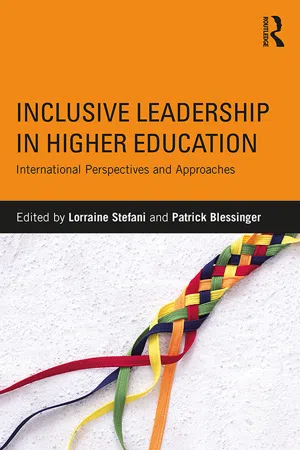
Inclusive Leadership in Higher Education examines leadership efforts that move beyond simple diversity programs in the journey towards the institutional transformation necessary to create inclusive educational environments. Chapter contributors from higher education institutions across the globe share how leadership is developed and implemented at all levels to create more inclusive organizational cultures. Diverse chapters address the forces and factors associated with organizational change while examining leadership theory, policy, and practices. This important volume provides a comparative perspective, highlighting common themes across a range of institutional and cultural contexts to help leaders promote an organizational mind-set and culture of inclusion and inclusiveness.
eBook - ePub
Inclusive Leadership in Higher Education
International Perspectives and Approaches
- 216 pages
- English
- ePUB (mobile friendly)
- Available on iOS & Android
eBook - ePub
Inclusive Leadership in Higher Education
International Perspectives and Approaches
About this book
Information
1
Inclusive leadership in higher education
Inclusion as a Core Institutional Value
Patrick Blessinger, Lorraine Stefani
Introduction
Although much has been written on the topics of diversity, inclusion, leadership, and higher education, there remains a dearth of literature on the intersection of these topics. A central aim of this chapter is to explore how education leaders can use leadership to create an organizational culture and mindset that respects and values all forms of diversity and identities, and that helps prepare administrators, faculty, and students to live and work in an increasingly pluralistic and globalized world.
To address these issues, the current higher education landscape is examined with respect to diversity, inclusion, and human rights for education. The chapter also focuses on the fundamental purpose and aims of leadership and how leadership can be developed at all levels within higher education institutions to create more inclusive organizational cultures. The forces and factors (e.g., exogenous and endogenous forces, planned and reactive, incremental and transformative) associated with organizational change from a leadership perspective will be touched on briefly.
The analysis presented in this chapter is indebted to the work of the following educational scholars: Altbach, Reisberg, & Rumbley, 2009; Barnett, 2012; Basit & Tomlinson, 2014; Beiter, 2006; Beitz, 2009; Blessinger & Anchan, 2015; Brighthouse & McAvoy, 2009; Burke, 2012; Curren, 2009; de Wit, 2013; Dewey, 1916; Freire, 1970; Karmel, 2009; Kezar, 2009; Kovbasyuk & Blessinger, 2013; Marginson & Sawir, 2011; McCowan, 2013; McMillan, 2010; Noddings, 2013; Palfreyman & Tapper, 2009; Smith, 2014; Trow, 1974; Vygotsky, 1989; and Woods, 2011.
The Need for Inclusive Leadership
The argument presented in this chapter is that creating an inclusive higher education community is an essential ingredient in helping to achieve social equality and is an important element of meaningful lifelong learning. A chief aim of inclusion is to eliminate negative attitudes and beliefs associated with race, ethnicity, sex, gender, sexual orientation, lifestyle, socio-economic class, age, language, religion, disability, and their intersections, since these identities are not mutually exclusive of each other. Also, identities may be visible or invisible and the interrelationships among the different identities may manifest themselves in unforeseen ways. This intersectionality of identities is often multi-layered and complex. For instance, people may belong to different groups and may experience both prejudice and privilege at the same time (Cole, 2009; Smith, 2014; Symington, 2004).
Negative attitudes relating to difference may be the result of hegemony, elitism, supremacism, or any attitude that privileges one group over another. For instance, these attitudes may be reflected in curricula that are solely centered on authors that are all from the same ethnicity or gender. The premise of this chapter is that it takes effective leadership at all levels to change policies and practices needed to create a more inclusive organizational culture and mindset that reflects both the reality of multiple identities and the increasing levels of diversity in society
Current Higher Education Leadership Models
The interest in leadership goes back thousands of years because of its usefulness and application in every sphere of life (e.g., political, military, business, religious, educational) (McCaffery, 2004). The formal study of leadership is not a new phenomenon either. Research on leadership has evolved from the trait approach to leadership in the 1800s to modern theories and styles of leadership which include, among others, the following: authentic leadership, contingency leadership, consensus leadership, democratic leadership, distributive leadership, intellectual leadership, moral leadership, servant leadership, transformational leadership, and values-based leadership. The multiple theories and styles may also be categorized using different criteria (e.g., trait, behavior, contingency, power) (Amanchukwu, Stanley, & Ololube, 2015). The general trend in leadership research and theory development has been towards an interdisciplinary approach to better understand leadership from multiple perspectives and disciplinary lenses.
Despite its long history and the many theories and styles on leadership, there is no single universally accepted definition of leadership (Mello, 1999). However, the common theme running through leadership theories and styles is the ability to influence others. Thus, the following definition of leadership is used: leadership is the ability to influence others to achieve a goal (Northouse, 2007). This definition implies several important aspects of leadership: 1) leadership is influence oriented (ability to influence) – leader actions and decisions enable the group to act; 2) leadership is relationship oriented (others) – it is a social relationship between leader and followers; and 3) leadership is future oriented (to achieve a goal) – it focuses on the group reaching a goal(s).
Using this definition, leadership is based on the following assumptions: 1) leadership can be learned and developed over time; 2) leadership can be employed using different styles of leadership together with different decision-making styles; 3) various contextual factors (e.g., political, economic, socio-cultural, nature of goals sought, and the type, size, mission, etc. of the organization) influence the type(s) of leadership used; and 4) various factors influence the quality and effectiveness of the leader (e.g., position within organizational structure, communication with followers, interactions among different personalities, decision-making styles) (Amanchukwu, Stanley, & Ololube, 2015).
In addition, Kouzes and Posner (2012) find the following practices to exist in effective leaders: 1) they model the way; 2) they inspire a shared vision; 3) they challenge the process; 4) they enable others to act; and 5) they encourage the heart. Regardless of the factors involved, leadership effectiveness is ultimately judged on the effectiveness of the leader in working with and through others to achieve the goal(s).
Thus, common themes that characterize effective leaders include: being future oriented (i.e., leaders inspire a shared vision), enabling others to act (i.e., leaders establish the direction and lead the way), and being trustworthy and credible (i.e., leaders operate ethically and with integrity). These characteristics are also indicative of a transformational orientation to leadership. A study by Bateh and Heyliger (2014), found that a transformational leadership style led to increased job satisfaction among faculty whereas a passive/avoidant leadership style led to decreased job satisfaction among faculty. One important aspect of transformational leadership is its focus on continually improving the quality of the relationship between leaders and followers and fostering self-realization in their followers (Bass and Riggio, 2006; Li & Hung, 2009).
Challenges of Traditional Leadership Models
The inclusion agenda naturally involves leadership because inclusion impacts every aspect of the institution and requires leadership at all levels in order to make it successful. Educational leadership can be an effective means to create a more inclusive institutional culture at all levels of the organization. It is important educational leaders examine the different conceptions of leadership (as discussed in the previous section) that may be useful in highly distributed organizations like higher education institutions.
Given the nature of higher education institutions and the particular challenge of making inclusion a high priority, inclusive leadership is grounded in the following leadership styles: democratic leadership, distributive leadership, and transformational leadership.
Democratic leadership focuses on meeting the needs and interests of the group through shared decision-making and participation. It emphasizes the principles of equity, equality, and inclusion. Democratic leadership can create highly productive work groups and as a leadership approach it fits well with an organization comprising a highly skilled, professional, and autonomous workforce (Martindale, 2011).
Distributive leadership is suitable for complex institutions (e.g., universities, hospitals, research facilities) where the tasks performed involve people from different functions and levels within the institutions. It emphasizes the principles of community, collaboration, and collective action. Distributed leadership can create highly productive work groups with high morale because it views leadership as a social process that is shared by both leaders and followers. As with the similar democratic leadership, it tends to work better in work groups that are highly skilled, professional, and autonomous (Spillane & Diamond, 2007).
Transformational leadership is aimed at creating positive change in individuals, groups, institutions, and other social settings. It emphasizes the principles of change, empowerment, and community. Transformational leadership is intended to increase capacity and capabilities at all levels. It tends to work better in organizations that are mature, structured, and professionalized. To create effective change, transformational leaders must create a high degree of respect and rapport with followers, be a model of integrity and moral leadership, and create a shared sense of belonging through an inspiring vision. Transformational leaders inspire followers to see beyond their own self-interests in order to work for the greater good (Bass, 1990).
Higher education institutions that operate within democratic societies have a responsibility to uphold basic democratic principles and human rights. Since inclusion is a basic democratic principle and education is a human right, then leadership that is oriented around these features provides a promising approach to leadership within higher education institutions, especially given the distributed nature of leadership in such institutions. An inclusive theory of leadership holds that inclusive leadership as a leadership style, with its emphasis on participation, community, empowerment, and respect for different identities, can provide an effective way to build an inclusive university culture.
Diversity and Inclusion in Higher Education
The concept of diversity is grounded in the premise that having diversity in a workplace or any group provides positive benefits overall since it has the potential to draw on different strengths, viewpoints, talents, etc. Inclusion is based on the principle of equal and equitable treatment for all which is a matter of social justice. Equal opportunity laws seek to ensure that no student is disadvantaged with regards to access to higher education. As such, inclusion agendas seek to protect basic human rights and, more specifically regarding higher education, they seek to create student populations that are more socially representative by increasing access opportunities from all segments of society. Diversity and inclusion are complementary and they reinforce each other. In short, inclusion is a set of practices that help create more diverse environments.
Moving beyond Access
While much progress has been made over the last several decades in this area, more work still remains to move beyond widening participation programs (albeit very important) and move towards creating more inclusive institutions in every aspect and at every level in higher education. For instance, an institution may be highly diverse in terms of student demographics but it may not be diverse in terms of its faculty, staff, and leadership. In addition, it may not be diverse in terms of its curriculum or its teaching and learning methods. Diversity must be defined by more than demographics, albeit student access for historically underrepresented groups is a natural starting point. Democratization of higher education has initially and naturally centered on access issues (that is, more equality or equity of access opportunities) and participation issues (that is, greater engagement in the teaching–learning process). Issues receiving less focus, until recently, have been completion issues, that is, students achieving expected learning outcomes upon graduation and life success issues such as achieving career and personal goals. In addition to these critical issues that apply to the student body, diversity and inclusion must also address other groups such as faculty, staff, and leadership as well as teaching, learning, curricula, research, and community engagement issues.
In addition to creating more diverse institutions that are representative of the broader society and the communities they are embedded in, institutions should also be actively engaged in creating and sustaining inclusive practices that respect and engage different identities and viewpoints (related to race, ethnicity, sex, gender, sexual orientation, socio-economic class, caste, age, language, religion, disability, and their intersections) in its teaching, learning, curricula, etc. Without inclusion, one can be part of the student or faculty body but one may still feel marginalized or excluded. Inclusion moves beyond what the law requires to create a more humane approach to education where all identities and viewpoints are respected and embraced, not just tolerated. Since complexities and tensions can arise around environments with multiple identities, the strategies needed to create more inclusive and pluralistic learning communities need more discussion at all levels (Smith, 2014, 2009; Chin & Sanchez-Hucles, 2007; Gutman, 2003; Maher & Tetrault, 2007).
A growing number of higher education institutions now seek to move beyond relatively simple widening access programs and move towards more multifaceted approaches of integrating inclusion into all aspects of the educational experience. For instance, this could involve creating a learning environment that better enables all students and faculty to develop more fully, not just cognitively but also socially, psychologically, and professionally. Ultimately, issues dealing with diversity, inclusion, identity, power, justice, rights, and agency are deeply connected to the strength, health, and longevity of a democratic society, and as such, inclusion is a major imperative for educational leaders.
Exemplars
A concrete example of this movement is the UK Higher Education Academy (HEA) program (Wray, 2013) that aims to develop a more inclusive culture in higher education. HEA defines an inclusive teaching and learning culture as one that “enables all students to develop academically, professionally and personally to fulfill their potential.” In addition to the HEA report, a good overview of the issues introduced above is presented by Blessinger & Anchan (2015), Smith (2014), Basit & Tomlinson (2014), Woods (2011), and Burke (2012) among others.
The HEA report discusses the following practices by some UK higher education institutions which, although not specifically highlighting leadership in higher education, will nevertheless require effective leadership across the institution if successful implementation is to be achieved:
• University of Edinburgh: The aim is the design and delivery of curricula that are inclusive of all students, enabling them to participate fully to achieve their full potential.
• University of Exeter: It is only through engagement with an inclusive learning and teaching environment that such a culture can develop.
• University of the West of Scotland: The project had three broad aims: 1) to embed the vision for an inclusive culture into the new University of the West of Scotland’s (UWS)...
Table of contents
- Cover
- Half Title
- Title Page
- Copyright Page
- Table of Contents
- List of Tables
- Foreword by Corey Gin
- Acknowledgments
- Preface: The Urgent Matter of Inclusive Leadership in Higher Education
- 1. Inclusive Leadership in Higher Education: Inclusion as a Core Institutional Value
- 2. Leadership Challenges for Women College and University Presidents: Personal Perspectives from Women Making a Difference
- 3. Women and Intellectual Leadership in East Asia’s Academic Professions: A Review of the Literature
- 4. Intersectionality and Inclusive Leadership in the University: Case Studies from Denmark
- 5. Cultivating Inclusive Leadership in Higher Education Teaching through Action Learning
- 6. Inclusive Environments in UK Universities: Some Surprising Challenges for Leaders
- 7. Navigating through Tough Waves towards Inclusive Leadership: A Case Study from Saudi Arabia
- 8. Leadership and Inclusiveness: A Perspective from Middle East and Central Asian Universities
- 9. Inclusive Leadership: Lessons from South Africa
- 10. To Be the African University in the Service of Humanity
- 11. Understanding the Grit and Gravitas Underlying Culturally Sustaining Inclusive Leadership in Academe
- 12. Inclusive Institutional Leadership through Community Engagement
- 13. A Multi-lens View of Inclusive Leadership in Higher Education
- List of Contributors
- Appendix 1
- Index
Trusted by 375,005 students
Access to over 1.5 million titles for a fair monthly price.
Study more efficiently using our study tools.
Frequently asked questions
Yes, you can cancel anytime from the Subscription tab in your account settings on the Perlego website. Your subscription will stay active until the end of your current billing period. Learn how to cancel your subscription
No, books cannot be downloaded as external files, such as PDFs, for use outside of Perlego. However, you can download books within the Perlego app for offline reading on mobile or tablet. Learn how to download books offline
Perlego offers two plans: Essential and Complete
- Essential is ideal for learners and professionals who enjoy exploring a wide range of subjects. Access the Essential Library with 800,000+ trusted titles and best-sellers across business, personal growth, and the humanities. Includes unlimited reading time and Standard Read Aloud voice.
- Complete: Perfect for advanced learners and researchers needing full, unrestricted access. Unlock 1.5M+ books across hundreds of subjects, including academic and specialized titles. The Complete Plan also includes advanced features like Premium Read Aloud and Research Assistant.
We are an online textbook subscription service, where you can get access to an entire online library for less than the price of a single book per month. With over 1.5 million books across 990+ topics, we’ve got you covered! Learn about our mission
Look out for the read-aloud symbol on your next book to see if you can listen to it. The read-aloud tool reads text aloud for you, highlighting the text as it is being read. You can pause it, speed it up and slow it down. Learn more about Read Aloud
Yes! You can use the Perlego app on both iOS and Android devices to read anytime, anywhere — even offline. Perfect for commutes or when you’re on the go.
Please note we cannot support devices running on iOS 13 and Android 7 or earlier. Learn more about using the app
Please note we cannot support devices running on iOS 13 and Android 7 or earlier. Learn more about using the app
Yes, you can access Inclusive Leadership in Higher Education by Lorraine Stefani, Patrick Blessinger, Lorraine Stefani,Patrick Blessinger in PDF and/or ePUB format, as well as other popular books in Education & Education General. We have over 1.5 million books available in our catalogue for you to explore.