Actors and Audiences
eBook - ePub

Actors and Audiences

Conversations in the Electric Air

  1. 202 pages
  2. English
  3. ePUB (mobile friendly)
  4. Available on iOS & Android
eBook - ePub

Actors and Audiences

Conversations in the Electric Air

About this book

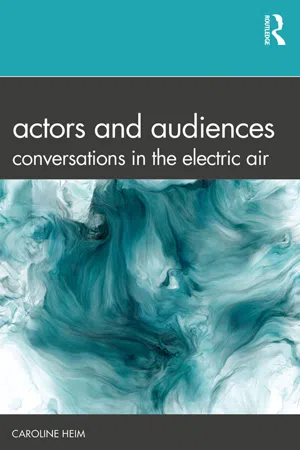
Actors and Audiences explores the exchanges between those on and off the stage that fill the atmosphere with energy and vitality. Caroline Heim utilises the concept of "electric air" to describe this phenomenon and discuss the charge of emotional electricity that heightens the audience's senses in the theatre.

In order to understand this electric air, Heim draws from in-depth interviews with 79 professional audience members and 22 international stage and screen actors in the United Kingdom, United States, France and Germany. Tapping into the growing interest in empirical studies of the audience, this book documents experiences from three productions – The Encounter, Heisenberg and Hunger. Peer Gynt – to describe the nature of these conversations. The interviews disclose essential elements: transference, identification, projection, double consciousness, presence, stage fright and the suspension of disbelief. Ultimately Heim reveals that the heart of theatre is the relationship between those on- and off-stage, the way in which emotions and words create psychological conversations that pass through the fourth wall into an "in-between space," and the resulting electric air.

A fascinating introduction to a unique subject, this book provides a close examination of actor and audience perspectives, which is essential reading for students and academics of Theatre, Performance and Audience Studies.

Frequently asked questions

Yes, you can cancel anytime from the Subscription tab in your account settings on the Perlego website. Your subscription will stay active until the end of your current billing period. Learn how to cancel your subscription.
No, books cannot be downloaded as external files, such as PDFs, for use outside of Perlego. However, you can download books within the Perlego app for offline reading on mobile or tablet. Learn more here.
Perlego offers two plans: Essential and Complete
  • Essential is ideal for learners and professionals who enjoy exploring a wide range of subjects. Access the Essential Library with 800,000+ trusted titles and best-sellers across business, personal growth, and the humanities. Includes unlimited reading time and Standard Read Aloud voice.
  • Complete: Perfect for advanced learners and researchers needing full, unrestricted access. Unlock 1.4M+ books across hundreds of subjects, including academic and specialized titles. The Complete Plan also includes advanced features like Premium Read Aloud and Research Assistant.
Both plans are available with monthly, semester, or annual billing cycles.
We are an online textbook subscription service, where you can get access to an entire online library for less than the price of a single book per month. With over 1 million books across 1000+ topics, we’ve got you covered! Learn more here.
Look out for the read-aloud symbol on your next book to see if you can listen to it. The read-aloud tool reads text aloud for you, highlighting the text as it is being read. You can pause it, speed it up and slow it down. Learn more here.
Yes! You can use the Perlego app on both iOS or Android devices to read anytime, anywhere — even offline. Perfect for commutes or when you’re on the go.
Please note we cannot support devices running on iOS 13 and Android 7 or earlier. Learn more about using the app.
Yes, you can access Actors and Audiences by Caroline Heim in PDF and/or ePUB format, as well as other popular books in Media & Performing Arts & Theatre. We have over one million books available in our catalogue for you to explore.

Information

Publisher
Routledge
Year
2020
Print ISBN
9781138210066
PART I
Electric air

1

The electric air of theatre

As an audience member, I have often sat in the theatre auditorium enthralled by the charge of electricity in the air that seems so combustible that a spark could ignite it. As an actor, I have often stood on the stage intoxicated by the heady atmosphere that rolls across the footlights and sharpens my senses and quickens my heartbeat. The electricity in the air changes the emotional temperature in the theatre. Every audience member or actor I have spoken with has experienced it in some way. It is addictive, exhilarating and gratifying. This is what I call the electric air. It is not confined to the performance alone. The electric air can be perceived from the moment an audience member enters the auditorium, the moment when the actors hear the familiar buzz of the audience from behind the curtain. The question “what is the electric air?” does not lend itself to a fixed answer. It is sensed, experienced and perceived. Is the electric air physical? Is it psychological? Does it move from the subjective to the objective in our bodies like excitement shows itself in increased heart rate? Audience members and actors describe the electric air in terms of feeling states: “It makes you tingle,” “It gives you a rush.”1 Like many of the enchantments of the theatre, it defies quantification. In this chapter I am not providing an explanation; I am describing the experience of the electric air and suggesting some elements that contribute to it.
In order to situate the electric air as part of the contemporary discourse in theatre studies, I begin with a description of closely related phenomena: atmosphere, liveness and electricity. In many ways the electric air is the atmosphere encountered in the theatre that is created by the live co-presence of two groups of people, facing each other, playing specific roles: that of actors and audience. There is a certain energy and vitality that is produced by the encounter of these two groups that I describe in terms of electricity: magnetic attraction. When we hold two magnets opposite each other a magnetic field that is powerful, tense and visceral is intensified. The electric air in between the actors and the audience has this magnetic quality: two poles strongly attracted.
The aesthetic properties of atmosphere have been discussed since the early eighteenth century and the experience of atmosphere in the theatre for actors and audience members grew to prominence in the early twentieth century. Debates about liveness in the theatre have raged since the early twentieth century. Discussion of electricity in the theatre was prevalent in the eighteenth and nineteenth centuries. Since then, study of it as a theatre phenomenon has dropped into relative obscurity. Atmosphere, liveness and electricity are what I call descriptors of the electric air. There may well be other descriptors and I acknowledge that there is certain slippage between description and allusion in these terms. The electric air as an entity or a felt experience is, however, constituted by so much more than atmosphere, liveness and electricity. They are, perhaps, descriptors that are easily conceived. In order to understand the electric air more fully, in the second half of this chapter I proffer a number of different elements that can be seen to be undercurrents of the electric air in the theatre.

Descriptors of the electric air

Atmosphere

When we walk into a room we immediately sense or feel its atmosphere, that “something in the air.” It could be a welcoming atmosphere, a hostile atmosphere, a tranquil atmosphere, an oppressive atmosphere. We can immediately gauge the kind of atmosphere not because we are trying to comprehend it, but because we are feeling it. The few theatre scholars that describe theatrical atmosphere in some form2 predominantly draw from the writings of the German philosopher Gernot Böhme. Böhme notes that we tend to describe atmospheres in terms of their character.3 We can talk about the atmosphere’s character in meteorological or emotive terms or a conflation of both. Often meteorological terms are used to describe emotive atmospheres. The atmosphere in a space can be warm, cold, sultry, icy, sunny, dark or electric. If we are in a gloomy mood, the cheerful atmosphere of a room can change our mood in a kind of emotional contagion as we “attune” to the atmosphere. In the Heideggerian sense, when we are immersed in an atmosphere it can attune us “through and through.”4
Atmospheres are ethereal, yet people have no hesitation in describing them. A coffee shop can have a cosy atmosphere; a humid summer’s day can have a stifling atmosphere; parks can have a pleasant atmosphere; political rallies can have a stirring atmosphere. Phenomenologist Mikel Dufrenne argues that atmospheres have a “certain quality which words cannot translate but which communicates itself in arousing a feeling.”5 Atmospheres are felt, but they also manifest in a material form. They are, perhaps, the convergence of the physical air in a particular place and a mood or feeling. Atmospheres described by people are not, therefore, purely metaphoric or abstract, they also have physical qualities. They occupy spaces and they can be felt.
Atmospheres are considered to have three principle properties:6 they pour out spatially, they work in in-between spaces and they are felt bodily. If, as Böhme suggests, “[a]tmospheres pour out into, and thus, shape spaces,”7 then the theatre atmosphere is shaped by several entities, including people. While Erika Fischer-Lichte concentrates on how smells, lighting and sounds emanating from the stage or the auditorium create atmosphere in the theatre, she also suggests that the bodily co-presence of actors and audience members helps create atmosphere:8 the live presence of two groups of people, face to face across the footlights. Theatre lighting and sound designers are experts in creating atmosphere. Stuart Grant argues, however, that atmosphere requires “bodies to experience it [and] bring it forth.”9 Atmospheres are experienced spatially and bodily.
For Böhme, atmospheres float “in-between” things and their perceiving subjects.10 In the theatre, the gulf between audience members and actors is an in-between space. It can be highly charged and magnetic. Böhme describes atmospheres as “spheres of presence” with “ekstases” – Böhme’s re-articulation of Walter Benjamin’s auras – radiating out from them.11 When the actors and audience meet across the footlights, I suggest that the energies or ekstases radiating out of the two groups create that tension, spark, thrill and buzz of theatrical atmosphere. The magnetic attraction or repulsion in the collision of these ekstases enlivens the atmosphere in the in-between space between the actors and the audience. Konstantin Stanislavski argued that one essential element of the “dramatic state” experienced in the theatre “is produced by the atmosphere surrounding an actor on the stage and by the atmosphere in the auditorium.”12 It is the collision of these two atmospheres that creates the sensory tingle of liveness felt in the theatre that is akin to what I call the electric air.
It is important to note that, as Patrice Pavis cautions, audience members’ reading and understanding of atmospheres in the theatre can tend to take a “universalist” approach. “Rather,” he argues, atmospheres “encourage us to start out from an understanding of our multiform identities so we can then have a better appreciation of how these cultural, ethnic, sexual and economic identities influence the way we decipher atmospheres.”13 Or, I would argue, create atmospheres. The audience member’s mood and equilibrium at the time of viewing the production can not only affect their perception, and thus their reception of the theatrical event, it can also help to shape the atmosphere. Unfortunately, in his definitions of atmosphere, Pavis fails to include the actors and their labour in creating atmosphere in the theatre.
Actor and director Michael Chekhov, nephew of the Russian playwright Anton Chekhov, urged actors to be influenced by the atmosphere that surrounds them, contending that atmosphere can support and inspire creativity in the actor if they open themselves to it.14 Atmospheres became a working technique to evoke emotional responses in his actors. Chekhov’s use of atmospheres as a space-filling phenomenon pervaded the actor exercises he devised.15 He taught his actors that “[a]tmosphere exerts an extremely strong influence upon your acting […] The atmosphere urges you to act in harmony with it.”16 He also argued that atmosphere creates a nexus with the audience across the footlights:
The actors who possess or who have newly acquir...

Table of contents

  1. Cover
  2. Half Title
  3. Title Page
  4. Copyright Page
  5. Dedication
  6. Table of Contents
  7. Acknowledgements
  8. Introduction
  9. PART I Electric air
  10. PART II Conversations
  11. Conclusion
  12. Appendix: Actor biographies
  13. Index