eBook - ePub
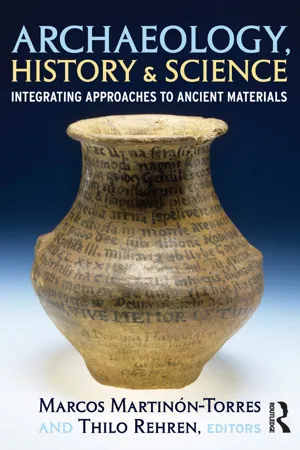
Archaeology, History and Science
Integrating Approaches to Ancient Materials
- 218 pages
- English
- ePUB (mobile friendly)
- Available on iOS & Android
eBook - ePub
Archaeology, History and Science
Integrating Approaches to Ancient Materials
About this book
Using a combination of historical, archaeological, and scientific data is not an uncommon research practice. Rarely found, however, is a more overt critical consideration of how these sources of information relate to each other, or explicit attempts at developing successful strategies for interdisciplinary work. The authors in this volume provide such critical perspectives, examining materials from a wide range of cultures and time periods to demonstrate the added value of combining in their research seemingly incompatible or even contradictory sources. Case studies include explorations of the symbolism of flint knives in ancient Egypt, the meaning of cuneiform glass texts, medieval metallurgical traditions, and urban archaeology at industrial sites. This volume is noteworthy, as it offers novel contributions to specific topics, as well as fundamental reflections on the problems and potentials of the interdisciplinary study of the human past.
Information
CHAPTER 1
Why Should Archaeologists Take History and Science Seriously?
ABSTRACT A significant number of studies of the human past involve a combination of historical, archaeological, and archaeometric information. However, the complex relationships between the different sources of information and research strategies are rarely considered critically and explicitly. This chapter presents a brief review of theoretical positions regarding those relationships, and of relevant methodological approaches. Subsequently, the discussion concentrates on the study of ancient materials and technologies, as a prominent field where archaeological, textual, and scientific analyses are routinely combined, often with little reflection on the variable nature and value of different resources. Based on a critical assessment of relevant case studies and broader literature, some recommendations are made for future work: These include a clearer focus on the contextual encounters between materials and texts, the definition of wider questions and theoretical paradigms engaging different specialists, and a more conscious and socially aware approach to archaeometric research and dissemination.
Introduction
Until recently (and still currently in many fora), it seemed entirely appropriate to ask questions such as: To what extent is archaeology necessary for the study of aspects of those periods from which written sources are available? I cannot help but wonder what these enquirers would make of the opposite question: Is historical research necessary when archaeological information is at hand? Twenty years ago, Lloyd (1986) persuasively argued why historians should take archaeology seriously and ended his essay by challenging historians to address an equally valid question: Why should archaeologists take history seriously? As far as I am aware, nobody has felt the need to answer, probably because the role and the value of history are taken for granted.
When archaeometric approaches are included in this debate, the matter becomes yet more complex, not least because analytical techniques often require extra time and resources, as well as invasive removal of samples from archaeological materials. For those who question the pertinence of invasive analysis of archaeological remains, the application of scientific techniques in the study of text-informed periods might appear even less necessary.
We ought not to be pessimistic, though; the current situation is rather encouraging. There is increasing dialogue between archaeometrists and archaeologists, and between the latter and historians, as well as growing numbers of individuals who cross the boundaries between two or all three specialities. What we do miss is a more overt critical consideration of how texts, materials, and analytical data relate to one another and explicit attempts at proposing best-practice strategies for these kinds of interdisciplinary research, especially for those involving archaeometric analyses.
This chapter aims at contributing to this optimistic scenario, by raising issues that should be of interest to archaeologists, historians, and scientists. Are there any common problems for these specialists? Can we define in abstracto the nature and informative potential of materials and documents? Is it possible to establish an overarching paradigm that may guide future practice? By reviewing the case studies presented in this book and other relevant publications, and considering the broader context in which they are inscribed, this introductory chapter tries to envisage some way forward.
Following a brief review of theoretical positions regarding the relationships between texts and archaeological materials, and of different methodological approaches, this essay concentrates on studies of ancient materials and technologies. The justification for this is twofold: First, I believe that technological activities and materials are cultural expressions, and thus their study constitutes one of the most powerful lines of enquiry about the human past; second, given the relative abundance of technical texts and recipes in the historical record, this is a prominent field where archaeological, textual, and scientific analyses are routinely combined, though often with little reflection on the variable nature and value of different resources. It is hoped that an explicitly critical approach may prove stimulating for future work.
Texts and Materials: A Changing Relationship
In two inspiring books, Andrén (1998) and Moreland (2001) have explored the evolving perceptions of the role and the value of documents and artefacts in our reconstructions of the past. Starting with early essays blatantly claiming the banality of historical archaeologies, both reviews move on to somewhat more encouraging views that have advocated the use of both types of sources, as they allegedly inform distinct questions. Texts and archaeology have been seen as informative of, respectively, ideology and technology, elites and peoples without history, the emic and the etic, the conscious and the unconscious, and even big questions and small questions. Both Andrén and Moreland contend that these perspectives implicitly or explicitly advocate the subordination of archaeology to the empire of the Word: If archaeology is used only to fill the gaps left by more or less spaced out written sources, or as a ‘testing ground’ to prove or refine wider theories formulated by historians, then its potential is seriously constrained. Materials appear as illustrations of historical stories, examples, or exceptions for broad reconstructions – ‘the icing on the cake’ – and the archaeologist’s ability to reconstruct past societies is seriously hindered. This excessive reliance on textual information or history-driven paradigms has raised colourful expressions such as ‘the tyranny of the historical record’ (Champion 1990) and ‘text-misled archaeology’ (Young 1992) and has inspired alternative programmes such as that of ‘text-aided archaeology’ (Little 1992).
These generic positions, however, are bound to demand qualifiers and exceptions and to raise disagreement among specialists. The way forward, according to Moreland (2001:77–97), entails beginning to appreciate the context-specific origins and meanings of both texts and materials, and their active role in the reproduction and transformation of power and identity. Andrén (1998:153–77) also advocates a more thorough ‘construction of the context’, an interpretation of the actual encounter between material culture and writing, and their relationship in each case. These useful perspectives will be revisited later but, before that, it is worth bringing up some of the more traditional viewpoints.
One of the most simple and famous epistemologies of archaeology, with a strong bearing here, is Hawkes’s ‘ladder of inference’ (Hawkes 1954). Hawkes’s basic proposition was that, for those periods before the emergence of writing, ‘material techniques are easy to infer to, subsistence-economics fairly easy, communal organisation harder, and spiritual life hardest of all [. . .] So the result appears to be that the more specifically human are men’s activities, the harder they are to infer by this sort of archaeology’. Accordingly, it would seem that texts are more apt to inform about these ‘difficult’ dimensions, hardly graspable for prehistoric periods. This was just a paragraph in a longer paper concerned with archaeological theory and method but, as Robb (1998:330) puts it, ‘Hawkes’s dictum was essentially a formalization of common sense, and its intuitive appeal has helped to enshrine it in archaeological theory’.
While this view is inherent in several subsequent studies, Hawkes has increasingly become the object of criticism on several grounds. His opponents are not only those who advocate a more respectable status for archaeological materials in the ‘artefacts vs texts’ debate (for example, Andrén and Moreland, above) but also, more generally, archaeologists involved in the reconstruction of symbolic systems (for instance, Hodder 1982:11–12; Robb 1998:330–31), or even archaeometrists who, in spite of their obvious focus on materials and technologies, realise the inextricable cultural dimension of technology and, thus, the role of technological studies as a path to past social structures and beliefs (for example, Andrews and Doonan 2003:77–78). In an enlightening paper, Evans (1998) has complained that Hawkes has been turned into a sort of ‘straw man’, usually without noticing, first, that he was talking only about prehistoric archaeology – that is, an archaeology not subordinated to texts but simply devoid of them; and, second, that the four degrees of difficulty were never described as four watertight levels of hierarchical importance.
Only one of the case studies presented in this book explicitly refers to Hawkes’s ladder. Graves-Brown thoroughly reviews the archaeological and textual evidence for the ritual and symbolic use of flint artefacts in Ancient Egypt. Using metaphor theory, she then explores the differences between both types of sources and, importantly, how this encounter changes over time. The resulting essay is informative with regard to Ancient Egyptian religion and to the past perception and use of different materials and sources, but it may also be inspiring as a methodological example for future studies in other areas. Clearly, Graves-Browns sides up with those who cite Hawkes to then contend that archaeology can indeed help access the ‘hardest of all’ arenas of past societies. In so doing, she also demonstrates the permeability of boundaries between technology and religion.
Freestone (this volume) takes a holistic approach to Roman glassmaking, combining a review of relevant excerpts from Pliny’s Historia Naturalis with archaeological, ethnographic, and analytical information. This allows him to decipher the written source and complete crucial bits of information regarding the raw materials employed and the organisation of glass production. Besides providing a meticulous understanding of how glass was made, this work offers a broad picture of the social and economic dimensions of glass manufacture, involving relationships between primary and secondary production workshops, as well as a wide international trade network to obtain soda, sand, and different additives. Even if not mentioning the famous ‘ladder of inference’, Freestone’s final discussion makes a statement that reminds of Hawkes’s original thought: ‘Ideology and belief are areas which are in general far more easily conveyed through words than through the analysis of objects or structures. However, technology is an area where textual evidence may be quite limited’ (Freestone, this volume, p. 97). Again, this acknowledgment compels neither subordinating archaeology to history nor constraining archaeological research to text-free zones. Freestone’s study itself provides a proof of this.
The power of archaeological studies for the understanding of past societies – including those peoples and facets of their lives for which we have written records – is further reinforced when one considers the crucial role of material culture as a medium through which humans structure and express their position in the world. I come back to this idea after reviewing the different methodological approaches engaging materials and texts.
Methodological Approaches
Three different – if overlapping – methodological approaches can be identified in this area of interdisciplinary work, all of which are exemplified in this book. These may be termed, respectively, problem-oriented, text-oriented, and material-oriented. Although the first one seems more in line with conventional research practice, it may be argued that they are all necessary and complement one another.
Problem-Oriented Research
A usual touchstone for good practice in research is the existence of a well-formulated question justifying the work. Funding bodies, researchers, and readers often ask: What is the point of doing this? What are the expected results? In historical sciences, the question can usually be phrased as: What will this research tell me about past peoples? A problem is first posed, and, from this starting point, resolute scholars use any tool at hand to obtain the most accurate answer, which will often require combining archaeological, historical, and analytical sources.
The criticism or oblivion levelled against many early archaeometric studies stemmed precisely from their lack of a problem. Archaeological materials were analysed for disparate reasons, few of which had to do with past peoples or wider scholarly concerns. As a result, many of these early publications, although valuable as pioneer efforts, could now be equated to the characters of Pirandello’s comedy – they are ‘six thousand numbers in search of an archaeological problem’. On the contrary, few present-day doctoral students will get away without a clear statement of their ‘research questions’.
Ashton’s study (this volume) departs from a neat question, with clear historical and archaeological implications: Where was the main production centre of artistic material culture for Ptolemaic and Roman Egypt? Traditional research, mostly by Classicists, drew on the amount and quality of literary and historical works produced in Alexandria and tended to characterise this city as the most important artistic centre. Ashton reconsiders this scenario by critically reviewing the historical information and supplementing this with a wealth of largely ignored archaeological evidence. The answer to the question is compelling, as production remains of faience, stone sculpture, and plaster moulds for figurines strongly suggest that the source of Greek artistic innovation in this period was Memphite rather than Alexandrian.
This is a suitable example of interdisciplinary strategies integrated to address a research question, as well as an expression of the fruitful use of material remains from old excavations and long stored in an archaeological museum. However, as stated above, there are other valid approaches to interdisciplinarity.
Text-Oriented Research
It would be naïve to neglect that, in some instances, texts deserve centre stage even if material remains are to be considered too. This is not necessarily an adverse bias but may be simply a reflection of the complex nature of a given written source and/or its social or academic notoriety, which render it worthy of focused attention. A paradigmatic example of this type of text is the Bible, and another one, discussed in this book, is the body of cuneifrom-inscribed clay tablets often referred to as the ‘Library of Assurbanipal’.
Using texts referring to glass as a case in point, Shortland (this volume) endeavours to unveil their intricate origins, purpose, and meaning, as well as their infor-mative potential. Like other texts addressed in this volume (see below), the cuneiform tablets present, to start with, the challenge of deciphering terms for which we lack a direct modern language counterpart but that may be better discernible as actual materials. Furthermore, the tablets were written in the 1st millennium B.C.E., but they are understood to constitute copies of 2nd-millennium B.C.E. originals – can we assume that nothing was changed or added to their content in 1,000 years of transmission? If they are to be read as mere technical recipes for the manufacture of glass, then we might expect copiers to have updated the information to adapt it to current knowledge. If, perhaps conversely, their role was primarily ritual and religious, maybe preserving their original form would have been more important. By showing that some parts of the recipes, if adequately followed, do lead to the production of glass, Shortland attests to the validity of this source for present researchers of ancient technologies. This is corroborated by the primary glass remains from Amarna, whose identification sheds light on, and is enlightened by, the cuneiform recipes. At the same time, the presence of symbolic elements in the text, and even the ‘ritualisation’ of a seemingly unnecessarily long glass production sequence, point toward social dimensions that reach beyond the realm of simple and utilitarian techniques. How can we interpret this? According to Shortland, we must consider the life-history of the text to understand its changing functions throughout the period. In this sense, just as these tablets may be illustrative of 2nd-millennium B.C.E. glassmaking practice, they may also inform about much later – 1st millennium B.C.E. – lexicographic and literary enterprises.
In other words, only once we know the ‘history of becoming’ of the text can we feel confident to use it for the appropriate historical or archaeological research topics. The text exegesis itself reveals interesting information about the people who inspired and were inspired by the text. Subsequently, relevant information may be extracted for further research purposes. Thus we can see the text-oriented study as a necessary means but also as an end in itself. Similar views can be held on material-oriented studies.
Material-Oriented Research
Despite the encouraging advances in surveying techniques and landscape archaeology, excavation arguably remains the most important archaeological strategy to obtain raw data – materials and contexts – for the understanding of past societies. Archaeologists increasingly begin to dig having a fair idea of what they are going to unveil, which is of great assistance for the planning of specialist consultancy, finds processing, and conservation, but not refined enough to replace excavation or, at least, to avoid finding the unexpected. Virtually any field report can furnish examples of features, materials, or associations that cannot be immediately interpreted. The obvious question emerges – ‘what is this?’ – and material-oriented research is what often ensues.
Archaeometallurgical remains are one of those categories usually requiring devoted attention before they can be suitably identified and used for further research. Although it may be generally unproblematic to attribute slag or crucibles alike to the hodgepodge category of ‘metallurgy’, this assertion is as relatively bland as ending a report by stating ‘this is a papyrus document’ or, for the case above, ‘this is indeed a cuneiform-inscribed tablet’. We need to go further – and archaeometric techniques often offer the best path.
Identifying specific raw materials and techniques is often a key to investigating cultural traditions and to understanding the social embeddedness of metallurgical practices. The availability and supply of different resources, the efficiency of craftspeople, and the sophistication of different technical strategies ar...
Table of contents
- Cover
- Half Title
- Title Page
- Copyright Page
- Contents
- Illustrations
- Preface
- 1 Why Should Archaeologists Take History and Science Seriously?
- 2 Licking Knives and Stone Snakes: The Ideology of Flint Knives in Ancient Egypt
- 3 Cuneiform Glass Texts: A Question of Meaning
- 4 Pliny on Roman Glassmaking
- 5 Ptolemaic and Roman Memphis as a Production Centre
- 6 Theophilus and the Use of Beech Ash as a Glassmaking Alkali
- 7 Medieval Precious Metal Refining: Archaeology and Contemporary Texts Compared
- 8 Lustre Recipes for Hispano-Moresque Ceramic Decoration in Muel (Aragón, Spain), or ‘How Much a Little Copper Weighs’
- 9 Naturam ars imitata: European Brassmaking between Craft and Science
- 10 Archives and Urban Archaeology: The Fairbank Surveyors’ Papers and Work on Brownfield Sites in Sheffield
- About the Authors
- Index
Trusted by 375,005 students
Access to over 1.5 million titles for a fair monthly price.
Study more efficiently using our study tools.
Frequently asked questions
Yes, you can cancel anytime from the Subscription tab in your account settings on the Perlego website. Your subscription will stay active until the end of your current billing period. Learn how to cancel your subscription
No, books cannot be downloaded as external files, such as PDFs, for use outside of Perlego. However, you can download books within the Perlego app for offline reading on mobile or tablet. Learn how to download books offline
We are an online textbook subscription service, where you can get access to an entire online library for less than the price of a single book per month. With over 1.5 million books across 990+ topics, we’ve got you covered! Learn about our mission
Look out for the read-aloud symbol on your next book to see if you can listen to it. The read-aloud tool reads text aloud for you, highlighting the text as it is being read. You can pause it, speed it up and slow it down. Learn more about Read Aloud
Yes! You can use the Perlego app on both iOS and Android devices to read anytime, anywhere — even offline. Perfect for commutes or when you’re on the go.
Please note we cannot support devices running on iOS 13 and Android 7 or earlier. Learn more about using the app
Please note we cannot support devices running on iOS 13 and Android 7 or earlier. Learn more about using the app
Yes, you can access Archaeology, History and Science by Marcos Martinon-Torres,Thilo Rehren in PDF and/or ePUB format, as well as other popular books in Social Sciences & Historiography. We have over 1.5 million books available in our catalogue for you to explore.