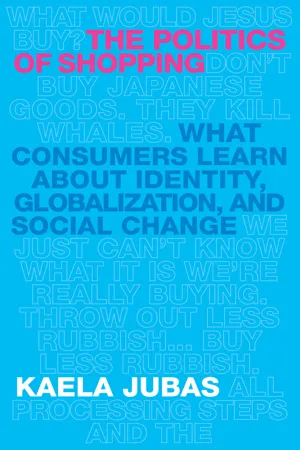
This revised version of Kaela Jubas' award winning dissertation focuses on contemporary shopping practices, analyzing the ways concerned shoppers think about globalization, consumption, and their personal effect on the status quo. By using numerous examples from modern advertising, interviews with self-described "radical" shoppers, and selected quotes from scholars and experts, Jubas delves into questions of social justice, environmental awareness, and consumer identity -- all demonstrated by individual choices made at the checkout counter. Employing a variety of qualitative research techniques and complex and counterintiuitive cultural theory, Jubas's study will interest those in adult education, cultural studies, consumer research, and qualitative inquiry.
Graffiti outside Central Train Station, Sydney, Australia, December 2006
Church sign, Dublin, Ireland, June 2007
Sign at the community market, Airlie Beach, Australia, December 2006
2
Under the Microscope: Conceptual Map
Research in the field of educational studies can be artistic, creative, and spontaneous, but, for the sake of ongoing usefulness, it also requires a purpose and a degree of rigour. The metaphor of the microscope that I use here recognizes that educational research has grown out of and challenges scientific traditions. Part of the rigour in research lies in developing and clarifying the concepts that anchor an inquiry and are used in making sense of phenomena under investigation. Borrowing from the physics of the optical microscope, I discuss the central concepts of my inquiry in this chapter.
In many dissertations, this chapter would refer to “theoretical framework”; however, I avoid that phrase because I think that, as I discuss in the following chapter, the theories that are brought together to “frame” an inquiry are evident in the inquiry’s ontology, epistemology, and methodology, as well as in its anchoring concepts and the analysis, which comes later. Over the course of my doctoral program, understanding and attending to the interrelated processes of conceptualization, methodology, and theorization in this way has helped me organize my thoughts and develop my inquiry.
The conceptual starting point for this inquiry is Gramsci’s (1971) writings, especially those known as the Prison Notebooks. Returning to the metaphor of the optical microscope, I use his concepts to provide a “coarse focus” in my analysis of the “object on the stage”—shopping as a case of learning about the links between consumption, citizenship, globalization, and resistance. In using the Prison Notebooks, I am mindful of the fact that they were compiled during Gramsci’s years of incarceration, a period when he had curtailed access to existing scholarship (especially Marxist work) and other individuals. He wrote largely to keep himself sane and did not have the regular advantages of cataloguing and publishing his writings, consulting a library of existing resources, or communicating with other theorists or activists. The Prison Notebooks is an unavoidably incomplete, ambiguous, inconsistent collection of thoughts. The “fine focus” is provided by more contemporary critical adult educators and critical scholars in related fields who help sharpen my view of shopping as a case of informal, political adult learning about
Basic optical microscope elements: 1. Ocular lens, or eyepiece
2. objective turret
3. objective lenses
4. coarse adjustment knob
5. fine adjustment knob
6. object holder or stage
7. mirror
8. diaphragm and condenser
Optical microscope, retrieved February 18, 2008 from Wikimedia Commons, http://en.wikipedia.org/wiki/Image:Mikroskop.png.
consumer-citizenship during contemporary globalization. Because they are central to experiences of consumer-citizenship and globalization, and to the guiding questions of this inquiry, conceptualizations of gender, class, and race are also included in this chapter. In relating these social categories to identity and status, I am then able to continue with a critical analysis of shopping, globalization, adult learning, and, perhaps most important, resistance. Together, these ideas constitute a conceptual map of my inquiry.
This map is divided into topical sections, most of which I explain throughout the remainder of this chapter and explore in subsequent chapters.
Conceptual map
Consumerism, anti-consumerism, and neoliberalism are all examples of ideologies active in contemporary Canadian culture. The ideas that I explore and develop in this chapter about holistic learning; critical, resistant, or possibly even “radical” shopping; and the individual in a global context are all examples of the dialectics of the individual and the collective, culture and social life. Even the methodology of case study bricolage, the explanation of which I leave for the next chapter, can be understood as an example of a dialectic within the culture of academe. Returning now to the metaphor of the microscope, I outline the central concepts in this inquiry and their mutual importance in addressing its underlying question.
Coarse Focus: Gramscian Theory and Concepts
The first step in bringing an item into view with a microscope is to use the coarse focus, which gives shape to what initially seems indiscernible. Gramsci’s (1971) concepts provide this inquiry with that basic, preliminary focus. In trying to answer his own question—why the proletarian revolution predicted by Marxism did not spread beyond Russia in the early twentieth century—Gramsci assembled several conceptual pieces. The resulting theory combines culture, economics, and politics to explain how leaders in all democratic societies manifest a central paradox: Using a balance of persuasion and force, they achieve popular consent for the maintenance of power relations, even when those relations oppress the very citizens who are consenting to them. Gramsci’s return to a Hegelian notion of the dialectic helps explain this paradox, and his use of the notion of “philosophy of praxis” and Marxist “historical materialism” sets the tone for his theoretical development.
While Gramsci’s use of the phrase “philosophy of praxis” acted as a code in his writing for Marxism, a way to get his letters past the scrutiny of prison officials (see Crehan, 2002; Ives, 2004), it also recognizes the general role of theory and practice in understanding and changing socioeconomic relations. Practice—the work of achieving societal change— is directed by theory, and theory is informed by practice. Because this back-and-forth relationship between theory and practice develops over time, historical analysis is central in understanding current society and moving toward change. Gramsci’s primary contribution to Marxism is the assertion that a similar tension also exists between ideas and experience, politics and culture, and economic structures and ideologies. These are seen as irresolvable, necessary tensions of social life in which one side actually helps to define, rather than to contradict, the other side. (A famous visual illusion might be seen as a young woman or an old woman, depending on the viewer’s perception; both images compose the picture at the same time, so that one cannot exist without the other.)
From this notion of philosophy of praxis, Gramsci develops his ideas about the role of intellectuals and ideology in civil society, and of civil society in politics and the economy. For Gramsci, democratic society comprises three elements: the economy, the political (or state), and civil society. Civil society includes educational, religious, cultural, and media institutions, processes, and products. Unlike civil society, government has access to authorized force; like civil society, its institutions and discourses justify, reflect, and reinforce economic structure. In Gramsci’s theory, civil society is important, because it is the sphere where ideologies and their associated common sense through which hegemony, the consent of sufficient groups of citizens, are constructed. Likewise, it is
The true fundamental function and significance of the dialectic can only be grasped if the philosophy of praxis is conceived as an integral and original phase in the development of world thought. It does this to the extent that it goes beyond both traditional idealism and traditional materialism, philosophies which are expressions of past societies, while retaining their vital elements. If the philosophy of praxis is not considered except in subordination to another philosophy, then it is not possible to grasp the new dialectic, through which the transcending of old philosophies is effected and expressed. —Antonio Gramsci (1971), Selectionsfrom the Prison Notebooks, pp. 435–436
Eric W. Weisstein, “Young Girl-Old Woman Illusion.” Retrieved August 25, 2008 from MathWorld—A Wolfram web resource, http://mathworld.wolfram.com/YoungGirlOldWomanIllusion.html.
in civil society where counter-hegemonic ideological discourses can germinate among marginalized groups—whom Gramsci refers to as “sub-altern” classes—and where movements for societal change can emerge.
One of the criticisms levelled today against Marxists and other materialists is that, in their focus on socio-economic class, they overlook the role of culture and discourse in developing identity or subjectivity. Neo-Gramscians extend the original focus on class to other forms of inequalities and oppression and to sites of inquiry beyond formal workplaces. Roger Simon (1991), for example, notes that the family is a unique institution of civil society, because it is where women’s unpaid and informal labour has traditionally occurred. Some scholars extend Gramsci’s focus on class by arguing that “Gramsci was, in a sense, developing (in relation to social classes) a special case of a general theory” (Holford, 1995, p. 103). Civil society is a diverse constellation of social groups and “reflects the inequalities of class, race and gender which structure the society in which it is embedded” (Blakeley, 2002, p. 94).
Civil society, like its political counterpart, is shaped by ideology, defined by Gramsci as “a specific ‘system of ideas’ [that] needs to be examined historically” (1971, p. 376). Ideologies that are “historically
One must therefore distinguish between historically organic ideologies, those, that is, which are necessary to a given structure, and ideologies that are arbitrary, rationalistic, or “willed”. To the extent that ideologies are historically necessary they have a validity which is “psychological”; they “organise” human masses, and create the terrain on which men [sic] move, acquire consciousness of their position, struggle, etc. To the extent that they are arbitrary they only create individual “movements”, polemics and so on (though even these are not completely useless, since they function like an error which by contrasting with truth, demonstrates it). —Antonio Gramsci (1971), Selections from the Prison Notebooks, p. 376
organic” (p. 376) develop in conjunction with and support social and economic structures in particular societies.
For example, the current ideology of consumerism accompanies and props up capitalist, patriarchal, and racist structures as they operate during globalization.
Gramsci discusses two types of intellectuals who lead the production and maintenance of ideology: traditional and organic. For Gramsci, “[a]ll men [sic] are intellectuals[;] one could therefore say: but not all men have in society the function of intellectuals” (p. 9). The purpose of intellectual activity is to build ideologies that operate through culture and politics. Hegemonic ideologies justify and bolster the status quo in economic and social structures that oppress certain groups of citizens; counter- hegemonic ideologies put forward an alternative vision of societal organization. Revolution, in the sense that most interested Gramsci, is a slow, educative process of fostering organic intellectuals to lead the adoption of alternative ideologies in order to generate a fairer society. Organic intellectuals are linked to a specific class (or, more broadly, social group) that develops in a particular society. Kenway explains that “Gramsci sees organic intellectuals as functioning to elaborate ideologies, to educate the people, to unify social forces, and to secure hegemony for the fundamental class to which they are organic” (2001, p. 52). In contrast, traditional intellectuals are unattached to any class and appear “as representatives of an historical continuity uninterrupted by the most complicated and radical changes in social and political forms” (Gramsci, 1957, p. 119 in Mayo, 1999, p. 41).
Some Gramscian scholars associate traditional intellectuals with the mainstream and organic intellectuals with the margins, in an apparent nod to Gramsci’s interest in marginalized groups (see, for example, Strine, 1991); however, this is an example of how Gramsci’s vagueness can come into play. I concur with Peter Mayo’s understanding that “organic intellectuals can, if they are organic to the dominant class/group (for example, managers), serve to mediate the ideological unity of the existing hegemony” (1999, p. 41). It is also possible for traditional intellectuals to join the ranks of citizens who work for change. To align intellectuals with the types of social groups they lead, we can then distinguish between “conservative” and what Diana Coben (1998) calls “revolutionary” or “radical” or what Noam Chomsky (cited in hooks, 2003) calls “dissident” intellectuals.
It is thr...
Table of contents
Cover
Half Title
Title
Copyright
Contents
List of Illustrations
Acknowledgments
Interlude I: Images of Promise and Desire
Interlude II: Images of Trouble and Critique
Interlude III: Shopping for a Dissertation
Interlude IV: A PhD Student, Her Books, and Her Search for a Bookcase
Interlude V: My Dinner at Moyo's
Interlude VI: Radical Accidents
Interlude VII: Rumours and Queues
References
About the Author
Trusted by 375,005 students
Access to over 1.5 million titles for a fair monthly price.
Study more efficiently using our study tools.
Frequently asked questions
Yes, you can cancel anytime from the Subscription tab in your account settings on the Perlego website. Your subscription will stay active until the end of your current billing period. Learn how to cancel your subscription
No, books cannot be downloaded as external files, such as PDFs, for use outside of Perlego. However, you can download books within the Perlego app for offline reading on mobile or tablet. Learn how to download books offline
Perlego offers two plans: Essential and Complete
Essential is ideal for learners and professionals who enjoy exploring a wide range of subjects. Access the Essential Library with 800,000+ trusted titles and best-sellers across business, personal growth, and the humanities. Includes unlimited reading time and Standard Read Aloud voice.
Complete: Perfect for advanced learners and researchers needing full, unrestricted access. Unlock 1.5M+ books across hundreds of subjects, including academic and specialized titles. The Complete Plan also includes advanced features like Premium Read Aloud and Research Assistant.
Both plans are available with monthly, semester, or annual billing cycles.
We are an online textbook subscription service, where you can get access to an entire online library for less than the price of a single book per month. With over 1.5 million books across 990+ topics, we’ve got you covered! Learn about our mission
Look out for the read-aloud symbol on your next book to see if you can listen to it. The read-aloud tool reads text aloud for you, highlighting the text as it is being read. You can pause it, speed it up and slow it down. Learn more about Read Aloud
Yes! You can use the Perlego app on both iOS and Android devices to read anytime, anywhere — even offline. Perfect for commutes or when you’re on the go. Please note we cannot support devices running on iOS 13 and Android 7 or earlier. Learn more about using the app
Yes, you can access The Politics of Shopping by Kaela Jubas in PDF and/or ePUB format, as well as other popular books in Business & Consumer Behaviour. We have over 1.5 million books available in our catalogue for you to explore.