eBook - ePub
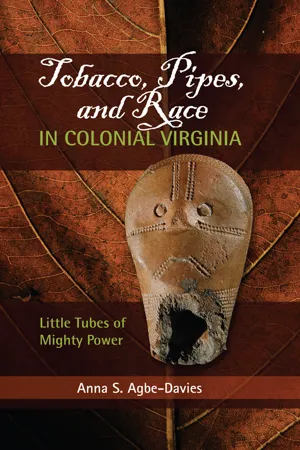
Tobacco, Pipes, and Race in Colonial Virginia
Little Tubes of Mighty Power
- 247 pages
- English
- ePUB (mobile friendly)
- Available on iOS & Android
eBook - ePub
About this book
Tobacco, Pipes, and Race in Colonial Virginia investigates the economic and social power that surrounded the production and use of tobacco pipes in colonial Virginia and the difficulty of correlating objects with cultural identities. A common artifact in colonial period sites, previous publications on this subject have focused on the decorations on the pipes or which ethnic group produced and used the pipes, "European," "African," or "Indian." This book weaves together new interpretations, analytical techniques, classification schemes, historical background, and archaeological methods and theory. Special attention is paid to the subfield of African diaspora research to display the complexities of understanding this class of material culture. This fascinating study is accessible to the undergraduate reader, as well as to graduate students and scholars.
Chapter 1
Introduction

“Now look at that. You can’t tell me that’s not an Indian pipe.” David gestured towards a display case out of which peered a small face (Figure 1.1). It embellished the bowl of a clay tobacco pipe that had lain buried for many years before archaeologists recovered it from the seventeenth-century site of Pope’s Fort and set it upon a tiny pedestal.

Figure 1.1 Why feature an artifact from Maryland in a book about pipes in colonial Virginia? Th is pipe belongs to the same local pipe tradition, and the response that its decoration evokes captures the “problem” of local pipes in a nutshell. Photograph courtesy of Historic St. Mary’s City.

Figure 1.2 John White’s likeness of “One of the wyves of Wyngyno” and these nineteenth century portraits of men and women from what is now Nigeria and Chad show but two of the many worldwide examples of facial decoration similar to that which inspired the maker of the St. Mary’s City pipe. (Left, © Trustees of the British Museum. Right, People of Northern Nigeria and Chad, 1820s; Image Reference 054, as shown on Hitchcock.itc.virginia.edu, compiled by Jerome Handler and Michael Tuite, and sponsored by the Virginia Foundation for the Humanities and the University of Virginia Library. Courtesy of Special Collections, University of Virginia, Charlottesville.)
He looked at the pipe and saw it in light of images like John White’s portraits of Pomeiock and Secotan villagers in sixteenth-century “Virginia,” now North Carolina. One woman gazes directly at the viewer, her face adorned with geometric designs (Figure 1.2a). My thoughts, on the other hand, turned toward a fellow student I had met while excavating at a site in the Republic of Benin. I don’t remember asking Didier about the lines of scarification that radiated out from the center of his face, but they highlighted its planes and angles much like the lines on the little face in the case. Where David saw links to a Native American artistic tradition, I saw connections to an African past (Figure 1.2b).
My friend and I had no hope of reconciling our two points of view on a busy field trip, with so much else to see. But I kept turning our conversation over in my mind. Why did we think that the association with one group or another mattered? I wasn’t even firmly committed to my interpretation; I simply thought it was as likely as his. How did our respective standpoints shape what we thought about life in colonial St. Mary’s City and the further meanings of the pipe? Because surely there was more to the pipe’s meaning than this question of attribution and identity. And yet it seemed as if our dilemma—who made this pipe—were the most natural thing in the world.

But, of course, it wasn’t natural. Our quandary was an artifact of our training as archaeologists and our enculturation as members of contemporary American society. If that pipe was a product of social transformations initiated in the seventeenth-century Chesapeake Bay colonies, then so, too, were our ideas. My interest in clay pipes like the one in the case originated with analyses proposing African antecedents, and then the subsequent backlash (for example, Emerson 1999 and Mouer et al. 1999). However, my focus quickly shifted to the foundations on which both positions rested. There was also a related problem having to do with the social context(s) in which inhabitants of the early colonial Chesapeake produced and distributed pipes. Therefore, I am concerned in this book with comparisons among pipes within particular contexts (that is, archaeological sites) and between the pipe assemblages that come from these contexts, not necessarily with the local pipe tradition in the abstract, divorced from time and place.

Figure 1.3 Local pipes are sometimes decorated, as with the two bowl fragments from Port Anne (top). Others, like the two pipe bowls from the Drummond plantation site (bottom), are very plain and closely resemble imported pipes.
Pipes mass-produced in England and the Netherlands betray their origins in the clay and stone versions made and used by the people whose land they settled, and who had first taught them to “drink” (as early English descriptions termed it) tobacco smoke. The white, brittle pipes were soon found throughout Europe and virtually everywhere Europeans colonized or traded with tobacco smoking populations. However, smokers in England’s Chesapeake Bay colonies had another option. Clay pipes were also pro duced locally (Figure 1.3). These local pipes can be distinguished from their imported European counterparts by a number of characteristics, including clay color (shades of reddish and yellowish brown instead of white) and composition, shape, manufacturing techniques (sometimes handmade instead of molded), and decorative style (often much more elaborate, but with less reliance on intricate stamps or molded decoration).1 Interestingly enough, these distinguishing features do not always coincide, so that archaeologists encounter pipes that resemble European imports in every other way but are deep red in color, or are handmade and sumptuously decorated with motifs that predate the arrival of Europeans in Virginia but also include letters from the Roman alphabet.
The imported pipes feature prominently in the archaeology of sites that post-date the arrival of Europeans in the Americas. By the 1620s, tobacco had become an export staple for England’s Virginia. But tobacco consumption was also an important part of life in the colony. At that time there was no consensus about the relative health merits or demerits of smoking, and there do not seem to have been strong social prohibitions limiting consumption by anyone because of either age or sex.2 Sites are commonly littered with pipe fragments—they were widely used, break easily, and do not decay once buried. Rapid but subtle changes in their size and shape allow archaeologists to date them with some precision (Figure 1.4).

Figure 1.4 These imported pipes are typical of the wares produced in English workshops during the seventeenth century. Note the different bowl styles. The lower register contains examples ca. 1610–1640. The two pipes in the middle date to ca. 1620–1660. The pipes at the top are typical of the years 1650–1680.
J. C. Harrington, one of the first archaeologists to excavate U.S. sites associated with colonists as well as Native Americans, was also an early innovator in the study of clay tobacco pipes. Historical archaeologists still use—and tweak—his mid-twentieth-century techniques for dating assemblages of pipes. Harrington’s discussion of local pipes in “Tobacco Pipes from Jamestown” is worth quoting at length, particularly because of the way in which his remarks foreshadow the work that was to come.
In addition to these white clays [the imported pipes], there are a great many pipes of similar shape, also made in a mold, but of yellow clay…. It has usually been assumed that these “yellow bowls” were made in Virginia, or at least in the American colonies; and this conclusion is supported by the absence of such pipes in collections in Great Britain…. This…also suggests that the colonists made them for their own use and not as an export item….
One of the most intriguing problems is that of the hand-molded pipes…. Many are obviously of Indian manufacture, but some may have been made by the settlers following Indian styles and techniques. To further complicate the problem, some of these pipes which are most Indianlike in character have well-formed English initials incorporated in the bowl decoration. Is this a case of the Indian copying an European idea; was the maker an “educated” Indian; or did a white man make an “Indian” pipe and put his initials on it? Detailed comparisons with pipes from Indian sites of the region would be an essential part of such a study. (1951: n.p.)
In a few short paragraphs, Harrington set the stage for decades of research on locally made pipes in the Chesapeake.
In the years that followed, archaeologists spent a great deal of time and effort trying to align the pipes with any number of parent traditions. Such arguments often, though not always, proceed as though pipe makers and pipe users belonged to a single group—but what if they didn’t? When material culture becomes an object of trade, the pathways of dissemination (exchange) no longer necessarily match those of replication (social learning; that is, culture) (Costin 1998; Urban 2001:47). Can we assume that pipe-makers and pipe smokers were the same people?3 I’m not sure that we can. The pipes represent not only ideas, passed from one generation to another, but interactions and relationships. This book considers the possibility that pipemaking was a specialized activity, with people using pipes that they had not made. If that were the case, we would next want to examine the nature of the relationships between user and maker. These questions are interesting for their own sake; the answers shed light on the workings of the seventeenth-century colony, especially its economy. The answers furthermore provide a new angle from which to consider what the pipes may have meant for members of that society (Bauer and Agbe-Davies 2010).
To take the problem even further: What do the pipes mean for archaeologists? And what does the study of them teach us about the discipline? The remainder of this chapter sets the scene. After an overview describing the place of tobacco, smoking, and pipes in the seventeenth century, I review the literature on local pipes and connect it to the methodological and theoretical underpinnings of the book, including the importance of a critical approach to classification. Chapter 2 expands on the concept of classification, arguing that the prevailing analytical methods constrain our interpretations of local pipes. I then turn to a description of the pipes analyzed in this study, with an emphasis on the technologies employed in their production, rather than on their decoration. The chapter concludes with a discussion of the parallels between the classification of artifacts and the classification of people.
Chapters 3 and 4 introduce the sites from which the pipes in this study came. Chapter 3 addresses the five plantation sites and considers the question of standardization and specialization. Analysis of the individual assemblages contradicts long-held ideas about how “local” these local pipes are. Chapter 4 focuses on Virginia’s capital city at Jamestown and the six structures there that contributed pipes to this study. The town sites and the plantation sites then come together in comparisons that demonstrate the distinctive characteristics of each assemblage, confirming distributed, rather than centralized, production. In Chapter 5, I consider power, its deployment in the colony, and the role of elite power and elite social networks in the production and distribution of the pipes. Chapter 6 returns to classification, this time from a seventeenth-century perspective. I use court records (land certificates, orders, and wills) to show how residents of the early Virginia colony engaged in the piecemeal construction of the racial and ethnic categories that continue to shape modern life, including archaeological practice.
The Task at Hand/The Rules of Engagement
An attempt to understand the labor relationships that produced pipes and put them in the hands of smokers in this small corner of the Atlantic World, this book also explores alternatives to the prevailing focus on decoration and identity, what that focus indicates about the practice of archaeology, and how it shapes disciplinary discussions and substantive contributions to the field. In this way, the book intervenes and neutralizes the problem that David and I shared. It disrupts the argument at several levels—archaeological technique, method, and theory are all implicated in reworking our approach to these pipes, and by extension our practice. The technical challenges are perhaps the most obvious: these artifacts have so far defied attempts to develop a standard nomenclature. When basing categories on decorative attributes, we privilege a narrow range of the characteristics that might be used to understand how people used pipes in the Virginia colony. Such a technique eliminates a majority of the pipe fragments actually found because they are undecorated, too fragmentary, or simply too idiosyncratic (we end up with as many “types” as pipes). In this book, I outline a strategy that incorporates all fragments into the analysis and shifts the unit of meaning from the artifact to the attribute. These techniques also expand the range of significant attributes to include those related to manufacturing style, capturing additional ways in which culture shapes material.
My move requires a shift in method as well. More than sixty years after Harrington’s initial ruminations on the pipes from Jamestown, archaeologists are no nearer to agreeing whether we should credit his “white man,” or any other exemplar, with the pipes. Culturally bound creatures that we are, archaeologists default to “incomplete” analogies, as David and I did. We saw a similarity between the characteristics of the object we faced and other phenomena familiar to us and concluded that the similarity represented a real relationship. Wylie (2002a:149–151) explains that “strong” analogies also take into account the number of similarities, their relationship to observable differences, their persistence across multiple examples and a range of settings, and the extent to which the similarities are “modest relative to the breadth and specificity of those cited.”4 With the pipes, big claims about attribution are found to rest on a very complex and ambiguous dataset. Our methodological training teaches us to see certain things as data (such as decorative style), to see certain questions as important (such as cultural affiliation). The deep-seated ideologies that guided the earliest scientific archaeologists continue to influence practice today. Standard operating procedure in archaeology reinforces a stubborn tendency to proceed as if a real one-to-one correlation exists between the decorative repertoire of an artifact tradition and the ethnic designation of the people making and using the artifacts.
The frustrating thing is that we know better. Archaeology, for the most part, gets it: ethnic groups and races are socially constructed categories. They are dynamic and relational, rather than static and essential (Battle-Baptiste 2011; Epperson 2001; Mullins 1999; Orser 2004; Voss 2008; Wilkie 2000). We have established the theoretical argument that “pots” do not equal “people.” Yet these insights do not appear to have changed the way archaeologists analyze these pipes, or colonoware,5 or any number of other artifact classes that have emerged as “markers” for a group of people. I have argued recently that the deficit is more methodological and technical than theoretical (Agbe-Davies under review a). Underlying all of these challenges—technical, methodological, and perhaps (still) theoretical—is the problem of unit creation, of classification. We need an attitude toward technique and method that is as critical as our theory.
In historical archaeology, classification is often routinized and to all appearances conceived of as a pre-analytical step. Perhaps this is because we often consult the written record for information about what our artifacts “are.” I call my study an exercise in critical systematics (for more on systematics generally, see Dunnell 1971b; O’Brien and Lyman 2003; Read 2007). As many have argued, classification is neither an automatic nor ideology-free enterprise. It is in fact fundamental to subsequent analysis, structuring our capacity for understanding phenomena, whether they be objects or people. Critical method, like critical theory, turns our focus explicitly to the research process and the me...
Table of contents
- Cover
- Half Title
- Dedication
- Title
- Copyright
- Contents
- List of Illustrations
- Acknowledgments
- Chapter 1: Introduction
- Chapter 2: Classification, or, This Is Not a Pipe
- Chapter 3: “The Subberbs of James Cittie”
- Chapter 4: Jamestown, Cities, and Crafts
- Chapter 5: Moving Pipes through Social and Physical Space
- Chapter 6: Little Tubes of Mighty Power, or, Doing Things with Words
- Notes
- References
- Index
- About the Author
Trusted by 375,005 students
Access to over 1.5 million titles for a fair monthly price.
Study more efficiently using our study tools.
Frequently asked questions
Yes, you can cancel anytime from the Subscription tab in your account settings on the Perlego website. Your subscription will stay active until the end of your current billing period. Learn how to cancel your subscription
No, books cannot be downloaded as external files, such as PDFs, for use outside of Perlego. However, you can download books within the Perlego app for offline reading on mobile or tablet. Learn how to download books offline
Perlego offers two plans: Essential and Complete
- Essential is ideal for learners and professionals who enjoy exploring a wide range of subjects. Access the Essential Library with 800,000+ trusted titles and best-sellers across business, personal growth, and the humanities. Includes unlimited reading time and Standard Read Aloud voice.
- Complete: Perfect for advanced learners and researchers needing full, unrestricted access. Unlock 1.5M+ books across hundreds of subjects, including academic and specialized titles. The Complete Plan also includes advanced features like Premium Read Aloud and Research Assistant.
We are an online textbook subscription service, where you can get access to an entire online library for less than the price of a single book per month. With over 1.5 million books across 990+ topics, we’ve got you covered! Learn about our mission
Look out for the read-aloud symbol on your next book to see if you can listen to it. The read-aloud tool reads text aloud for you, highlighting the text as it is being read. You can pause it, speed it up and slow it down. Learn more about Read Aloud
Yes! You can use the Perlego app on both iOS and Android devices to read anytime, anywhere — even offline. Perfect for commutes or when you’re on the go.
Please note we cannot support devices running on iOS 13 and Android 7 or earlier. Learn more about using the app
Please note we cannot support devices running on iOS 13 and Android 7 or earlier. Learn more about using the app
Yes, you can access Tobacco, Pipes, and Race in Colonial Virginia by Anna S Agbe-Davies in PDF and/or ePUB format, as well as other popular books in History & African American History. We have over 1.5 million books available in our catalogue for you to explore.