- 200 pages
- English
- ePUB (mobile friendly)
- Available on iOS & Android
eBook - ePub
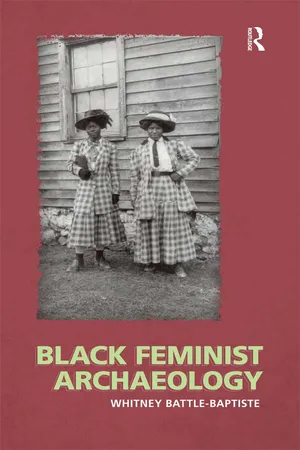
Black Feminist Archaeology
About this book
Black feminist thought has developed in various parts of the academy for over three decades, but has made only minor inroads into archaeological theory and practice. Whitney Battle-Baptiste outlines the basic tenets of Black feminist thought and research for archaeologists and shows how it can be used to improve contemporary historical archaeology. She demonstrates this using Andrew Jackson's Hermitage, the W. E. B. Du Bois Homesite in Massachusetts, and the Lucy Foster house in Andover, which represented the first archaeological excavation of an African American home. Her call for an archaeology more sensitive to questions of race and gender is an important development for the field.
Information
CHAPTER I

Constructing a Black Feminist Framework
I arrived at the Hermitage plantation during the second half of the summer of 1996 as a five-week archaeological intern. I was excited to do archaeology on a real plantation site. I was nervous because this was my first time away from the safe and protected world of the Colonial Williamsburg Foundation. I had been there nearly two weeks and loved almost every aspect of the internship. However, there was something a little off that I could not yet explain. I was immersed in the full field experience; I was digging, eating, socializing, and living with the field crew. I was learning from archaeologists like Larry McKee (the director of the program) and Brian Thomas (the assistant director) and Jillian Galle (the field supervisor) and absorbing as much as I could. I had a lot to learn and was doing my best to make sure that I did not mess anything up. I loved to be in the dirt, in an excavation unit, finding artifacts and thinking about the people that were connected to all this material I was uncovering. All the archaeology was amazing, but sometimes the down times were difficult. I was on a real plantation, and for me the energy was intense. There were times when I would think about the people who labored at the site, who lived, loved and died there as captives. It was really overwhelming at moments; I felt things that were hard to explain to my colleagues. I did not really understand how to process these feelings. There were general conversations about the field of archaeology and the specifics of what we were doing for the summer. Then there were the discussions of the African American past. This is when it would get uncomfortable for me. I had a four-year undergraduate degree in History Education from a Historically Black University where I had specialized in contemporary African history and culture. I had grown up with an educator mother invested in my knowing the African and African American past, had grown up in a vibrant African Traditionalist community, and I had a solid familiarity with most of the canons in the Black intellectual tradition. I began to even take those conversations personally; I never understood why everyone did not have this level of historical background in their preparation for digging at this site. Now, as a “fully-grown” archaeologist and academic, I do not blame the archaeologists that I met that summer, but I was taken off guard. Initially, I was angered. I wanted these archaeologists to be aware of the historical and contemporary issues facing people of African descent, and I wanted everyone to understand who the people were beyond a surface understanding of their lives and culture. I wanted them to see it my way, to prove to me that they were really about this thing we were calling African American archaeology. So, I was offended that the time had not been taken to understand not just slavery, but the struggles for recognition, acknowledgment and freedom. I thought about the complex arguments of W. E. B. Du Bois, Marcus Garvey, and Angela Davis, and I did not see this reflected anywhere in our conversations. For many reasons, I was not sure if this was the field for me. I was not confident that I could accept the lack of knowledge about my people within the discipline. That summer was long, hot and trying, but it was a summer that shaped the archaeologist I am today.
Introduction
Growing up Black and female in the United States is an exercise in skill, fortitude and perseverance. Early in my childhood I developed an awareness of an inability to express my frustration about racism, sexism, and just growing up female. This precarious combination of factors made for a complex web of emotion, anger and disconnect in how I would grow up and position myself in the larger world. As an adult, I became increasingly disillusioned by the arrogance of scholars from all types of disciplines giving “voice” to the silenced, forgotten souls of women of African descent. Frankly, as a woman of African descent, I never felt silenced in my life. Invisible, yes, but not silenced. There were many moments when I was screaming at the top of my lungs, only to look around and realize that no one was listening. As African Diasporic people, we understand that not every person’s voice or story holds equal value in the past or present.
This country has never paid close attention to my existence. Women of African descent, here from the start of the colonial experience (Morton 1991), have remained marginal in comparison to men of African descent, Euroamerican women, and Euroamerican property owning men. This marginal existence can become quite bothersome and is why I profess that I have never been “silent,” just busy, working, cleaning, nursing, raising, teaching, nurturing and existing for generations. The voices have not been silent, just in constant communication with other marginalized and subjugated women. We rarely have the time to contemplate how our stories will be remembered to a broader audience, part of the reason I argue we are often written about. The writing of our stories traditionally falls into the hands of scholars outside of the larger descendant community. From an early age, I was disillusioned by the way my sisters are often remembered, portrayed or characterized by historians, cultural critics, and popular media (duCille 1994, Morton 1991, Wallace 1990). However, as I grew older and decided that I wanted to engage in the work of historical archaeology, I noticed that overall in the academy our status as subject was rising, as chronicled by Ann duCille:
Within and around the modern academy, racial and gender alterity has become a hot commodity that has claimed black women as its principle signifier. I am alternatively pleased, puzzled, and perturbed—bewitched, bothered, and bewildered—by this, by this alterity that is perpetually thrust upon African American women, by the production of black women as infinitely deconstructable “othered” matter. Why are black women always already Other? I wonder. To myself, of course, I am not Other; to me it is the white women and men so intent on theorizing my difference who are the Other….The attention is not altogether unpleasant, especially after generations of neglect, but I am hardly alone in suspecting that the overwhelming interest in black women may have at least as much to do with the pluralism and perhaps the primitivism of this particular postmodern moment as with the stunning quality of black women’s accomplishments and the breadth of their contributions to American civilization. (1994: 591–592)
For me, the works of African descendant women describing our own experiences become the most reliable source for developing a coherent theoretical dialogue about women in captivity and beyond. Black Feminist Archaeology, therefore, demonstrates through an analysis of the material past a method to positively enhance the texture and depth of how we understand the experiences of captive African peoples and further creates an archaeology that can be directly linked to the larger quest for social and political justice in the United States and beyond. Archaeology is neither race nor gender neutral, or absent of its share of racist, sexist, and social misunderstandings that are part of the larger history of the social sciences (Patten 1997, LaRoche & Blakey 1999, McDavid 1997). In addition, archaeology has demonstrated a traditionally slow paced reaction to change. Beneath all of this, however, is the reality of how we as experts do not want to be wrong about the work we do and how we come at our often personal methodological approaches to historic sites. Through a relatively new methodological approach like Black Feminist Archaeology, I argue, archaeologists can collaborate and create inclusive dialogues equipped with engaged research agendas to produce incredibly activist oriented outcomes that appeal to a multitude of audiences.
“Womanist Is to Feminist as Purple Is to Lavender”
When I decided to pursue a career in archaeology I predicted that my work would provide solutions to my own internal frustrations and solve the world’s core problems. This premonition was quite naive, I will admit, but this belief continues to motivate me to find a realistic way to connect scholarship and real life issues. In the process I still experience extreme internal warfare stemming from my training in mainstream history and education and concern about how the larger archaeological audience will perceive my alternative approaches to the study of material culture. This internal battle I am referring to first began in my claiming a Black Feminist identity. My early experience with feminism was mostly an association with mainstream Euroamerican “stereotypical” ideas about being a feminist. I felt strongly that mainstream feminism was tied closely to consensus and compromise, therefore opposite of the Womanist philosophy (see definition below) I had fully embraced by that point. I really believed that the central tenets of the mainstream feminist philosophy could never fully embrace my cultural heritage or my needs as a woman of African descent. It was just not a “Black thing” (Hudson-Weems 2004, Walker 1983, Collins 2000, McClaurin 2001, hooks 2000). I also believed that this feminism, when claimed by women of African descent, was removed from the real struggles of Black life and community; it was an intellectual exercise that only the privileged could embrace (Morgan 2000). As my dissertation project was shaping and forming, I was trying very hard to avoid any association with the evil that “feminism” brings, but soon realized that the work I was doing was about the lived experience of captive African women, the captive family, and the complexity of domestic spaces, all topics marginalized in most androcentric perspectives. For me to demonstrate my commitment to understanding the juxtaposition of race and gender in the making of the female captive African subject, I discovered that archaeology was the right tool for this narrative. However, there needed to be some minor updates to how the discipline approached this topic methodologically. Initially, I was under the illusion that with the addition of materiality to my narrative of captive African domestic life, I could keep a superficial feminist approach and provide a deeper understanding of Black cultural production. So, I slowly expanded my cursory knowledge of Black Feminist theory and literature to make up what was missing in my attempts at addressing race and gender.
Womanist. From womanish. (Opposite of ‘girlish,’ i. e., frivolous, irresponsible, not serious.) A black feminist or feminist of color. From the black folk expression of mothers to female children, ‘You acting womanish,’ i.e., like a woman. Usually referring to outrageous, audacious, courageous or willful behavior. Wanting to know more and in greater depth than is considered ‘good’ for one. Interested in grown-up doings. Acting grown up. Being grown up. Interchangeable with another black expression: ‘You trying o be grown.’ Responsible. In charge. Serious. (Walker 1983: xi)
Also: A woman who loves other women, sexually and/or nonsexually. Appreciates and prefers women’s culture, women’s emotional flexibility (values tears as natural counter-balance of laughter), and women’s strength. Sometimes loves individual men, sexually and/or nonsexually. Committed to survival and wholeness of entire people, male and female. Not a separatist, except periodically, for health. (Walker 1983: xi)
Until the writing process, I maintained my identity as a Womanist [a term coined by Alice Walker that first appeared in Alice Walker’s Searching for Our Mother’s Garden: A Womanist prose (Walker 1983)]. I was not convinced that claiming a Black Feminist identity or doing “Black Feminist work” was right for me, even though it might have helped with the work I was doing (also see Franklin 2001, Wallace 2004, McClaurin 2001, Collins 2000, Morgan 2000). Simultaneously, I was feeling some pressure from my dissertation advisor, Maria Franklin, to seriously consider what Black Feminist theory really was. She urged me to look past my personal biases and look further into Black Feminist thought and theory. As I began this new relationship I searched for a connection to the mainstream feminism that I could not relate to. I needed answers to fill those gaps in my work where I felt that my methodological approach was disjointed, so I began to think through the process of how Black Feminist thought and theory could enhance what I was trying to do with archaeology.
I delved deeper into some classic Black Feminist texts and kept a critical eyebrow raised. However, I saw that Black Feminist theory provided a clearer way of seeing things, altered my initial conceptualizations of the historical narrative, the meaning behind artifacts, and the thinking through of a methodology that could be whole and healing. Around this juncture I discovered the words of the Combahee River Collective, a group of radical Black Feminists that gathered regularly from 1973 to 1980. They are best known for the Combahee River Collective Statement that chronicled the history of contemporary Black Feminism and the development of a broader understanding of an inclusive Black Feminist identity. This is one of the first statements that struck me:
A political contribution which we feel we have already made is the expansion of the feminist principle that the personal is political. In our consciousness-raising sessions, for example, we have in many ways gone beyond white women’s revelations because we are dealing with the implications of race and class as well as sex. Even our Black women’s style of talking/testifying in Black language about what we have experienced has a resonance that is both cultural and political. We have spent a great deal of energy delving into the cultural and experimental nature of our oppression out of necessity because none of these matters has ever been looked at before. No one before has ever examined the multilayered texture of Black women’s lives. (Combahee River Collective 1982)
Part of my own identity formation was connecting the personal with the political; it was how I wanted to structure my methodology. I understood the impact of not only focusing on gender in my work, but how certain “innocent” assumptions often play an active role in contemporary forms of racialized and gendered stereotypes. For example, one of my fears was that my work could mistakingly be perceived as reproducing old imageries of a broken and dysfunctional Black family forced by captivity into a non-patriarchal, therefore “pathological” (women-centered) family structure. This would then lead to yet another analysis of the exploded sense of the “strong Black woman” as a way of understanding Black culture and the Black family (Wallace 1999). This imagery is a part of the complexity of writing about race and gender in the past. There are very real contemporary implications to how archaeologists shape their larger interpretations.
The role of women of African descent in the historical memory of the United States is fraught with misconceptions, misgivings and stereotypes. Whether negative or positive, they are fully entangled in the way women of African descent are perceived generally. Motherhood and mainstream ideals of the feminine is a realm that I briefly explored in my dissertation about racialized femininity and representation of women of African descent through time. A central theme in the experiences of captive African women was sexual exploitation and abuse. These themes were often left out of the literature of the time (for example see Harriet Jacobs narrative, Yellen 1987) because the women writing their stories needed to appear as sexually pure as possible to appeal to abolitionists and Euroamerican women caught in a very real Victorian mindset (Patten 1999). So, I had to be sensitive about how I approached the topic of women, family and female/male relationships. An example would be the emphasis of, and (often exaggerated) importance of, Black women as culture bearers. On the ground level, this categorization is so normalized in our historical imagination that it is almost impossible to separate the myth of the overbearing Black woman from the image of a collective, at times semi-egalitarian captive and then freed community. With an attempt to highlight the absence of women of African descent in the larger understanding of the colonial and antebellum past, a gendered analysis has to be extra careful with the words and images that are created by the work. I do not want to attempt to create an image of the Black domestic sphere as without fault or simply in opposition to the evil norm of Euroamerican patriarchal culture. Things were not perfect, and the ability to create an egalitarian social system in a captive context is probably a theoretical stretch in many ways. I recognized that there was a form of internalized patriarchy that was a real aspect of life within a captive community. The inability of captive African men to actively pursue their patriarchal destiny was controlled in very dehumanizing ways by plantation owners and overseers. Captive men were thrust into a society ruled by a patriarchal design; however, they could not actively participate as property themselves. There was a severe disadvantage in their inability to protect the women and children in their “families.” With this in mind, my theoretical approach had to acknowledge that captive men were directly affected by this contradiction of core social systems of colonial and antebellum America and the reality of their lived situation.
Therefore, to shape an interpretation of the captive African domestic sphere, there had to be a larger understanding of how women of African descent were viewed in the past and present. Archaeological material is important to a discussion of issues of resistance, family formation, and daily life; however at the same time, archaeology has to contend with the reality of racialized and gendered stereotypes of captive women and men. I did not want to “mistakenly” recreate an image of emasculating captive women and weak, unproductive captive men, nor glorify the captive domestic sphere as the template for all understanding of Black domestic cultural production. This one issue had, for me, a lot more baggage attached to my interpretation than just seeing the value of captive women shaping their family’s domestic spaces, an example of the sensitivity of a Black Feminist Archaeological approach.
Identity Formation and Black Women’s Fiction
In my writing I began to actively engage with these issues of contemporary African America without placing modern notions of social or racialized political elements onto my interpretations of the past. I searched for sources that addressed my needs and questions of the African American past from a gendered perspective. I knew the written sources would be scarce, but never imagined that they would border on nonexistent. I searched for material that could address my questions, compliment my developing interpretative frameworks, and potentially confront historical inconsistencies I was sure to encounter. Black women’s fiction had always spoken to me at different points in my life and career. I used these texts when I was depressed, lonely, sad or homesick. I savored the words of wise warrior women in ways that helped me to fight the good fight and continue to see my value, knowing that one day I too wanted to touch the world with the narrative of my own struggles and experiences. However, as a trained historian that was now an anthropological archaeologist, I felt extremely uneasy about using literature or my own history in a way that was academically acceptable.
The connection between contemporary Black women writers and slavery is found in the ways that gender articulates with race in the contemporary work of these women (Patton 1999: xiv). In fact, the very foundation of Black feminist thought is linked to the de-gendering process experienced by Black women during slavery throughout the African Diaspora. Venetria Patton explains this process as the “institution’s attempt to de-gender female slaves and their resistance to such tactics generated alternative gender constructs. Due to the socially constructed nature of maternity, slave mothers and thei...
Table of contents
- Cover
- Half Title
- Dedication
- Title Page
- Copyright Page
- Table of Contents
- List of Illustrations
- Foreword
- Acknowledgments
- Introduction: Understanding a Black Feminist Framework
- Chapter I. Constructing a Black Feminist Framework
- Chapter II. The Hermitage
- Chapter III. Revisiting Excavations at Lucy Foster’s Homestead
- Chapter IV. The Burghardt Women and the W. E. B. Du Bois Boyhood Homesite
- Chapter V. Moving Mountains and Liberating Dialogues
- References
- Index
- About the Author
Trusted by 375,005 students
Access to over 1.5 million titles for a fair monthly price.
Study more efficiently using our study tools.
Frequently asked questions
Yes, you can cancel anytime from the Subscription tab in your account settings on the Perlego website. Your subscription will stay active until the end of your current billing period. Learn how to cancel your subscription
No, books cannot be downloaded as external files, such as PDFs, for use outside of Perlego. However, you can download books within the Perlego app for offline reading on mobile or tablet. Learn how to download books offline
Perlego offers two plans: Essential and Complete
- Essential is ideal for learners and professionals who enjoy exploring a wide range of subjects. Access the Essential Library with 800,000+ trusted titles and best-sellers across business, personal growth, and the humanities. Includes unlimited reading time and Standard Read Aloud voice.
- Complete: Perfect for advanced learners and researchers needing full, unrestricted access. Unlock 1.5M+ books across hundreds of subjects, including academic and specialized titles. The Complete Plan also includes advanced features like Premium Read Aloud and Research Assistant.
We are an online textbook subscription service, where you can get access to an entire online library for less than the price of a single book per month. With over 1.5 million books across 990+ topics, we’ve got you covered! Learn about our mission
Look out for the read-aloud symbol on your next book to see if you can listen to it. The read-aloud tool reads text aloud for you, highlighting the text as it is being read. You can pause it, speed it up and slow it down. Learn more about Read Aloud
Yes! You can use the Perlego app on both iOS and Android devices to read anytime, anywhere — even offline. Perfect for commutes or when you’re on the go.
Please note we cannot support devices running on iOS 13 and Android 7 or earlier. Learn more about using the app
Please note we cannot support devices running on iOS 13 and Android 7 or earlier. Learn more about using the app
Yes, you can access Black Feminist Archaeology by Whitney Battle-Baptiste in PDF and/or ePUB format, as well as other popular books in Social Sciences & African American Studies. We have over 1.5 million books available in our catalogue for you to explore.