African American literature is over. With this provocative claim Kenneth Warren sets out to identify a distinctly African American literature—and to change the terms with which we discuss it.
Rather than contest other definitions, Warren makes a clear and compelling case for understanding African American literature as creative and critical work written by black Americans within and against the strictures of Jim Crow America. Within these parameters, his book outlines protocols of reading that best make sense of the literary works produced by African American writers and critics over the first two-thirds of the twentieth century.
In Warren's view, African American literature begged the question: what would happen to this literature if and when Jim Crow was finally overthrown? Thus, imagining a world without African American literature was essential to that literature. In support of this point, Warren focuses on three moments in the history of Phylon, an important journal of African American culture. In the dialogues Phylon documents, the question of whether race would disappear as an organizing literary category emerges as shared ground for critical and literary practice. Warren also points out that while scholarship by black Americans has always been the province of a petit bourgeois elite, the strictures of Jim Crow enlisted these writers in a politics that served the race as a whole.
Finally, Warren's work sheds light on the current moment in which advocates of African American solidarity insist on a past that is more productively put behind us.
- 193 pages
- English
- PDF
- Available on iOS & Android
eBook - PDF
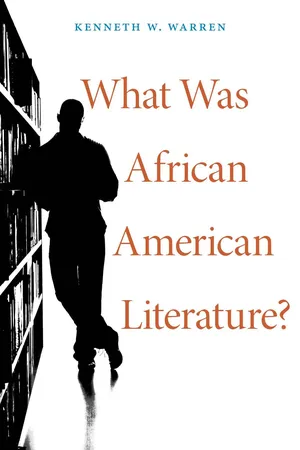
What Was African American Literature?
About this book
Information
Publisher
Harvard University PressYear
2011Print ISBN
9780674066298
9780674049222
eBook ISBN
9780674059566
Table of contents
- Contents
- Acknowledgments
- 1. Historicizing African American Literature
- 2. Particularity and the Problem of Interpretation
- 3. The Future of the Past
- Conclusion: The Past in the Present
- Notes
- Index
Trusted by 375,005 students
Access to over 1.5 million titles for a fair monthly price.
Study more efficiently using our study tools.
Frequently asked questions
Yes, you can cancel anytime from the Subscription tab in your account settings on the Perlego website. Your subscription will stay active until the end of your current billing period. Learn how to cancel your subscription
No, books cannot be downloaded as external files, such as PDFs, for use outside of Perlego. However, you can download books within the Perlego app for offline reading on mobile or tablet. Learn how to download books offline
Perlego offers two plans: Essential and Complete
- Essential is ideal for learners and professionals who enjoy exploring a wide range of subjects. Access the Essential Library with 800,000+ trusted titles and best-sellers across business, personal growth, and the humanities. Includes unlimited reading time and Standard Read Aloud voice.
- Complete: Perfect for advanced learners and researchers needing full, unrestricted access. Unlock 1.5M+ books across hundreds of subjects, including academic and specialized titles. The Complete Plan also includes advanced features like Premium Read Aloud and Research Assistant.
We are an online textbook subscription service, where you can get access to an entire online library for less than the price of a single book per month. With over 1.5 million books across 990+ topics, we’ve got you covered! Learn about our mission
Look out for the read-aloud symbol on your next book to see if you can listen to it. The read-aloud tool reads text aloud for you, highlighting the text as it is being read. You can pause it, speed it up and slow it down. Learn more about Read Aloud
Yes! You can use the Perlego app on both iOS and Android devices to read anytime, anywhere — even offline. Perfect for commutes or when you’re on the go.
Please note we cannot support devices running on iOS 13 and Android 7 or earlier. Learn more about using the app
Please note we cannot support devices running on iOS 13 and Android 7 or earlier. Learn more about using the app
Yes, you can access What Was African American Literature? by Kenneth W. Warren in PDF and/or ePUB format, as well as other popular books in Social Sciences & North American Literary Criticism. We have over 1.5 million books available in our catalogue for you to explore.