- 292 pages
- English
- ePUB (mobile friendly)
- Available on iOS & Android
eBook - ePub
About this book
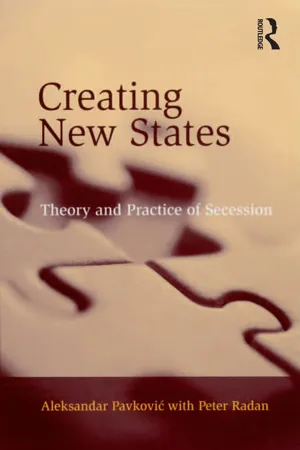
Secession is the creation of a new independent state out of an existing state. This key volume examines the political, social and legal processes of the practice of secession. Following an analysis of secessionist movements and their role in attempts at secession, eight case studies are explored to illustrate peaceful, violent, sequential and recursive secessions. This is followed by a look at the theoretical approaches and a discussion that focuses on the economic causes. Normative theories of secession are discussed as well as the status of secession in legal theory and practice. The book systematizes our present knowledge of secessions in an accessible way to readers not familiar with the phenomenon and its consequences. It is ideal as a supplementary text to courses on contemporary political and social movements, applied ethics and political philosophy, international relations and international law, state sovereignty and state formation.
Information
Chapter 1
What is Secession?
A definition of secession
The Latin roots of the verb ‘secede’ – ‘se’ meaning ‘apart’ and ‘cedere’ meaning ‘to go’ – suggest that to secede is to leave or to withdraw from some place. This meaning – ‘an act of going away from one’s accustomed neighbourhood’ (OED, meaning 1) – is now obsolete in English. At the moment, ‘secession’ is usually taken to mean ‘formally withdrawing from an alliance, a federation, a political or religious organization or the like.’ (OED, meaning 3). In this book the term is used in a narrower sense restricted to the context of creation of new states. For the purposes of our exploration of secession, we define secession as follows:
Secession is the creation of a new state by the withdrawal of a territory and its population where that territory was previously part of an existing state.
For ease of understanding the discussion of secession in this book, the term ‘host state’ refers to the ‘existing state’ referred to in the definition, and the term ‘seceded state’ refers to the new state created as a result of secession.
Our definition of secession sees the seceded state as the product of a process. The process in question is that of seceding from the host state. How is the process, resulting in a seceded state, completed? During the process leading to the creation of the seceded state, the representatives of a population settled on a territory within the host state proclaim an independent state on that territory. In most cases they do so by means of a declaration of independence. In some, but not all, cases in which independence is so proclaimed, other states and international organizations formally recognize the independence of the new state. This recognition of independence by other states is vital evidence that the newly proclaimed state satisfies generally accepted requirements of statehood. The process of secession is said to be successfully completed when the state the secessionists proclaimed is recognized by a significant number of other states.
In this book, the term ‘secession’ is used to refer to the process of secession, to a stage or stages in this process prior to the completion of the process and to the completion of this process. Thus, secession is said to be successful when the process has been completed and the new state has been recognized. When this process was not completed – primarily because there was insufficient international recognition of the new state – secession was not successful. In such cases we can say that there was an attempt at secession or that secession has been attempted (for an explanation of these terms see Chapter 2).
There is no consensus amongst social scientists and legal scholars1 on a precise definition of secession. This lack of consensus often leads to problems with interpreting the literature on secession as scholars are not always talking about the same thing. Among various alternative definitions we should note the following two. First, James Crawford defines secession as ‘… the creation of a State by the use or threat of force without the consent of the former sovereign’ (Crawford 2006, 375). Second, Julie Dahlitz defines secession as follows: ‘The issue of secession arises whenever a significant proportion of the population of a given territory, being part of a State, expresses the wish by word or by deed to become a sovereign State in itself or to join and become part of another sovereign State’ (Dahlitz 2003, 6).
The three critical elements that appear in one or other of these definitions, but which do not form part of our definition, relate to (i) secession requiring the use or threat of force (Crawford); (ii) secession requiring opposition from the host state (Crawford); and (iii) secession not requiring the creation of a new state on the relevant territory, (that is, secession also involving cases in which the relevant territory does not become a new state) (Dahiltz). The first two of these elements qualify our definition by claiming that certain types of territorial withdrawals from existing states are not secessions. The third, appears to expand the definition of secession, but in fact refers to transfer of territory from one state to another which, as will be argued below, is something quite distinct from secession.
In relation to Crawford’s qualification that secession must involve the use or threat of force, this element relates only to the means by which secession is achieved. It is irrelevant whether the process of secession is peaceful or violent because the product of the process is the same, namely the creation of a new state over territories which of themselves were not states previously. This point can be illustrated by analogy to childbirth. The birth of a child may be either by vaginal delivery or by Caesarean section. This difference in means of delivery does not change the fact that in each case birth has occurred and a new child has joined the community of human beings.
In relation to the qualification that the host state must be opposed to secession, this too is an irrelevant factor. The fact that at some stage of the process of secession the host state did not oppose the creation of the seceded state does not affect the final outcome – its creation. The same outcome, the creation of a new state, resulted in those cases in which the host state, at some stage, did oppose its creation. Whether the host state opposed the creation of a new state or not is thus irrelevant to the final outcome, the creation of a new state on what was formerly the host state’s territory. Again, the point can be illustrated by analogy. The termination of a marriage is not defined differently depending upon whether one of the parties to the marriage is or is not opposed to the other applying to terminate the relationship. In either case the termination is defined as a divorce.
The word ‘secession’, for a variety of reasons, is often viewed negatively. First, states are generally opposed to secession, although the strength of that opposition will vary depending upon the circumstances. For example, if state ‘A’ is a host state, its opposition to an attempt to create another state out of its territory will usually be determined and backed up by the use of force. However, the extent of opposition by other states to such an attempt will usually not be as determined and will most likely not extend to them using force to defeat the claim. The extent of other states’ support for the host state’s opposition to an attempt at secession from its territory against it will largely be determined by an assessment of their strategic and other interests.
Second, the violence that is often associated with secession has made ‘secession’ an ‘undesirable’ or ‘dirty’ word, best to be avoided, except if one wants to denounce or oppose claims that secessionists make. Thus, secessionists rarely use the word when propounding their claims. Declarations of independence almost invariably make no reference to the word. Host states, however, will almost invariably invoke the word when voicing opposition to secessionists’ claims and their attempts to secede.
This general hostility to secession and the negative connotations associated with the word itself has led to the above definitions of secession that are beset with what we have argued are irrelevant elements. More importantly, these definitions are also not very helpful. This is because they do not regard as secessions the creation of new states that are, in all relevant aspects, secessions. For example, as Crawford states, pursuant to his definition of secession and excluding cases of decolonization, Bangladesh is the only secession to have occurred since 1945 (Crawford 2006, 415). Other cases of new state creation during that period that would fall within our definition of secession – and that are discussed in Part I of this book – are, according to him, simply not secessions. According to him, these new states are created, not through the process of secession, but rather as the result of agreement or in the wake of the dissolution of a state. By giving different labels to what we argue are cases of secession, these definitions ignore the crucial feature that is common to all of them, namely that in each case there arose a new state over territory which of itself was not a state previously. Giving different labels to the processes with the same type of outcome does not help us in our endeavour to understand and analyse the political, normative and legal aspects of both the processes and their outcomes. This book argues that there is a commonality between all of these cases which justifies the broad definition we have given to the word ‘secession’.
How is a territory ‘withdrawn’ from a host state?
Contrary to the suggestion of the Latin word ‘cedere’, a territory does not – and cannot – ‘walk away’ from a host state. When a territory secedes, the institutions of the host state on that territory cease to function and its laws no longer hold for or are enforced on that territory. One can illustrate this with a rather simple and thus crude example: when a territory secedes, the prime minister and/or president of the host state are no longer the prime minister and/or president of the seceded state. The same holds for the parliament or any such representative body of the host state or for its highest courts: none of these state institutions exercise their previous powers over the territory of the seceded state. Accordingly, the laws of the host state no longer apply or are enforced on that territory as the laws of the host country – the police and other law enforcement agencies no longer report to or take orders from the host state officials.
Paradoxically, when a territory secedes, it is not the seceded territory itself and its population but the host state and its institutions that are withdrawn. When a territory secedes, it is the political, legal and coercive powers of the host state that are withdrawn from the territory. This withdrawal is manifested in a variety of the ways. For example, the previous name labels of state institutions and their coats of arms and flags are replaced with new ones; many office-holders and civil servants on the territory leave their posts and even depart from the seceded territory and they, sometimes, take with them the instruments they used when in power, such as communication equipment, vehicles and weapons. The replacement of name labels, coats of arms and flags is in some cases carried out in public and widely reported by the media as events symbolizing the achievement of the much coveted independence from the host state.
Secession thus consists not only of a withdrawal of power from a territory but its transfer to the new set of institutions and office holders – the institutions and office holders of a new state.
The creation of a new state on the territory
In the process of transfer of powers to the new institutions and office-holders, the seceded state gets, most importantly, a new name to assert its status as a state and to distinguish it from its previous status as a non-state territory. Thus the thirteen British colonies in America were, in 1776, named the ‘United States of America’. In 1991 the Socialist Republic of Slovenia became the Republic of Slovenia, shedding its status of a federal unit in the Yugoslav federation. In keeping with the new name and status, new offices and institutions are also created to match these changes, such as the offices of president or prime minister and other ministries; alternatively, the existing offices are re-named and given broader or enhanced powers. And, equally importantly, new state borders are demarcated and border crossing points established where there were none before (as the seceded state’s territory was then part of the host state). These new state borders encircle the whole territory of the seceded state, demarcating it from all other states, including the host state or the remaining parts of the host state.
Secession thus involves the creation of a new state with its own borders on the withdrawn territory. In that way it is different from incorporation (‘redemption’) of the withdrawn territory into an already existing state.
Transfer of a territory from one state to another: ‘redemption’ of the ‘irridenta’
A territory can be withdrawn from an existing state without the creation of a new state on it. A territory can be transferred from one state to another – usually to a neighbouring state. In the late nineteen century, nationalists in Italy sought to incorporate a number of territories populated by Italians which were then part of Austria-Hungary and Switzerland. They called these territories ‘Italia irridenta’ – ‘unredeemed Italy’. Hence the term ‘irredentism’ to denote a territorial claim that one sovereign state makes on the territory of another (Mayall 1990, 57). Some of those territories – the cities of Trieste and Fiume and the surrounding areas – were ‘redeemed’ or transferred to Italy after World War I. Similarly, after World War I, the province of Alsace was transferred from Germany to France. As in a case of secession, such a transfer, based on an irredentist claim, involves a withdrawal of the officials, institutions and symbols – flags and coats of arms – of the host state. But instead of newly created state institutions and offices and newly created state symbols, the withdrawn ones are replaced with the institutions of another existing, usually neighbouring, state. The borders of that neighbouring state are extended to encompass the withdrawn territory and new borders between the former host state and the new host state are demarcated. Such a transfer or ‘redemption’ can be thus viewed as a case of border change or adjustment. However different, both secession and successful ‘redemption’ of a territory from another state involve a transfer of sovereignty and jurisdiction.
Sovereignty
The changes that we have described can be succinctly described using two technical terms ‘sovereignty’ and ‘jurisdiction’. In the cases either of secession or of transfer of a territory to another state, the previous – host – state loses sovereignty and jurisdiction over a territory and another state gains sovereignty and assumes jurisdiction over that territory. Let us now explain what this means.
The Latin roots of the English word ‘sovereignty’ – ‘super’ meaning ‘above’ and ‘regnere’ meaning ‘to rule’ – suggests a supreme or overriding rule. Indeed, the word ‘sovereignty’ in the present context refers to supreme rule: sovereignty is a political and legal right to control or to rule over all inhabitants on a particular territory which overrides all other rights to exercise power or control. A sovereign power is thus a power that, by right, overrides any other power over a territory and is, in this sense, a supreme power over a territory. Not surprisingly, in our times it is a state and its office-holders that exercise sovereignty over a territory: a state that has the supreme right to control, by coercion if necessary, the territory and its inhabitants within its state borders.2 In order to control a territory and its population, a state and its officeholders must be able, at least, to maintain order (that is, to prevent and/or stop large-scale violent conflict among the population), to extract tax or revenue from people and commercial organizations on its territory, to regulate the movement of people and goods across its borders and to prevent any other state or outside group from exercising control over its territory and its population. In controlling the territory and its population, a state is thus exercising its sovereign powers, such as the sovereign power of maintaining order.
In preventing any other state or outside group from exercising control, the state is exercising its sovereignty in relation to other states or outside groups. A state’s sovereignty thus excludes other states or other states’ officials from exercising control over its territory. In order for a state to exclude other states effectively, other states need to recognize that state as a sovereign state – as a state which has the right to control its territory. In excluding other states from the control over territory of a particular state, sovereignty implies independence of a sovereign state from other states. In recognizing a state’s sovereignty, other states are recognizing its independence from other states. In our present system of sovereign states, states formally recognize other states as independent and sovereign states through the establishment of diplomatic relations with each other and by subscribing to principles of international law that require states to recognize and respect each other’s sovereignty. Recognition of the independence of a new state, as we shall see in Chapter 2, is one of the main goals of any secessionist movement.
How are these concepts of sovereignty and independence related to secession?
In attempting to secede from a state, secessionists deny a host state the right of control over part of its territory and demand that another, new state assumes that right. In this sense, the secessionists deny the host state sovereignty over the relevant territory and demand that a new state assume the sovereignty, that is, the right to control that territory. They are demanding not only that a new state exercise this control but that its right of control, its sovereignty, be recognized by other states, including the host state. As we have seen above, they are demanding that other states recognize the newly seceded state as independent from its host state and thus as a state sovereign over its territory. From a legal point of view, recognition by other states and international organizations completes the creation of a new state.
A successful secession thus involves first, a transfer of sovereign or supreme powers from one set of state institutions and office holders to another, newly created, set and, second, the recognition by other states and international organizations of the sovereignty of the state which these newly created institutions represent.
Recognition of a new state in international law
In inte...
Table of contents
- Cover Page
- Half Title page
- Dedication
- Title Page
- Copyright Page
- Contents
- List of Maps
- List of Boxes
- Preface
- Introduction
- 1 What is Secession?
- Part I Secession in Practice
- Part II Secession in Theory
- Appendix
- Bibliography
- Index
Trusted by 375,005 students
Access to over 1.5 million titles for a fair monthly price.
Study more efficiently using our study tools.
Frequently asked questions
Yes, you can cancel anytime from the Subscription tab in your account settings on the Perlego website. Your subscription will stay active until the end of your current billing period. Learn how to cancel your subscription
No, books cannot be downloaded as external files, such as PDFs, for use outside of Perlego. However, you can download books within the Perlego app for offline reading on mobile or tablet. Learn how to download books offline
We are an online textbook subscription service, where you can get access to an entire online library for less than the price of a single book per month. With over 1.5 million books across 990+ topics, we’ve got you covered! Learn about our mission
Look out for the read-aloud symbol on your next book to see if you can listen to it. The read-aloud tool reads text aloud for you, highlighting the text as it is being read. You can pause it, speed it up and slow it down. Learn more about Read Aloud
Yes! You can use the Perlego app on both iOS and Android devices to read anytime, anywhere — even offline. Perfect for commutes or when you’re on the go.
Please note we cannot support devices running on iOS 13 and Android 7 or earlier. Learn more about using the app
Please note we cannot support devices running on iOS 13 and Android 7 or earlier. Learn more about using the app
Yes, you can access Creating New States by Aleksandar Pavkovic,Peter Radan in PDF and/or ePUB format, as well as other popular books in Politics & International Relations & International Law. We have over 1.5 million books available in our catalogue for you to explore.