![]()
Part I
What Is a Sound System?
What is a sound system? How does sound itself work? What are the components we need in order to get signal to our audience? Part I examines the fundamentals of sound and all the standard components of a contemporary sound system.
![]()
Section I: Basics
![]()
Chapter 1
The Four Standard Elements of the Analog Sound System
What Is a Sound System?
This seems like a straightforward question—a sound system is that thing your neighbor turns up way too loud when you’re trying to sleep, right?
As is the case with most seemingly straightforward questions, the answer proves to be more complex than we might think at first glance. Do you think of your cell phone as a sound system? How about a piece of cardboard rolled up in a cone shape, used as a megaphone? How about a greeting card that allows you to record your voice saying “happy birthday!” to your Grandma? All of these are, in some fashion, sound systems.
In the contemporary world, sound systems surround most of us all day, every day, and yet until we are standing in front of a giant subwoofer stack at a concert, most of us never give sound systems a second thought (even then we may not give them a second thought unless the mix engineer allows the system to feedback). In Part I of this book, we will be examining sound systems, breaking them down to their component pieces, and discussing when, why, and to what ends we use them.
This book is focused on professional sound systems for live entertainment and installation sound systems for themed entertainment, retail, and corporate environments, with a little focus on production spaces such as studios. While we may not spend dedicated time on that system inside your Nana’s greeting card, the principles we define in this chapter apply not only to that greeting card but also in one way or another to any sound system anywhere.
To begin, we must first define the term sound system.
Sound System
A collection of components, assembled for the purpose of taking an audio signal (acoustic, electrical, or digital, live, or pre-recorded), processing it, amplifying it, and reproducing it.1
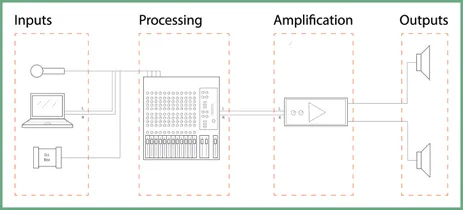
Figure 1.1 Signal Flow of the Four Standard Elements
Every sound system known to humans (even the rolled-up paper cone megaphone) consists, at root, of four standard elements:
- 1. Inputs
- 2. Processing
- 3. Amplification
- 4. Outputs
In an analog sound system, the above elements (which we will discuss in detail in a moment) may be the only elements of the system. In the digital world, there are often added elements that allow us a range of functionality and flexibility we don’t possess in the analog world—those will be addressed beginning in Chapter 2. Figure 1.1 shows the signal flow of the standard four analog elements.
In any given sound system, audio content enters the system via the input stage. That content is processed (changed) in some fashion, amplified (made louder), and then made audible again in its final form at the output stage. To consider the example of perhaps the most rudimentary sound system—the cone-shaped cardboard megaphone—the four elements break down like this:
- The INPUT stage is your voice, sending sound into the system via an acoustic path.
- The PROCESSING stage is the narrow throat of the cone, which imparts specific acoustic changes to the source acoustic signal.
- The AMPLIFICATION stage is the throw from the narrow throat of the cone to the wide mouth of the cone. The cone works as an acoustic resonator (among other things), which helps add constructively to the loudness of your voice.
- The OUTPUT stage is the wide mouth of the cone, which spreads the sound out into the space, acting as a waveguide.
Waveguide
A structure that shapes the path of oscillating energy—most commonly used in sound system design as a term to describe acoustic energy shapers, such as loudspeaker horns,2 but also used to describe any shaped path through which signal can be forced to move—e.g., optical fiber is a WAVEGUIDE for optical data transmission.
While that describes (albeit in a simplified fashion) how a cone megaphone serves as a rudimentary sound system, most sound systems are at least a bit more complex than this.
We will begin by examining analog sound systems, because analog systems in their elemental form represent the most straightforward possible signal path.
Analog
When used to describe a sound system, this is a term referring to a signal path in which acoustic energy (voice, music, sound effects, anything else worth hearing) is transduced into ANALOGOUS electrical energy, that electrical energy (now an electronic signal) is manipulated and amplified, and then the amplified signal is transduced back into acoustic energy and played via loudspeakers, with no computer/digital signal path in between.
Transducer
A device that changes one form of energy to another. Transduction is a constant function of sound systems: a MICROPHONE transduces acoustic energy to electrical energy; a LOUDSPEAKER does the same in reverse.3
Digital
When used to describe a sound system (or part thereof), this is a term referring to a signal path in which electrical energy (the electronic audio signal) is sensed and then converted into a data stream in order that it may be stored in a computer’s memory and/or processed by software.4
A note on the terms “Electrical Energy” and “Electronic Signal”:
Electrical Energy is an imprecise common-language term that will be used in this text to mean “current flowing along conductors.” “Electronic Signal” is another imprecise common term, that will be used in this text to mean “audio flowing through electronic equipment, e.g., microphones, mixing consoles, etc.” 5
Let us imagine a very simple entertainment event, with a very simple sound system.
We are in a public park. There is a small stage, and on that stage is a solo performer—a singer with an acoustic guitar. The park is so small that there is no need for onstage monitoring (speakers aimed back at the artist so that they can hear themselves or their bandmates).6 Before the musician’s set, quiet music is playing from a cassette tape deck that is jacked into the system. The musician’s set will be amplified. This concert is a typical small event, like those held in parks all across the world during the warm months. The simple needs of such an event predicate a simple sound system—often a basic analog sound system.
Mixing Console
An electronic device that combines a variety of input signals and sends them to the amplification stage in that combined form. Mixing consoles are also used to adjust individual source loudness, to bring microphone-level signals to line level,7 and to implement other processing options. In the simplest systems, multiple audio inputs are combined to a single output pathway. In the most complex systems, the mixing console may route a signal to a wide variety of output locations, via different types of output paths.
Our stage features two microphones, both wired. One is for announcements and for the singer’s voice. The other is on a lower stand, aiming at the guitar. The microphones are connected to our mixing console via XLR cables, and the tape deck that plays our entry music is connected via RCA cables.8 These cables carry electronic signals over copper wires into the mixing console.9
Tales From the Field
In some audio production circles, it is fashionable to adore analog gear and claim its superiority to digital. While I love the sound of warm tape compression in the studio as much as the next engineer, in the live realm, digital gear has become standard for a reason. In addition to working as a designer, I have worked as a live sound engineer on thousands of events, and since most of those took place in the 2000s, a majority of the systems I have operated have been digital—but that certainly wasn’t always the case. Back around the turn of the 21st century, I was working a benefit show at the Geffen Playhouse in Los Angeles, as Front-of-House (FOH) engineer. One of the acts was a venerable comedy duo who shall remain nameless. I was told they had sound effects for their act, and so I sent a stage assistant down to retrieve what I was expecting to be a CD of their cues. The stage assistant returned with the very aged cassette tape on which their cues were recorded. This sent me into a panic, as I wasn’t even sure the Geffen still possessed a working tape deck. After much searching, I located one, hooked it into the system, inserted their cassette, hit play, and immediately saw the tape spool out onto the floor and heard it snap in more than one spot. I sent the assistant back down to the dressing room to ask after another copy of the cues. As it happened, not only did the brothers not have another copy of the cues with them, they didn’t have another copy … period. They had been using this one cassette tape, that someone had prepared for them 20 years prior, at every single show for those last two decades—and this was the day it decided to break. We didn’t have any proper splicing tape at the theater, so for the next 10 min, I feverishly reassembled the magnetic tape with Scotch tape, wound it back into the cassette with a pencil, and crossed my fingers that these cues (which were critical to the act) would be audible and would not contain massive glitches in the middle. To my great delight, the repairs held up, both during the rehearsal and during the show. Whew! After the show, I asked the brothers if they would like for me to burn those sounds onto a CD for them before they left, but they had another function to attend and couldn’t wait around, so they left with their hodgepodge cassette in hand and, presumably, continued using it at subsequent shows. While I was glad in that moment that I knew how to splice tape, always remember, when designing a system, reliability is key. Digital is our friend.—J.L.
Our mixing console may or may not have effects built into it, or there may be some external effects devices connected to it.10 From the console, the signals, now combined, are sent to an amplifier, and then to loudspeakers. (The amplifier may be built into the loudspeakers or may be external to them.)11 We hear the sounds, from the tape deck, and from the performer, louder than we would hear them without the system. Our goal is achieved!
In this example,
- the INPUT stage consists of our microphones and our tape deck playing music;
- the PROCESSING stage consists of our mixing console and any effects;
- the AMPLIFICATION stage consists of our amplifie...