- 104 pages
- English
- ePUB (mobile friendly)
- Available on iOS & Android
eBook - ePub
About this book
Five percent of all accident and emergency admissions are caused by prescribed medicines. This figure rises to an alarming twelve percent in elderly patients. This may be through inappropriate use or dosage, side effects, drug:drug interactions, failing metabolism in the liver and reduced excretion by the kidneys. Also, erratic compliance with drug taking by a large proportion of patients complicates and sometimes worsens iatrogenic harm. This practical guide details the most common errors made in prescribing and is ideal for day-to-day use. The clear, accessible language used throughout makes for quick and easy reference. It clarifies complex scientific issues and presents them in a practical format, indispensable for professional life. It is highly recommended for all prescribers, clinical pharmacists, medical students and Foundation Year doctors. It is also a vital resource in the medication review now required for the Quality and Outcomes Framework for General Practitioners in England.
Information
1
Treatment failure due to antacids
Complex modern drugs have a variety of chemical radicals which readily interact with other compounds in the body. Indeed, it is just such properties which enable drugs to bind to their intended target to achieve their therapeutic effect (see How Drugs Work, Chapters 5, 6, 7, 8 and 9).1 Unfortunately, a number of important drugs react chemically with all antacids containing calcium, aluminium or magnesium, if any of these are present in the stomach or duodenum when the drug is swallowed. This reaction alters the drug’s structure and either prevents its absorption from the intestine or renders it inactive at its target site in the body – heart, liver, kidneys, etc. The inevitable result is therapeutic failure, and unless you are aware of its cause, you will not recognise the problems. Table 1.1 lists the most important drugs which must not be taken if there is antacid in the stomach. From this you will realise how important the problem is. Many clinicians are unaware of the risk, and since antacids are so widely consumed by patients who ‘don’t think it worth mentioning’ to the doctor or nurse, the problem needs determined action to prevent it.
Table 1.1 Drugs whose absorption is impaired if an antacid has been taken
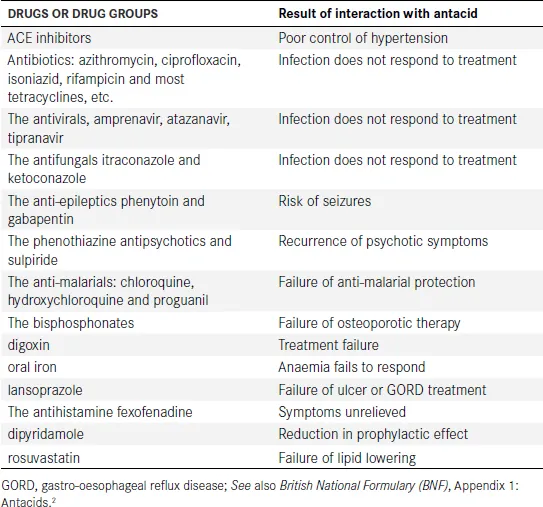
GORD, gastro-oesophageal reflux disease; See also British National Formulary (BNF), Appendix 1: Antacids.2
In the light of Table 1.1, it is clearly essential that prescribers warn patients not to take antacids just before or at the same time as their prescription drugs. Pharmacists, too, need to reinforce this message at every repeat dispensing, and to ask patients about prescription drugs whenever they sell an antacid over the counter (OTC). If the drugs in Table 1.1 are taken before a meal, there is no reason why an antacid, if needed, should not be taken after the meal, when it will not affect drug absorption.
For those curious enough to wish to know the antacid–drug interaction involved, there are four:
- formation of a chemical complex – complexation
- adsorption of the drug by the antacid
- resin binding
- destruction of a drug’s acid-resistant coating due to the increased pH in the stomach that results from the antacid.
So next time you encounter treatment failure, don’t increase the dose without asking the following questions:
- 1 Is it due to non-compliance?
- 2 Is it due to an antacid?
References
1 McGavock H. How Drugs Work. 2nd ed. Oxford: Radcliffe Publishing; 2005.
2 Joint Formulary Committee. British National Formulary. 56th ed. London: British Medical Association and Royal Pharmaceutical Society of Great Britain; 2008.
2
Grapefruit juice can cause drug toxicity
As every clinician knows, the small intestine is not just a passive membrane. A major part of its complex function is the active absorption of nutrients, salts and some vitamins. What many people still don’t know is that the small intestine also has a powerful drug-metabolising mechanism whose evolutionary function was to detoxify poisonous materials ingested with food, preventing their absorption and rendering them harmless. This mechanism includes enzymes identical to the drug-metabolising liver enzymes – the so-called cytochrome P450 oxidase system (of which more in Chapter 9).
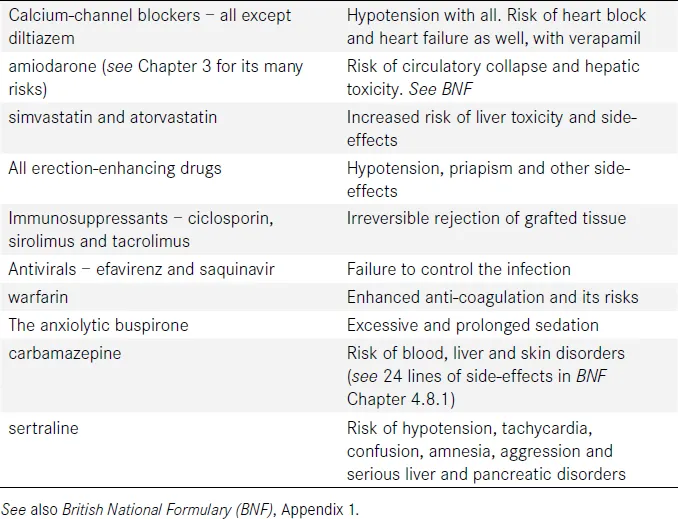
Unfortunately for the prescriber, these enzymes in the intestinal mucosa also metabolise and render impotent many important modern drugs, of which the left column of Table 2.1 is a major sample. Drug companies are well aware of this, and set the standard dose of the drugs shown in Table 2.1 up to double the dose that would be adequate were the intestine devoid of metabolic function. So what is the problem? It is that a single glass of grapefruit juice, half a grapefruit or a Seville-type (bitter) orange irreversibly blocks the intestinal P450 enzymes for up to 24 hours. During that period, up to double the correct dose of the drugs in Table 2.1 may be absorbed into the circulation. This may lead to toxic concentrations in the tissues. Note that it doesn’t matter at what time the grapefruit juice is consumed – the intestinal metabolic enzymes will be ‘knocked out’ for 24 hours. Some authorities, who should know better, suggest that a litre of grapefruit juice must be consumed to cause this effect. This is not so – a 250-ml glass is enough to affect the intestinal enzymes as described.
Table 2.1 Drugs whose absorption is enhanced by a glass of grapefruit juice, a helping of grapefruit or a Seville (bitter) orange
Tactics to Avoid the Risk of Excessive Drug Absorption
- The Easy Way Out (EWO)! The simplest way of avoiding the risks of grapefruit juice is to tell all patients taking short-term or maintenance medication to avoid it. This is no great hardship, and a ‘blunderbuss’ approach makes life a little easier for the prescriber and the dispenser.
- A more subtle tactic. Use your prescribing software to ‘flag up’ a warning message on the counterfoil of the prescription form, whenever one of the drugs listed in Table 2.1 is prescribed. This should always be accompanied by a strong verbal warning, since many patients don’t read counterfoil instructions, let alone those on the patient information leaflet (package insert).Have no illusions – grapefruit juice is a major prescribing pitfall, especially in older patients and those with reduced kidney or liver function.For the curious, the culprit in grapefruit juice has been identified as a furanocoumarol, also found in bitter oranges. This blocks the intestinal P450 enzyme irreversibly. However, the intestinal mucosa generates a fresh population of enzyme, usually within 24 hours.
A footnote: cranberry juice
Cranberry juice enhances the anticoagulant effect of warfarin, and other coumarins, in some patients.
INTRODUCTION TO CHAPTERS 3, 4 AND 5: THREE EFFECTIVE AND DANGEROUS DRUGS
The following three important and commonly prescribed drugs, warfarin, amiodarone and all NSAIDs, are responsible for a disproportionate amount of preventable prescription-related disease (PPRD) and death – ask your local Accident and Emergency consultant! A large percentage of this drug-related harm is due to a failure to remember a few basic facts, and these chapters will aim to remind you of these.
3
Warfarin
Warfarin is a particularly effective drug in the prevention of deep vein thrombosis (DVT), pulmonary embolism, embolisation in atrial fibrillation and some prosthetic heart valves. It is also used during haemodialysis and to prevent myocardial infarction in patients with unstable angina. No better drug has been developed in the past 70 years. It was discovered and marketed by the Wisconsin Alumni Research Foundation as a result of their research into haemorrhagic disease in cattle, hence its name – ‘WARF’ plus ‘arin’, the last letters of coumarin, its chemical group. Its initial use was as rat poison. If you think of this every time you prescribe warfarin or co-prescribe it with another drug, you may avoid its becoming a human poison! As in rats, its main function is as a potent vitamin K antagonist, producing progressive, dose-related anticoagulation. As all family doctors and warfarin clinic nurses know, there is only a small difference between the clinically effective dose and the toxic dose, for a given patient. The maintenance dose must be determined for each patient by INR estimation, taken at the same time on each occasion and monitored regularly.
Every year, patients die as a result of being dispensed warfarin tablets 5 mg instead of the intended 0.5 mg (in hospitals as well as in primary care). This shouldn’t happen. Prescribers who are aware of this possibility will regularly remind patients of their tablet colours – e.g. one blue tablet (3 mg) and one white tablet (0.5 mg) daily. This shou...
Table of contents
- Cover Page
- Halftitle Page
- Title Page
- Copyright Page
- Dedication
- Contents
- Introduction
- 1 Treatment failure due to antacids
- 2 Grapefruit juice can cause drug toxicity
- 3 Warfarin
- 4 Amiodarone: a candidate for the title ‘riskiest drug’
- 5 The non-steroidal anti-inflammatory drugs (NSAIDs), including the ‘COXIB’ NSAIDs
- 6 Drugs that disrupt the fine equilibrium of renal function
- 7 Sudden cardiac collapse due to often-prescribed drugs causing QTc prolongation
- 8 Some important interactions between drugs at shared sites of action and/or therapeutic effect
- 9 Major prescribing pitfalls due to drug–drug interactions in the liver
- 10 Two serious prescribing pitfalls caused by alcohol use (and abuse)
- 11 Monitoring the effects of drug treatment to avoid pitfalls. Which drugs? Which tests? How often?
- 12 Serious lung diseases caused by prescribed drugs
- 13 Preventable prescription-related illness caused by patient non-compliance
- 14 The scientific basis of prescribing for the elderly
- 15 Clinical quizzes: practical examples from Chapters 1–13
- 16 Answers to clinical quizzes
- Index
Trusted by 375,005 students
Access to over 1.5 million titles for a fair monthly price.
Study more efficiently using our study tools.
Frequently asked questions
Yes, you can cancel anytime from the Subscription tab in your account settings on the Perlego website. Your subscription will stay active until the end of your current billing period. Learn how to cancel your subscription
No, books cannot be downloaded as external files, such as PDFs, for use outside of Perlego. However, you can download books within the Perlego app for offline reading on mobile or tablet. Learn how to download books offline
Perlego offers two plans: Essential and Complete
- Essential is ideal for learners and professionals who enjoy exploring a wide range of subjects. Access the Essential Library with 800,000+ trusted titles and best-sellers across business, personal growth, and the humanities. Includes unlimited reading time and Standard Read Aloud voice.
- Complete: Perfect for advanced learners and researchers needing full, unrestricted access. Unlock 1.5M+ books across hundreds of subjects, including academic and specialized titles. The Complete Plan also includes advanced features like Premium Read Aloud and Research Assistant.
We are an online textbook subscription service, where you can get access to an entire online library for less than the price of a single book per month. With over 1.5 million books across 990+ topics, we’ve got you covered! Learn about our mission
Look out for the read-aloud symbol on your next book to see if you can listen to it. The read-aloud tool reads text aloud for you, highlighting the text as it is being read. You can pause it, speed it up and slow it down. Learn more about Read Aloud
Yes! You can use the Perlego app on both iOS and Android devices to read anytime, anywhere — even offline. Perfect for commutes or when you’re on the go.
Please note we cannot support devices running on iOS 13 and Android 7 or earlier. Learn more about using the app
Please note we cannot support devices running on iOS 13 and Android 7 or earlier. Learn more about using the app
Yes, you can access Pitfalls in Prescribing by Hugh McGavock in PDF and/or ePUB format, as well as other popular books in Medicine & Clinical Medicine. We have over 1.5 million books available in our catalogue for you to explore.