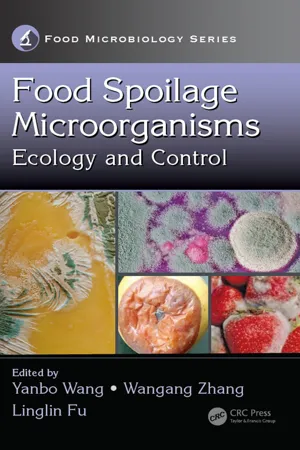
Food Spoilage Microorganisms: Ecology and Control focuses on the occurrence, outbreak, consequences, control, and evaluation of spoilage microorganisms in food, providing the necessary basic knowledge of food spoilage ecology and control so as to ensure food safety, especially in developing countries where food hygiene in storage requires special care. The first part of the book looks at spoilage microorganisms in plant origin foods, such as cereals, beans, fruits, and vegetables, and the second part tackles the spoilage microorganisms in animal origin foods like meat, poultry, seafood, powdered milk, and egg products.
In each chapter, the taxonomy of spoilage microorganisms, spoilage characteristics, consequences and possible mechanisms, and specific methods for detection and evaluation are discussed based on the basis surface introduction. The control, prevention, and management options for spoilage microorganisms are also presented. In addition, opportunities and challenges are summarized and predicted in the last part of each chapter.
- 192 pages
- English
- ePUB (mobile friendly)
- Available on iOS & Android
eBook - ePub
About this book
Information
5 | Spoilage Microorganisms in Meat Products |
CONTENTS
5.1 Introduction
5.2 Classification of Spoilage Microorganisms in Meat Products
5.2.1 Source of Microbial Contamination
5.2.2 Classification of Spoilage Microorganisms in Meat Products
5.2.2.1 Pseudomonas
5.2.2.2 Lactic Acid Bacteria
5.2.2.3 Enterobacteriaceae
5.2.2.4 Brochothrix
5.2.2.5 Other Bacteria Associated with Meat Spoilage
5.2.2.6 Molds and Yeasts Associated with Meat Spoilage
5.3 Characteristics of Possible Mechanisms Associated with Spoilage Microorganisms
5.3.1 The Apparent Phenomenon of Meat Spoilage
5.3.1.1 Slime Formation
5.3.1.2 Discoloration
5.3.1.3 Off-Odors
5.3.1.4 Mildew Stain
5.3.2 Spoilage Mechanisms
5.4 Methods Used to Detect and Evaluate Spoilage Microorganisms
5.4.1 Repetitive Sequence-Based PCR
5.4.2 Quantitative Real-Time PCR (RT-PCR)
5.4.3 RAPD-PCR
5.4.4 Pulsed-Field Gel Electrophoresis
5.4.5 High-Throughput Sequencing
5.5 Control, Prevention, and Management Options for Spoilage Microorganisms
5.5.1 Cleaning of Hides and Carcasses
5.5.2 Cleaning of Equipment Surfaces and the Surrounding Environment
5.5.3 Preservative Technologies
5.5.3.1 Preservative Packaging
5.5.3.2 Other Preservative Technologies
5.6 Conclusion and Future Trends
References
5.1 INTRODUCTION
Current food microbiology research often focuses on hazards caused by pathogenic microorganisms to humans while neglecting food spoilage (Mohareb et al., 2015). Spoilage of chilled raw meat remains a major challenge to the meat industry, because meat spoilage causes large losses every year. The original muscle tissue of healthy animals is sterile; however, a large number of microorganisms exist in cuts that occur during a series of processing procedures from muscle to meat after slaughter (Sofos, 1994). Subsequent storage and sales processes are also associated with the reproduction of spoilage microorganisms until the end of the shelf life of the meat. Therefore, the common goals of the meat industry and meat microbiologists are to determine the origin, the classification, and the distribution characteristics of those meat spoilage-related microorganisms and the factors affecting their growth are also considered. Then, the ultimate purpose is to achieve the accurate and rapid identification, and effective control of these microorganisms.
Numerous studies have been done on microbial contamination in large-scale cattle, hog, and sheep slaughterhouses in developed countries (Gill, 2005; Gill and Bryant, 1992; Sofos et al., 1999). However, in some developing countries such as China, although some of the hog slaughtering houses are developed well to automation, most cattle slaughtering houses are small-scale operations, and no more than 100 cattle slaughtering houses have a daily throughput of more than 200 cattle (Luo and Cao, 2011). Here, the contamination and distribution of spoilage microorganisms in the animal slaughter environment and during subsequent meat sales and distribution might differ from previous findings. Therefore, this chapter focuses on the current status of microbial contamination, the type of spoilage organisms involved, and the corresponding countermeasures adopted in red meat producers in developing countries. On the basis of the existing literature, a further review is given to summarize the characteristics of red meat spoilage, possible spoilage mechanisms, and the methods used to detect and quantify spoilage microorganisms.
At the same time, we should pay attention to the development of the meat microbiology. Research on this area has continued to broaden, and great progress has been made since the community first began to express concern about meat spoilage and associated microorganisms in the 1970s. For instance, only some types of microorganisms are known to occur in meat in the early days, whereas hundreds of microbial species are currently identified (Zhao et al., 2015), and the detection of the spoilage microorganisms at strain level has become an important issue recently (Doulgeraki et al., 2012). Research on the spoilage mechanisms of microorganisms has extended from the metabolic activity of individual organisms to the synergism, antagonism, and quorum sensing exhibited by multiple microorganisms (Nychas et al. 2008, 2007). Concerning the detection and evaluation of spoilage microorganisms, researchers previously have used a laborious plate count technique to isolate and screen spoilage organisms from meat; however, polymerase chain reaction (PCR)–based molecular and spectroscopic techniques are currently available for the rapid detection of them and allow for tracking of microbial origins (Ercolini et al., 2007; Pennacchia et al., 2009; Doulgeraki et al., 2012; Kamruzzaman et al., 2015). Furthermore, researchers have also explored spoilage gene markers in spoilage organisms (Mohareb et al., 2015). For the control of spoilage microorganisms, antimicrobial measures by single chemical or physical means have been evolved to the present establishment of management control systems including Good Manufacturing Practices (GMP), Sanitation Standard Operating Procedures (SSOP), Hazard Analysis and Critical Control Points (HACCP), and Food Safety Objectives (FSO) (Koutsoumanis et al., 2006). All the aforementioned issues are also summarized and discussed in Sections 5.2, 5.3, 5.4, and 5.5.
5.2 CLASSIFICATION OF SPOILAGE MICROORGANISMS IN MEAT PRODUCTS
5.2.1 SOURCE OF MICROBIAL CONTAMINATION
As known, the animal hides and contaminants attached are two major origins of microorganisms in the slaughterhouse, and consequently contaminated the carcasses (Gill, 2004, 2005; Koutsoumanis et al. 2006; Byrne et al., 2000; Bell, 1997). The level of visible dirt on cattle hair can affect the number of microorganisms on the carcass (Byrne et al., 2000). The contaminants include feces, soil, waste, and others that can be transferred onto the animal hide during animal feeding, transportation, lairage, and so on (Biss and Hathaway, 1996), and then have an effect on the hygienic conditions of the carcasses. Researchers have investigated visual cattle cleanliness and correlation to hide and carcass microbial contamination, and data obtained from some Chinese cattle slaughtering houses showed that the numbers of the microbial load on the hide and on the corresponding carcasses were significantly affected by the degree of visible dirt of the cattle hide (Table 5.1). As the visible dirt degree increased from 1 to 5, the total number of bacterial colonies on the cattle hides and carcasses increased. The number increased from 4.88 to 5.74 log10 CFU/cm2 for the cattle hide and from 2.85 to 3.60 log10 CFU/cm2 for the corresponding carcasses. Coliforms have been considered as the indicator organisms of carcass contamination in some countries. The numbers of coliforms on the carcass and cattle hide also increased as the degree of visible dirt on cattle hides increased, which was in agreement with the former research on cattle and sheep carcasses (Byrne et al., 2000; Hadley et al., 1997; Gill and Landers, 2004). Therefore, microbial contamination of the carcass begins when the knife could be cutting through the microorganism-bearing hide for bloodletting. Subsequently, almost each of the following steps of the slaughtering procedure would give a further contamination to the carcass (Koutsoumanis et al., 2006; Zhang et al., 2011).
The legs, buttocks, chest, and abdomen are contaminated successively with the removal of the hooves and the preskinning of the rear and front legs, as knife incisions for the removal of animal hides introduces bacteria from the hide onto the underlying tissue (Koutsoumanis et al., 2006). At this point, the skinning knife and operating hands become the greatest sources of microbial contamination. The number of microorganisms reaches as high as 7.34 log10 CFU/cm2 on skinning knives in certain slaughterhouses (Yu, 2012). As the completion of dressing, the entire carcass is exposed to the air, which makes it more vulnerable to contamination. In some Chinese cattle slaughterhouses, the total visible counts of the carcass is 2.7–4.0 log10 CFU/cm2 (Zhang et al., 2011) and the coliforms is in the range of 0.57–2.37 log10 CFU/cm2 (Zhang, 2011). In the Northern America, most animal slaughterhouses applied water/steam/organic acid spraying to wash the entire carcass after dressing and before eviscerating resulting in a significant bacteria reduction (Gill and Bryant, 1997; Gill and Landers, 2003; Sofos, 2002). Currently, the automatic spraying equipment is not sufficient in China. Most of the cattle slaughterhouses apply the spray procedure with lactic acids solutions or apply water spraying alone at the end of the slaughter line. As for the hog, the average bacteria distribution on the carcass is 4.2 log10 CFU/cm2 during the slaughter while the number of coliforms is 2.06 log10 CFU/50 cm2 in dressing (Wang, 2006). And dressing is rarely used before slaughter for hog; however, the depilation machine is a major source of micro-bial contamination (Gill and Jones, 1995). Li (2006) found that the microbial diversity of the hog carcasses decreased after scalding.
Eviscerating after dressing is also a critical operation. Leakage of the gastrointestinal contents will contaminate the carcass greatly. In this stage, both cutting tools and operating hands are major sources of microbial contamination, and the total number of bacterial colonies has been reported to be approximately 5 log10 CFU/cm2 in some Chinese slaughterhouses. As mentioned, in the developed countries, the carcass is often washed with high-pressure water, hot steam, and an organic acid spray between dressing and evisceration (Sofos, 2002). At this point, microorganisms from the air and other origins have not yet firmly attached to the carcass, and the bacteria-reducing effect will be evident (Hamby et al., 1987; Cabedo et al., 1996; Dickson and Anderson, 1992). In China, spraying immediately after skinning is not used and it is more common to spray the carcasses with clean water before the carcass enters the chilling room. Few slaughterhouses use the clean water, steam, and organic acid spray device in China. Prior to spraying with water, the total number of bacterial colonies on beef (chuck, brisket, back, and buttocks) is reported to range from 2.6 to 4.4 log10 CFU/cm2. Spraying with clean water alone does not significantly reduce the number of microorganisms on the carcass surface; instead, it redistributes the existing microorganisms on the carcass surface. After spraying with clean water, the total number of bacterial colonies counted on meat at the above four positions is reportedly to reach 3.0 log10 CFU/cm2 (Xu, 2013).
TABLE 5.1
Visual Evaluation of Cattle Cleanliness and Correlation to Hide and Carcass Microbial Contamination

Source: Data from Xu, 2013.
Notes: Carcass sampling parts were foreleg, buttock, abdomen, chest, hind leg, neck. Means within the columns with different letters differ at p < .05.
After chilling, both the number and diversity of contaminant microorganisms on the carcass can decrease. However, during the cutting stage, work-contact surfaces, cutting tools, and operating hands become the major sources of microbial contamination; this is particularly true of the conveyor belt that carries meat obtained from various parts of the carcass (Gill and Jones, 1995, Gill et al., 1999). Available data have revealed the contamination of work-contact surfaces at various steps in the cutting department of three medium-sized cattle slaughterhouses in China (Table 5.2). The knives and hands related with boning and trimming are the seriously contaminated area with the total viable counts at the range from 4.69 to 6.92 log10 CFU/cm2 (Yu, 2012). And the number on those surfaces is increasing...
Table of contents
- Cover
- Half Title
- Title Page
- Copyright Page
- Table of Contents
- Preface
- Editors
- Contributors
- SECTION I
- SECTION II
- Index
Trusted by 375,005 students
Access to over 1.5 million titles for a fair monthly price.
Study more efficiently using our study tools.
Frequently asked questions
Yes, you can cancel anytime from the Subscription tab in your account settings on the Perlego website. Your subscription will stay active until the end of your current billing period. Learn how to cancel your subscription
No, books cannot be downloaded as external files, such as PDFs, for use outside of Perlego. However, you can download books within the Perlego app for offline reading on mobile or tablet. Learn how to download books offline
Perlego offers two plans: Essential and Complete
- Essential is ideal for learners and professionals who enjoy exploring a wide range of subjects. Access the Essential Library with 800,000+ trusted titles and best-sellers across business, personal growth, and the humanities. Includes unlimited reading time and Standard Read Aloud voice.
- Complete: Perfect for advanced learners and researchers needing full, unrestricted access. Unlock 1.5M+ books across hundreds of subjects, including academic and specialized titles. The Complete Plan also includes advanced features like Premium Read Aloud and Research Assistant.
We are an online textbook subscription service, where you can get access to an entire online library for less than the price of a single book per month. With over 1.5 million books across 990+ topics, we’ve got you covered! Learn about our mission
Look out for the read-aloud symbol on your next book to see if you can listen to it. The read-aloud tool reads text aloud for you, highlighting the text as it is being read. You can pause it, speed it up and slow it down. Learn more about Read Aloud
Yes! You can use the Perlego app on both iOS and Android devices to read anytime, anywhere — even offline. Perfect for commutes or when you’re on the go.
Please note we cannot support devices running on iOS 13 and Android 7 or earlier. Learn more about using the app
Please note we cannot support devices running on iOS 13 and Android 7 or earlier. Learn more about using the app
Yes, you can access Food Spoilage Microorganisms by Yanbo Wang,Wangang Zhang,Linglin Fu in PDF and/or ePUB format, as well as other popular books in Technology & Engineering & Food Science. We have over 1.5 million books available in our catalogue for you to explore.