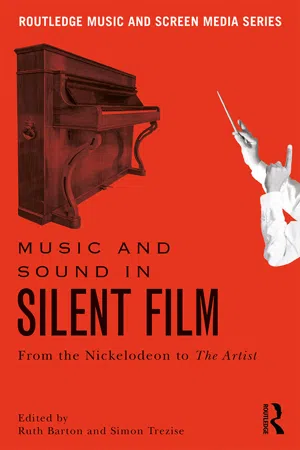
Despite their name, the silent films of the early cinematic era were frequently accompanied by music and other sound elements of many kinds, including mechanical instruments, live performers, and audience sing-alongs. The 12 chapters in this concise book explore the multitude of functions filled by music in the rapidly changing context of the silent film era, as the concept of cinema itself developed. Examples are drawn from around the globe and across the history of silent film, both during the classic era of silent film and later uses of the silent format. With contributors drawn from film studies and music disciplines, and including both senior and emerging scholars, Music and Sound in Silent Film offers an essential introduction to the origins of film music and the cinematic art form.
eBook - ePub
Music and Sound in Silent Film
From the Nickelodeon to The Artist
- 214 pages
- English
- ePUB (mobile friendly)
- Available on iOS & Android
eBook - ePub
Music and Sound in Silent Film
From the Nickelodeon to The Artist
About this book
Information
Part I
The Evolution of Sound and Performance Practices
The American Experience
Chapter 1
‘Better Music at Smaller Cost’
Selling Mechanical Instruments to American Motion Picture Houses in the 1910s
Allison Wente and James Buhler
Traditional accounts of early cinema have emphasised the importance of live musical accompaniment.1 Music in these accounts not only substitutes for the film’s lack of voice, but also compensates for the mechanical reproduction of movement. In brief, music was said to vivify the motion pictures, to give them the appearance of life, and this infusion was presumed to derive from live performance. ‘You cannot mechanize art’, Joseph N. Weber, President of the American Federation of Musicians, confidently proclaimed when he opened a fight against synchronised sound in 1928.2 Others supportive of live performance were so convinced of the obviousness of this fact that they initially came out in favour of the device, presuming that it would raise expectations for musical performance in all houses and so lead to an increase in demand for union musicians.3 Though supporters of live music would be sorely disappointed – musicians would be virtually eliminated from theatres by 1930 – Weber’s confidence that film required live music to make it art is most revealing of the strength of the cultural assumption.
Of course, live music was never a necessary condition of film exhibition. Vachel Lindsay thought live music coupled aristocratic values of the theatre to the motion picture.4 While Lindsay advocated screening films accompanied only by ‘the hum of the conversing audience’, exhibitors unable or unwilling to pay musicians adopted a wide number of solutions, including phonographs and other automated instruments.5 Moreover, theatres might change policy throughout the day, using a mechanical instrument to spell a pianist on break, or as insurance in case of a musicians’ strike.
Automated instruments and phonographs were also frequently deployed for ballyhoo outside theatres. Frederick J. Haskin perceptively recognised a deep affinity between the motion picture and mechanical accompaniment:
New York’s great trouble has been that the noise of the “barkers’” megaphones and phonographs at the entrances cause annoyance, and formal complaints have been filed against the nickelodeons by merchants of their neighborhoods. As a result, the barker may go, but the phonograph, under one of its many guises may remain, for, in this age of machinery that must soon minimize man’s services in many ways, even as a mechanism throws the figures of the actors and actresses on the canvas in the darkened rooms where owl-eyed ushers skillfully find you a seat, so it must eventually furnish the entrance calls, the urgent invitations to come and see what is inside, and all the gay music that sets you to wondering what lies beyond the doors.6
Haskin thought the phonograph was an especially effective lure inasmuch as its disembodied sound created an enigma about its source. He also understood the motion picture theatre as following a logic of mechanisation that worked to minimise human labour. Although live music would become the ordinary practice in almost all theatrical configurations, Haskin’s comment reminds us that one appeal of nickelodeons was the way they made a spectacle out of mechanisation. Exhibitors saw music and live entertainment both as an important part of a motion picture show and as a ‘problem’ that threatened the theatre’s bottom line. Given the investment of motion pictures in mechanisation, it should hardly be surprising that many exhibitors pursued mechanical solutions to their ‘music problem’.
The ‘music problem’ was present outside the cinema as well, as women’s new roles outside of the home created a need for economical entertainment in the domestic sphere. Motion picture houses aided in society’s departure from buttoned-up Victorian culture, and in leading young women away from keyboards and into entertainment venues.7 The newly vacated piano benches in the home became markers of absent domestic labour, labour that could be carried out by a mechanical instrument, and player piano companies used this absence to their advantage with their advertisements. Magazines and newspapers included ads highlighting the instrument’s perfect musical reproduction, its labour-saving capabilities, and its ability to teach young students to play through imitation.8 Ads in period trade papers thus emphasised some of the same and some different features of mechanical instruments as those targeting the home.
In this chapter, we examine advertisements for mechanical musical instruments primarily from Moving Picture World (1907–1919), the leading trade paper for the motion picture industry at the time.9 These ads were directed at exhibitors and sought to convince them of the efficacy of supplementing or replacing their musicians with mechanical instruments. We analyse and categorise these ads in order to determine what needs firms specialising in mechanical instruments identified in the film industry, and how these firms advertised their instruments to construct and address those needs. We organise the ads into two large groups – those that focus on cost savings for the theatre and those that focus on increasing patronage at the theatre.
This arrangement allows us to show how these firms sought to convince the industry that the mechanisation of musical labour improved the bottom line without needing to sacrifice quality. Although mechanised accompaniment would not become the dominant mode of exhibition until the late 1920s, the presence of mechanical instruments in theatres helped ready exhibitors and filmgoers for what was to come. The ideological work of these ads prepared the discursive ground for the eventual mechanisation of theatre exhibition: the sound film.
Labour and Capital
The most important thing mechanical instruments offered film exhibitors was a replacement for labour. Music was one of the largest costs of running a theatre – only the film rentals routinely exceeded it in a normal theatre – and the largest cost of music was for the actual musicians. What’s more, the cost of musicians rose quickly with the size of the ensemble. Although more sophisticated machines required a capable operator, the operator generally did not need to be a professional-level performer. As with much machine automation, self-playing instruments were thus a means of deskilling the labour force.10
Besides replacing labour, automatic musical instruments were also immune to fatigue. In a business of continuous performance, this was an especially important consideration. Live musicians required breaks, and were liable to ask for raises, get job offers from other theatres, or go on strike. Automatic instruments, on the contrary, were like projectors: they required only routine maintenance, a minimally competent employee, and a steady diet of new music rolls.
In the following, we discuss four appeals that ads made in favour of substituting automatic musical instruments for live musicians: automatic instruments as labour-saving devices, a mechanical replacement for costly musicians; the ease of operation, instruments so simple a schoolgirl could operate them; men at war, the automatic instrument as skilled labourer, keeping theatre music viable while the men of the orchestra served overseas; and automatic instruments as investment, banking on the promise that the instrument will ‘pay for itself’.
Labour-Saving Device
This category includes ads that described mechanical instruments as ‘all but human’, and t...
Table of contents
- Cover Page
- Half Title
- Series Page
- Title Page
- Copyright Page
- Table of Contents
- About the Editors
- About the Contributors
- Historical Introduction
- PART I The Evolution of Sound and Performance Practices: The American Experience
- PART II The Evolution of Sound and Performance Practices: The Global Experience
- PART III Synchronisation and Scoring: Historical Practices
- PART IV Synchronisation and Scoring: Contemporary Reworkings
- Index
Trusted by 375,005 students
Access to over 1.5 million titles for a fair monthly price.
Study more efficiently using our study tools.
Frequently asked questions
Yes, you can cancel anytime from the Subscription tab in your account settings on the Perlego website. Your subscription will stay active until the end of your current billing period. Learn how to cancel your subscription
No, books cannot be downloaded as external files, such as PDFs, for use outside of Perlego. However, you can download books within the Perlego app for offline reading on mobile or tablet. Learn how to download books offline
Perlego offers two plans: Essential and Complete
- Essential is ideal for learners and professionals who enjoy exploring a wide range of subjects. Access the Essential Library with 800,000+ trusted titles and best-sellers across business, personal growth, and the humanities. Includes unlimited reading time and Standard Read Aloud voice.
- Complete: Perfect for advanced learners and researchers needing full, unrestricted access. Unlock 1.5M+ books across hundreds of subjects, including academic and specialized titles. The Complete Plan also includes advanced features like Premium Read Aloud and Research Assistant.
We are an online textbook subscription service, where you can get access to an entire online library for less than the price of a single book per month. With over 1.5 million books across 990+ topics, we’ve got you covered! Learn about our mission
Look out for the read-aloud symbol on your next book to see if you can listen to it. The read-aloud tool reads text aloud for you, highlighting the text as it is being read. You can pause it, speed it up and slow it down. Learn more about Read Aloud
Yes! You can use the Perlego app on both iOS and Android devices to read anytime, anywhere — even offline. Perfect for commutes or when you’re on the go.
Please note we cannot support devices running on iOS 13 and Android 7 or earlier. Learn more about using the app
Please note we cannot support devices running on iOS 13 and Android 7 or earlier. Learn more about using the app
Yes, you can access Music and Sound in Silent Film by Ruth Barton, Simon Trezise, Ruth Barton,Simon Trezise in PDF and/or ePUB format, as well as other popular books in Media & Performing Arts & Music. We have over 1.5 million books available in our catalogue for you to explore.