Representational technologies including photography, phonography, and the cinema have helped define modernity itself. Since the nineteenth century, these technologies have challenged our trust of sensory perception, given the ephemeral unprecedented parity with the eternal, and created profound temporal and spatial displacements. But current approaches to representational and cultural history often neglect to examine these technologies. James Lastra seeks to remedy this neglect.
Lastra argues that we are nowhere better able to track the relations between capital, science, and cultural practice than in photography, phonography, and the cinema. In particular, he maps the development of sound recording from its emergence to its confrontation with and integration into the Hollywood film.
Reaching back into the late eighteenth century, to natural philosophy, stenography, automata, and human physiology, Lastra follows the shifting relationships between our senses, technology, and representation.
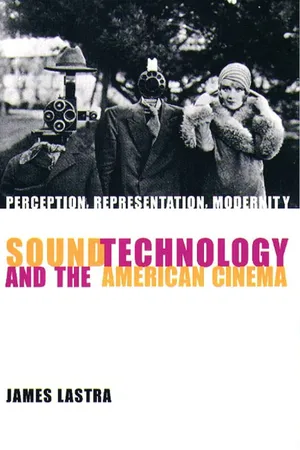
eBook - ePub
Sound Technology and the American Cinema
Perception, Representation, Modernity
- English
- ePUB (mobile friendly)
- Available on iOS & Android
eBook - ePub
About this book
Information
Subtopic
20th Century HistoryCHAPTER 1
INSCRIPTIONS AND SIMULATIONS
The Imagination of Technology
I am experimenting upon an instrument which does for the Eye what the Phonograph does for the Ear. —Thomas Edison (October 1888)1
Was it really so clear only ten years after its first exhibition and mere weeks after its initial commercial availability what, exactly, the “Phonograph [had done] for the Ear?” And, assuming it was, in what sense could these acoustic transformations be duplicated for the eye? What made it appear obvious to discuss the two instruments as if somehow equivalent in effect? Given the numerous incommensurabilities between the visible and the audible, it seems strange to think of motion pictures and the phonograph in the same terms, and as accomplishing the same effects. Whatever their conceptual weaknesses, however, such cross-media and cross-sensory analogies were and continue to be intuitively appealing. We feel we know what Edison meant, even if it is difficult to describe precisely how his comparison illuminates the manner in which these instruments altered the shape of modern life.
Yet Edison was hardly the first to see analogies between different technological media. Before him, French photographer Nadar had imagined the possibility of an “acoustic daguerreotype,” a sort of “box within which melodies are fixed and retained, just as the darkroom seizes and fixes images.”2 Twenty-two years before its material invention, he imagined that the phonograph would “do for the ear” what the photograph apparently had done for the eye. Indeed, there was hardly a writer in the nineteenth century, regardless of occupation, who did not speculate in similar terms. These revolutionary instruments had so touched the minds and imaginations of artists, scientists, and general public alike that no technological possibility seemed too remote, nor any new device too insignificant, to merit comment.3 Even when based on misapprehension or outright fantasy, such vernacular discussion and evaluation conditioned not only contemporary understandings but also future technological innovation and exploitation, shaping the events through which new and old devices were reimagined, redefined, and even reinvented.
Both Edison’s and Nadar’s analogies try to describe the implications of one representational technology in terms of another’s impact or, rather, as part of a broader project of historical transformation in which they jointly participate. Needless to say, the instruments imagined by both writers were yet to be invented, but like innumerable other forecasters, they felt intuitively that these devices were destined to change the nature, the context, the range, and the very possibilities of sensory experience. And in a very real sense, they did. Clearly, whatever was being “done for” the senses, or for experience in general, was a source of excitement and concern. Public conjecture, debate, and discussion were the primary outlets through which the culture at large, as well as specific subcultures, negotiated and defined the impact and meaning of these new representational forms.
Edison himself felt compelled to address the mass interest generated by the phonograph in an 1878 essay, where he tried to define the impact of a device that had “commanded such profound and earnest attention throughout the civilized world.” This attention, he muses, is due to “that peculiarity of the invention which brings its possibilities within range of the speculative imaginations of all thinking people, as well as the almost universal applicability of the foundation principle, namely, the gathering up and retaining of sounds hitherto fugitive, and their reproduction at will.”4 He adds further that,
From the very abundance of conjectural and prophetic opinions which have been disseminated from the press, the public is liable to become confused, and less accurately informed as to the immediate result and effects of the phonograph than if the invention had been one confined to certain specific applications, and therefore of less interest to the masses.
Edison’s mixture of satisfaction (mass interest means mass market) and trepidation (mass conjecture means the phonograph’s future is beyond his immediate control) indicates both the limits and the potential of public debate. Such bursts of anticipatory discussion were typical of a technological utopianism permeating nineteenth-century American culture and characterized the reception of most of the century’s representational technologies—even currently unavailable ones.5 While the material invention of instruments was still in the hands of a few, their imaginative invention and reinvention were profitably and dangerously in the hands of the many, who might expand their significance and their uses beyond an inventor’s wildest dreams or even against his wishes.
Indeed, Edison’s own invention was anticipated by several months by a friend of Verlaine, Manet, and Baudelaire—the poet Charles Cros. This dilettante inventor deposited a sealed envelope detailing his phonographic device with the Académie des Sciences on April 30, 1877, some eight months before Edison received his own patent.6 Described in nearly every history of the phonograph as “a dreamer,” Cros’s success at conceiving the phonograph—there is no doubt it would have worked—demonstrates just how involving these questions were to the imagination of the day, and how those concerned with giving poetic utterance to the newest forms of modern life were equally engaged with its more technical expressions. But it is Cros’s close friend, Villiers de l’Isle-Adam, who is better remembered for his less scientific but more compelling and disturbing musings on the meaning of Edison’s work.
Begun in 1878 and published in 1889 (one of the first copies being given to the inventor while at the Exposition Universelle), Villiers’s L’Eve future offers us a Faustian Edison, who brings his immense technical knowledge to bear on the most difficult of mechanical problems. Entertaining a visiting old friend, Lord Celian Ewald, the “Phonograph’s Papa”7 listens attentively to his companion’s tale of woe. Ewald laments that he has fallen in love with a singer, Alicia Clary, the most beautiful woman in the world, whose one fault, alas, is an utterly vulgar soul. Ewald regards her physical beauty as quite literally ideal and her soul just as surely profane, dominated as it is by stupidity and petit bourgeois materialism. Edison is spurred by this account to complete a languishing project—a mechanical woman—which he offers as a substitute for Alicia. The skeptical Ewald unwittingly falls in love with Hadaly, an automaton constructed in Alicia’s physical image, but who expresses sentiments and ideas he finds profound and irresistible. Mechanical to the core, the ghost in this machine is a pair of phonographs cleverly designed to allow her to respond intelligently and with apparent feeling to any number of questions or occasions. Ecstatic over what he believes to be an ideal combination of body and soul, Ewald sets sail for home with Hadaly, only to lose his love to a violent storm at sea.8
Beyond the equally stunning literary experimentation and virulent misogyny, L’Eve future offers a striking portrait of an Edison (“The Wizard of Menlo Park,” not the historical individual, Villiers tells us) whose various inventions (the author attributes the telephone, the microphone, the phonograph, and the light bulb to him) haunt the world with alluring, fantastic, and dangerous possibilities. Like his friend Cros, Villiers offers an unrealized vision of technological possibility as well as technological consequence, imagining the next logical step on the transformative road of modernity—a vision of creeping calculation and mechanism, affecting not only industry but the human soul as well.9
Edison himself offered a different view of the possibilities and consequences implied by his device in an essay for the North American Review, in June 1878, when, by some accounts, Villiers was already hard at work upon an early version of L’Eve future. The picture Edison presents is less startling, but no less troubling. It is worth quoting at length. “The … stage of development reached by … the phonograph,” he notes, “demonstrates the following faits accomplis”:
1. The captivity of all manner of sound waves heretofore designated as “fugitive,” and their permanent retention.
2. Their reproduction with all their original characteristics at will, without the presence or consent of the original source, and after the lapse of any period of time.
3. The transmission of such captive sounds through ordinary channels of commercial intercourse and trade in material form, for purposes of communication or as merchantable goods.
4. Indefinite multiplication and preservation of such sounds, without regard for the existence or non-existence of the original source.
5. The captivation of sounds, with or without the knowledge or consent of the source of their origin.10
It takes but a moment’s reflection to recognize these faits as classic philosophical criteria, deriving from Plato’s Phaedrus, for differentiating writing from speech—its relative “absence” compared to the presence of speech, its reuse in new contexts “without the knowledge or consent of the” speaker, or its “indefinite multiplication … and preservation” regardless of the existence or nonexistence of the speaker. More capitalist than Platonist, however, Edison finds little to criticize here, questions of profit far outweighing questions of Being. Phrases like “without the presence or consent of the source,” “after the lapse of any time,” and “preservation … without regard for the existence or non-existence of the original source” have a utopian dimension to be sure, promising future generations the possibility of hearing long-passed statesmen, singers, and poets in their own voices, but they sound an ominous note as well. The words “without knowledge or consent” in particular evoke a situation for which the word “captivation” is all-too-perfect.
Revisiting these concerns ten years later in the same magazine, Edison describes the “Perfected Phonograph” as having fulfilled most of the promises he made in his earlier essay, but he nevertheless alters a few of his claims. Among the notable changes in his list of phonographic possibilities is an elaboration of point five, above. Now eschewing a language redolent of surveillance and punishment, he instead emphasizes its capabilities as an unimpeachable, legal record of business dealings. Surveillance, while still implicit here, emerges explicitly at the end of his essay, where he suggests that we will or should internalize a psychic phonograph—an external ear—whose possibly real ubiquity “will teach us to be careful what we say—for it imparts to us the gift of hearing ourselves as others hear us—exerting thus a decided moral influence.”11
Still, the analogy between recording and writing is neither univocal nor unfailingly pessimistic, and Edison’s vision of a perpetual and anonymous surveillance is by no means the only interpretation available. But just as with Villiers’s automaton, who threatens to confuse previously secure definitions of humanity, recorded sound, as “writing,” threatens to disrupt long-established patterns of human interaction and to create new forms of experience for which there are no clear historical precedents. From the nineteenth century forward, representational technologies increasingly shaped and even dominated certain arenas of modern life, producing what Walter Benjamin would later call new “structures of experience,” whose consequences for individual and collective life could not easily be foretold. So important did these consequences seem, however, that an entire culture groped collectively for an appropriate vocabulary through which to express them.
Therefore, when Edison turns to a logic of writing and Villiers to one based upon the imitation of human functioning in order to comprehend the phonographic transformation of life, these tropes, metaphors, or ways of thinking are not to be taken lightly. They serve to mark the manner in which individuals, here ones endowed with a fair amount of cultural prestige, struggled to understand and control the world in which they lived. But the importance of these tropes—inscription and simulation—cannot be measured by their authors’ prestige alone. Rather, they need to be evaluated in terms of their cultural pervasiveness, their explanatory power, and the degree of their historical influence and institutionalization. In short, did they make material differences in nineteenth-century lives, and does their metaphorical power translate into historical explanation?
In this case they certainly do, for writing and physiological or perceptual simulation are, in fact, the master tropes through which the nineteenth century sought to come to grips with the newness of technologically mediated sensory experience, and together they set the boundaries for describing, understanding, and deploying new representational technologies. Because of their flexibility, their ability to concretize a wide variety of real dilemmas in communicable form, and because they organized both logics of representational production and interpretation, writing and simulation were, and continue to be, powerfully influential conceptual tools whose assumptions are readily translated into practical strategies.
Why do notions of writing and of human simulation so pervade discussions of technological representation across media? On the one hand, the answer is quite simple—even obvious. The link between representation and human perception is perhaps the single most persistent mechanism for explaining representational form in all of history. To say that a painting duplicates what the painter sees reaches back to our earliest discussions of art, and straddles otherwise distinct traditions. Nevertheless, no painting ever does duplicate vision, nor is perceptual duplication the only way to discuss image-making.12 The idea of representation as a form of perceptual simulation, while a continually available metaphor, comes to the fore at specific historical moments in order to justify particular representational practices or to solve particular cultural problems. If nothing ...
Table of contents
- Cover
- Half title
- Series Page
- Title
- Copyright
- Dedication
- Contents
- Acknowledgments
- Introduction—Discourse/Device/Practice/Institution: Representational Technologies and American Culture
- Chapter 1. Inscriptions and Simulations: The Imagination of Technology
- Chapter 2. Performance, Inscription, Diegesis: The Technological Transformation of Representational Causality
- Chapter 3. Everything But the Kitchen Sync: Sound and Image Before the Talkies
- Chapter 4. Sound Theory
- Chapter 5. Standards and Practices: Aesthetic Norm and Technological Innovation in the American Cinema
- Chapter 6. Sound Space and Classical Narrative
- Conclusion
- Notes
- Index
Trusted by 375,005 students
Access to over 1.5 million titles for a fair monthly price.
Study more efficiently using our study tools.
Frequently asked questions
Yes, you can cancel anytime from the Subscription tab in your account settings on the Perlego website. Your subscription will stay active until the end of your current billing period. Learn how to cancel your subscription
No, books cannot be downloaded as external files, such as PDFs, for use outside of Perlego. However, you can download books within the Perlego app for offline reading on mobile or tablet. Learn how to download books offline
Perlego offers two plans: Essential and Complete
- Essential is ideal for learners and professionals who enjoy exploring a wide range of subjects. Access the Essential Library with 800,000+ trusted titles and best-sellers across business, personal growth, and the humanities. Includes unlimited reading time and Standard Read Aloud voice.
- Complete: Perfect for advanced learners and researchers needing full, unrestricted access. Unlock 1.5M+ books across hundreds of subjects, including academic and specialized titles. The Complete Plan also includes advanced features like Premium Read Aloud and Research Assistant.
We are an online textbook subscription service, where you can get access to an entire online library for less than the price of a single book per month. With over 1.5 million books across 990+ topics, we’ve got you covered! Learn about our mission
Look out for the read-aloud symbol on your next book to see if you can listen to it. The read-aloud tool reads text aloud for you, highlighting the text as it is being read. You can pause it, speed it up and slow it down. Learn more about Read Aloud
Yes! You can use the Perlego app on both iOS and Android devices to read anytime, anywhere — even offline. Perfect for commutes or when you’re on the go.
Please note we cannot support devices running on iOS 13 and Android 7 or earlier. Learn more about using the app
Please note we cannot support devices running on iOS 13 and Android 7 or earlier. Learn more about using the app
Yes, you can access Sound Technology and the American Cinema by James Lastra in PDF and/or ePUB format, as well as other popular books in Media & Performing Arts & 20th Century History. We have over 1.5 million books available in our catalogue for you to explore.