- 472 pages
- English
- ePUB (mobile friendly)
- Available on iOS & Android
eBook - ePub
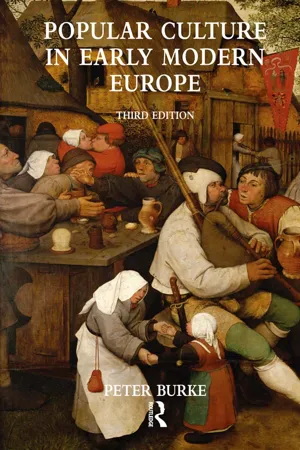
Popular Culture in Early Modern Europe
About this book
The concept of cultural history has in the last few decades come to the fore of historical research into early modern Europe. Due in no small part to the pioneering work of Peter Burke, the tools of the cultural historian are now routinely brought to bear on every aspect of history, and have transformed our understanding of the past. First published in 1978, this study examines the broad sweep of pre-industrial Europe's popular culture. From the world of the professional entertainer to the songs, stories, rituals and plays of ordinary people, it shows how the attitudes and values of the otherwise inarticulate shaped - and were shaped by - the shifting social, religious and political conditions of European society between 1500 and 1800. This third edition of Peter Burke's groundbreaking study has been published to mark the thirtieth anniversary of the book's publication in 1978. It provides a new introduction reflecting the growth of cultural history, and its increasing influence on 'mainstream' history, as well as an extensive supplementary bibliography which further adds to the information about new research in the area.
Trusted by 375,005 students
Access to over 1.5 million titles for a fair monthly price.
Study more efficiently using our study tools.
Information
PART 1
In Search of Popular Culture
CHAPTER ONE
The Discovery of the People
It was in the late eighteenth and early nineteenth centuries, when traditional popular culture was just beginning to disappear, that the ‘people’ or the ‘folk’ became a subject of interest to European intellectuals. Craftsmen and peasants were no doubt surprised to find their homes invaded by men and women with middle-class clothes and accents who insisted that they sing traditional songs or tell traditional stories. New terms are as good a guide as any to the rise of new ideas, and this was a time when a whole cluster of new terms came into use, especially in Germany. Volkslied, for instance: ‘folksong’. J.G. Herder gave the name Volkslieder to the collections of songs he made in 1774 and 1778. There is Volksmärchen and Volkssage, late eighteenth-century terms for different kinds of ‘folktale’. There is Volksbuch, a word which became popular in the early nineteenth century after the journalist Joseph Gärres had published an essay on the subject. Its nearest English equivalent is the traditional term ‘chap-book’. There is Volkskunde (sometimes Volkstumskunde), another early nineteenth-century term which might be translated as ‘folklore’ (a word coined in English in 1846). There is Volkspiel (or Volkschauspiel), a term which came into use about 1850. Equivalent words and phrases came into use in other countries, usually a little later than in Germany. Thus Volkslieder were folkviser for the Swedes, canti popolari for the Italians, narodnye pesni for the Russians, népdalok for the Hungarians.1
What was happening? Since so many of the terms began life in Germany, it may be useful to look for an answer there. The ideas behind the term ‘folksong’ are expressed with force in Herder’s prize essay of 1778, on the influence of poetry on the morals of peoples in ancient and modern times. His main point was that poetry had once possessed an effectiveness (lebendigen Wirkung) which is now lost. Poetry had been effective in this way among the Hebrews, the Greeks and the northern peoples in early times. Poetry was regarded as divine. It was a ‘treasury of life’ (Schatz des Lebens); that is, it had practical functions. Herder went on to suggest that true poetry belongs to a particular way of life, which would later be described as the ‘Organic Community’, and wrote with nostalgia of peoples ‘whom we call savages (Wilde), who are often more moral than we are’. The implication of his essay seems to be that in the post-Renaissance world, only folksong retains the moral effectiveness of early poetry because it circulates orally, is recited to music, and performs practical functions, whereas the poetry of the educated is poetry for the eye, cut off from music, frivolous rather than functional. As his friend Goethe put it, ‘Herder taught us to think of poetry as the common property of all mankind, not as the private possession of a few refined, cultured individuals’.2
The association of poetry with the people received even more emphasis in the work of the Grimm brothers. In an essay on the Nibelungenlied, Jakob Grimm pointed out that the author of the poem is unknown, ‘as is usual with all national poems and must be the case, because they belong to the whole people’. Their authorship was communal: ‘the people creates’ (Das Volk dichtet). In a famous epigram, he wrote that ‘every epic must write itself’ (jedes Epos muss sich selbst dichten). These poems were not made; like trees, they just grew. Hence Grimm described popular poetry as ‘poetry of nature’ (Naturpoesie).3
The ideas of Herder and the Grimms were extremely influential. In his Essay on the History of the Culture of the Human Race (1782), the scholar J.C. Adelung affirmed that ‘the culture of the people cannot be the culture of the upper classes’ [die Cultur des Volkes nicht die Cultur der obern Classen seyn kann]. Collection after collection of national folksongs appeared. To mention only some of the most famous, there was a collection of Russian byliny or ballads, published in 1804 under the name of a certain Kirsha Danilov; the collection of German songs made by Achim von Arnim and Clemens Brentano, Des Knaben Wunderhorn, which drew on oral tradition and printed broadsheets and was published in parts between 1806 and 1808; the Afzelius–Geijer collection of Swedish ballads, collected from oral tradition in Västergötland and published in 1814; the Serbian ballads edited by Vuk Stefanović Karadžić, first published in 1814 and enlarged later; and Elias Lönnrot’s Finnish songs, which he collected from oral tradition and arranged to form an epic, the Kalevala, published in 1835.
The Mediterranean countries were backward in this movement, and one famous English editor was less of a pioneer than he may look. Thomas Percy, a Northamptonshire clergyman, published his Reliques of English Poetry in 1765. These ‘reliques’, as he called them with deliberately archaic spelling, included a number of famous ballads, such as Chevy Chase, Barbara Allen, The Earl of Murray and Sir Patrick Spence. Percy (who was something of a snob and changed his name from ‘Pearcy’ in order to claim noble descent) did not think ballads had anything to do with the people, but rather that they were composed by minstrels enjoying a high status at medieval courts. However, the Reliques was interpreted, from Herder onwards, as a collection of folksongs, and received with enthusiasm in Germany and elsewhere. In Ireland, Charlotte Brooke entitled her collection Reliques of Irish Poetry (1789) in homage to Percy. 4
Although unbelievers could be found, the Herder–Grimm view of the nature of popular poetry quickly became orthodox. The great Swedish poet-historian Erik Gustav Geijer used the term ‘poetry of nature’, asserted the communal authorship of the Swedish ballads and looked back with nostalgia to the days when ‘the whole people sang as one man’ (et helt folk söng som en man).5 Similarly, Claude Fauriel, a French scholar who edited and translated the popular poetry of the modern Greeks, compared folksongs to mountains and rivers and used the phrase ‘po6sie de la nature’ .6 An Englishman of an older generation summed up the trend:
The popular ballad … is rescued from the hands of the vulgar, to obtain a place in the collection of the man of taste. Verses which a few years past were thought worthy the attention of children only, are now admired for that artless simplicity which once obtained the name of coarseness and vulgarity.7
It was not only the folksong which became fashionable, but other forms of popular literature as well. The writer Gotthold Ephraim Lessing collected and appreciated what he called Bilder-reimen (‘verses for pictures’), in other words German satirical broadsheets. The poet Ludwig Tieck was an enthusiast for German chap-books, and produced his own versions of two of them, The Four Sons of Aymon and The Beautiful Magelone. Tieck wrote:
The common reader should not make fun of the popular stories (Volksromane) which are sold in the streets by old women for a groschen or two, for The horned Siegfried, The sons of Aymon, Duke Ernst and Genoveva have more true inventiveness and are simpler and better by far than the books currently in fashion.8
A similar admiration for chap-books was expressed by Joseph Görres in his essay on the subject. Then there was the folktale, transmitted by oral tradition. Several volumes of folktales were published in Germany before the famous collection of the Grimm brothers came out in 1812.9 The Grimms did not use the term ‘folktale’, calling their volume ‘childrens’ and domestic tales’ (Kinder-und Hausmärchen), but they did believe that these stories expressed the nature of the ‘folk’, and followed them up by two volumes of German historical tales or Sagen.10
The example of the Grimms was soon followed all over Europe. Georg von Gaal published the first collection of Hungarian folktales, in German, in 1822. He made his collection not in the countryside but in Vienna, from the hussars of a Hungarian regiment whose colonel, a friend of his, issued an order to his men to write down any stories they knew.11 Two particularly famous collections of tales were published in Norway and Russia: P.C. Asbjornsen and J. Moe’s Norske Folk Eventyr (1841) which included the story of Peer Gynt that inspired Ibsen and Grieg, and A.N. Afanasiev’s Narodnye russkii skazki (1855 onwards).
Finally there was the ‘folk-play’, a category which included the puppet-plays about Faust which inspired both Lessing and Goethe; the traditional Swiss play on William Tell which Schiller studied before writing his own; the Spanish autos sacramentales, which the German romantics discovered with enthusiasm; the English mystery plays published by William Hone, and the German ones published by F.J. Mone. 12
This interest in different kinds of traditional literature was itself part of a still wider movement, which might be called the discovery of the people. There was the discovery of popular religion, for instance. The Prussian aristocrat Arnim wrote, ‘for me, the religion of the people is something extremely worthy of respect’, while in his famous book on the ‘genius of Christianity’, the French aristocrat Chateaubriand included a discussion of dévotions populaires, the unofficial religion of the people, which he saw as an expression of the harmony between religion and nature.13 According to Edward Thompson, ‘folklore at its very origin’ expressed a ‘sense of patronising distance’. He may well be right in the case of Britain. In 1824, the Anglo-Irishman Thomas Croker published what he called his researches into ‘the manners and superstitions’ of the Irish peasantry.14 In other parts of Europe, on the other hand, folklorists were less patronising and more reverent.
Then there was the discovery of popular festivals. Herder, who was living in Riga in the 1760s, was thrilled by the midsummer festival of St John’s Eve.15 Goethe was excited by the Roman Carnival, which he witnessed in 1788 and interpreted as a festival ‘which the people give themselves’.16 This excitement led to historical research, and to books like Joseph Strutt’s book on sports and pastimes, Giustina Renier Michiel’s study of Venetian festivals, and I.M. Snegirov’s book on the holidays and ceremonies of the Russian people. 17
There was also the discovery of folk-music. In the late eighteenth century V.F. Trutovsky (a court musician) published some Russian folksongs together with their music. In the 1790s, Haydn made arrangements of Scottish folksongs. In 1819, a government decree ordered the collection of folk-tunes by the local authorities in Lower Austria on behalf of the Society of the Friends of Music. A collection of Galician folksongs published in 1833 gives melodies as well as texts. 18
Attempts were made at this time to write the history of the people rather than the history of the government; in Sweden, Erik Geijer, who had already edited folksongs, published The History of the Swedish People (1832–6). Although it devoted most of its space to the policies of kings, Geijer’s history did include separate chapters on ‘land and people’. The same can be said for the Czech historian Frantisek Palackÿ (who had gone folksong collecting in Moravia in his youth) and his History of the Czech People (1836–76); for the historical works of Jules Michelet (an admirer of Herder who had once planned an encyclopedia of folksongs), and for Macaulay, whose History of England, published in 1848, contains his famous third chapter on English society in the late seventeenth century, based in part on the broadside ballads he loved. 19
The discovery of popular culture also made considerable impact on the arts. From Walter Scott to Alexander Pushkin, from Victor Hugo to Sándor Petőfi, poets imitated the ballad. Composers drew on folk-music as in Mikhail Glinka’s opera of 1836, A Life for the Tsar. The painter Gustave Courbet was inspired by popular woodcuts, though a serious interest in folk-art did not develop till after 1850, perhaps because popular artifacts were not threatened by mass-production until that time .20
Perhaps the most vivid illustrations of the new...
Table of contents
- Cover
- Half Title
- Title Page
- Copyright Page
- Table of Contents
- List of Plates
- Acknowledgements
- Note
- Prologue
- Introduction to the Third Edition
- Part 1 In Search of Popular Culture
- Part 2 Structures of Popular Culture
- Part 3 Changes in Popular Culture
- Appendix 1 The Discovery of the People: Select Studies and Anthologies, 1760–1846
- Appendix 2 Select Publications Illustrating the Reform of Popular Culture, 1495–1664
- Select Bibliography
- Index
Frequently asked questions
Yes, you can cancel anytime from the Subscription tab in your account settings on the Perlego website. Your subscription will stay active until the end of your current billing period. Learn how to cancel your subscription
No, books cannot be downloaded as external files, such as PDFs, for use outside of Perlego. However, you can download books within the Perlego app for offline reading on mobile or tablet. Learn how to download books offline
We are an online textbook subscription service, where you can get access to an entire online library for less than the price of a single book per month. With over 1.5 million books across 990+ topics, we’ve got you covered! Learn about our mission
Look out for the read-aloud symbol on your next book to see if you can listen to it. The read-aloud tool reads text aloud for you, highlighting the text as it is being read. You can pause it, speed it up and slow it down. Learn more about Read Aloud
Yes! You can use the Perlego app on both iOS and Android devices to read anytime, anywhere — even offline. Perfect for commutes or when you’re on the go.
Please note we cannot support devices running on iOS 13 and Android 7 or earlier. Learn more about using the app
Please note we cannot support devices running on iOS 13 and Android 7 or earlier. Learn more about using the app
Yes, you can access Popular Culture in Early Modern Europe by Peter Burke in PDF and/or ePUB format, as well as other popular books in History & World History. We have over 1.5 million books available in our catalogue for you to explore.