![]()
1 Electricity
Electricity: The versorium needle, Guericke’s Sulphur Sphere, Gray’s Dangling Boy, The Leyden Jar, Galvani’s animal electricity, Volta’s Electric Pile, Ørsted’s Needle and Faraday’s Motor.
Introduction
Electricity is learnt, like all abstract concepts, through a gradual accumulation of experience and knowledge. We seldom learn about electricity through words: we understand electricity through diagrams, problem solving, models and practical work with circuits.
So, in most physics classrooms, we neglect what Daniel Willingham refers to as “the privileged status of story” (Willingham 2004). Without the stories, electricity can become dry and functional – there’s little spark. The abstract needs something human to adhere to.
That is why a narrative is so important. In this chapter, I have selected eight inventions to tell the story of electricity from 1600 until 1839. After 1839, the narrative of electricity merges with the story of particles, so the story continues in Chapter Four.
Following the story section, this chapter moves into the classroom. Electricity suffers from very specific terminology, pretending to be everyday words: charge, current and electricity. Although I have tried to explain these terms clearly, explanations are not the answer: the answer is exemplars – the standard problems that every physicist has solved.
Students of electricity also have to overcome persistent misconceptions – electricity seems to have more than most. I have listed a few, and suggested strategies for overcoming them.
An exploration of four commonly used models follows. I think we should teach all of them and support learners to compare and critique them all. With knowledge, more is more.
Finally, I have finished the chapter by describing key classroom practicals: why it is useful, what can go wrong and how to fix problems.
A history of electricity
The versorium needle – 1600
These are the utterly false and disgraceful tales of the writers.
(Gilbert 1600: 48)
This history begins, like all science, with an error: “Amber, when rubbed, will not attract dried basil” (Alexander Aphrodiseus, cited by Gilbert 1600: 48). It isn’t true and it is very simple to prove – just rub some amber on cloth and watch it attract dried basil. You can try it yourself. But the error persisted for more than 2,000 years, until it was disproved in 1600 by William Gilbert of Colchester.
In 1600, William Gilbert began the modern study of electricity, publishing a book which presented a true account of electricity and magnetism: De Magnete. The quote at the top of this page is from this book. Errors like the amber/basil mistake clearly made Gilbert cross.
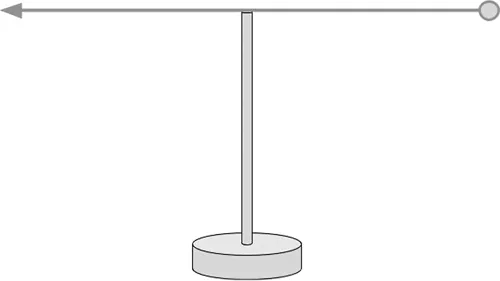
To investigate this phenomenon, Gilbert invented a mysterious instrument: the versorium needle, as shown in Figure 1.1.
Figure 1.1 The Versorium needle
The needle is made from un-magnetised metal. When rubbed amber is brought towards the versorium, the needle will turn until it points towards the amber. Gilbert could not explain how the versorium worked (Stephen Gray demonstrated electrostatic induction with his ‘dangling boy’ 130 years later), but he used it to prove more Ancient Greek statements wrong.
The Greeks believed that amber alone had the property of attracting when rubbed. Gilbert used his versorium to prove that many other materials showed the same property. His list of materials included: diamond, sapphire, glass, sulphur, sealing wax and resin. He named these materials electrics because they behave like amber (‘elektron’).
So Gilbert resolved the great amber/basil error and demonstrated that many more substances can be charged than amber.
Gilbert (1600: 113) also contributed to the great chain of scientific errors by introducing one of his own:
All electricks attract all things: they never repel or propel anything at all.
Gilbert’s great mistake was not recognised until 1663, when a remarkable scientific inventor, Otto von Guericke, demonstrated repulsion using his electrical sulphur sphere.
Museum of electrical history
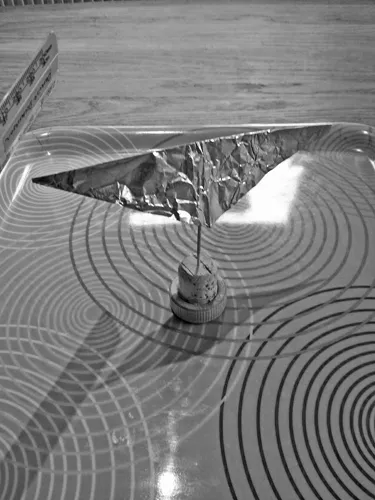
A versorium needle is very simple to make. The set-up is shown in Figure 1.2.
Figure 1.2 Gilbert’s versorium needle
1 Cut an elongated diamond of aluminium foil (about 75mm long and 30mm wide) and fold along the long line of symmetry. This is the needle.
2 Balance the needle on a cocktail stick set in a cork or clay.
3 Test various electrics (insulators) after rubbing with cloth. The needle should react clearly.
How the versorium needle works
At the end of the 16th century, William Gilbert invented a device for detecting electric charge. He called it the versorium needle. When a charged object is brought towards the needle, the needle will point to the charge.
We understand this now, because we know that charges in the metal (electrons) can move. When a positive charge is brought near the needle, the electrons are attracted towards it, making the needle’s point negative. The negative point is attracted towards the charged object.
If a negative object is brought near the needle, the electrons move to the far end of the needle, leaving the point with a positive charge. The positive point is attracted towards the charged object.
But Gilbert didn’t know that.
Guericke’s sulphur sphere – 1672
It seems reasonable to suppose that if the Earth has a fitting and appropriate attractive potency it will also have a potency of repelling things that might be dangerous or disagreeable to it.
(von Guericke 1672: chapter 6)
Otto von Guericke was extraordinary. He is most famous for inventing the air pump and using it to demonstrate the enormous effect of atmospheric pressure with his dramatic Magdeburg Hemispheres (proving, finally, that horror vacui or ‘nature abhors a vacuum’ is not true). He also invented the electrical generator.
In 1663, Guericke made a hollow ball of sulphur that could be rotated. When the operator placed a dry hand (Guericke had famously dry hands) onto the rotating sphere, the sphere became charged. Dry human skin is especially effective, though other materials, including wool and leather, also work well.
The apparatus was made by blowing a glass sphere (“about the size of a child’s head” (von Guericke 2012: 227) and using it as a mould for molten sulphur. When the sulphur solidified, the glass was broken, producing a hollow sulphur ball.
Guericke noticed that the sphere first attracted chaff, but once the chaff touched the sphere, it would then be repelled. He noticed that a feather was first attracted to the sphere, and then, once contact had been made, the feather was repelled back to the ground from where it was again attracted. A feather could make the journey repeatedly.
Even though Guericke’s sulphur sphere was unreliable to use and expensive to make, electrical philosophers across Europe rushed to build their own. One experimenter stopped at the glass mould stage and tested the glass sphere instead. It produced charge even more effectively than the sulphur.
Some say Isaac Newton was the inventor of the glass globe generator. It was a small development, and if Newton discovered it, it was the only useful thing he did for electricity. His behaviour towards other electricians was jealous, spiteful and obstructive, especially towards Stephen Gray, the hero of the next section, with his ‘dangling boy’.
Museum of electrical history
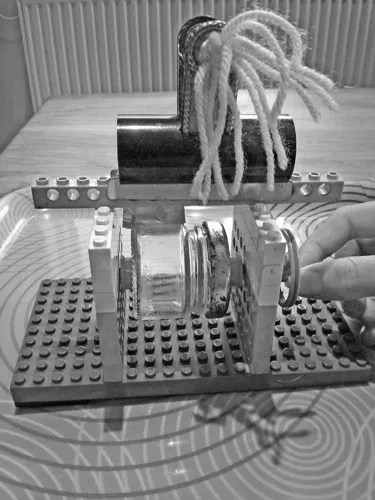
A glass generator can be made using a clean glass jar, as per Figure 1.3.
Figure 1.3 ...