This volume provides a unique synthesis of the relevant literature from academic studies in the fields of political science, marketing, advertising, speech communication, telecommunication, and public relations combined with the practical wisdom of professional consultants. Offering the reader both the theory and practical applications associated with negative political advertising, this is the first book devoted exclusively to the various forms of negative campaigning in the United States. After developing a typology of negative political spots for greater clarity in explaining and evaluating them, the book addresses effectiveness questions such as: What works? When? Why? and How?
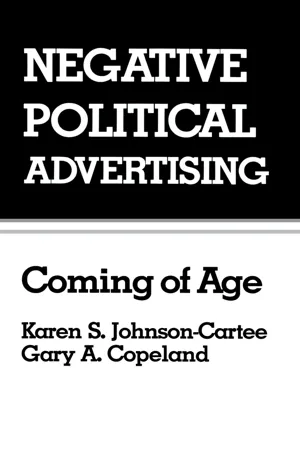
- 332 pages
- English
- ePUB (mobile friendly)
- Available on iOS & Android
eBook - ePub
About this book
Information
I
Introduction
Man is the symbol-using (symbol-making, symbol-misusing) animal inventor of the negative (or moralized by the negative) separated from his natural condition by instruments of his own making goaded by the spirit of hierarchy (or moved by the sense of order) and rotten with perfection.
– K. Burke (1966, p. 16)
Today, voters no longer experience politics firsthand but rather through the eyes and ears of the mass media system. From the mass media we obtain symbols, which we then interpret, redefine, and alter through our communication with other people. What we know as our political world is not a photocopy of the objective world but rather a created world of symbols, often mass-mediated symbols.
People use symbols without questioning or thinking about their origin. We use symbols nonchalantly without realizing the social, political, or personal ramifications for having used them. We often accept for ourselves the symbols created by others without analyzing the merits or appropriateness of their symbolic logic.
Politics is a symbolic world. Men and women divide the goods of society among groups of people. The goods are mostly symbolic in nature but considered precious nevertheless. We construct our rules and regulations based on our symbolic knowledge of the world. We know good and bad, right and wrong, just and unjust. We deal with these polarized symbols or positive-negative dichotomies in our political negotiations. We know that the opposite of wealthy is poor, the opposite of lawful is unlawful, and the opposite of good is bad. We simplify our political reality by categorizing political actors into polar opposites: white hats versus black hats, Candidate X versus Candidate Y, Democrats versus Republicans, and conservatives versus liberals.
These positive-negative dichotomies in some strange way comfort us, for we believe that the world is knowable, that our life tasks are do-able. We can make sense out of the complexities of life, and thus we can in some small way manage and control the world around us. We prioritize and order the world around us by using these dichotomies, and we establish “a definition of rulers and ruled, leaders and followers, governors and governed that corresponds to the spirit of hierarchy (status) goading us all” (Nimmo, 1978, pp. 92–93). Our world is clearly a world of positives and negatives. And because we usually associate the positives with ourselves or people like ourselves, we naturally focus our wary attention on the other or the negatives.
Yet researchers seemed befuddled by our preoccupation with both the negative and the positive. They write about bad news and negative political advertising, as if they were somehow antithetical to the natural state of humans. Rather, it should be understood as just another enigma associated with the symbol-using animal.
In this book, we also examine negative symbols in the form of negative political advertising. We do not take a pejorative stance; rather we examine and explain how negative political advertising has been used in American political history. We provide both an academic and a professional orientation toward the subject.
In Part I, we consider a wide variety of research in the areas of political science, marketing, public relations, product and political advertising, cognitive psychology, and political consulting. We offer a critical review of existing studies. Part II provides a framework from which to analyze negative political advertising: substance, style, sponsorship, and channels. Part III offers a practical guide to negative political advertising. Strategies for combating negative ads are explored and evaluated, and the legal and ethical considerations involving negative political advertising are presented. Finally, we consider the potential impact of negative political advertising on our society.
1
Negative Political Advertising: History, Research, and Analysis
The American Tradition: Negative Political Campaigning
Although voters and journalists alike have lamented the rise of negative campaigning in the 1980s, it is not a new American political phenomenon. In 1952, Estes Kefauver used the first direct attack television ad against Eisenhower (Diamond & Bates, 1988; Wilson, 1987). And, every presidential election year since 1952 has had its share of negative television ads. What is new is the pervasiveness of this technique. Although negative political advertising has been defined in various ways, both academicians and consultants seem to agree that negative ads make up a significant portion of modern political advertising. Researchers estimate that between 30% and 50% of all political advertising produced can be described as negative (Kaid & Davidson, 1986; Sabato, 1981; Taylor, 1986). Some political observers contend that negative political advertising is the hallmark of American media politics in the late 20th century (Taylor, 1986). According to Advertising Age, over $450 million were spent in the 1986 House and Senate races (Colford, 1986). And over 50% of that amount was spent in negative political advertising (Taylor, 1986).
Negative political ads are now staples in federal, state, and local campaigns. But, before we examine modern negative political advertising, we must first understand the American tradition of negative campaigning.
The Early Years
As late 20th-century observers of the American political scene, we sometimes forget that political parties and newspapers, as we know them today, did not always exist in the United States. At the time of the Constitutional Convention of 1787 there did not exist any groups that satisfy the modern-day definition of a political party, which is “any group, however loosely organized, seeking to elect governmental office-holders under a given label” (Epstein, 1967, p. 9). Instead, there were loose voting blocs, representing opposing political philosophies that have continued through the years and have led to a marked tension in our system of government. However, it is interesting to note that although the constitutional delegates were operating within voting coalitions, the constitutional fathers made no mention of political parties in the U.S. Constitution.
Bryce (1896) labeled the opposing groups the centrifugal and centripetal factions. The centrifugal group supported individual freedom as its paramount concern. The centripetal group supported a strong federal government and desired the states to be subordinate to a federal authority.
By 1791, these same factions were operating in the Congress of the United States. The centripetal faction was known as the Federalist faction, and the centrifugal faction was known as the Republican faction (Charles, 1961). These groups served as loose voting coalitions only within the houses of Congress and did not operate as a modern-day political party. Only 50% of the members of Congress belonged to either faction (Charles, 1961). It was not until 1800 that the Federalist faction held its first nominating congress and established itself as the first modern political party in the United States.
An analysis of early American political communication channels reveals an historical association between the growth of competing political parties and the rise of newspapers supporting them in 18th-century United States (Seymour-Ure, 1974). In 1791, the two major political factions in Congress started their own newspapers: The Gazette of the United States and The National Gazette. The Federalists operated The Gazette of the United States, and the Republicans operated The National Gazette (Blum et al., 1973). This period of our political-media history has become known as the party organism stage of media development in the United States. During the party organism stage, “the party either owns or controls the newspaper through political cronies” (Johnson, 1981, p. 133). Thus, the newspapers during this period were not the independent voices that we have today, but rather the voices of the political party that controlled them. This stage lasted from 1791 until the late 19th and early 20th centuries.
It was in these early newspapers that we see the beginnings of negative political campaigning. Indeed, from the earliest days of the American republic, politicians engaged in personal attacks against their opponents that, as Wood (1978) put it, were marked by their “verbal excesses and emotional extravagances” (p. 112). Wood explained: “No accusation was too coarse or too vulgar to be made—from drunkenness and gambling to impotence and adultery” (p. 109; see also Bailyn, 1967).
During the first party-contested election in 1800, the newspapers engaged in direct attacks against both opposition parties and their candidates. In 1800, The Connecticut Courant, a Federalist newspaper, printed the following column, which directly attacked the Republican party:
The fate of Frenchmen will be the fate of Americans. The French boasted that they were the most civilized and humane people in the world. We can say no more of ourselves. Their Jacobins were wicked, cruel, profligate, atheistical –ours are the same. Their pretense ever was, to consult the good of the people – ours make the same. The people in that country have been robbed, enslaved, and butchered – we shall be served in the same manner, unless we arouse instantly, and rescue our government from the fangs of those who are tearing it in pieces. Look at your houses, your parents, your wives, and your children. Are you prepared to see your dwellings in flames, hoary hairs bathed in blood, female chastity violated, or children writhing on the pike and the halbred? If not, prepare for the task of protecting your Government. Look at every leading Jacobin as at a ravening wolf, preparing to enter your peaceful fold, and glut his deadly appetite on the vitals of your country. Already do their hearts leap at the prospect. Having long brooded over these scenes of death and despair, they now wake as from a trance, and in imagination seizing the dagger and the musket, prepare for the world of slaughter. GREAT GOD OF COMPASSION AND JUSTICE, SHIELD MY COUNTRY FROM DESTRUCTION. (Blum, et al., 1973, p. 154)
Similarly in that same year, a Republican, James T. Callender, printed a text entitled “The Prospect Before Us.” This particular piece directly attacked the Federalist presidential candidate, John Adams:
It is not so well known, as it should be, that this federal gem John Adams, this apostle of the parsons of Connecticut, is not only a repulsive pedant, a gross hypocrite, and an unprincipled oppressor, but that he is, in private life, one of the most egregious fools upon the continent. When some future Clarendon shall illustrate and dignify the annals of the present age, he will assuredly express his surprise at the abrupt and absurd elevation of this despicable attorney. He will enquire by what species of madness, America submitted to accept, as her president, a person without abilities, and without virtues; a being alike incapable of attracting either tenderness, or esteem. The historian will search for those occult causes that induced her to exalt an individual, who has neither that innocence of sensibility, which incites us to love, nor that omnipotence of intellect which commands us to admire. He will ask why the United States degraded themselves to the choice of a wretch, whose soul came blasted from the hand of nature; of a wretch, that has neither the science of a magistrate, the politeness of a courtier, nor the courage of a man. (Blum et al., 1973, p. 154)
As Jamieson (1986) noted, “In 1800, the Columbian Centinel observed that The papers are overrunning with electioneering essays, squibs, and invectives’ ” (p. 7). In addition to partisan newspapers, the political leaders of the day relied on handbills, pamphlets, banners, badges, bandannas, and kerchiefs to bring their messages to the voters (Hart, 1956; Jamieson, 1984, 1986; Rosenberg & Rosenberg, 1962; Washburn, 1963, 1972). Political parades became standard fare during presidential election years (Jamieson, 1984; Washburn, 1963): “Campaign banners and flags, transparencies and torches were carried through the streets by marching enthusiasts – some professional paid marchers, some volunteers – often dressed in patriotic uniform” (Jamieson, 1986, p. 2). The transparencies were “constructed of partially transparent cheesecloth or cotton,” which had been lettered or drawn on, and they were then “wrapped around either wooden or steel frames and affixed to a pole” (Jamieson, 1986, p. 3). At night, kerosene torches were placed behind the transparencies to illuminate the messages. The messages both supported candidates and attacked opponents (Jamieson, 1986).
Andrew Jackson in 1828 began the tradition of campaigning with a “log cabin and hard-cider barrel” as prominent political symbols (Hart, 1956, p. 32). But these symbols represent more than the folksy, backwoods way of life that they are associated with in contemporary America. They were used as political symbols in opposition to the grand palaces and fine champagnes and wines associated with the aristocracy of the early republic (Washburn, 1963). The log cabin and hard-cider barrel represent the early use of the implied negative political strategy.
Songs and chants became very popular during political campaigns. In 1842, Clay supporters sang “Do you know a traitor viler, viler, viler/Than Tyler?” (Jamieson, 1986, p. 5). Perhaps the most famous negative political chant was the one used against Democratic candidate Grover Cleveland in 1884 by the Republican forces supporting James G. Blaine. Cleveland had fathered a child out of wedlock by Maria Halpin, and the Blaine forces made much use of this dirty linen with the short chant: “Ma! Ma! Where’s my Pa?” (Rosenberg & Rosenberg, 1962, p. 4). The Reverend Mr. Ball of Buffalo joined in the Republican attacks against Cleveland and appeared in many of the nation’s political magazines. He described Cleveland in this rather colorful manner:
A champion libertine, an artful seducer, a foe to virtue, an enemy of the family, a snare to youth and hostile to true womanhood. … Women now married and anxious to cover the sins of their youth have been his victims, and are now alarmed lest their relations with him shall be exposed. Some disgraced and broken-hearted victims of his lust now slumber in the grave. (Rosenberg & Rosenberg, 1962, p. 8)
But Blaine had his own troubles. Before the presidential campaign had even begun, numerous charges that Blaine had used his office in the Congress for personal financial gain had surfaced. And repeatedly, personal correspondence appeared in the nation’s press that supported these charges. Blaine continued to deny the accusations, but it is no wonder that the Democrats chanted: “Blaine! Blaine! Jay Gould Blaine! The Continental Liar from the state of Maine!” (Rosenberg & Rosenberg, 1962, p. 99). And, after the Democratic Sentinel of Indianapolis investigated his personal life, the newspaper discovered that Mrs. Blaine delivered her first child only 3 months after her wedding day. The Democratic newspaper exploited this juicy scandal to the fullest, writing that “there is hardly an intelligent man in the country who has not heard that James G. Blaine betrayed the girl whom he married, and then only married her at the muzzle of a shotgun. …” (Rosenberg & Rosenberg, 1962, p. 97).
After Cleveland won the election, Rosenberg and Rosenberg (1962) described the victory marchers chanting: “Ma! Ma! Where’s my Pa? Gone to the White House-Ha! Ha! Ha!” (p. 100); and, “Hurrah for Maria! Hurrah for the kid! I voted for Cleveland, and I’m damned glad I did” (p. 100; see also, Will 1986).
From this albeit brief review of early American political campaigning, it is clear that “from the country’s first contested election, strategists have offered voters advertising that venerated their candidate and vilified his opponents” (Jamieson, 1984, preface). Jamieson explained, “in many ways televised political advertising is the direct descendant of the advertised messages carried in song and on banners, torches, bandannas, and broadsides” during the early years of the republic (p. 448).
Negative Political Advertising: Research and Analysis
Negative political advertising has certainly come of age, yet academicians are still wrestling with problems of definition, operationalization, effectiveness, and societal impact. Clear differences can be observed between the findings of early research conducted in the 1970s and that conducted in the 1980s. In addition, academicians and independent research consultants differ as to how they evaluate the effectiveness of negative political advertising. And news reports concentrating on the use of negative political advertising have done little to clear up the confusion.
The Pre-1980 Word on Negative Political Advertising
Negative political advertising is not a new political phenomenon. Yet in 1964, Lyndon Johnson’s daisy commercial attacking Goldwater’s bellicose rhetoric was perceived as being a radical campaign move (Diamond & Bates, 1988). Early resea...
Table of contents
- Cover Page
- Half Title page
- Frontmatter
- Title Page
- Copyright Page
- Dedication
- Contents
- Preface
- I Introduction
- II Analysis Of Negative Political Advertising
- III Negative Political Advertising And Society
- References
- Author Index
- Subject Index
Trusted by 375,005 students
Access to over 1.5 million titles for a fair monthly price.
Study more efficiently using our study tools.
Frequently asked questions
Yes, you can cancel anytime from the Subscription tab in your account settings on the Perlego website. Your subscription will stay active until the end of your current billing period. Learn how to cancel your subscription
No, books cannot be downloaded as external files, such as PDFs, for use outside of Perlego. However, you can download books within the Perlego app for offline reading on mobile or tablet. Learn how to download books offline
Perlego offers two plans: Essential and Complete
- Essential is ideal for learners and professionals who enjoy exploring a wide range of subjects. Access the Essential Library with 800,000+ trusted titles and best-sellers across business, personal growth, and the humanities. Includes unlimited reading time and Standard Read Aloud voice.
- Complete: Perfect for advanced learners and researchers needing full, unrestricted access. Unlock 1.5M+ books across hundreds of subjects, including academic and specialized titles. The Complete Plan also includes advanced features like Premium Read Aloud and Research Assistant.
We are an online textbook subscription service, where you can get access to an entire online library for less than the price of a single book per month. With over 1.5 million books across 990+ topics, we’ve got you covered! Learn about our mission
Look out for the read-aloud symbol on your next book to see if you can listen to it. The read-aloud tool reads text aloud for you, highlighting the text as it is being read. You can pause it, speed it up and slow it down. Learn more about Read Aloud
Yes! You can use the Perlego app on both iOS and Android devices to read anytime, anywhere — even offline. Perfect for commutes or when you’re on the go.
Please note we cannot support devices running on iOS 13 and Android 7 or earlier. Learn more about using the app
Please note we cannot support devices running on iOS 13 and Android 7 or earlier. Learn more about using the app
Yes, you can access Negative Political Advertising by Karen S. Johnson-Cartee,Gary Copeland in PDF and/or ePUB format, as well as other popular books in Sozialwissenschaften & Konsumverhalten. We have over 1.5 million books available in our catalogue for you to explore.