eBook - ePub
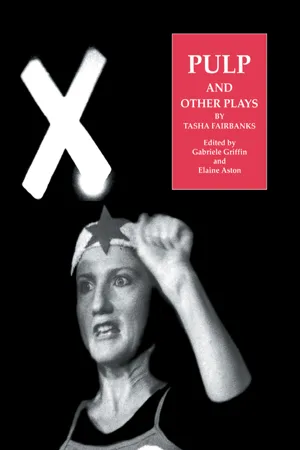
Pulp and Other Plays by Tasha Fairbanks
- 158 pages
- English
- ePUB (mobile friendly)
- Available on iOS & Android
eBook - ePub
Pulp and Other Plays by Tasha Fairbanks
About this book
Pulp and other Plays by Tasha Fairbanks is an anthology of plays which were written for the British group Siren Theatre Company, a lesbian theatre collective founded in 1979 by women from the punk music scene and worked with their unorthodox performance skills to challenge mainstream traditions of 'straight' acting. This anthology of three of the company's plays brings together long overdue recognition to the company which was Britain's foremost lesbian collective in the 1980s. This collection indicated the diversity of te Siren's theater work: their radical feminist critique of heterosexuality and male violence in 'Curfew', their celebration of lesbian glamour and desire in 'Pulp' and a scathing attack on Thatcherite Britain in ' Now Wash Your Hands, Please'.
Information
PULP
by
TASHA FAIRBANKS
FROM DISCUSSION AND WORKSHOPS WITH SIREN THEATRE COMPANY
SONG LYRICS: JANE BOSTON
COMPOSITION: JANE BOSTON AND JUDE WINTER
FIRST PERFORMED AT THE DRILL HALL, LONDON, 1985
THE COMPANY
MAGDA AND DAGMAR: JANE BOSTON
HEDDY AND ELLA: JUDE WINTER
DOLORES AND MONIKA: TASHA FAIRBANKS
KAY: HILARY RAMSDEN
DESIGNER AND TECHNICIAN: DEBRA TRETHEWEY
THE PLAY WAS DIRECTED BY NOELLE JANACZEWSKA
PERFORMANCE NOTES
There are two time dimensions in PULP. The bulk of the action takes place in a sleazy downtown New York bar, during the McCarthyite Fifties, and is set over a period of several months. Another, parallel, story is set in Ella’s upmarket London flat, in 1985, during the course of one evening.
Magda and Dagmar are one woman, living in two different time zones, both unaware of each other.
THE FIFTIES CHARACTERS
Magda—Early thirties. At the opening of the play she is a beautiful, glamorous Hollywood star, at the height of her profession, but about to topple.
Heddy—Mid-thirties. A journalist with a social conscience.
Kay—Mid-thirties. An apparently inept private eye.
Dolores—Early twenties. A dangerously ambitious dreamer.
THE EIGHTIES CHARACTERS
Dagmar—Late twenties. An employee in a British Government security service. She is played by the same actor who plays Magda.
Ella—Early forties. A senior employee in the same service and Dagmar’s lover.
Monika—Mid-fifties. Ella’s next-door-neighbour and a German expatriate.
STAGE DESIGN
The stage was divided into Fifties New York, represented by a period drinks bar, lit garishly from inside and padded with orange leopard skin. Around were a few high stools. The Eighties side was represented by a couple of sterile-looking designer armchairs and a coffee table. Behind both areas were tall flats, padded in black velvet.
The lighting aimed at a ‘film noir’ effect, contained and directional, producing stark light and shadow.
THE MUSIC
Because of Magda’s role as a bar room singer, much of the music in this play was able to emerge fairly seamlessly out of the action, (i.e, with ‘Trouble’, ‘Time’ and ‘Looking at Lana’), once an audience had become accustomed to the other actors dropping their roles and picking up rock instruments.
‘Trouble’ served as a narrative device to install Magda in the club and convey time passing; ‘Time’ set an atmosphere for type dislocation of reality in the piece; ‘Looking at Lana’ echoed the nostalgic longing of Heddy for her ‘great Hollywood dream’; and ‘Pulp’ framed the opening of the play with a lyrical foretelling of what is to come.
Of the song and dance routines, ‘Dance with a Difference’ was a joyous and funny moment of togetherness for the four women, before betrayal divided them. ‘Odd Girl Out’ was a sinister presentiment of danger for the spies who are spied upon.
PULP
Prologue
Pulp Song
ACT ONE
SCENE ONE
HEDDY: A seedy tale, told on seedy paper. But one that’s got to be told if only to understand. That’s important. It’s important to get things straight, that you see why things happened like they did. I’ve always thought of myself kind of outside of things. Detached—an observer of other people’s lives. That’s how it started out. And that’s how it should’ve gone on. But somehow, somewhere along the line, I got involved in the whole messy business. I can’t even say when exactly. One minute I was propping up the bar, lapping up the action, smiling inside—and the next thing I knew I was in up to my neck.
It shouldn’t have been like that. As a reporter you deal in facts, pure and simple. well, that’s how I saw it. I’ve learned a lot since then. Like, facts aren’t pure or simple. It’s what people do with them that matters.
Yeah, O.K., I should’ve known better. Should’ve seen earlier. But I wanted to get to the truth. It was too late when I realised truth comes in a lot of different forms, and it all depends on who’s looking at it and from where. Maybe if I’d thought this out sooner, a lot of what happened could have been avoided.
But I’m getting ahead of myself. It all started… when? I guess you can’t ever say when something really began. Or when, if ever, it ends. But for the sake of the records, let’s say this story dates from July 5th 1955, exactly six months ago. It all started with old Joe McCarthy and his gang of commie bashers. Joe McCarthy was worried that Joe Stalin had got himself some pals in the movie industry. He thought Hollywood might start shooting propaganda pictures against Uncle Sam and Momma’s home-made apple pie. So he started the biggest witch-hunt since the Spanish Inquisition. Anyone who’d ever put a dime into a Civil Rights collecting box suddenly got a file on her an inch thick. With the risk of losing their swimming pools along with their reputations, the Hollywood greats fell over themselves to co-operate with Joe—McCarthy, that is. In 1955 Judas would have had himself one heck of a time in Beverley Hills.
Well, anyway, that’s how come Clara Lamont was found that night in the bath of her home in Sunset Boulevard, with her wrists slashed and her stomach full of gin and phenobarbitone.
(Black-out. Lights up on Magda alone in spot)
ACT ONE
SCENE TWO
VOICE: Miss Thornton, the House Committee for Un-American activities would like to thank you for your extreme honesty and candour in cooperating with us. You have proved a very friendly witness, and have given us all the information required. Thank you. (Black-out and cameras popping. Magda moves away)
MAGDA: No comment. No comment.
ACT ONE
SCENE THREE
(Lights come up on Magda with her back to audience, retching, while Heddy casually watches her)
HEDDY: Like fishbones, aren’t they?
MAGDA: (Spinning round) What?
HEDDY: Lies. Like fishbones. They stick in your throat.
MAGDA: What the hell are you talking about?
HEDDY: Nice little performance you gave at the Hearing. Probably your best. Shame Sam Goldwyn didn’t catch it on celluloid.
MAGDA: Who the hell are you?
HEDDY: Heddy Vance, reporter. (Flashes card) New York Chronicle.
MAGDA: Press! I said ‘no comment’ and I meant ‘no comment’. Get it?
HEDDY: Sure. You know, it’s a funny thing being a woman in this game. The guys go into the Men’s Room and come out with a story. You’d never believe how much ...
Table of contents
- Cover
- Half Title
- Title Page
- Copyright Page
- CONTENTS
- Introduction to the Series
- List of Plates
- Introduction
- Curfew (1982)
- Pulp (1985)
- Now Wash Your Hands, Please (1984/5)
Trusted by 375,005 students
Access to over 1.5 million titles for a fair monthly price.
Study more efficiently using our study tools.
Frequently asked questions
Yes, you can cancel anytime from the Subscription tab in your account settings on the Perlego website. Your subscription will stay active until the end of your current billing period. Learn how to cancel your subscription
No, books cannot be downloaded as external files, such as PDFs, for use outside of Perlego. However, you can download books within the Perlego app for offline reading on mobile or tablet. Learn how to download books offline
Perlego offers two plans: Essential and Complete
- Essential is ideal for learners and professionals who enjoy exploring a wide range of subjects. Access the Essential Library with 800,000+ trusted titles and best-sellers across business, personal growth, and the humanities. Includes unlimited reading time and Standard Read Aloud voice.
- Complete: Perfect for advanced learners and researchers needing full, unrestricted access. Unlock 1.5M+ books across hundreds of subjects, including academic and specialized titles. The Complete Plan also includes advanced features like Premium Read Aloud and Research Assistant.
We are an online textbook subscription service, where you can get access to an entire online library for less than the price of a single book per month. With over 1.5 million books across 990+ topics, we’ve got you covered! Learn about our mission
Look out for the read-aloud symbol on your next book to see if you can listen to it. The read-aloud tool reads text aloud for you, highlighting the text as it is being read. You can pause it, speed it up and slow it down. Learn more about Read Aloud
Yes! You can use the Perlego app on both iOS and Android devices to read anytime, anywhere — even offline. Perfect for commutes or when you’re on the go.
Please note we cannot support devices running on iOS 13 and Android 7 or earlier. Learn more about using the app
Please note we cannot support devices running on iOS 13 and Android 7 or earlier. Learn more about using the app
Yes, you can access Pulp and Other Plays by Tasha Fairbanks by Elaine Aston, Gabriele Griffin, Elaine Aston,Gabriele Griffin in PDF and/or ePUB format, as well as other popular books in Literature & Theatre. We have over 1.5 million books available in our catalogue for you to explore.