- 74 pages
- English
- ePUB (mobile friendly)
- Available on iOS & Android
eBook - ePub
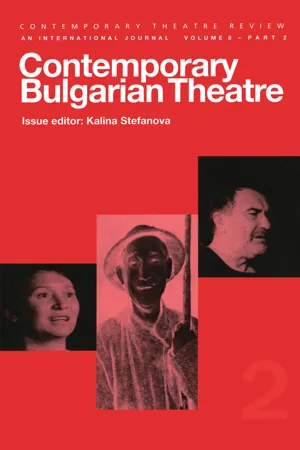
Contemporary Bulgarian Theatre
About this book
First Published in 1998. This is Volume 8 Part 2 of Contemporary Theatre Review which is an international journal concerned with all aspects of theatre - from text-based drama and current developments worldwide, to work of an interdisciplinary or cross-cultural nature. This edition features the second part of a collection of articles on contemporary Bulgarian Theatre with the plays Stanislav Stratiev and Stefan Tsanev.
Information
The Other Death of Joan of Arc A Folk Legend
God emerges from under the bed to save the Virgin, and the Executioner attacks him with his sword; God performs one of his miracles and deprives him of his manhood.
The castrated Executioner, now limp, begins to lose his human dignity – he begs for mercy, crawling and kissing God’s feet. Joan is disgusted and horrified – she sees what she herself will be like when she repents.
She decides it is better to die than, by repenting, kill the legend of Joan of Arc. In fact, she isn’t Joan of Arc. The real Joan was killed in battle, but her enemies feared that the legend would never die. So they staged a trial and hired an actress condemned to death for adultery – to save her own life, she must perform the part of Joan of Arc at the trial (which has been scripted) and publicly repent, thus discrediting Joan of Arc.
Joan the actress plays her final scene – unscripted – choosing to die on the stake, but to immortalise Joan of Arc.
Characters
Joan
God
Executioner
France, the Rouen prison.
The night before 30 May 1431.
Prologue
Faraway tolling of a bell, rare and forlorn, as if announcing a funeral. On the front stage, before the curtain opens, the Executioner is seated on a wooden prison bed. His hands are playing with the links of a heavy chain as if they were rosary beads. Haltingly he reads THE TEN COMMANDMENTS.
EXECUTIONER: “I am the Lord thy God; Thou shalt have no other gods before me.” Not very liberal, our leader …
“Thou shalt not make unto thee any graven image, or any likeness of any thing that is in heaven above, or that is in the earth beneath, or that is in the water under the earth; Thou shalt not bow down thyself to them, nor serve them.” Yes, sir! That’s what I call a master! None of that pluralism, or whatever you call it …
“Thou shalt not take the name of the Lord thy God in Vain.” (Thinks long, does not comment)
“Remember the sabbath day, to keep it holy. Six days shalt thou labour, and do all thy work: But the seventh day is the sabbath of the Lord thy God.” The way we have been working lately – you may think every day has been the sabbath of the Lord, may God help us!
“Honour thy father and thy mother: that thy days may be long upon the land which the Lord thy God giveth thee.” That’s all right…
“Thou shalt not kill.” Obviously this one doesn’t apply for executioners. Move on!
“Thou shalt not commit adultery.” My, my … On this count, I shall be in Hell for sure …
“Thou shalt not steal.” And here, we have had it, all of us …
“Thou shalt not bear false witness against thy neighbour.” Now, that’s daft. I mean, if I were to obey this commandment, then who do I put on the stake tomorrow? … Obviously it wouldn’t be the girl, it would have to be them, her judges and prosecutors … (He pulls himself up, glances around, listens, crosses himself in fear).
“Thou shalt not covet thy neighbour’s wife …” – so if it isn’t a neighbour, it’s all right then … “Thou shalt not covet thy neighbour’s house, nor his life … Thou shalt not covet his manservant, nor his maidservant, nor his ox, nor his ass, nor any of his livestock – any thing which is his.” – I bet someone has been making amendments to this commandment…
The bell tolls forlorn in the distance.
They’ve set the bells tolling. It’s time to fix up the stake. (Gets up) The wood is bloody wet in May – to get the fire going, I shall have to use newsprint…
He goes out, the chain trailing after him. Behind him the curtain opens up very slowly – like the flower of a cactus.
First Visitation
A cell in a jail, mouldy stone walls, no window. In the far end, a candle burns under a simple wooden Crucifix. To the right, a rusty iron door. On the wall opposite, to the left, a helmet and chain-armour hang on a nail. On the front stage – a bare wooden bed. Joan is kneeling before the Crucifix, with her back to the audience – her head is shorn, she is wearing a soldier’s chain-mail shirt.
JOAN: Oh Right Reverend Bishop of France, Monseigneur Cochon, my benefactor and my judge;
Your Highness, Count Warrick, commandant of Rouen, emissary of our lawful master the king of England;
and you great inquisitioner Mgr Jean Le Maitre;
you merciful investigator Mgr Jean de Lafontaine;
you noble prosecutor Mgr Jean D’Estivet;
and you, much respected professors in the Sorbonne, the pride of educated France … Monseigneurs Jean Beuyer, Nicolas Midi, Tomas de Courselle, Gerrard Gellet, Jacques de Tourinne, and Pierre Maurisse …
And you, 15 Doctors of divinity, 4 Doctors of canon law, and further 17 Bachelors and Licensees – the pride of learned Europe –
My fair prosecutors, all 42 of you;
and you, venerable members of the jury, 120 justice-loving representatives of the obedient people of France –
I, the unworthy Joan of Arc, shepherdess from Domremmie, later known as the Virgin, Virgin Joan, the Virgin from Domremmie, the Virgin of Orleans, or the Virgin of France;
I, the ungrateful daughter of Jacques of Arc, a modest, respected tax-collector, and of Isabelle Rommet, a pious woman,
I fall on my knees before you all and repent my pride which made me break the canon laws and the civil laws,
I fall on my knees and I admit my guilt of committing the 70 deadly sins of which you are justly accusing me, namely:
that I broke the First commandment by saying that for me there is nothing holier than the freedom of France, thus putting God in second place;
that I broke the Second commandment by starting from an early age to learn black magic and spells from old witches;
that of a night when the moon was full, I would go and dance wickedly under the Fairy Tree;
that I broke the Third commandment by saying that God had called upon me to save France;
that it was the devil and not God who prompted me this crazy idea;
that for this purpose the devil made me change my womanly attire preordained to me by God, and profane my body by dressing up in men’s clothes and soldier’s armour;
that I broke the Fourth commandment by doing all this on a Sunday – a day barred for any work and set aside only for prayers to the Lord;
that I broke the Fifth commandment by not listening to the advice of my father and mother who forbade me to do such things;
that I myself secretly placed the rusty sword incrusted with five crosses behind the altar in the Abbey of St Catherine de Fierbois, thus deceiving the overlords, the seigniors, the clergy and the simple people that God had pointed to me where they may find it and chase with it the English from the lands of France;
that I put a spell on this sword, calling it the Sword of Providence, and then, that I put a spell also on my banner;
that I broke the Sixth commandment which says: “Do not kill!” …
Forlorn bell in the distance.
… when with this sword I spilled the innocent blood of our merciful masters, the English;
that I broke the Seventh commandment by seducing the rulers and the people of France in order that they should follow me;
that I broke the Eighth ...
Table of contents
- Cover
- Copyright Page
- Title Page
- Table of Contents
- Stanislav Stratiev, or How the Theater Has Produced a Playwright
- On the Other Side
- On the Other Side by Stanislav Stratiev: Production History
- “Anathema” and “Glory be” to Stefan Tsanev
- The Other Death of Joan of Arc
- The Other Death of Joan of Arc by Stefan Tsanev: Production History
- Notes on Contributors
- Index
Trusted by 375,005 students
Access to over 1.5 million titles for a fair monthly price.
Study more efficiently using our study tools.
Frequently asked questions
Yes, you can cancel anytime from the Subscription tab in your account settings on the Perlego website. Your subscription will stay active until the end of your current billing period. Learn how to cancel your subscription
No, books cannot be downloaded as external files, such as PDFs, for use outside of Perlego. However, you can download books within the Perlego app for offline reading on mobile or tablet. Learn how to download books offline
Perlego offers two plans: Essential and Complete
- Essential is ideal for learners and professionals who enjoy exploring a wide range of subjects. Access the Essential Library with 800,000+ trusted titles and best-sellers across business, personal growth, and the humanities. Includes unlimited reading time and Standard Read Aloud voice.
- Complete: Perfect for advanced learners and researchers needing full, unrestricted access. Unlock 1.5M+ books across hundreds of subjects, including academic and specialized titles. The Complete Plan also includes advanced features like Premium Read Aloud and Research Assistant.
We are an online textbook subscription service, where you can get access to an entire online library for less than the price of a single book per month. With over 1.5 million books across 990+ topics, we’ve got you covered! Learn about our mission
Look out for the read-aloud symbol on your next book to see if you can listen to it. The read-aloud tool reads text aloud for you, highlighting the text as it is being read. You can pause it, speed it up and slow it down. Learn more about Read Aloud
Yes! You can use the Perlego app on both iOS and Android devices to read anytime, anywhere — even offline. Perfect for commutes or when you’re on the go.
Please note we cannot support devices running on iOS 13 and Android 7 or earlier. Learn more about using the app
Please note we cannot support devices running on iOS 13 and Android 7 or earlier. Learn more about using the app
Yes, you can access Contemporary Bulgarian Theatre by Stefanova, Kalina Stefanova in PDF and/or ePUB format, as well as other popular books in Mezzi di comunicazione e arti performative & Teatro. We have over 1.5 million books available in our catalogue for you to explore.