- 245 pages
- English
- ePUB (mobile friendly)
- Available on iOS & Android
eBook - ePub
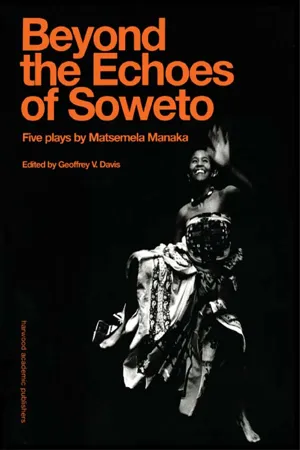
Beyond The Echoes of Soweto
About this book
First Published in 2004. This volume presents a representative selection from the work of one of the most innovative of the younger generation of South African dramatists, Matsemela Manaka, who productions have been acclaimed not inly in is home country but also tour in Europe and America. Includes are the Egoli, Pula and Children of Asazi, Toro and Goree. Each play has been edited with the particular needs of readers outside South Africa in mind; unfamiliar references have been annotated and African-language passages in the texts provides with English translation. To facilitate a comprehensive view of Manaka's work a number of his essays on the practice of 'theatre for social reconstruction' have been reprinted along with a long introduction by Geoffrey V. Davies.
Information
CHILDREN OF ASAZI
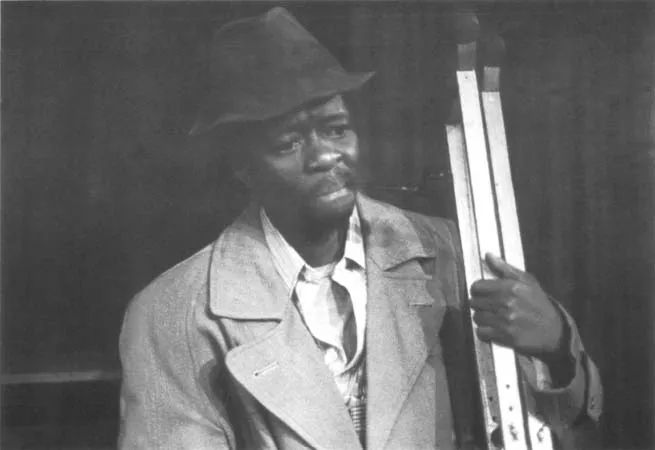
4. Children of Asazi. Peter Boroko as Nduna. © Sols Photosdoc 1986
CHARACTERS
DILIZA – a young activist who is about twenty years old
CHARMAINE – a young apolitical girl who is about twenty years old
NDUNA – an old jazz guitarist who is in his late fifties
GOGO – a disguised woman who is about fifty years old
MAJIKA – an older politician who is about fifty years old
MABU – a jazz saxophonist who is about forty-five years old
OFFICER – an old man in his early forties
Diliza means “demolish” in Zulu.
Nduna means “headman”
Gogo means “old lady”
Majika means “chameleon”
Mabu means “child of the soil”
CAST
The cast of the 1986 production was as follows:
| Diliza | Ali Hlongwane |
| Charmaine | Soentjie Thapeli |
| Nduna | Peter Boroko |
| Gogo | Thelma Pooe |
| Majika | Job Kubatsi |
| Mabu | Khaya Mahlangu |
| Officer | Peter Boroko |
| Blind Woman | Soentjie Thapeli |
CHILDREN OF ASAZI
PROLOGUE
(The stage resembles a proclaimed slum in Johannesburg, Alexandra Township.1 It is a windy night. There are five corrugated irons with windows and candle light burning behind each corrugated sheet of iron. We hear people singing.)
| SONG: | Alexandra Khayalami |
| Alexandra Khayalami | |
| Alexandra Khayalami | |
| Alexandra Khayalami |
| You may be a dark city | |
| but you are a home | |
| the candle blows | |
| the night away | |
| like in all shelters | |
| Alexandra Khayalami |
| You may be a dark city | |
| but you are a home | |
| the candle blows | |
| the night away | |
| like in all shelters | |
| Alexandra Khayalami |
| Alexandra Khayalami | |
| Alexandra Khayalami | |
| Alexandra Khayalami | |
| Alexandra Khayalami |
(The wind blows stronger. Blows off the candle lights. Rain falls. Lightning strikes. They continue to hum the song. The morning breaks. They stop singing. We hear the sound of a bulldozer; a demolition is in progress. We hear angry voices. Some people are moving about. They throw their belongings out of their homes. Others peep through the windows and sing.)
| SONG: | Kwenzenjani na! | [What could have gone wrong |
| Masiduduka | When we run helter skelter | |
| Sigoduka | Going away | |
| Ezwenilethu | From the land of our birth]. | |
| Kwenzenjani na! | ||
| Kwenzenjani na! | ||
Masiduduka | ||
| Sigoduka | ||
| Ezwenilethu | ||
| Thina siyajikeleza | [We run in circles | |
| Ho! kulelizwe | In this land | |
Ho! siduduka | Running helter skelter | |
Ho! sigoduka | Going away]. | |
| Thina siyajikeleza | ||
| Ho! kulelizwe | ||
| Ho! siduduka | ||
| Ho! sigoduka | ||
| Thina siyajikeleza | ||
| Ho! kulelizwe | ||
| Ho! siduduka | ||
| Ho! sigoduka | ||
| Kwenzenjani na! | ||
| Masiduduka | ||
| Sigoduka | ||
| Ezwenileth | ||
| Thina siyajikeleza | ||
| Ho! kulelizwe | ||
| Ho! siduduka | ||
| Ho! sigoduka |
(Then the choreographed movement with corrugated irons. It is resistance. The sound of the bulldozer fades. People reassemble their belongings. They sing a song of resistance.)
| SONG: | Sothutha siyephina! | [Where will we go |
| Kulomhlaba wobawo’mkhulu | In this, the land | |
| Sothutha siyephina! | of our forefathers]. | |
| Kulomhlaba wobawo’mkhulu | ||
| Sothutha siyephina! | ||
| Kulomhlaba wobawo’mkhulu | ||
| Masithethe ngazwinye | [Let us speak as one and say | |
| Sithi! | We shall not move | |
| Asihambi | Here we will die | |
| Sizofelala | We shall not move | |
| Asihambi | Here we will die]. | |
| Siyofelala |
(It is resistance. The sound of the bulldozer fades off. It’s a choreographed movement of people reassembling their belongings, they arrange props [the chair, table, lamp, Diliza’s bag, jersey and writing material.] Exit the choreography. There is a spot on Charmaine reading a letter and then Diliza also reading a letter.)
CHARMAINE: Dear Father,
Many thanks for your letter. Only silence can keep us apart. Exile is not as far away as the distance of silence. Your letter came at the time when I was begining to feel very lonely. An intimate friend of mine, Diliza, who like you is one of those people who still believe they can change the world. And now I am afraid that exile may snatch him away from me like it did to you.
Baba, I hope you received my last letter. Since the disappearance of mama, strange stories come to me through uncle Gabashiane. Is it true that my mother died on the run from Sharpeville? And if that is the case, who is the woman who has been more than a mother to me?
Baba, today I am a woman. I would like to be able to tell my children about my history. Could you please tell me the truth before it is too late.
Your daughter
Charmaine
DILIZA: Dear Mother,
After all these years of an endless search, I began thinking of asking for your address in heaven. I thought you were no longer with us. Your mysterious letter gave me hope to continue the search. Wherever you are, know that your house is no more. Only memories are there. The bulldozer is striking real blows. I am writing this letter from the streets.
Mama, whenever, I see children in the streets, sniffing glue and drinking methylated spirits, I think of myself an...
Table of contents
- Cover
- Half Title
- Title Page
- Copyright Page
- Contents
- Introduction to the Series
- List of Illustrations
- Acknowledgements
- Preface
- Introduction
- Theatre of the Dispossessed
- Egoli
- Pula
- Blues me (Interviews with Matsemela Manaka)
- Children of Asazi
- Toro: The African Dream
- Gorée
- Afterword
- Appendix: Reviews of Egoli, Pula, Children of Asazi, Toro and Gorée
- Bibliography
Trusted by 375,005 students
Access to over 1.5 million titles for a fair monthly price.
Study more efficiently using our study tools.
Frequently asked questions
Yes, you can cancel anytime from the Subscription tab in your account settings on the Perlego website. Your subscription will stay active until the end of your current billing period. Learn how to cancel your subscription
No, books cannot be downloaded as external files, such as PDFs, for use outside of Perlego. However, you can download books within the Perlego app for offline reading on mobile or tablet. Learn how to download books offline
Perlego offers two plans: Essential and Complete
- Essential is ideal for learners and professionals who enjoy exploring a wide range of subjects. Access the Essential Library with 800,000+ trusted titles and best-sellers across business, personal growth, and the humanities. Includes unlimited reading time and Standard Read Aloud voice.
- Complete: Perfect for advanced learners and researchers needing full, unrestricted access. Unlock 1.5M+ books across hundreds of subjects, including academic and specialized titles. The Complete Plan also includes advanced features like Premium Read Aloud and Research Assistant.
We are an online textbook subscription service, where you can get access to an entire online library for less than the price of a single book per month. With over 1.5 million books across 990+ topics, we’ve got you covered! Learn about our mission
Look out for the read-aloud symbol on your next book to see if you can listen to it. The read-aloud tool reads text aloud for you, highlighting the text as it is being read. You can pause it, speed it up and slow it down. Learn more about Read Aloud
Yes! You can use the Perlego app on both iOS and Android devices to read anytime, anywhere — even offline. Perfect for commutes or when you’re on the go.
Please note we cannot support devices running on iOS 13 and Android 7 or earlier. Learn more about using the app
Please note we cannot support devices running on iOS 13 and Android 7 or earlier. Learn more about using the app
Yes, you can access Beyond The Echoes of Soweto by Matsemela Manaka,Geoffrey V. Davis in PDF and/or ePUB format, as well as other popular books in Literature & Theatre. We have over 1.5 million books available in our catalogue for you to explore.