- 208 pages
- English
- ePUB (mobile friendly)
- Available on iOS & Android
eBook - ePub
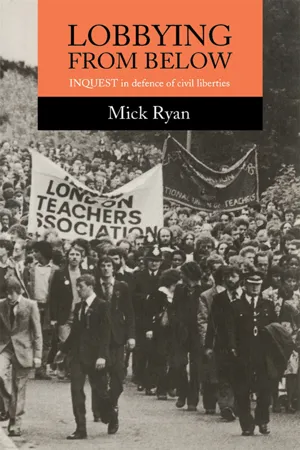
Lobbying From Below
About this book
This volume examines the origins and development of the pressure group, INQUEST, and its struggle for penal reform, against the backdrop of the intense political and social upheaval that characterized the late 1970s and 1980s.
Information
Chapter 1

Introducing INQUEST and inquests
It is perhaps one of the most obvious human paradoxes that death is an integral part of life. In the normal course of events the routine death of a member of the family or a friend is a deep, private grief, even resignation in the face of wider, impersonal forces. However, there are deaths that are far from routine and that invoke quite different responses – feelings of anger, recrimination and public disputation. Such deaths are often, although of course not always, the subject of a coroner’s inquest and raise wider questions about the culpability of state officials, their political masters or private employers. In other words, they become matters of public concern. The role of the pressure group INQUEST, founded in 1981, is to provide families and friends involved in such inquests with the emotional support and legal expertise they need to help piece together the circumstances that surround the death that has transformed their grief into anger.
This simple description of INQUEST’s role requires amplification. First and foremost, the quality of the casework it does with families involved with controversial deaths is greatly hampered by both the legal procedures governing inquests and the manner in which these procedures are interpreted by coroners. Thus, while INQUEST is working with families on a routine basis in cases across the country it is at the same time campaigning at Westminster for changes in inquest procedures, significant changes that require legislative force. Secondly, and more visibly, inquests often reveal inadequacies in institutional procedures, say the administration of suicide prevention procedures in prisons, and INQUEST campaigns in a high profile way to repair these deficiencies. Indeed, it is arguably more associated in the public mind with these campaigns arising out of its casework than with the reform of inquest procedures per se. We will therefore return to consider some of these campaigns in later chapters.
INQUEST is thus best introduced as a campaigning organization driven in a direction largely determined by its casework. Getting the balance right between casework and campaigning has been a source of tension within INQUEST over the years. However, and not entirely unrelated to this tension, it is also worth noting that INQUEST is unusual, although by no means unique, among pressure groups for its involvement across a whole range of what political scientists and policy analysts call policy communities and/or policy networks.1 That is to say, while many groups will confine their activities to networking their own well defined lobbies, housing for example, INQUEST on the other hand is likely to network across several lobbies on a routine basis. To start with the example we have already touched on, it will be working in the penal lobby with groups like the Prison Reform Trust on suicides in prisons while at the same time networking with civil liberties groups over deaths in police custody and/or with MIND on issues around psychiatric care.
The story of how this networking first got started and how it has sustained INQUEST over the years is something I shall develop in subsequent chapters. We will also return to discuss the distinction that is sometimes drawn between policy networks and policy communities later. More immediately, however, it is important that we begin with a brief description of how inquests work; exploring, for example, the role of the coroner and his relationship with officials and public, and reviewing the procedures that govern the conduct of the inquest itself. What I am doing at this point is simply sketching in INQUEST’s site of operations for the uninitiated, so to speak. A more detailed picture will emerge as the story of the group unfolds.
Inquests and coroners
The first point to make is that coroners are not involved in every death that is registered in any given year. What mostly happens when a death occurs is that a death certificate is signed by the general practitioner or hospital doctor involved and sent to the Registrar of Births, Marriages and Deaths. The matter rests there unless the death falls into one of the following categories, in which case the Registrar is obliged to pass it on to the coroner who is an independent judicial officer:
• a sudden or unexplained death,
• a death occurring in suspicious circumstances,
• a death caused by industrial injury or a death contracted at work,
• a death that may have been due to neglect, poisoning, drug abuse or abortion,
• a death caused by injury received while on military service,
• a death in prison custody,
• a death where the body has not been seen for fourteen days,
• and a death unattended by a doctor.
In 1994, the last year for which figures are available, the proportion of all registered deaths reported to the coroner was 34 per cent.2 Some of these cases, for example, where the physical cause of a sudden death can readily be explained, are easily resolved, sometimes at the instigation of a telephone call to a doctor or a hospital physician by one of the coroner’s officers. However, postmortems to establish the physical cause of death were still required in 68 per cent of all those cases reported to the coroner in 1994.3
The power to order a postmortem in order to establish the physical cause of death is vested solely in the coroner and is carried out on his behalf by a pathologist who is selected from a list provided by the Home Office. Interested persons, relatives, for example, are entitled to be represented at the postmortem, and if they are dissatisfied with the first postmortem they may finance a second one.4 If having received the pathologist’s report and any other information relating to the death the coroner is still uncertain about the cause of death or about the circumstances immediately surrounding it, he can order an inquest. In certain cases, for example prison deaths, inquests are mandatory.
In 1994 just under 21,000 deaths resulted in an inquest, 11 per cent of all deaths reported to the coroner.5
Exceptionally, inquests have to be held with juries:
• where the death has occurred in prison,
• where the death was caused by industrial accident or disease,
• where death occurred in circumstances that if continued would be prejudicial to the health and safety of the public,
• or where the death occurred while the deceased was in police custody or resulted from an injury inflicted by a police officer in the purported execution of his/her duty.
In 1994 only around 4 per cent of all deaths reported to the coroner required an inquest with a jury.6 The verdicts available to a jury include unlawful killing, justifiable homicide, accident or misadventure, suicide or, where the evidence is inconclusive, an open verdict can be returned. These verdicts are drawn from a standard list that is usually employed, although coroners and/or juries can (and occasionally do) phrase their own verdicts. In Chapter 5, for example, I refer to the verdict of “suicide due to official indifference and lack of care” that was returned at an inquest into the death of an immigration detainee. Normally, however, more standard verdicts are returned under the coroner’s direction. In 1994, deaths by accident or misadventure accounted for 47 per cent of all inquest verdicts and suicides for 18 per cent.7
On the face of it these procedures seem sensible, even desirable. In a free society it is surely important that in the absence of evidence that leads to an immediate criminal prosecution, all deaths, especially those that are sudden, unexplained or violent, should be subject to an investigation – usually in public – by an independent judicial officer. Furthermore, it is comforting to believe that while free societies regrettably have to use instruments and institutions of coercion, police and prisons for example, those who run them are especially accountable in this and other ways. We do not operate Gulags in the West where those detained are beaten to the point of death, driven to suicide, or simply neglected to rot away through lack of care, or if such things do occur, those responsible are held accountable for their actions.
True, our confident sketch about the role of coroners and inquests in these matters suggests some obvious omissions. For example, there is no statutory requirement to hold inquests – with or without juries – on those who die while in secure hospitals for the criminally insane like Ashworth, nor are they required on those who die having been “sectioned” to ordinary psychiatric hospitals under mental health legislation. Nor, for that matter, is it strictly necessary for a coroner to hold an inquest into a death in police custody; the only requirement here is that if he or she does hold an inquest it must be with a jury. But these omissions aside, some of which could easily be put right by simply amending the Coroners’ Rules, surely these safeguards are adequate? And if they are not, what is going wrong?
Causes for concern
Perhaps the first thing to point out is that INQUEST does not believe, as some of its members once did, that the inquest system is so entirely worthless that it should be abandoned. Nor, for that matter, does it deny that in many routine cases inquests satisfy – even reassure – family and friends of the deceased. Its case is rather that in a relatively small but important number of instances often, although by no means always, involving institutional care and/or police arrests, the rules governing inquests, and the way coroners interpret these rules, work against discovering the truth. The effect of this is often to protect the interests of the powerful against the interest of the powerless. According to INQUEST this comes about in several ways.
In the first place, families and friends of the deceased cannot claim legal aid to pay for a solicitor or barrister to represent them at an inquest. True, under what is known as the green form scheme they are entitled to legal advice about inquest procedures and their rights within those procedures, but in controversial cases this is hardly sufficient and puts already distressed families or friends at a great disadvantage. An inquest into the death of someone in prison, for example, could take place – and sometimes has – with the unrepresented family and friends of the deceased having to confront a lawyer representing the Home Office, one representing the Prison Medical Service and yet another one representing the Prison Officers’ Association. This is hardly a level playing field, and INQUEST has criticized successive Lords Chancellor for failing to explain why the public purse can run to funding Home Office barristers to protect civil servants and politicians, but not the bereaved.
However, even if a solicitor or a barrister is at hand – and some families go to great lengths to ensure this even if it means getting into debt – this is no guarantee of equal treatment. To take the example I referred to above, a death in prison custody. In a case like this the coroner would first contact a pathologist to undertake a postmortem. He or she might instruct one of his or her officers to attend the examination and/or speak to the pathologist about any suspicious or incriminating marks that are on the body. In the meantime other officers – sometimes retired or seconded police personnel – would be interviewing people and collecting statements from witnesses or anyone else at the prison with relevant information. In due course these statements would be passed on to the coroner, as would the results of the prison’s own internal inquiry or any police investigation. In other words, and unlike the procedure in a criminal court where the judge (and jury) wait to be convinced by the evidence unfolding before them in an adversarial setting as presented either by the defence or the prosecution who are at liberty within well defined rules to bring who they like before the court, the coroner arrives at court often – or so it seems – having already been through the available evidence and reached a conclusion. A conclusion, by the way, that will almost certainly dictate who should be called to give evidence, a prerogative that at inquests lies wholly with the coroner.
Furthermore, while in such a case any police report might be given to the barrister or solicitor representing the Home Office, it would not be handed over to the lawyers acting for the family and friends of the bereaved, nor would their lawyer be permitted to address the court on the facts, in other words, to sum up putting forward their version of events. These criticisms have led a long-time critic of inquests and a member of INQUEST to observe that:
The fundamental defect of coroners’ courts is that the coroner has too much power over the conduct and the outcome of the inquest, and the parties and the jury have too little. This imbalance can be redressed by giving the parties as nearly as possible the same opportunities to present an effective case to the jury as they would in a criminal or civil trial; to obtain legal aid, to see the statements of witnesses and other relevant documents before the hearing, to call witnesses (in addition to those selected by the coroner), and to address the coroner or the jury on the facts.8
While it is true that these several disadvantages are not insurmountable, and skilful lawyers with the help of flexible and fair-minded coroners can get at most or all of the evidence that is on record and technically available during the inquisition, INQUEST’s experience is that those representing the deceased often face an uphill struggle, a struggle that is sometimes made all the more arduous when key witnesses exercise their legal right not to give ev...
Table of contents
- Cover
- Half Title
- Title page
- Copyright page
- Table of Contents
- Preface
- Acknowledgements
- List of abbreviations
- 1 Introducing INQUEST and inquests
- 2 Origins
- 3 Campaigns
- 4 Defining issues
- 5 Other issues
- 6 Keeping afloat
- 7 Conclusion
- Notes
- Index
Trusted by 375,005 students
Access to over 1.5 million titles for a fair monthly price.
Study more efficiently using our study tools.
Frequently asked questions
Yes, you can cancel anytime from the Subscription tab in your account settings on the Perlego website. Your subscription will stay active until the end of your current billing period. Learn how to cancel your subscription
No, books cannot be downloaded as external files, such as PDFs, for use outside of Perlego. However, you can download books within the Perlego app for offline reading on mobile or tablet. Learn how to download books offline
Perlego offers two plans: Essential and Complete
- Essential is ideal for learners and professionals who enjoy exploring a wide range of subjects. Access the Essential Library with 800,000+ trusted titles and best-sellers across business, personal growth, and the humanities. Includes unlimited reading time and Standard Read Aloud voice.
- Complete: Perfect for advanced learners and researchers needing full, unrestricted access. Unlock 1.5M+ books across hundreds of subjects, including academic and specialized titles. The Complete Plan also includes advanced features like Premium Read Aloud and Research Assistant.
We are an online textbook subscription service, where you can get access to an entire online library for less than the price of a single book per month. With over 1.5 million books across 990+ topics, we’ve got you covered! Learn about our mission
Look out for the read-aloud symbol on your next book to see if you can listen to it. The read-aloud tool reads text aloud for you, highlighting the text as it is being read. You can pause it, speed it up and slow it down. Learn more about Read Aloud
Yes! You can use the Perlego app on both iOS and Android devices to read anytime, anywhere — even offline. Perfect for commutes or when you’re on the go.
Please note we cannot support devices running on iOS 13 and Android 7 or earlier. Learn more about using the app
Please note we cannot support devices running on iOS 13 and Android 7 or earlier. Learn more about using the app
Yes, you can access Lobbying From Below by Mick Ryan in PDF and/or ePUB format, as well as other popular books in Politics & International Relations & Political Advocacy. We have over 1.5 million books available in our catalogue for you to explore.