- 373 pages
- English
- ePUB (mobile friendly)
- Available on iOS & Android
eBook - ePub
Moving Notation
About this book
Designed specifically for university-level study, Moving Notation will benefit students and teachers of both dance and music, offering a complete introduction to the theory and practice of musical rhythm and elementary Labanotation. Performing Arts Studies aims to provide stimulating resource books of both a practical and philosophical nature for teachers and students of the performing arts: music, dance, theatre, film, radio, video, oral poetry, performance art, and multi-media forms.
Information
1
GETTING STARTED
RHYTHMIC CONCEPTS

1.1 Time
“Time is nature’s way of keeping every thing from happening at once.”
Woody Allen
As we all know, time is continuous. In traditional music, time’s continuity is divided into units called beats. Beats (sometimes referred to as pulses) are nothing more than divisions of time.
Beats are not always regular – beats can also change speed. The fascinating thing about beats and speed is that as you listen to them being measured on a metronome, the sound (click) you hear marks only the beginning of the beat. It is the length of time between the clicks that determines the beat’s speed. So, when you use the term “beat”, think of the entire “duration” of the beat and not just the click.


1.2 Beat Divisions (Sub-beats)
There are only two subdivisions of beat: a duple division and a triple division. Duple beats are those which are divided into equal halves and are counted 1 &, and triple beats are divided into equal thirds and are counted 1 a da:
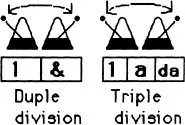
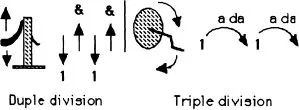
When you count 1 &, the “and” indicates the duple division of the beat. When you count 1 a da, the “a da” indicates the triple division of the beat. Notice also that the duple beat looks and feels square, while the triple beat feels round, the difference between pumping a pump and turning a wheel:
1.3 Rhythm versus Beat
The difference between rhythm and beat is generally understood as that which changes and that which does not: rhythm adds a flexible variety of changing sounds against a landscape of regular beats. This definition, while not a “law”, does cover a wide range of “rhythmic reality”.
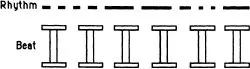
Traditionally, beat and rhythm go hand in hand. A beat is selected at a particular tempo and then rhythm is added “to” the beat, “over” the beat, “on top of” the beat. In this manner, beats become the architectural pillars upon which rhythm is supported:
There are only three ways in which rhythmic durations can relate to a beat:
(1) Thru-beat. The rhythm’s duration is longer than the beat, thereby sustaining through the end of one beat into the next. Call this a “thru-beat rhythm”.

(2) Full-beat. The rhythm’s duration is the same size as the beat. Call this a “full-beat rhythm”.
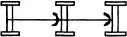
(3) Sub-beat. Each rhythmic duration is shorter than the beat. Call this a “sub-beat” rhythm:

The United States National Anthem reveals all three rhythmic activities in the opening musical line:
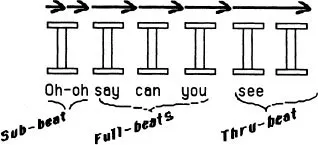
In any given musical composition all three categories of rhythmic duration will be present, although composers will from time to time employ one type exclusively for effect. For example, exclusive thru-beats can sound suspenseful, sad, or languid. Exclusive full-beats can sound march-like. Exclusive sub-beats can sound agitated or exciting.

Table of contents
- Cover
- Half Title
- Title Page
- Copyright Page
- Dedication
- Table of Contents
- Introduction to the Series
- Acknowledgements
- Introduction
- 1 GETTING STARTED
- 2 GETTING ORGANIZED
- 3 FIRST EXPANSIONS
- 4 APPROACHING PERFECTION
- 5 2’S AND 3’S
- 6 UPSETTING THE BALANCE
- 7 CHANGING TIMES
- 8 CONCLUSIONS
- Appendix A
- Appendix B
- Index
Trusted by 375,005 students
Access to over 1.5 million titles for a fair monthly price.
Study more efficiently using our study tools.
Frequently asked questions
Yes, you can cancel anytime from the Subscription tab in your account settings on the Perlego website. Your subscription will stay active until the end of your current billing period. Learn how to cancel your subscription
No, books cannot be downloaded as external files, such as PDFs, for use outside of Perlego. However, you can download books within the Perlego app for offline reading on mobile or tablet. Learn how to download books offline
Perlego offers two plans: Essential and Complete
- Essential is ideal for learners and professionals who enjoy exploring a wide range of subjects. Access the Essential Library with 800,000+ trusted titles and best-sellers across business, personal growth, and the humanities. Includes unlimited reading time and Standard Read Aloud voice.
- Complete: Perfect for advanced learners and researchers needing full, unrestricted access. Unlock 1.5M+ books across hundreds of subjects, including academic and specialized titles. The Complete Plan also includes advanced features like Premium Read Aloud and Research Assistant.
We are an online textbook subscription service, where you can get access to an entire online library for less than the price of a single book per month. With over 1.5 million books across 990+ topics, we’ve got you covered! Learn about our mission
Look out for the read-aloud symbol on your next book to see if you can listen to it. The read-aloud tool reads text aloud for you, highlighting the text as it is being read. You can pause it, speed it up and slow it down. Learn more about Read Aloud
Yes! You can use the Perlego app on both iOS and Android devices to read anytime, anywhere — even offline. Perfect for commutes or when you’re on the go.
Please note we cannot support devices running on iOS 13 and Android 7 or earlier. Learn more about using the app
Please note we cannot support devices running on iOS 13 and Android 7 or earlier. Learn more about using the app
Yes, you can access Moving Notation by Jill Beck,Joseph Reiser in PDF and/or ePUB format, as well as other popular books in Media & Performing Arts & Music Theory & Appreciation. We have over 1.5 million books available in our catalogue for you to explore.