eBook - ePub
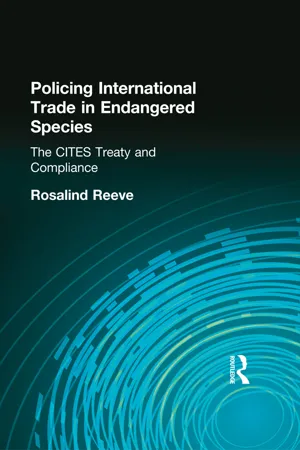
Policing International Trade in Endangered Species
The CITES Treaty and Compliance
- 368 pages
- English
- ePUB (mobile friendly)
- Available on iOS & Android
eBook - ePub
About this book
A comprehensive examination of the way in which the Convention on the International Trade in Endangered Species (CITES) is implemented and policed. CITES is one of the oldest international environmental agreements and has been responsible for some striking conservation successes. But, given the way it has evolved, there are also some critical weaknesses that unscrupulous countries and commercial interests can exploit, especially regarding information, institutions and enforcement. The convention needs reform and this book gives a trenchant critique, including practical and effective recommendations for change.
Information
Part I
Setting the scene
1 Introduction

Rationale and structure of the book
One of the greatest challenges facing us today is to ensure that the rapidly evolving legal rules in multilateral environmental agreements (MEAs) are applied – to close the gap between the law in books and the law as it is practised by states and followed by individuals. In the last 30 years, MEAs have proliferated in response to the growing international environmental crisis. Well over 200 MEAs have been negotiated, addressing a wide range of environmental problems.1 As this is a relatively new area of international law, more agreements can be expected in the coming years, either regional or global protocols to implement existing MEAs, or new conventions addressing issues sparsely covered by existing international legal rules, such as forest exploitation and timber trade. Meanwhile, the substantive provisions and procedures in existing MEAs will continue to be elaborated to meet new challenges. This will inevitably involve a growth in complexity as MEAs age and mature.
The 1973 Convention on International Trade in Endangered Species of Wild Fauna and Flora (CITES) is one of the oldest MEAs. A specific tool rather than a global solution, it addresses one of the many threats to Earth’s biological diversity – international trade in endangered species. Since its inception, CITES has been seen as the flagship wildlife agreement.2 It is a cornerstone MEA, lying at the nexus of international trade and species conservation, and largely respected among the conservation community. Most perceive it as effective,3 although this perception must be qualified by saying that there has never been a thorough empirical assessment of the effectiveness of CITES. Nevertheless, the specific and detailed provisions of this MEA compare farourably with the general and heavily qualified provisions of the1992 Convention on Biological Diversity (CBD). As a framework agreement in all but name, the CBD is an attempt to provide a global solution but so far has proved disappointing as a tool to arrest the decline in biodiversity. Its most practical realization is likely to be through protocols addressing specific threats to biodiversity, such as the Cartagena Protocol on Biosafety adopted in February 2000, as yet untested. By contrast, CITES has 27 years of experience on which to draw since it entered into force. Not only are there lessons to be learned from its system to promote compliance and deal with non-compliance by parties, but now is the time to examine how the system works in light of modern compliance theory and practice in order to identify weaknesses and lessons for the future.
This book therefore provides a comprehensive analysis of the system that has evolved over more than a quarter of a century to implement and enforce CITES, and to achieve compliance with its provisions – otherwise known as a self-policing system. It grew from a thesis submitted for a Masters’ degree in environmental law. The four years of research on which the book is based led the author to a firmly held conviction that strengthening MEA compliance systems is one of the most important tasks facing international environmental law today. A global enforcement agency to oversee compliance with international treaties, or, to quote Professor Christopher Stone,4 an ‘international sheriff with badge and pistol’, does not exist and would be out of the question in a global political order based on sovereign states. Instead, treaty-specific compliance systems and non-compliance procedures have evolved to fill the void. For regulatory MEAs such as CITES which place specific obligations on parties, it is particularly important that these self-policing systems are effective.
Since existing literature was found to be rather sparse and lacking in detail, much of the information for the book has been compiled from original CITES documents dating back to the first meeting of the Conference of the Parties (COP1) in 1976. Where possible, this source material has been supplemented with personal experience gained in the field or from participation in CITES meetings. Setting the scene for the book, this introduction includes an outline of the problem CITES exists to address. Then, to assist readers unfamiliar with the subject of compliance control, Chapter 2 contains a brief overview defining the main terms and outlining the necessary elements of compliance systems as well as the main schools of thought. The CITES compliance system is then reviewed in Parts II and III under three separate sub-systems: primary rules, compliance information, and – the main substance of the book – non-compliance response. Under ‘primary rules’ (Chapter 3) have been included the origin and objectives of the Convention, its principles and provisions, national measures, institutions, financial system and strategic vision. Under ‘compliance information’ (Chapter 4), the mechanisms used to collect, analyse and disseminate information are discussed. The section on non-compliance response is divided into chapters dealing with country-specific, issue-specific and species-specific mechanisms, followed by a discussion of enforcement, technical assistance and capacity-building. Chapter 5 on country-specific responses contains a detailed review of case studies involving individual problem countries. In Part IV, weaknesses in the CITES compliance system are identified, other compliance systems are analysed for lessons to improve the CITES system, and the potential for conflict with the multilateral trading system (MTS) and its implications for CITES are examined. Finally, in Part V, conclusions are drawn and recommendations made for the future.
The book does not attempt to review the effectiveness of CITES, a concept quite distinct from compliance. To do this would involve an assessment of whether CITES has succeeded or failed in reducing pressure from trade on endangered species and ultimately enabling their populations to increase, a huge task given the thousands of species covered by the Convention, and beyond the scope of an essentially desk-based study.
Disappearing wildlife
Biodiversity crisis
The Earth is currently experiencing mass extinction on a scale potentially akin to the disappearance of the dinosaurs. If it continues unchecked, we may lose up to 50% of species by the end of this century.5 This dramatic loss of Earth’s biological diversity – the variety of all living organisms in terrestrial and aquatic ecosystems – is well documented. But assessing the rate of extinction is fraught with difficulty. One estimate predicted the loss of 20–75 species per day by 2040,6 while a study by the United Nations Environment Programme (UNEP) estimated that between 2% and 25% of surveyed species in tropical forests might become extinct by 2020.7 In its most recent state of the environment report, GEO-3, UNEP states that 24% of all mammals (1,130 species), 12% of birds (1,183 species) and 5,611 species of plants are currently regarded as globally threatened. The true figure for plants is probably higher, since only 4% of known plant species have been properly evaluated.8
Threats
Wild species face many threats, most of which are attributable to human activity. Destruction of natural habitats is recognized as the greatest threat.9 Others include the introduction of alien invasive species, pollution, intensive agriculture and over-exploitation through domestic commercial use (e.g. the bushmeat trade) and international trade, not to mention climate change and ozone depletion.10 But even if wildlife trade is not the main cause of biodiversity loss, the pressure of international consumer demand adversely affects many individual species. Collection and harvest from the wild for trade can also cause collateral damage to ecosystems through the removal of keystone species, specific age classes or sexes; the removal of plants providing a food supply for wild fauna; or the use of destructive collection techniques such as cyanide and dynamite fishing.
Nature and role of international trade
Wildlife trade involves live animals and plants as well as a wide variety of their by-products, including hides, furs, ivory, timber, bark, fish products and a host of other derivatives. Only a proportion of the trade is subject to CITES regulations – many wildlife species in trade are not listed in the CITES Appendices and so fall outside its remit. From an economic viewpoint, the most significant sectors are the fisheries and timber industries. But despite heavy exploitation, most fish and timber-producing species in international trade are not listed, though pressure is increasing to subject some of them to regulation under the Convention.
Wildlife is traded legally within CITES trade rules and national laws, and illegally in contravention of those rules and laws. Deliberate violations of national laws governing wildlife capture and trade amount to wildlife crime. Consumer markets drive the demand. They include the fashion, food and pet industries; traditional medicine; medical and pharmaceutical research; zoos; and private collectors of rare and exotic animals and plants. Much of CITES trade is characterized by its ‘luxury orientation, reflecting consumer patterns often ranging from the non-essential to the perverse’.11 The trade flows mainly from developing countries rich in biodiversity to affluent developed countries or regions, particularly Japan, the United States and the European Union (EU). Some countries, however, such as Australia, China, Indonesia and South Africa, are both consumers and range states (producer countries where species are indigenous).
Consumer demand in many sectors of the wildlife trade has increased in the last 20 years. The fall of the Iron Curtain proved to be a significant event: since then there has been a huge rise in wildlife trade in Eastern Europe and an increase in smuggling, particularly of live animals, into the EU.12 Interest in exotic species in Europe appears to be increasing significantly, reflected in regular seizures of live reptiles from travellers entering both eastern and western European countries.13 Demand for exotic pets has intensified in other parts of the world, notably the United States and Japan, but also in producer/consumer countries such as Indonesia and South Africa.14 Tropical ornamental plants are also in great demand, fuelled by the proliferation of garden...
Table of contents
- Cover
- Half Title
- Title Page
- Copyright Page
- Table of Contents
- List of figures, tables and boxes
- Foreword
- About the author
- Acknowledgments
- Acronyms and abbreviations
- Part I: Setting the scene
- Part II: CITES compliance system: primary rules and information
- Part III: CITES compliance system: non-compliance response
- Part IV: Weaknesses, lessons and potential conflict
- Part V: Looking to the future
- Part VI: Annexes
Trusted by 375,005 students
Access to over 1.5 million titles for a fair monthly price.
Study more efficiently using our study tools.
Frequently asked questions
Yes, you can cancel anytime from the Subscription tab in your account settings on the Perlego website. Your subscription will stay active until the end of your current billing period. Learn how to cancel your subscription
No, books cannot be downloaded as external files, such as PDFs, for use outside of Perlego. However, you can download books within the Perlego app for offline reading on mobile or tablet. Learn how to download books offline
Perlego offers two plans: Essential and Complete
- Essential is ideal for learners and professionals who enjoy exploring a wide range of subjects. Access the Essential Library with 800,000+ trusted titles and best-sellers across business, personal growth, and the humanities. Includes unlimited reading time and Standard Read Aloud voice.
- Complete: Perfect for advanced learners and researchers needing full, unrestricted access. Unlock 1.5M+ books across hundreds of subjects, including academic and specialized titles. The Complete Plan also includes advanced features like Premium Read Aloud and Research Assistant.
We are an online textbook subscription service, where you can get access to an entire online library for less than the price of a single book per month. With over 1.5 million books across 990+ topics, we’ve got you covered! Learn about our mission
Look out for the read-aloud symbol on your next book to see if you can listen to it. The read-aloud tool reads text aloud for you, highlighting the text as it is being read. You can pause it, speed it up and slow it down. Learn more about Read Aloud
Yes! You can use the Perlego app on both iOS and Android devices to read anytime, anywhere — even offline. Perfect for commutes or when you’re on the go.
Please note we cannot support devices running on iOS 13 and Android 7 or earlier. Learn more about using the app
Please note we cannot support devices running on iOS 13 and Android 7 or earlier. Learn more about using the app
Yes, you can access Policing International Trade in Endangered Species by Rosalind Reeve in PDF and/or ePUB format, as well as other popular books in Politics & International Relations & Ecology. We have over 1.5 million books available in our catalogue for you to explore.