Dancers are top performance athletes on stage – to keep fit and
healthy proper nutrition is an integral part of an optimal dance
training. Nutrition for Dancers provides the principles of nutrition
for dancers of all genres. Authors Liane Simmel and Eva-
Maria Kraft clarify widespread nutritional mistakes and give
advice on how a healthy diet can be incorporated into the everyday
life of dancers.
eBook - ePub
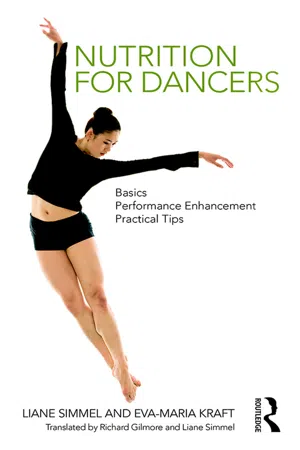
Nutrition for Dancers
Basics, Performance Enhancement, Practical Tips
- 180 pages
- English
- ePUB (mobile friendly)
- Available on iOS & Android
eBook - ePub
About this book
Information
1
The Basics – an Overview
Why do we eat? Science offers a clear answer to this question. Every second there are around 1030 chemical reactions going on in our bodies. Every day, around 600 thousand million cells die and just as many new ones are formed, seamlessly becoming part of the body’s systems. Dancing places even more demands on this system. Physical activity leads to micro-injuries in the tissues and raises the amount of waste products. Through complex biochemical processes, injured tissues are rebuilt, while the products of metabolism are removed and eliminated from the body. This can only happen with outside help. Through the food we eat, we give our bodies the necessary nutrients, provide it with sufficient energy and building blocks to build up and restructure tissue. But who is thinking of the metabolic process when biting into a juicy apple? For most people, it is the emotional satisfaction which dominates their choice of what, when, and how much they eat. In our society, many people tend to eat to be sociable or out of boredom, as a reward or to reduce stress, but rarely based on the basic human instinct of hunger.
Nutritional science casts light on the complexity of human nutrition. Foods are classified into different groups for simplicity’s sake, but nature’s diversity is not so easily represented by such straightforward compartmentalization. As in our body, different nutrients do not just affect us by way of their unique components, but rather, through their complexity and their symbiotic chemical effects. Only the combination of their macro- and micronutrients, their mixtures of carbohydrates, fats and proteins, along with minerals, vitamins and phytonutrients make foods the source of energy and building blocks for the human body, enabling the organism to absorb and optimally utilize the nutrients.
Table 1.1:An overview of the groups of nutrients
| Macronutrients | Carbohydrates |
| Fats | |
| Proteins | |
| Micronutrients | Vitamins (organic) |
| Minerals (inorganic): Macrominerals/trace elements | |
| Other nutritional elements | Phytonutrients |
| Fibre |
Dancing Requires Energy
Dancing is strenuous. The muscles work, the heart rate increases, the breathing quickens, and the nervous system is working at its peak. All these processes require energy. Yet the human organism cannot produce energy on its own. The only provision of energy for the body comes from feeding it. A body without food is like a car without gasoline – nothing works. And just as the tank in the car holds a reserve of power for the next trip, the human body also has its systems for storing energy for later use. That makes sense; without it, we would have to spend the whole day eating.
The body has two different systems for storing excess energy. Carbohydrates are stored in the form of glycogen; both in the liver and directly in the muscles themselves. This has its advantages, for it guarantees that the energy required to dance can be provided right where it is needed – in the muscles. Yet, unfortunately, the capacitiy for storing glycogen is rather limited, so the body has to rely on another way to store reserves for larger amounts of energy: adipose tissue – also known as body fat. If excess food is transformed into fat, it can be stored almost indefinitely for later uses. Body fat is our largest reserve of energy.
The body can extract energy directly from the digested food, or from its stored energy reserves. In both cases, energy is provided according to the same pattern. Energy is created by dividing the complex nutrients from ingested or stored food into smaller and smaller building blocks – a process also called ‘oxidation’. The body then uses the energy according to its needs; either for physical or mental activities, or simply for metabolic purpose. This is necessary because even when we rest, there are innumerable chemical processes taking place and our tissues are continually being restructured. When additional demands are made of the body, whether through exercising, because of an injury, or through physical growth, the body’s needs increase. For the necessary restructuring and growth processes, further energy and building blocks must be provided. If stored reserves are empty and energy cannot be provided quickly enough through the intake of food, the body tries to economize its energy; then important repairs are left undone and tissues are broken down.

Under normal conditions, the body follows clear guidelines. Energy that is needed quickly comes from the use of carbohydrates, and fat burning provides energy for slower or more long-term energy use. To use energy stored in proteins is rare. Only when there are no other reserves left and the body faces an extreme emergency, does the body break down its structural proteins.
Providing Energy – Oxygen Is the Key
Everyone knows that life needs oxygen. Yet what is less well known is that oxygen determines how and in what quantity the body produces its energy. The transformation of nutrients into energy takes place through two methods in the body: either by using oxygen – aerobic respiration, or without oxygen – anaerobic respiration. The type of strain on the body, its duration and the intensity, determine which of the two metabolic pathways will be used.
Low-intensity work over a longer period of time with a sufficient amount of oxygen in supply are the prerequisites for aerobic energy production. Slowly, in a complex process and in the presence of oxygen, carbohydrates, and – if the strain on the body lasts longer – fat will be burned to produce energy. The human body can easily deal with the accumulating waste products: water is excreted through the kidneys and carbon dioxide is exhaled from the lungs. This allows the muscles to work for a long time with less fatigue. Yet in dance, the body often faces other conditions: given the high-intensity workout and the short energy peaks required in numerous dance styles, the aerobic respiration process reacts too slowly and thus is of limited use.
This is when the body resorts to anaerobic energy production. This process can step in when the body quickly needs a large amount of energy but circulation and respiration cannot deliver oxygen fast enough. Unfor...
Table of contents
- Cover
- Half Title
- Title Page
- Copyright Page
- Endorsement
- Dedication
- Contents
- Getting Started
- 1 The Basics – an Overview
- 2 Drinking – Fluids Are Crucial
- 3 What? The Overwhelming Number of Choices
- 4 When? Timing Is Everything
- 5 How? Healthy Nutrition in the Daily Routine
- 6 Fit and Slim – a Challenge for Dancers
- 7 Tables of Foods and Nutrients
- Further Reading
- Useful Websites
- Acknowledgements
- About the Authors
- Index
Trusted by 375,005 students
Access to over 1.5 million titles for a fair monthly price.
Study more efficiently using our study tools.
Frequently asked questions
Yes, you can cancel anytime from the Subscription tab in your account settings on the Perlego website. Your subscription will stay active until the end of your current billing period. Learn how to cancel your subscription
No, books cannot be downloaded as external files, such as PDFs, for use outside of Perlego. However, you can download books within the Perlego app for offline reading on mobile or tablet. Learn how to download books offline
Perlego offers two plans: Essential and Complete
- Essential is ideal for learners and professionals who enjoy exploring a wide range of subjects. Access the Essential Library with 800,000+ trusted titles and best-sellers across business, personal growth, and the humanities. Includes unlimited reading time and Standard Read Aloud voice.
- Complete: Perfect for advanced learners and researchers needing full, unrestricted access. Unlock 1.5M+ books across hundreds of subjects, including academic and specialized titles. The Complete Plan also includes advanced features like Premium Read Aloud and Research Assistant.
We are an online textbook subscription service, where you can get access to an entire online library for less than the price of a single book per month. With over 1.5 million books across 990+ topics, we’ve got you covered! Learn about our mission
Look out for the read-aloud symbol on your next book to see if you can listen to it. The read-aloud tool reads text aloud for you, highlighting the text as it is being read. You can pause it, speed it up and slow it down. Learn more about Read Aloud
Yes! You can use the Perlego app on both iOS and Android devices to read anytime, anywhere — even offline. Perfect for commutes or when you’re on the go.
Please note we cannot support devices running on iOS 13 and Android 7 or earlier. Learn more about using the app
Please note we cannot support devices running on iOS 13 and Android 7 or earlier. Learn more about using the app
Yes, you can access Nutrition for Dancers by Liane Simmel,Eva-Maria Kraft in PDF and/or ePUB format, as well as other popular books in Medicine & Nutrition, Dietics & Bariatrics. We have over 1.5 million books available in our catalogue for you to explore.