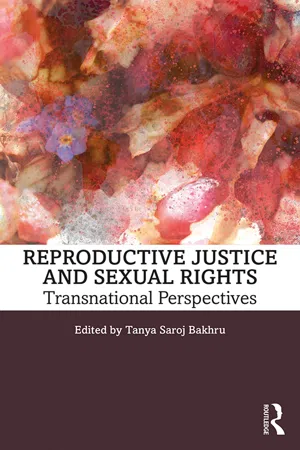
This book takes an intersectional, interdisciplinary, and transnational approach, presenting work that will provide the reader with a nuanced and in-depth understanding of the role of globalization in the sexual and reproductive lives of gendered bodies in the 21st century. Reproductive Justice and Sexual Rights: Transnational Perspectives draws on reproductive justice and transnational feminism as frameworks to explore and make sense of the reproductive and sexual experiences of various groups of women and marginalized people around the world. Interactions between globalization, feminism, reproductive justice, and sexual rights are explored within human rights and transnational feminist paradigms. This book includes case studies from Mexico, Ireland, Uganda, Colombia, Taiwan, and the United States. The edited collection presented here is intended to provide academics and students with a challenging and thought-provoking look into sexual and reproductive health matters from across the globe. In this way, the work presented in this volume will help the reader understand their own reproductive and sexual experiences in a more nuanced and contextualized way that links individuals and communities to each other in a quest for justice and liberation.
- 264 pages
- English
- ePUB (mobile friendly)
- Available on iOS & Android
eBook - ePub
About this book
Information
COLONIAL LEGACIES AND POST-COLONIAL CONDITIONS
1
WHITE PROPERTY INTERESTS IN NATIVE WOMEN’S REPRODUCTIVE FREEDOM
SLAVERY TO TRANSRACIAL ADOPTION
In 2017 at San José State University I, along with students from my classes, hung over 100 red dresses across campus to bring awareness to the missing and murdered Indigenous1 women in the United States, Canada, and Mexico. The REDress Project was started by Jamie Black to call attention to the more than 1,000 missing and murdered Aboriginal women in Canada. Many Indigenous communities suffer similarly high rates of murder and disappearance. In 2016, the National Congress of American Indians called for a day to acknowledge the missing and murdered Indigenous women in the United States, and, in 2017, United States Senate Resolution 60 was adopted to recognize May 5 as a “National Day of Awareness for Missing and Murdered Native Women and Girls” (United States Senate Resolution 401 (2018)).
The murder and disappearance of American Indian women is not new; it is indicative of a broader system of colonial violence. Unlike most ethnic groups, the majority of crimes committed against Native women and girls are perpetrated by non-Natives, which, as I will argue, can be understood as an outgrowth of white property interests that can be traced back to slavery. The bodily and reproductive violence that Indigenous women face can be understood, in part, as an investment in the state and white American property interest that denies Native American women, parents, and communities of reproductive autonomy. In particular, this chapter will focus on the removal of Native children from their mothers and communities as an act of reproductive violence linked to slavery.
Native children are the most overrepresented ethnic group in foster care and state-assisted adoption (Wildeman and Emanuel 2014; DeMeyer 2010; de Bourbon 2013; Unger 2004), with the highest racial disproportionality index of any group (Rosay 2016). The removal of 25–35 percent of Native children from their families is simultaneously a violation of an Indigenous people’s reproductive rights, a group-based harm against the community, and an investment in whiteness. The state-sanctioned infusion of whiteness with property interests over Native women’s reproductive freedom through the termination of parental rights and divestiture of children is tied to their historical entrapment in state-sanctioned systems of slavery. This chapter investigates how whiteness has been imbued with property rights vis-à-vis the control of Native women’s reproductive freedom through enslavement, indentured servitude, land dispossession, and the removal of children (for a more detailed analysis of these issues, see de Bourbon 2013).
The Framework of Whiteness
Although there is a body of literature on whiteness as it is entangled with property, only a few scholars carefully discuss whiteness and property in relation to Indigenous peoples. Moreton-Robinson’s (2015) work looks at several different aspects of investment in whiteness. In addition to Moreton-Robinson’s work, Harris’s (1993) seminal publication uses theories of property interest buttressed by case law to articulate how whites not only have feelings of entitlement, but actual legal claims over Black and Native peoples, which she traces back to slavery and conquest, respectively. Other scholars investigate the way property rights have been and continue to be asserted by the United States and the general public over Native cultures (Carpenter, Katyal, and Riley 2009; Moreton-Robinson 2015). It is important to note, as Moreton-Robinson (2015) does, many scholars address white property interests in Natives, but they do not name it as such (Deer 2010, 2015; Philip Deloria 1998; Deloria Jr. 1985, 2006; Deloria Jr. and Lytle 1983, 1998; Deloria Jr. and Wilkins 2011; Forbes 1993; Ramirez 2007; Ross 1998; Tayac 2009).
There are three scholars who specifically address white property rights as emanating from slavery: Deer (2010), Harris (1993), and Roberts (1997). Deer articulates the linkage of Native women’s reproductive control from slavery to the sex trade industry, noting that Native women “suffer sexual violence at the highest rate of any ethnic group within the United States” (624). Deer argues the disproportionate numbers of Native women in the sex trade today is not a new phenomenon but rather must be understood in relation to the history of Indigenous women’s enslavement. Deer’s work illustrates the need to continue the effort of relating the sexual exploitation of Native women’s reproductive freedom to their historical enslavement; however, her work does not specifically address how this history constituted a white property interest, or how the taking of Native children is part of the larger state-sanctioned investment in white property emanating from slavery. Like Deer, Harris and Roberts address pieces, but not the entirety, of how Native women’s reproductive control as a white property interest emanates from slavery.
Slavery: White Property Interests in Native Women’s Bodies
Until recently, there was widespread disavowal in historical literature of the existence of Indigenous slavery. The complex history of slavery was and often continues to be flattened into a biracial framework of African American enslavement and white ownership in order to maintain a cohesive narrative of bondage that does not deviate from previous prevailing notions of master/slave relations. To trouble this biracial dichotomy, a more nuanced scholarship of enslavement is required–one that includes the wholesale enslavement of certain Native groups; the slavery of Chinese women; un-free white labor; American Indian slaveholding (as in the Cherokee slavery of Africans); and the interchanges between Native and Black slaves under colonization, including, but not limited to, intermarriages. A number of scholars have begun to address the historical omissions (Brooks 2002; Carocci and Pratt 2012; Deer 2010, 2015; Ekberg 2007; Forbes 1993; Gallay 2009; Gonzales 2009; Halliburton 1977; Heizer 1993; Ingersoll 2005; Katz 1997; Littlefield 1978; Miles 2005; Miles and Holland 2006; Minges 2004; Naylor 2008; Perdue 2009; Stannard 1992; Sturm 2002; Tayac 2009; Yarbrough 2008).
For example, as Katz (1997) notes: “On both northern and southern American continents, Europeans enslaved Africans and Native Americans and drove both hard to pile up profits in the shortest possible time” (101). Another example shows how the Spanish maximized profits in Native slaves by marking their status as immutable:
[They] had their chattel status burned into their faces with branding irons that stamped them with the initials of their owners. When sold from one Spaniard to another, a replacement brand was made. Consequently, some slaves’ faces were scarred with two or three or four branding mutilations identifying them as transferable pieces of property.
(Stannard 1992, 84)
The branding of Indigenous slaves not only indicated white property interest on the part of the individual “owner,” but also inscribed the slave’s status as a transferable unit of property. White property interests were literally inscribed on their bodies. This history of brutality is often minimized by arguing that the number of Native slaves was small, yet this assertion is far from the truth. Millions of Indigenous people were captured, tortured, and enslaved: “[b]y 1542 Nicaragua alone had seen the export of as many as half a million of its people for slave labor” (Stannard 1992, 82). While this chapter does not address the whole myriad of slave relations, it does explore how whiteness was and continues to be invested with a property interest in Native women’s reproductive freedom: specifically, the right to claim ownership over Indigenous children.
It is important not to conflate the many colonial relationships that existed between Native nations and invading European nations from the sixteenth through the nineteenth centuries; it is also important to recognize—and can be said generally—that no colonizing relationship was “mutually beneficial” as some scholars have claimed (Jones et al. 2014; Anderson 2006). Although the French, English, and Americans entered into treaties and made alliances with Native nations, they did not do so in good faith and simultaneously violated those treaties by enslaving Indigenous women and girls for sexual exploitation (Deer 2010). Deer gives examples of the sexual exploitation of Native women under each colonizer, making it clear these relationships cannot be thought of as “mutually beneficial.”
This passage from the Daily Cleveland Herald in 1858 regarding frontiersmen “purchasing” Native women throughout the plains illustrates that the United States did not have a “mutually beneficial” relationship with Indigenous nations:
Almost every white man along this route has an Indian concubine purchased … When a white man gets tired of his slave-wife, he ships her off and gets another. The children of their union are totally neglected by their father and grow up as they may under the care of the mothers.
(“Squaw Slaves” 1858)
This passage underscores the extensive property rights white men exercised over Indigenous women through capture, rape, and ownership of Indigenous women and children. In addition to being able to control Native women’s bodies, white men were mandated by law to capture escaped Native and Black slaves throughout the United States and return them to their “owners.” Weller (2010) writes about the concept of capture, inquiring who has had, and continues to have, the right (or requirement) to capture, and who was, and is, “capturable.” Weller traces minority groups’ legal disenfranchisement to their status as “capturable”:
the move from legal human objecthood to legal human subjecthood is also a move from captured to captor. A mark of capturable remains on categories of humans who have been in the class of legal object, and removal of this mark is achieved only on an individual basis by those who are both able and willing to capture, able and willing to help police the border between human-person and nonhuman-thing-property, which is always already laced with race-class-gender-sexuality-ability determinations.
(53)
Weller’s notion of capture is useful when thinking through the property rights the state enjoined to white citizens over Native women’s bodies and children. When theorizing about Native people, it is fruitful to envisage the way the government has framed Native people as lacking subjecthood, as ownable— perpetually positioned as objects, as property of the white state and public— which would encapsulate a wide range of white investiture not only in bodies, but also in reproductive rights, language, culture, religion, land, human remains, and personhood.
Native and Black Entanglements Under Captivity
The idea of being ownable is particularly useful when thinking through Native enslavement in relationship to African slavery. It is important to note how the reproductive control of Native women mirrors and diverges from that of African American women under slavery. Although European enslavement of Indigenous peoples predates entrapment of African peoples on this continent, they should be read together for at least three reasons: (1) colonizers enslaved both diverse groups at the same time, even if initially on different continents, and there was intermixing between these communities while in bondage; (2) Native freedom was often read against Blackness; and (3) Native and Black peoples, although they have very different histories and lived experiences, continue to suffer the highest rates of overrepresentation in state apparatuses of control such as systems of punishment and the child welfare system. This overrepresentation of people of color in state systems of control thus constructs white people as inherently freer, particularly in terms of the right to have and raise their own children.
Confronting Native enslavement requires thinking through how the state thought of and treated Native peoples in relation to African peoples. The reading together of African and Native enslavement began as early as the sixteenth century under the auspices of scholarly debates over the humanity of Indigenous people; the best-known example was a debate between Gines de Sepulveda and Bartolome de Las Casas in 1550 (Mohawk 1992).
The two philosophers placed Native peoples within the existing racial hierarchy (many philosophers at this time thought Indigenous people were a missing link between men and apes).2 De Sepulveda argued that Natives did not have souls, were made by God to be in servitude, and were therefore “natural slaves.” In contrast, de Las Casas argued although Natives were “completely barbaric,” they nonetheless had souls and therefore could not be “natural slaves” (Stannard 1992; Robinson 1983). Although some historians laud de Las Casas for “standing up for Indians,” his solution was to replace Native slaves with a group both de Sepulveda and de Las Casas agreed were “natural slaves”—Africans—and that is exactly what the Spanish undertook (Robinson 1983). The introduction of African slavery did not obliterate Native slavery; it only meant that Natives and Africans would toil together under the same system of entrapment.
The debate between de Sepulveda and de Las Casas measured Native freedom against African enslavement, not against white freedom, and 200 years later, the framework continued to be argued in court cases in the United States brought by mixed lineage Indigenous slaves in the 1700s. These cases, often called freedom suits, are a site where white investments in capture and enslavement were visible and Native freedom continued to be framed against African enslavement. Many of the slave laws at this time could not account for people who were both Black and Native—a person was either Black or Native, but not both. This distinction proved to be precarious, given the complex relationships between Africans and Natives under captivity. Freedom suits can be seen not only as a site of resistance, where interrelations between communities became appreciable, but also as a domain where the state and white citizens calcified racial classifications in order to maintain their property interests by maintaining slavery and a system of white supremacy. These cases were directly linked to Native women’s freedom and the freedom of their children, in part because colonizers traced slave status matrilineally: “All and every Negro, Indian, Mulatto, or Mestee shall follow the state a...
Table of contents
- COVER
- HALF TITLE
- TITLE PAGE
- COPYRIGHT PAGE
- TABLE OF CONTENTS
- NOTES ON CONTRIBUTORS
- ACKNOWLEDGMENTS
- INTRODUCTION
- PART I: COLONIAL LEGACIES AND POST-COLONIAL CONDITIONS
- PART II: THE STATE, THE LAW, AND SEXUAL AND REPRODUCTIVE JUSTICE
- PART III: MIGRATION AND ACCESS TO CARE
- PART IV: GLOBALIZATION, REPRODUCTION, AND TRANSNATIONAL POLITICS
- INDEX
Trusted by 375,005 students
Access to over 1.5 million titles for a fair monthly price.
Study more efficiently using our study tools.
Frequently asked questions
Yes, you can cancel anytime from the Subscription tab in your account settings on the Perlego website. Your subscription will stay active until the end of your current billing period. Learn how to cancel your subscription
No, books cannot be downloaded as external files, such as PDFs, for use outside of Perlego. However, you can download books within the Perlego app for offline reading on mobile or tablet. Learn how to download books offline
Perlego offers two plans: Essential and Complete
- Essential is ideal for learners and professionals who enjoy exploring a wide range of subjects. Access the Essential Library with 800,000+ trusted titles and best-sellers across business, personal growth, and the humanities. Includes unlimited reading time and Standard Read Aloud voice.
- Complete: Perfect for advanced learners and researchers needing full, unrestricted access. Unlock 1.5M+ books across hundreds of subjects, including academic and specialized titles. The Complete Plan also includes advanced features like Premium Read Aloud and Research Assistant.
We are an online textbook subscription service, where you can get access to an entire online library for less than the price of a single book per month. With over 1.5 million books across 990+ topics, we’ve got you covered! Learn about our mission
Look out for the read-aloud symbol on your next book to see if you can listen to it. The read-aloud tool reads text aloud for you, highlighting the text as it is being read. You can pause it, speed it up and slow it down. Learn more about Read Aloud
Yes! You can use the Perlego app on both iOS and Android devices to read anytime, anywhere — even offline. Perfect for commutes or when you’re on the go.
Please note we cannot support devices running on iOS 13 and Android 7 or earlier. Learn more about using the app
Please note we cannot support devices running on iOS 13 and Android 7 or earlier. Learn more about using the app
Yes, you can access Reproductive Justice and Sexual Rights by Tanya Saroj Bakhru in PDF and/or ePUB format, as well as other popular books in Social Sciences & Feminism & Feminist Theory. We have over 1.5 million books available in our catalogue for you to explore.