Winner of the 2010 Distinguished Book Award from the American Sociological Association; Sex and Gender Section
2009 Choice Outstanding Academic Title
An important work documenting how the criminal justice system polices women's reproductive capacity
The intense policing of women's reproductive capacity places women's health and human rights in great peril. Poor women are pressured to undergo sterilization. Women addicted to illicit drugs risk arrest for carrying their pregnancies to term. Courts, child welfare, and law enforcement agencies fail to recognize the efforts of battered and incarcerated women to care for their children. Pregnant inmates are subject to inhumane practices such as shackling during labor and poor prenatal care. And decades after Roe, the criminalization of certain procedures and regulation of abortion providers still obstruct women's access to safe and private abortions.
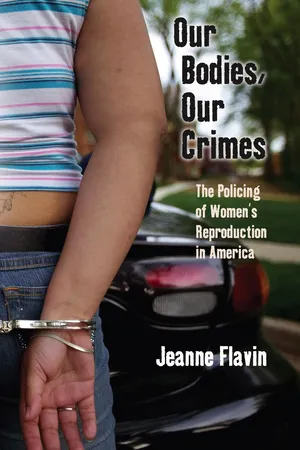
In this important work, Jeanne Flavin looks beyond abortion to document how the law and the criminal justice system police women's rights to conceive, to be pregnant, and to raise their children. Through vivid and disturbing case studies, Flavin shows how the state seeks to establish what a "good woman" and "fit mother" should look like and whose reproduction is valued. With a stirring conclusion that calls for broad-based measures that strengthen women's economic position , choice-making, autonomy, sexual freedom, and health care, Our Bodies, Our Crimes is a battle cry for all women in their fight to be fully recognized as human beings. At its heart, this book is about the right of a woman to be a healthy and valued member of society independent of how or whether she reproduces.
- 288 pages
- English
- ePUB (mobile friendly)
- Available on iOS & Android
eBook - ePub
About this book
Information
Topic
Ciencias socialesSubtopic
CriminologíaBeginning
1
“Race Criminals”
Reproductive Rights in America
The man or woman who deliberately foregoes [the supreme blessings of children] whether from viciousness, coldness, shallow-heartedness, self-indulgence, or mere failure to appreciate aright the difference between the all-important and the unimportant,—why, such a creature merits contempt as hearty as any visited upon the soldier who runs away in battle, or upon the man who refuses to work for the support of those dependent upon him, and who tho able-bodied is yet content to eat in idleness the bread which others provide. The existence of women of this type forms one of the most unpleasant and unwholesome features of modern life.
—President Theodore Roosevelt, in a speech delivered before
the National Congress of Mothers, March 13, 1905
the National Congress of Mothers, March 13, 1905
What is the problem of women’s freedom? It seems to me to be this: how to arrange the world so that women can be human beings, with a chance to exercise their infinitely varied gifts in infinitely varied ways, instead of being destined by the accident of their sex to one field of activity—housework and child-raising.
—Crystal Eastman, “Now We Can Begin,” December 1920
To illustrate more than 200 years of reproductive rights history in the United States, one might imagine drawing a line that begins when abortion was a widely deplored crime. Our line would then move steadily up and on to the 1960s when women’s sexual liberation gained more attention and helped abortion become more widely accepted. Naturally, our line would culminate in the progressive present when abortion is legal and our laws and policies reflect widespread acceptance and respect for all women’s reproductive rights.
One might imagine such a line, but one would be very, very wrong.
This book focuses mainly on the contemporary context of the struggle for reproductive justice; however, in this chapter I sketch a very broad historical overview of this struggle. The history of abortion and, indeed, the entire history of reproductive rights is not a straight line but one that is uneven and jagged, to say the least. In particular since the 1980s, reproductive rights have eroded steadily, and today is hardly a zenith, especially for low-income racial and ethnic minority women. We need more than one line to capture the erratic attitudes and actions of medical and legal professionals, not to mention politicians, activists, and the general public. Nor can a single line record all of the institutional sites where this control takes place. The regulation of women’s reproduction has a long history, one that has always been tied up in larger societal concerns about the “right” people reproducing in the “right” ways. To that end, I look not only at the battle over abortion but also the eugenics campaigns of the twentieth century.
Abortion and the Crusade against Quack Doctors
Most people are aware that abortion used to be considered a crime in the United States. Far fewer realize that at the beginning of the nineteenth century, abortion was essentially legal in America and first-trimester abortions (and many second-trimester abortions) faced little regulation.1 Abortion before quickening (or the point usually occurring during the fourth and the sixth months when a woman can feel fetal movement) was considered, at most, a misdemeanor. In the 1820s, a handful of state statutes were introduced that punished abortion after quickening.2
In the early nineteenth century, abortion was practiced mainly by unmarried and desperate women. By 1840, however, married, middle-class or upper-middle-class, native-born Protestant women were increasingly using abortion to control the spacing and number of their children.3 By the middle of the century, abortion had become fairly common. Possibly as many as one-fifth to one-third of all pregnancies in the early and mid-nineteenth century ended in abortion.4 Then, in the 1870s, the tenor shifted, and grisly accounts of botched abortions began to appear more and more frequently in newspapers.5 By 1900, every state had passed a law criminalizing abortion at any stage of pregnancy, unless it was required to save a woman’s life.
What accounts for the rapid change? Abortions had not suddenly become unsafe. Rather, the shift reflected in large part a campaign generated by elite or “regular” physicians who opposed abortion and birth control use among middle-class “native” Protestant women. These physicians preyed on growing fears of race suicide and the higher fertility rates of poor, foreign-born, and predominantly Catholic women.6
Regular physicians used abortion to suit their own ambitions—that is, they wanted to become recognized as professionals.7 In nineteenth-century America, anyone who claimed medical talent could practice medicine. Physicians who had some formal training and subscribed to the medical model found themselves competing with midwives, healers, botanics, homeopaths, and out-and-out quacks who—in the absence of licensing laws—also could claim the title of “doctor.” To address this problem, professional physicians launched what one headline heralded as a “Crusade against Quack Doctors.” An 1876 New York Times article announced the New York County Medico Society’s crusade against “the hundreds of quacks, abortionists, and all sorts of irregular medical practitioners whose names, prefixed by “Dr.,” adorn the house-fronts on almost every street in the City.”8 The crusading doctors focused on abortion, successfully pressing to outlaw it unless it was necessary to save a woman’s life and declaring that only doctors would decide when abortion was permitted.9 Physicians presented themselves as being obligated to save women from the ignorance that led them to become inadvertent murderesses.10
Even after abortion was criminalized, most nineteenth-century laws included a therapeutic exception that allowed abortions when physicians deemed it necessary to save a woman’s life. Doctors did not forbid abortions absolutely because a complete ban on abortions would not have advanced their own professional goals. Making a moral claim (“We are saving the lives of unborn embryos”) based on technical expertise (“Only we can determine when a pregnant woman’s life is in jeopardy”) also prevented other interested parties, such as lawyers, clergy, and women, from challenging doctors’ asserted right to control abortion.11 At the time, feminists were more concerned about promoting voluntary motherhood (including the right of a woman to refuse to sexually submit to her husband) and reducing death in childbirth than with abortion.12 Without an effective challenge to the medical profession’s control of abortion, the public came to accept, and continues to do so, even today, the legitimacy of doctors’ decision-making in the area of abortion (not to mention pregnancy and childbirth).13 As a result, a personal decision has become a medical one.14
The laws at the time mainly criminalized abortion providers. As Rosalind Pollack Petchesky observes in Abortion and Woman’s Choice, “Laws criminalizing abortion in the latter half of the nineteenth century did not suppress abortion as much as they revealed it, regulated it, certified it as a legitimate domain of public intervention and control.”15 Up until 1940, prosecutors focused specifically on abortion providers whose practices killed or seriously injured a woman patient. Relatively few people were ever charged under the abortion laws, and when they were charged, jurors were reluctant to convict them. When abortion providers were convicted, punishments were lenient and often included probation.16 Some state laws did not specify any punishment at all for women who sought abortions. In 1934, the punishment for women who had abortions ranged from fines of $100 to $1,000, and periods of incarceration ranged from 30 days to 10 years.17 The lack of consistency in enforcing the existing laws or pursuing prosecution or serious punishment suggests an ambivalence toward the practice.18 In spite of abortion’s illegality, large numbers of early-twentieth-century women were still able to obtain abortions from physicians and midwives.
The Depression, Physicians, and “Back-Alley Butchers”
Over time, proportionally fewer abortions were performed out of medical necessity. Between World War I and World War II, medical advances meant that fewer conditions (such as tuberculosis or cardiovascular disease) could be considered as indications that an abortion was necessary to save a woman’s life. Also, as physicians became more comfortable with their professional status, they relaxed their standards about performing abortions. They performed abortions not only when a woman’s life was in danger but also when her offspring might be deformed or when they sympathized with her plight—for example, if she was poor or the victim of rape or incest.
The Great Depression of the 1930s brought the relationship between economics and reproduction into stark relief. Unable to afford to have children, women sought abortions on a massive scale.19 Legal and illegal abortion practices expanded as women appealed to doctors for help. Increasingly, physicians considered social conditions in making medical decisions about which abortions were “therapeutic,” that is, necessary to preserve a woman’s life or health.20
During the same period, the site of medical care (including minor surgical procedures such as early abortions) was shifting from midwives’ practices and private physicians’ offices to hospitals.21 This trend accelerated after World War II. Accompanying this shift was greater public awareness and oversight of the medical processes taking place in hospitals.22 Hospital administrators feared that their facilities would develop reputations as abortion mills. In the 1940s and 1950s, they began to introduce therapeutic abortion boards to determine whether an abortion was justified.23 Typically, these boards encouraged doctors to keep the incidence of abortion low. The institutional support that these boards provided took the pressure off individual physicians whose abortion decisions might be challenged.24
Physicians and hospital boards were more likely to accommodate white middle-class women’s requests for a therapeutic abortion.25 Poor and minority women and women in rural areas were much more likely than their white, middle-class, and urban counterparts to patronize more dangerous and inexpensive illegal abortion providers.26 Many poor women’s lack of ties to an informal network prevented them from finding a provider. They were compelled to either give birth or attempt self-abortion, at times with fatal or life-threatening consequences.27 Fear led many women to defer seeking help, which made illegal abortions even riskier.28 Those poor and minority patients who did receive a therapeutic abortion were more likely to be involuntarily sterilized. Basically, a few therapeutic abortions became legal, while poor women’s access to abortion was restricted further. Non-therapeutic abortions became criminalized and harder to procure, even through physicians operating a private practice.29
Within a section of the medical profession, however, doctors came to form a liberal consensus about the horrors of criminalized abortion and the importance of performing abortions for those patients who needed them. Hospitals were increasing the sites where abortions took place and where women sought treatment for medical complications from illegal abortions. Doctors’ awareness of the disastrous consequences of abortion laws grew.30 Eventually, their concern led them to form an uneasy alliance with a grassroots social movement led by women that contributed to abortion’s legalization.31
“Race Criminals” and the Eugenics Movement
The eugenics movement of the first decades of the twentieth century underscored the notion that some women’s reproductive capacity was more valuable than others. In the 1920s, many (though not all) Progressives in America promoted a eugenics agenda that they claimed would ensure the health of the “native” white European Protestant population.32 African Americans, immigrants, and the working class were perceived to be present in growing numbers. So, too, were what President Theodore Roosevelt called “race criminals”—white middle-class women of “good stock” who chose not to have children.33 Women were reproducing, but it was the “wrong” women, those deemed unworthy of reproduction who came from dubious genetic origins.
Eugenics advocates played into fears of “race suicide” by advancing the notion that not only were immigrant women intellectually and morally inferior but they also could pass on deviant traits to their many offspring. At the same time as physicians encouraged native women to reproduce, they launched a program designed to limit the propagation of the poor, the foreign-born, and the so-called unfit.34 Toward those ends, eugenicists encouraged white Protestant women to have children and steer clear of birth control and abortion (i.e., “positive eugenics”). While abortions were discouraged among white Protestant women, eugenics advocates promoted a campaign to limit the fertility of poor and...
Table of contents
- Cover Page
- Title page
- Copyright page
- Dedication
- Contents
- Introduction
- PART I Beginning
- PART II Begetting
- PART III Bearing
- PART IV Mothering
- Conclusion: Being
- Notes
- Bibliography
- Acknowledgments
- Index
- About the Author
Trusted by 375,005 students
Access to over 1.5 million titles for a fair monthly price.
Study more efficiently using our study tools.
Frequently asked questions
Yes, you can cancel anytime from the Subscription tab in your account settings on the Perlego website. Your subscription will stay active until the end of your current billing period. Learn how to cancel your subscription
No, books cannot be downloaded as external files, such as PDFs, for use outside of Perlego. However, you can download books within the Perlego app for offline reading on mobile or tablet. Learn how to download books offline
Perlego offers two plans: Essential and Complete
- Essential is ideal for learners and professionals who enjoy exploring a wide range of subjects. Access the Essential Library with 800,000+ trusted titles and best-sellers across business, personal growth, and the humanities. Includes unlimited reading time and Standard Read Aloud voice.
- Complete: Perfect for advanced learners and researchers needing full, unrestricted access. Unlock 1.5M+ books across hundreds of subjects, including academic and specialized titles. The Complete Plan also includes advanced features like Premium Read Aloud and Research Assistant.
We are an online textbook subscription service, where you can get access to an entire online library for less than the price of a single book per month. With over 1.5 million books across 990+ topics, we’ve got you covered! Learn about our mission
Look out for the read-aloud symbol on your next book to see if you can listen to it. The read-aloud tool reads text aloud for you, highlighting the text as it is being read. You can pause it, speed it up and slow it down. Learn more about Read Aloud
Yes! You can use the Perlego app on both iOS and Android devices to read anytime, anywhere — even offline. Perfect for commutes or when you’re on the go.
Please note we cannot support devices running on iOS 13 and Android 7 or earlier. Learn more about using the app
Please note we cannot support devices running on iOS 13 and Android 7 or earlier. Learn more about using the app
Yes, you can access Our Bodies, Our Crimes by Jeanne Flavin in PDF and/or ePUB format, as well as other popular books in Ciencias sociales & Criminología. We have over 1.5 million books available in our catalogue for you to explore.