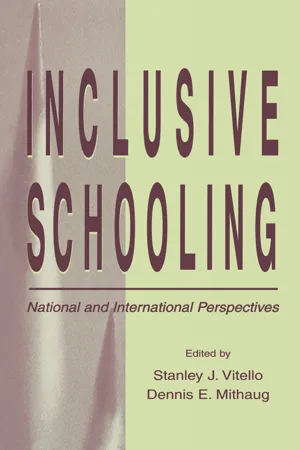
This book provides new information on how various inclusion policies have been implemented in different schools and school districts in North America and in a range of European countries.
The purpose of inclusion policy is to prevent the marginalization of people who experience unfavorable circumstances in life. It is an approach to the education of students with disabilities that is based on a commitment to what all members of a free society deserve in order to become fully participating members--a fair chance to find a meaningful place in their own communities.
This book is a kind of status report on what inclusive education has achieved and what it may achieve in the future for children and youth with disabilities. It describes the philosophical, legal, and practical terrain covered by inclusion policy in general and inclusive schooling in particular. Contributors assess inclusion policy and suggest ways to reconceptualize it, bringing to their data analysis a depth of experience and knowledge about public schooling in their respective countries.
Although inclusion of students with disabilities in general education classes has been embraced by politicians and educators calling for equal opportunity in our society and is being incorporated into national and international education laws, it continues to be controversial and the debate is sometimes heated. A goal of this book is to shed some light on this debate. Is inclusion mostly about student placement? Are students with disabilities attaining social and learning membership in general classrooms? Have they benefitted from inclusion? How about students without disabilities? What have been the benefits? Must learning take second priority to socialization and friendship? Are teachers getting the training they need? How do parents feel about inclusion programs? How do students feel? What kind of curricular accommodations should be made? These and other questions are addressed.
This volume is based on original papers presented by the contributing authors in October 1997 at the Rutgers Invitational Symposium on Education on Inclusive Schooling: National and International Perspectives.
eBook - ePub
Inclusive Schooling
National and International Perspectives
- 202 pages
- English
- ePUB (mobile friendly)
- Available on iOS & Android
eBook - ePub
About this book
Information
1
The Alternative to Ideological Inclusion
Columbia University
In 1954 when the Warren Court ruled in Brown v. Board of Education that a separate education was an unequal education, Americans were introduced to the moral principle that no person should be left out of the mainstream of society’s opportunities because of race, poverty level, or disability. In the decades following Brown, four innovative social experiments were constructed to reflect the inclusion ideal. They included a busing experiment to desegregate the public schools, an affirmative action experiment to eliminate discrimination in employment, a welfare rights experiment to reduce the harm caused by poverty, and a special education experiment to include disabled children in the mainstream of public schooling.
The events leading to the busing experiment were set in motion in 1964 when Congress enacted Section 402 of the Civil Rights Act that authorized the commissioner of education to conduct a national survey to determine the condition of inequality in U.S. schools. James Coleman directed that survey of 4,000 elementary and secondary schools and found that African-American and Puerto Rican students enrolled in segregated schools performed lower on standardized achievement tests than White and Asian students in nonsegregated schools. He concluded that school integration across socioeconomic lines would increase the achievement of African-American students (Coleman, 1990). This was the basis for the nation’s first experiment with inclusion policy: mandatory busing to desegregate the public schools.
During the same period, a second experiment was conducted to reduce the social unrest that began in 1965 when nearly 100,000 African-Americans participated in riots in the Watts section of southern Los Angeles. The riots lasted 6 days and resulted in 34 deaths, more than 1,000 injuries, and 4,000 arrests. The riots that followed Watts motivated business leaders, to advocate racial hiring to defuse social unrest (cited in Skrentny, 1996). Alfonso J. Cervantes argued in the Harvard Business Review that “If the businessman does not accept his role as leader in the push for the goals of the ‘Great Society’ … we will be increasingly smothered by a growing welfare state ridden with riots and arson and spreading slums largely unchecked by the proliferating programs for the unemployed poor” (Skrentny, 1996, p. 89). Wharton School professor Herbert Northrup agreed, claiming that “The more educated, the more experienced, and more integrated the Negro labor force becomes, the less tension and the fewer problems we’ll have in this country. … Industry in this country cannot survive with an unintegrated, angry minority” (cited in Skrentny, 1996, p. 90). And President Lyndon Johnson added to this growing belief that including “left-out” people in employment would eliminate social unrest. “You can put these people to work … you won’t have a revolution because they’ve been left out. If they’re working, they won’t be throwing bombs in your homes and plants. Keep them busy and they won’t have time to burn your cars” (cited in Skrentny, 1996, p. 91). An affirmative action policy emerged from the ashes of Watts to constitute the nation’s second experiment with inclusion.
The third experiment began in the late 1960s and early 1970s when the federal government expanded its commitment to support the poor by easing eligibility requirements for Aid to Families with Dependent Children (AFDC), by giving food stamps to the poor, providing a guaranteed minimum income for the elderly and disabled through Supplemental Social Security, and establishing a national health insurance program for welfare recipients and the elderly under the Medicaid and Medicare programs (Katz, 1989). Advocates for the poor sustained these entitlements in the courts, which resulted in increased benefits to hundreds of thousands of poor women and their children (Katz, 1989). This was the nation’s third experiment with inclusion.
The fourth experiment began on the heels of PARC v. The Commonwealth of Pennsylvania (1971) and Mills v. Board of Education (1972), which established the legal claim that no child should be denied a public education due to mental, behavioral, physical, or emotional disabilities (Scheerenberger, 1983). In 1975, Congress followed this precedent and that established by various state laws mandating public education for disabled children by enacting Public Law 94–142, which guaranteed a free and appropriate public education (FAPE) in the least restrictive environment (LRE) for all children with disabilities. This last of the four great inclusion experiments welcomed the most vulnerable of the country’s children into the mainstream of U.S. education opportunity.
The new beliefs supporting these experiments provided a moral and theoretical foundation for arguing that the country’s educational, occupational, and social security benefits should be available to all Americans regardless of their circumstances. This altered perhaps forever our concept of what it means to be a person in a democratic society based on the ideals of freedom and equality. No longer was it acceptable for the majority to allow members of a minority to be excluded due to circumstances of race, poverty, or disability. The emerging consensus among policymakers was that any institutional practice that marginalized or excluded individuals or groups on these grounds was wrong and was to be prohibited. The significance of this claim was its justification by the inclusion ideal, which was now on a par with the ideal of equal freedom in the formulation of social policy. After all, what does it mean to promise the right to self-determination for all when some are systematically excluded from experiencing that right?
The Results
Unfortunately, these experiments did not turn out as hoped. By the 1970s, Coleman’s follow-up study on the school desegregation policy revealed negative effects on the White population. He concluded that “In the large cities (among the largest 22 central-city school districts) there is a sizable loss of whites when desegregation takes place.” And that, “In addition to the effects of desegregation on white loss, both the absolute proportion of blacks in the central city and their proportion relative to those in the surrounding metropolitan areas have strong effects on loss of whites from the central-city district” (Coleman, 1990, p. 193). Even more problematic for Coleman was his finding that desegregation had marginal effects on the achievement of Black students. “In general, these results can be summarized by saying that achievement benefits of school desegregation for blacks are sometimes found, sometimes not, and where they are found, are generally small, much smaller than would have been predicted from the Coleman report.” Finally, Coleman (1990) concluded that “the psychological effects (such as effect on self-esteem) and the attitudinal effects (such as interracial attitudes) of school desegregation are not uniformly in a positive direction, and are sometimes negative” (pp. 200–201).
The special education experiment also produced mixed results. In 1983, Glass evaluated the performance gains of students with disabilities enrolled in regular and special classes and found no significant differences, which suggested that the specialized instruction students received had not produced measurable benefits. Also during that year, a colleague and I conducted a statewide follow-up study of special education students who graduated from Colorado schools and found they were under-employed, underpaid, and overly dependent on parents and family (Mithaug & Horiuchi, 1983). A follow-up interview with their parents indicated that these students were unable and perhaps unwilling to pursue their own ends in life. Most of them lived at home awaiting direction from others about what to expect and what to do (Mithaug, Horiuchi, & McNulty, 1987). Other statewide follow-up studies reported similar findings (Hasazi, Gordon, & Roe, 1985; Wehman, Kregel & Seyfarth, 1985).
By the 1990s, the collateral effects of the special education system were also revealed. A 1993 cover issue of U.S. News & World Report was entitled “Separate and Unequal: How Special Education Programs Are Cheating Our Children and Costing Taxpayers Billions Each Year.” A year later The New York Times ran an article entitled “Special Education Absorbs School Resources,” (Dillon, 1994b) which reported that “It costs $6,394 to educate a student in a conventional classroom in New York City, while each special education student costs $19,208.” The article noted that the special education system had “grown unchecked for 20 years, starting from an enrollment of 20,000 students in 1974 [one year prior to the passage of PL 94-142] to today’s 130, 037, about 13 percent of the city’s one million schoolchildren. With its $1.67 billion budget, special education has become a Cadillac in a school system of broken-down Fords” (Dillon, 1994a p.A1, B5). And a subsequent article concluded that the New York City “Board of Education has allowed special education and bilingual programs to develop bloated payrolls, draining money from students in regular classrooms” (Dillon, 1994, p. A1).
The welfare experiment was also evaluated in the 1980s by Murray (1994), who reported on the relation between welfare policy and poverty, unemployment, wages, education, crime, and family well–being. In Losing Ground: American Social Policy 1950–1980, Murray concluded that welfare policy had little if any effect on reducing much less eliminating poverty. In fact, declines in poverty were greater between World War II and the 1960s than they were during the 1970s when the policy was in effect. Murray argued that the policy had deleterious effects on the poor: It contributed to the decline in two-parent families among Blacks, increased crime rates among Black males, and increased illegitimate Black births to unmarried women. Mead (1986) drew a similar conclusion in Beyond Entitlement: The Social Obligations of Citizenship.
Starting in the late 1960s, black single mothers and their children went on AFDC in large numbers, making welfare the economic mainstay of ghetto communities around the nation. Black reliance on government thus increased dramatically. In 1969 black families living in poverty still drew 63 percent of their income from their own earnings and 37 percent from other sources, mainly government income programs. By 1976 the proportions had more than reversed, with 65 percent of poor blacks’ income now coming from outside sources and only 35 percent from earnings. The proportion of their income coming from welfare doubled from 22 to 44 percent. Black use of other income programs also increased. By 1973 nearly three-fifths of all black families received unearned income from some source, usually from government, and a quarter of them were on welfare. (p. 40)
Affirmative action policy, the last of the four inclusion experiments to be challenged, was promoted by the federal government and adhered to on a voluntary basis in education and industry throughout the 1970s and 1980s. Although some claimed it was successful and should end, that it failed and should end, or that it was partially successful and should continue, many believed it was discriminatory and hence, unfair (Bergmann, 1996). In 1978, Allan Bakke won this argument before the Supreme Court in a claim that the University of California Medical School had unfairly denied him admission in favor of less qualified Black applicants. This judgment was reaffirmed in 1995 when a federal appeals court disallowed a University of Maryland Blacks-only scholarship, when the Supreme Court curtailed a minority set-aside program that had been awarded road-building jobs to minority-owned business on the basis of racial inequality, and then in 1996 when a federal appeals court ruled in Hopwood v. Texas that race could not be used as a factor in college admissions (Newsweek, 1996). Later that year, California voters approved Proposition 209, which prohibited the state from discriminating against or granting preferential treatment to any person or group in public employment, education, or contracting. In 1997, the U.S. Court of Appeal for the Ninth Circuit in San Francisco upheld Proposition 209 and the Supreme Court refused an emergency request to block California from enforcing it (Greenhouse, 1997).
The Aftermath
By now it should be apparent that the inclusive society as conceived by the policymakers of the 1960s and 1970s is not going to happen. There have been too many policy failures and unexpected negative consequences in the last decade. Consider this sampling. School desegregation policy failed to desegregate the nation’s schools and to improve school achievement of Black students, but it did produce White flight from the inner city to the suburbs. Special education failed to improve learning or employment outcomes for students with disabilities but it did produce a separate system of public education that competed successfully with regular education for school dollars. Welfare assistance to poor single mothers failed to eliminate poverty, but it did increase the number of single mothers depending on welfare for long-term support. Affirmative action failed to equalize wages among White and Black men and women, but it did produce a White backlash to eliminate race-based preferences in employment and in higher education admissions.
What happened during these great experiments is that the value of inclusion came into conflict with other values Americans held just as dearly—freedom and equality. When Blacks were forcibly integrated in predominately White schools, for example, many White families acted on their freedom of association and moved to the suburbs. When special education policy provided a new system of services for students with disabilities, it provided separate and unequal educational resources for those students. When welfare benefits were extended to include more poor people under the protective parameters of a national safety net, many recipients of that new protection chose to remain where they were rather than to risk entering the mainstream of competitive employment. Finally, when affirmative action policies were enacted to equalize opportunities for education and employment for Blacks, Whites claimed they were treated unequally and hence unfairly by the practice of reverse discrimination.
Clearly, the desire to include left-out members in the mainstream of community life was not the only value influencing support for inclusion policies during the post-1970s era. Because if it were, there would have been nothing to prevent policymakers from constraining the liberty of Whites by prohibiting them from moving to the suburbs. There would have been no reason to claim that spending more on special education students than regular education students was unfair. There would have been no reason to claim that working poor people who struggle to support themselves were morally superior to poor people who lived on welfare. And there would have been no claim of unequal treatment among those already in the mainstream because they were denied those opportunities promised to people often excluded from the mainstream.
Ideological Inclusion
By the 1990s, this troubling debate over the inclusion of left-out groups polarized along ideological lines that were defined by welfarism, liberalism, conservatism, and libertarianism. Welfarists and liberals argued that social policy should maximize the inclusion of left-out people; whereas conservatives and libertarians argued that social policies should minimize the exclusion of left-out people. Although all four ideological groups acknowledged that inclusion was a moral ideal toward which society should evolve, each group proposed a different means of reaching that end. Proinclusion advocates insisted the ideal be reached by guaranteeing that all members have opportunities to participate and that all members be protected from hardship, whereas antiexclusion advocates insisted the inclusion ideal be reached by demanding that all new members be of good character and that they be meritorious. Each is considered in turn here.
The proinclusion argument we hear from liberals in today’s debates about helping the needy is that individuals who are left out of the mainstream of society’s social and economic life have been denied opportunities to participate due to gender, race, or ethnic origin. Because this is unfair, the collective should take action to prevent the harm caused by this type of discrimination. Good societies do this routinely because they are based on the belief that every person is of equal moral worth. Consequently, every person deserves to be protected from unfair obstacles to living the rewarding life, as Galbraith (1996) explained in The Good Society: The Humane Agenda.
If put in sufficiently general terms, the essence of the good society can be easily stated. It is that every member, regardless of gender, race or ethnic origin, should have access to a rewarding life. Allowance there must be for undoubted differences in aspiration and qualification. Individuals differ in physical and mental facility, commitment and purpose, a...
Table of contents
- Cover
- Half Title
- Title Page
- Copyright Page
- Table of Contents
- Acknowledgments
- Foreword
- Preface
- 1. The Alternative to Ideological Inclusion
- 2. The Law on Inclusion
- 3. Changing Tactics: Embedding Inclusion Reforms Within General Education Restructuring Efforts
- 4. The Inclusion of Students With Disabilities in School Reform and Restructuring: An Analysis of Five Local School Districts
- 5. Characteristics of Elementary School Classrooms Where Children With Moderate and Severe Disabilities are Included: A Compilation of Findings
- 6. Factors for Successful Inclusion: Learning from the Past, Looking toward the Future
- 7. Parents and Inclusive Schooling: Advocating for and Participating in the Reform of Special Education
- 8. Inclusion Practices in Canada: Social, Political, and Educational Influences
- 9. Challenges to Inclusive Education: A European Perspective
- 10. Inclusion Implementation and Practices In Scandinavia
- Author Index
- Subject Index
Trusted by 375,005 students
Access to over 1.5 million titles for a fair monthly price.
Study more efficiently using our study tools.
Frequently asked questions
Yes, you can cancel anytime from the Subscription tab in your account settings on the Perlego website. Your subscription will stay active until the end of your current billing period. Learn how to cancel your subscription
No, books cannot be downloaded as external files, such as PDFs, for use outside of Perlego. However, you can download books within the Perlego app for offline reading on mobile or tablet. Learn how to download books offline
Perlego offers two plans: Essential and Complete
- Essential is ideal for learners and professionals who enjoy exploring a wide range of subjects. Access the Essential Library with 800,000+ trusted titles and best-sellers across business, personal growth, and the humanities. Includes unlimited reading time and Standard Read Aloud voice.
- Complete: Perfect for advanced learners and researchers needing full, unrestricted access. Unlock 1.5M+ books across hundreds of subjects, including academic and specialized titles. The Complete Plan also includes advanced features like Premium Read Aloud and Research Assistant.
We are an online textbook subscription service, where you can get access to an entire online library for less than the price of a single book per month. With over 1.5 million books across 990+ topics, we’ve got you covered! Learn about our mission
Look out for the read-aloud symbol on your next book to see if you can listen to it. The read-aloud tool reads text aloud for you, highlighting the text as it is being read. You can pause it, speed it up and slow it down. Learn more about Read Aloud
Yes! You can use the Perlego app on both iOS and Android devices to read anytime, anywhere — even offline. Perfect for commutes or when you’re on the go.
Please note we cannot support devices running on iOS 13 and Android 7 or earlier. Learn more about using the app
Please note we cannot support devices running on iOS 13 and Android 7 or earlier. Learn more about using the app
Yes, you can access Inclusive Schooling by Stanley J. Vitello,Dennis E. Mithaug in PDF and/or ePUB format, as well as other popular books in Pedagogía & Educación general. We have over 1.5 million books available in our catalogue for you to explore.