There is endless talk about the need for an urban renaissance; can it happen in the real world? In this broad, challenging and highly engaging book, Nicholas Schoon argues that the foremost priority for regeneration is to make neighbourhoods and cities places where people with choices choose to live.
The author surveys the last two centuries of metropolitan growth and decay, analyzes the successes and failures of recent changes in urban policy and proposes a wide range of radical measures to make the renaissance a reality. Comprehensively researched, The Chosen City is a wake up call for everyone interested and involved in urban regeneration - degree students and academics, planning and housing professionals, architects, surveyors, developers and politicians. The text is illustrated with powerful black and white images from a leading national newspaper photographer.
- 384 pages
- English
- ePUB (mobile friendly)
- Available on iOS & Android
eBook - ePub
The Chosen City
About this book
Information
Chapter 1: THE ABANDONED CITY
Hayes still remains clean and tidy with good schools, plenty of parks, but gradually the area has become less friendly and the spread from London seems to be drifting our way. Within five years we will have moved further into Kent to give our children a better start in life.
I feel safe, secure and contented here but I don’t like to dwell on the fact that we are only a few miles away from troublesome areas. If this was to encroach upon my immediate area, I would move further out.
Residents of Hayes, a suburb on the rim of south-east London
We talked pleasantly enough, until I told him that Moses’ road was going to blow every trace of both of our childhoods away. Fine, he said, the sooner the better; didn’t I understand that the destruction of the Bronx would fulfil the Bronx’s own basic moral imperative? ‘What moral imperative?’ I asked. He laughed as he bellowed in my face: ‘You want to know the morality of the Bronx? Get out, schmuck, get out!’ For once in my life I was stunned into silence. It was the brutal truth: I had left the Bronx, just as he had, and just as we were all brought up to, and now the Bronx was collapsing not just because of Robert Moses but also because of all of us. It was true, but did he have to laugh?
Marshall Berman, All That is Solid Melts into Air 1
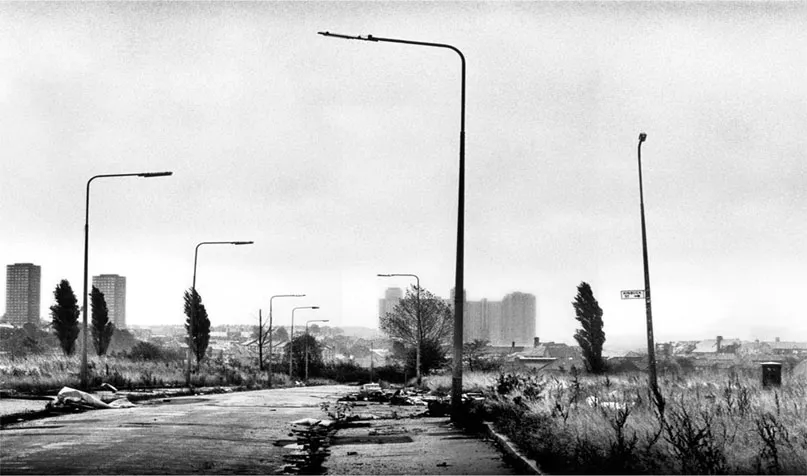
MOST OF BRITAIN’S BIG CITIES now have their emptying quarters, places where despair and decline have gone so deep that large-scale abandonment of homes and business premises is underway. The most spectacular and unsettling example I came across was in Possilpark, one mile out from Glasgow’s thriving centre with its crowds of shoppers and office workers.
To reach it, you follow the familiar spoor of urban decay, passing low-rise, postwar blocks of council flats with big, raucous scrawls of graffiti and the easily-burgled ground floor units boarded up, then a battered-looking primary school fortified with CCTV and a high, spiked steel fence. Finally you come to a place of solitude and silence where there is no longer any housing. Here is a grid of tarmac streets, road lamps, street signs and even bus stops covering hundreds of acres, but only grass and weeds slowly engulfing levelled rubble fill the space in between.
Hundreds of council flats once stood in this part of Possilpark and were lived in for a decade or two. Then, as with tens of thousands of other municipal homes in the UK’s City of Architecture 1999, they became harder and harder to let, even to poor people with few choices in life who seemed fairly desperate for council housing. This neck of the woods became known as a place of isolation, disrespect and danger. Eventually the council decided, as it had done many times before, that the only way forward was mass demolition.
That happened in 1994; the site has lain abandoned ever since. Glasgow and the rest of Britain have more and more places like this. The government admits there are parts of our towns and cities that are so dejected and rejected that it makes no sense to rebuild there. Most Britons know next to nothing about them, for they have no reason ever to visit them. They offer only smashed up blocks of flats and row after row of mean houses with doors and windows covered by steel or plywood shutters. The local councils no longer bother to keep the streets clean and the few cars you see are often burnt out. You don’t see many people about, and those you do often look poor. If mass demolition of the housing in these areas has not begun, then it appears as if it soon will.
And, in most of these areas, a fresh start is unlikely. No new and better homes to last longer this time. There is no prospect of any real redevelopment because there is no confidence in these neighbourhoods being a place where anyone – rich, poor or middling – would choose to live.
Yet the heart of Glasgow, with its blatant prosperity and endless entertainments, its hundreds of thousands of jobs, splendid streets and celebrated architecture, is a 20-minute walk away from Possilpark. The drains and utility mains which lie below those vanished homes, the network of roads which once connected them to the rest of the city, an urban infrastructure worth millions of pounds, lie idle.
Meanwhile, the national debate about where to build the more than four million new homes Britain is forecast to need over the next quarter century becomes louder and angrier. What chiefly excites the pressure groups, the press, the public and the politicians – in roughly that order of causation – is the threat to the UK’s remaining countryside from this frenzy of construction. Two questions being asked are whether government has got its projections right – can the demand for new homes really be that large when population growth is so slow – and how much of that development can be squeezed into existing towns and cities instead of obliterating greenfield land?
Apart from covering an area of fields and woods as large as Greater London in bricks, mortar and tarmac, what further environmental harm will be done by these millions of new houses built in the countryside? Other types of development – shops, workplaces, leisure facilities – will spread with them. More roads will have to be laid. There will be many more car journeys to work and to play, to schools and shops, accompanied by more noise, air pollution and congestion. The area in which the glare of street lights puts out the stars at night will grow.
These fears are quite justified, but they miss the worst thing about this unending spread of housing. It is not only the damage it does to the countryside that matters. A much more precious environment is being damaged in the process – the urban one. This, after all, is the home of millions of people, whom only the most fanatical environmentalist would say matter less than wildlife and scenery.
Since the industrial revolution began in these islands, the history of most of its cities has essentially been one of desertion by people with choice and money. Most Britons appear to hate them, getting out if they can, escaping to the countryside or small towns or suburbia. If they can’t, then they dream of a day when they will be able to. The cities were where almost all our wealth was created, where the middle classes were formed and grew. But even as their populations exploded, as they sucked people from the countryside into their overcrowded, stinking and lethal centres, anyone who succeeded in life was getting out. With them went their standards and money, children and talents, voices and votes. Over a hundred years ago Britain’s large towns and cities had settled into smaller versions of the structures you can still find today – a commercial core with offices, shops and a few grand public buildings to demonstrate the city fathers’ civic pride, encircled by residential suburbs segregated by class. The dense, low-income housing tended to be nearest the centre with more spacious suburbs for the better off further out.
The rapid suburbanisation of the past 200 years had to happen. Without it people’s overall standard of living and life expectancy could not have been raised. Midway through the nineteenth century the population was rising fast and more than a million urban poor were crammed together in squalid courts, cellars, tenements and back-to-back houses. Reformers fretted about epidemics, sanitation, drunkenness and depravity; improvements were slowly pushed through. But for most people, a move into a less densely populated area further from the city centre was the way to better housing and health, and by the end of the century the innermost areas of the big cities had begun to depopulate.
Possilpark, Glasgow, overleaf
We continue to demand new suburbs because we are still fleeing the city. The population of Britain’s eight largest conurbations* fell by two million between 1961 and 1991.2 Each day they suffer a net loss of around 300 people to smaller towns and the countryside.3 People perceive that as well as being a place of crime, deviancy and people who don’t know how to behave, the big city has failing schools, ‘immigrants’ (who have often lived here for two or more generations) and unbearable road traffic. The stock of existing suburban and rural and small town homes is nowhere near large enough to satisfy the demands that arise from this shunning of the urban. So new suburbs spread into the countryside and abandonment continues. The cities are left with poorer people, less money, diminishing social capital. The blight spreads out from the inner city, seeping into tree-lined streets where large houses become dilapidated and big gardens turn to scrub. What was once the best of suburbia is degraded and devalued, people with choices in life no longer want to live there, and so still more new suburbs are needed.
Britain’s housebuilders and planners, the chief defenders of the status quo, see things differently. They point out that for the past 50 years we have had a complex, democratic system that negotiates and plans the growth of our towns and cities. It is not just the prosperous who have escaped from the cities; the system has decanted hundreds of thousands of working-class families into suburban-style council housing on the urban fringe or into verdant new towns deep in the countryside. Furthermore, they say, it is unfair to accuse a spanking new, three-bedroom house on a greenfield estate on the edge of town of causing urban decline. The real culprit is the changing structure of the economy, or advances in technology, or plain poverty, or something else. An ordinary, hard-working family will buy that new house, cherish it and make it a home.
But we do not really have a planning system, we have organised, formal attempts to control and slow the spread of towns and cities. And while low-income families were moved out from crowded homes near the centres during waves of slum clearance, this only worsened the prospects of many of them – and deprivation remains an abidingly inner city phenomenon. And yes, that new house on the edge is contributing to urban decline. If it could have been built in an inner city and sold to a family with a middling income, it would be improving rather than worsening urban prospects.
Isn’t suburbanisation rather like slash and burn farming? And don’t the quotations at the beginning of this chapter, from residents of the suburb where I lived, sum up the process? The countryside is consumed by development and for a few decades the land is valuable. Then, all too often, it starts to go wrong and the money moves off to cover new countryside, leaving barren ground behind.
Surely we should not to treat our urban environments this way. We can no longer justify the urban exodus by saying that people and homes are overcrowded, that they need more room to breathe and that, if they get it, the population as a whole will be better off. The link between density and wretchedness was broken decades ago. Some of Britain’s most deprived people live in spacious, grassy council estates on the edge of cities while some of its richest live in high density apartments at their heart. (The most deprived electoral ward in England turns out to be in Wythenshawe, a leafy, medium-density suburb of council semis built on Manchester’s southern edge between the wars. It was designed to be England’s third garden city.4)
People are sometimes pulled to the suburbs or to smaller towns outside the big conurbations because they can purchase more house and garden space; it is a consumer option. But what is pushing them away from the cities is as important and that, primarily, is the presence of poorer people. The greatest shortages in the city are not of space and greenery, clean air and quiet, but of trust and security, of earned incomes and self-esteem. Each decision to leave further concentrates the population who lack money and choices, which makes the inner city an even less desirable place to live.
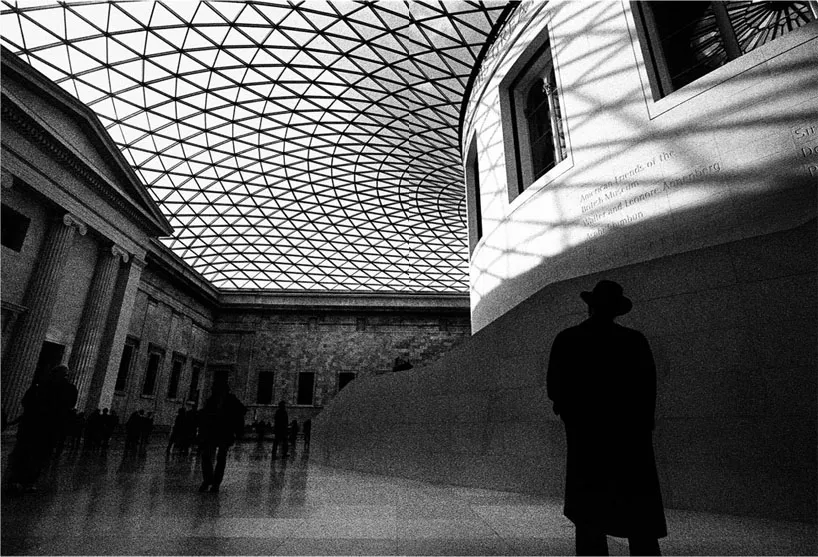
Yet the core of most of Britain’s big cities enjoyed a revival through the 1990s, thanks to sustained growth in the service economy. Waves of National Lottery money and public spending have helped things along.** The city centres have survived the booms in out-of-town shopping, leisure and working which have devastated some smaller towns. People with money still want to work, meet, shop and play in city centres, and by and large they have become better places for all of these activities. Their great squares, public buildings and railway stations have been refurbished. That most wonderful of things, the tram, is making a comeback and whisking people in and out of them. They offer more shops and restaurants, bars and cafés, and better ones too. There are spectacular new concert halls, exhibition centres and galleries.
National Lottery-driven renewal; the British Museum’s Great Court,overleaf
On the back of this has come a surge in city centre living led – as always – by London. Each year thousands of new homes are completed in the core of Britain’s cities, by converting redundant offices, warehouses and shops or building new flats and town houses on canal banks, docksides and factory sites. This is highly fashionable and shows no signs of slowing but it is tiny compared to the flow to the suburbs and beyond. When young, prosperous loft dwellers plan babies they almost always get out of town. The city centre housing boom does not spread out into the tatty, sad badlands of the inner city which lie just beyond, into the council estates and the remaining rows of small Victorian and Edwardian terrace houses.
In a sane world the inner belt lying one to two miles out from the centre of Glasgow, Birmingham or Manchester should be where their more prosperous and successful citizens lived in grand houses. These would be the most desirable addresses, with the highest house prices. Work and play in the city centre would be just five or ten minutes away. The rest of us, with less spending power, would have to live in cheaper property further out, wasting more of our less valuable time in commuting to the centre. (Which is what happens, to some extent, in London, a very unusual British city.) But instead the inner belt is a doughnut of deprivation where the poorest citizens predominate. They often have little reason to travel to the city centre. They have no jobs to commute to and their lack of spending power makes them unwanted.
Some people will argue that all urban areas, from small towns to the largest conurbations, are bound to become divided into residential areas defined by income. Nothing can be done about this; it is as inevitable as the differences in incomes and wealth. They are missing the point. The bigger a British city, the more – in general – it has of more than its fair share of poverty, not just in its inner city but across the conurbation. Take Greater Manchester. Its population of 2.6 million is spread among 214 roughly equally populated electoral wards. Of these, 109 – more than half of its wards – belong among the most deprived fifth of all wards in England. But only eight in the whole of Greater Manchester belong to the least deprived fifth of all wards in England. The conurbation has a great excess of the deprived and a great deficit of the prosperous.5
The long exodus of people with choices from the larger cities is sabotaging Britain’s chances of becoming a fairer, more meritocratic country. The mainstream left may have abandoned the idea of equality but it still stands for equality of opportunity, provided its pursuit does not offend focus groups. If UK plc is to remain a rich, first world country, its supply of bright, talented, hard-working people has to be maximised; we have to be open to talent. You are allowed to be poor, but only if you are lazy and unenterprising as well as stupid. When the electorate finally ejected the Conservatives in 1997 it had, somewhere near the front of its collective mind, the idea that New Labour stood for a fairer Britain. This would be achieved not so much by the old-fashioned method of redistributing income but by altering incentives and by social investment. At the heart of it all was Tony Blair’s slogan, ‘Education, education, education’. Improved state schools would enable the entirety of each new generation to fulfil its potential.
But the polarisation of our cities, the gradual abandonment of them by people with choices, make this quite impossible. It polarises the schools themselves. They are in the front line of urban decline, both its victim and its cause. This is such a big problem that it deserves, and gets, a chapter of its own later in this book. If a school is perceived to be a good one by local parents, its pupil numbers rise, it gets more money from the government and can expand – the money follows the pupils. Mothers and fathers who care about their children’s education want to move into the catchment area of a good local school. Wealthier, owner-occupier parents have a much better chance of making this move than poorer ones living in council and housing association homes. This can push up house prices around the school, meaning you have to be wealthier still to make the move needed to get your children into it. Head teachers call it ‘selection by mortgage’. Middle-class children whose parents are willing and able to fund helpful extras such as computer hardware dominate the intake. They have good reason to value education and they expect their kids to come away with clutches of qualifications. Most teachers would prefer to teach in this kind of school so head teachers find it easier to pick the best of them, which makes the school still more attractive to parents.
The process tends to move in the opposite direction for schools serving declining inner city neighbourhoods or big, post-war council estates further out. The intake is dominated by children from poor households often lacking a home environment that encourages learning. The output has few or no qualifications. The school, and the quality of its teaching, are dragged down by its troubles. The government struggles to improve such schools and there are ‘superheads’ who have turned around some of those facing the worst of circumstances. But th...
Table of contents
- COVER PAGE
- TITLE PAGE
- COPYRIGHT PAGE
- FOREWORD
- PREFACE
- ACKNOWLEDGEMENTS
- CHAPTER 1: THE ABANDONED CITY
- CHAPTER 2: DARKSHIRE AND COKETOWN: THE APPROACH TO 1900
- CHAPTER 3: ENTER THE STATE: 1900 TO 1951
- CHAPTER 4: OVERSPILL AND HIGH RISE: 1951 TO 1976
- CHAPTER 5: THINGS CAN ONLY GET BETTER: 1976 TO 2000
- CHAPTER 6: TEN OPPORTUNITIES
- CHAPTER 7: PUSHES AND PULLS
- CHAPTER 8: THE MILTON KEYNES EFFECT
- CHAPTER 9: HOW TO MINGLE
- CHAPTER 10: EDUCATION, EDUCATION, REGENERATION
- CHAPTER 11: THE FRIGHTENED CITY
- CHAPTER 12: MIXED USES AND HIGHER DENSITIES, OR MUHD
- CHAPTER 13: THE IDEAL HOME
- CHAPTER 14: EROSION OF CITIES OR ATTRITION OF CARS
- CHAPTER 15: TOWN AND COUNTRY
- CHAPTER 16: NEW NEW TOWNS
- CHAPTER 17: RENAISSANCE OR STILLBIRTH?
- ENDNOTES
Trusted by 375,005 students
Access to over 1.5 million titles for a fair monthly price.
Study more efficiently using our study tools.
Frequently asked questions
Yes, you can cancel anytime from the Subscription tab in your account settings on the Perlego website. Your subscription will stay active until the end of your current billing period. Learn how to cancel your subscription
No, books cannot be downloaded as external files, such as PDFs, for use outside of Perlego. However, you can download books within the Perlego app for offline reading on mobile or tablet. Learn how to download books offline
Perlego offers two plans: Essential and Complete
- Essential is ideal for learners and professionals who enjoy exploring a wide range of subjects. Access the Essential Library with 800,000+ trusted titles and best-sellers across business, personal growth, and the humanities. Includes unlimited reading time and Standard Read Aloud voice.
- Complete: Perfect for advanced learners and researchers needing full, unrestricted access. Unlock 1.5M+ books across hundreds of subjects, including academic and specialized titles. The Complete Plan also includes advanced features like Premium Read Aloud and Research Assistant.
We are an online textbook subscription service, where you can get access to an entire online library for less than the price of a single book per month. With over 1.5 million books across 990+ topics, we’ve got you covered! Learn about our mission
Look out for the read-aloud symbol on your next book to see if you can listen to it. The read-aloud tool reads text aloud for you, highlighting the text as it is being read. You can pause it, speed it up and slow it down. Learn more about Read Aloud
Yes! You can use the Perlego app on both iOS and Android devices to read anytime, anywhere — even offline. Perfect for commutes or when you’re on the go.
Please note we cannot support devices running on iOS 13 and Android 7 or earlier. Learn more about using the app
Please note we cannot support devices running on iOS 13 and Android 7 or earlier. Learn more about using the app
Yes, you can access The Chosen City by Nicholas Schoon in PDF and/or ePUB format, as well as other popular books in Architecture & Residential Architecture. We have over 1.5 million books available in our catalogue for you to explore.