- 258 pages
- English
- ePUB (mobile friendly)
- Available on iOS & Android
eBook - ePub
About this book
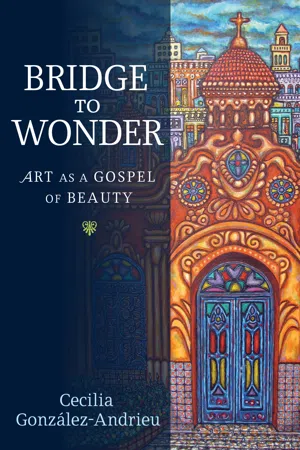
It is often difficult to describe beauty or even justify attempts to experience something beautiful. Yet if artists--whether painters or poets, actors or musicians, architects or sculptors--teach us anything, it is that the pursuit of beauty is a common feature among all humanity. As Cecilia González-Andrieu contends, these varied experiences with artistic beauty are embedded with revelatory and prophetic power that not only affects a single individual but allows for communal formation. Named one of America magazine's most promising young theologians, González-Andrieu seeks to engage art in order to reveal its religious significance. Bridge to Wonder proposes a method of theological aesthetics allowing readers to mine the depths of creative beauty to discover variegated theological truths that enable greater communion with each other and the One source of all that is beautiful.
Information
Subtopic
Théologie chrétienne1
Introduction
Even though his works are part of art collections from the Vatican to the Smithsonian, John August Swanson (American, b. 1938) routinely admits to feeling like an amateur, even after four decades as an artist.1 In one of his early works, the beautifully rendered visual story Inventor (1975, Plate 1.1), he summarizes the work of the artist and the humility he feels every time he works. The eight panels present an artist, as the newspaper headline announces, who claims to have invented a machine that transforms junk into beauty. Juxtaposed between this claim and the last panel, Swanson presents the young inventor working and draws the beauty that emerges as swirling colors, spheres, concentric circles, and stars. The last panel reports, this time through an old radio, that “an amateur is someone who doesn’t know something can’t be done, so he does it.” My students, who have often had the blessing of interviewing Swanson in our class, are routinely mesmerized by this work and by the honesty of Swanson’s humility.2 In Inventor as well as in his disarming encounter with them, Swanson calls into question the image of artists as geniuses and of art as an elite pursuit. As he speaks with them from his heart, he makes visible what philosopher John Dewey contends is “inherent in the work of an artist, the necessity of sincerity; the necessity that he shall not fake or compromise.”3 The wonder my students experience at the beauty of Swanson’s art and the fruitfulness of his commitment to sincerity are two guiding principles for me as I undertake this work.
My interest in the relationship of the artistic and the religious can be traced to repeated experiences with art (both self-consciously religious and not so much) during my childhood. I recall being asked as a young adult to search out my first awareness of Jesus Christ. As I pondered the question, it was a large mural or painting (I am unsure which) that immediately flooded my memory. I was very young, probably about six years old, and although the sermons preached at my parish of Nuestra Señora del Carmen in La Habana were often beyond my reach, the art was not. I frequently sat, rapturously contemplating this large image showing Jesus on the cross, flanked by the two thieves under a furiously dark and stormy sky. It was an image of Calvary not for the squeamish, and yet even to a child, it was incongruously beautiful. I also discerned a difference between the way I entered that work, forgetting everything around me, and the kind of interest I felt in following the labyrinthine lines of one of my father’s few experiments with abstract painting.4 Calvary had a profound relationship with me, while the abstract lines simply invited me to play. One haunted me, the other was fun . . . but forgettable.
But it was not only pictorial art that engrossed me. In Communist-ruled Cuba electricity was scarce, and many evenings were spent mainly in the dark as the government imposed “energy-saving” blackouts on the centuries-old colonial city. Again, quite paradoxically, these times were filled with creativity. Neighbors often shared porches and conversations, depending on the starlight, the moon, and each other to dispel the physical and emotional gloom, and children found ways to create shadow puppet theaters with a single candle, an old sheet, and many funny voices. We were well past the midpoint of the twentieth century, yet we often lived in a medieval world.
One of my favorite survival strategies during those nights without electricity was to play the piano or listen to my mother play.5 Not needing light to play, fingers nimbly searched out the keys and beautiful sounds filled the night, wafting through the tall open windows. All seemed right then, even in the midst of the chaos and hunger that was life in La Habana. On afternoons, returning home from school under a dictatorship that attempted to control our every thought, I would do my homework in the room closest to the living room. There I could listen as my grandmother’s gifted students practiced vocal scales and finished by singing stunning arias.6 I fell madly in love with opera then, a love that today comfortably snuggles up intimately with Gregorian chant, Afro Cuban music, and American jazz. Back in our art-filled church, the creative and inventive community found ways to put on many plays, and also to recreate (behind the safety of the fortress-like parish walls, because public displays of religion were outlawed) rituals and stories from more beautiful times. In the church basement, yellowing and threadbare robes were washed and pressed by loving mothers so little children could be angelitos in May singing praises to Mary, or in December exuberantly announcing the birth of the Savior.
After leaving Cuba for the United States, I have often pondered the relationship between those experiences of beauty in community and the profound longing that their tragic loss evoked. What I most missed, as many others forced to leave their homes have recounted, was indeed the beauty that insisted on appearing in the most unlikely places. Transplanted to a land lacking one’s cultural markers and the familiarity of those relationships, it is the gift of spaces in which to recover and rebuild these markers and relationships that brings comfort. The power of our symbols becomes heightened when these are denied to us. I could relate to our forebears in exile, who wrote in their agonized song,
By the rivers of Babylon—
there we sat down and there we wept
when we remembered Zion.
On the willows there
we hung up our harps.
For there our captors
asked us for songs,
and our tormentors asked for mirth, saying,
“Sing us one of the songs of Zion!”
How could we sing the LORD’s song
in a foreign land? (Ps 137:1-4)
Eventually, it was precisely learning to sing the Lord’s songs in a foreign land that returned to me a sense of home. Here was the power of shared symbol. As a displaced refugee, I finally felt loved and welcomed as I sang and prayed inside the beautiful church space of Sacred Heart Chapel at Loyola Marymount University.7 On many afternoons in my late teens, I sat in the church as the sunset set the stained glass windows aflame, outlining in iridescent light the solitary figure of Christ on the cross over the main altar. This Christ is very alone, and his aloneness moves me exceedingly to this day. Just behind the altar and hidden by the large wooden screen is the apse, which in those days included a series of small radiating altars surmounted by magnificent stained-glass windows.8 Here, the student choristers would wait together for our turn to sing for the university’s choral concerts. It was here, not as I sang, but as I listened behind the screen to the men’s chorus sing, that my heart was filled with an indescribable peace as I recognized our common song of praise and prayer, our shared cosmic music. The land stopped being “foreign” because the music united heaven and earth and all separations (at least momentarily) ceased.
I have never returned to Cuba, and I am often asked why. Beyond the obvious answers of the ongoing political turmoil, my parents’ fears that something might happen to me, and my stance against doing anything that would prop up regimes that abuse the God-given dignity of other human beings, there is a deeper reason, and that reason is beauty. Memory, when attuned to beauty, can be an abundant and lasting gift. It can hold before us the tiny face of our child when she first looked at us, or the sound of our grandmother’s gentle voice telling bedtime stories. In my case, my memory holds in all its fragility the beauty of that land where I was born and first became aware of God’s constant and loving companionship. Today, much of La Habana of my parents’ day is just rubble, destroyed under the weight of totalitarian cruelty and geopolitical forces that have looked the other way. And I know that if I were to see it, to walk down its streets again, the beautiful city that has taken refuge in my memory would be gone forever, shattered like a rock smashes the image in a beloved stained-glass window. I hope to return someday, I pray to do so, but grieving for the loss of the city’s and my community’s beauty would only make sense if my return would help someone, help rebuild. Beauty would then find a new luminescent home in the many of us who would lovingly restore dilapidated walls, feed hungry children, shine the bright light of dignity and education, and more importantly love the land and its people back into being. Beauty transcends destruction, as Christ on the cross unflinchingly shows us, and shines most brightly in resurrection.
This, then, is the life that sets the contours of my theological questions. Such questions arise from this tapestry woven by the power of beauty to reveal, lift, move, sustain, and transform, and from my solidarity with persons on the margins who long to feel at home and who have stories to tell.9 Since my early teens I have lived in Los Angeles, a land of deep Spanish Mexican roots that are uncomfortably juxtaposed against Hollywood’s troubling artificiality and sunk into many layers of ethnic and financial exclusion. Yet, Los Angeles can also be a land of awe-inspiring diversity, like a field of exceptional wildflowers that share a small space of earth, brimming in the colors of many languages, foods, and rituals. Here, I first discovered Shakespeare and the wonders of the English language, Japanese food, Gospel and Arab music, and the ongoing feasts of Mexican trios. In my early thirties, and after growing up in L.A. always aware of my “otherness,” I recall one memorable sunny afternoon when, as I participated with a praying community in a liturgy where an image of Our Lady of Guadalupe was carried in procession, the tears in my eyes told me I was no longer “other.” I was grafted by love into this Mexican American community because I loved her too. I know that if we can begin to share each other’s songs, images, and memories, we can connect to each other and to that ineffable One who makes us family by loving us all without distinction, the One that poet Federico García Lorca calls “Love liberated from time.”10
A central image of Christianity is derived from St. Paul and his insistence on the difference and unity of the many parts (Christians) that make up the Body of Christ (1 Cor 12:12-14). This is an image that finds resonance in creative works and the perplexing alchemy that unites notes into song, speech into drama, and minerals into shape. This appreciation of the multiplicity and variety of gifts and of callings also gives hope to those who strive to contribute to the building of the reign of God, even as they stand outside the centers of power.
Yet, such radical difference as that between an ear and an eye (1 Cor 12:16) seems insurmountable at times, and we long for the stable feeling of homogeneity.11 How does an ear know what seeing is, or an eye know about hearing? The work of speaking across disciplines (in my case chiefly the arts and theology with all their tributary disciplines) can sometimes feel impossible or at least unstable. Different modes of argumentation, which are not propositional but unfold as experiences, are sometimes necessary. Similarly, given its subject, language that could be terse and sparse often flowers into poetry.12
The work of interdisciplinarity and interculturality is in many ways quite new, replacing universalizing tendencies with self-consciously transparent particularity that speaks from its location yet insistently seeks the other. Consequently, the book you are holding or perhaps reading on a glowing screen (something the previous generation of theologians could not have imagined) may be unusual in the strands that make it up and the way in which I invite us to interlace these together.13 I ask for your patience and companionship as strands of theology wind around strands of art, as threads of U.S. Hispanicity (itself a complex mixture) encounter the otherness of London or of Paris at another time. At times my view will benefit from my belonging to a community and at others my radical distance will also be acknowledged. To borrow a thought from theologian Roberto Goizueta, when we choose to walk with those who are other to us, those experiences force us “to be honest about reality by forcing us to recognize the intrinsically relational, or communal character of all human persons and human action.”14 Our potential for unity is most realized when we become aware that this is a difficult and challenging task.
This book, then, is an invitation to join me in discovering ways we can initiate new and fruitful encounters by cultivating our ability to engage works of human creativity, most often represented in what we call the “arts.” These works are a way to know one another through our questions and our experiences as we search and sometimes indeed beautifully find the shimmering glow of the presence of God.
Because scintillating starlight and an expressive world are certainly not exclusive to Cuba or to childhood, I have tried to recognize these qualities wherever I meet them. During graduate school, the bounty of kindness allowed my little family and I to share the home of a retired lady, which overlooked another bay over two thousand miles from the bay of Havana. There, the ocean shimmered—sometimes with a blinding sunlight and at other times with furious white-caps—and just at the edge of the bay, apparently linking together the whole world, was the Golden Gate Bridge (Plate 1.3). From our home in Berkeley, we watched as the passing of the year and the earth’s tilt became playfully apparent in the always changing position of the setting sun in relation to the bridge. From this high vantage point, we watched the bay often completely shrouded in a diaphanous fog, while above it a bright silver moon shone brightly. Looking out toward the bridge, I often marveled at the seamless collaboration between the natural world, with its cliffs and craggy rocks flanking the sea, and human ingenuity, as the orange-red bridge completed the scene. It is difficult to imagine San Francisco Bay without the Golden Gate Bridge: it seems like it was always meant to be there. Nature and human have worked together, and this collaboration is truly a monumental work of art.
So let me suggest the Golden Gate Bridge as a metaphor for this book. Our destination may be somewhere on the far side of an occasionally stormy and invariably windy bay, but what I hope we can do as we move toward it is to notice the bridge itself. As we imagine the furiously windy bay, we must also imagine that the Golden Gate Bridge has not been built . . . yet. It is exhilarating to visualize building it, but in order to build and then to experience a passage, we clearly need to want to do it. So we need a reason for wanting to cross. The very storminess of the bay dissuades us, and we wonder if there could really be anything worth seeing over there. Maybe we should just turn around and ignore this bay and what lies beyond it. This is not an idle temptation; we live in a time when our grip on “reality” and on what matters about our existence seems to be fading, as the “virtual” world envelops us and provides a buffer between us and what earlier generations would have understood as real suffering and also as very real joy. We busy ourselves with cell phones and iPads and strange plastic Blackberrys (which, unlike the real version, do not taste very good). Perhaps we busy ourselves precisely because we do not want to look past ourselves, toward what is other and therefore what may ask something of us.
Yet, somewhat inexplicably, hundreds of people walk, drive, and bicycle across the Golden Gate Bridge everyday—not because they want to get to the other side, but because the experience is so beautiful. The revelatory and transforming beauty of the suspe...
Table of contents
- Cover
- Title Page
- Copyright
- Dedication
- Contents
- List of Illustrations
- Acknowledgments y Agradecimientos
- 1 Introduction
- 2 This Book Is Not about Art
- 3 In Search of Wonder
- 4 Seeing (as) Salvation, the Hope of Art and Religion
- 5 Beautiful Differences
- 6 Beyond Boundaries and Unknowable Otherness
- 7 The Impossible Definition
- 8 Beauty in Turmoil
- 9 The Bridge to Wonder Is Ours to Build
- 10 Glimpses and Destellos
- Notes
- Bibliography
- Index
Trusted by 375,005 students
Access to over 1.5 million titles for a fair monthly price.
Study more efficiently using our study tools.
Frequently asked questions
Yes, you can cancel anytime from the Subscription tab in your account settings on the Perlego website. Your subscription will stay active until the end of your current billing period. Learn how to cancel your subscription
No, books cannot be downloaded as external files, such as PDFs, for use outside of Perlego. However, you can download books within the Perlego app for offline reading on mobile or tablet. Learn how to download books offline
Perlego offers two plans: Essential and Complete
- Essential is ideal for learners and professionals who enjoy exploring a wide range of subjects. Access the Essential Library with 800,000+ trusted titles and best-sellers across business, personal growth, and the humanities. Includes unlimited reading time and Standard Read Aloud voice.
- Complete: Perfect for advanced learners and researchers needing full, unrestricted access. Unlock 1.5M+ books across hundreds of subjects, including academic and specialized titles. The Complete Plan also includes advanced features like Premium Read Aloud and Research Assistant.
We are an online textbook subscription service, where you can get access to an entire online library for less than the price of a single book per month. With over 1.5 million books across 990+ topics, we’ve got you covered! Learn about our mission
Look out for the read-aloud symbol on your next book to see if you can listen to it. The read-aloud tool reads text aloud for you, highlighting the text as it is being read. You can pause it, speed it up and slow it down. Learn more about Read Aloud
Yes! You can use the Perlego app on both iOS and Android devices to read anytime, anywhere — even offline. Perfect for commutes or when you’re on the go.
Please note we cannot support devices running on iOS 13 and Android 7 or earlier. Learn more about using the app
Please note we cannot support devices running on iOS 13 and Android 7 or earlier. Learn more about using the app
Yes, you can access Bridge to Wonder by Cecilia González-Andrieu in PDF and/or ePUB format, as well as other popular books in Théologie et religion & Théologie chrétienne. We have over 1.5 million books available in our catalogue for you to explore.