eBook - ePub
Available until 31 Dec |Learn more
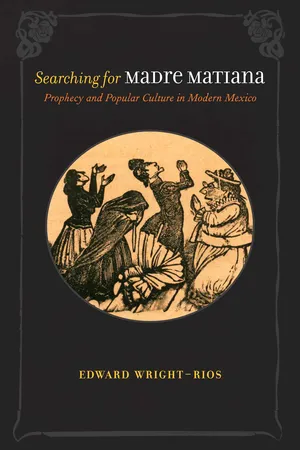
Searching for Madre Matiana
Prophecy and Popular Culture in Modern Mexico
This book is available to read until 31st December, 2025
- 392 pages
- English
- ePUB (mobile friendly)
- Available on iOS & Android
eBook - ePub
Available until 31 Dec |Learn more
About this book
In the mid-nineteenth century prophetic visions attributed to a woman named Madre Matiana roiled Mexican society. Pamphlets of the time proclaimed that decades earlier a humble laywoman foresaw the nation's calamitous destiny—foreign invasion, widespread misery, and chronic civil strife. The revelations, however, pinpointed the cause of Mexico's struggles: God was punishing the nation for embracing blasphemous secularism. Responses ranged from pious alarm to incredulous scorn. Although most likely a fiction cooked up amid the era's culture wars, Madre Matiana's persona nevertheless endured. In fact, her predictions remained influential well into the twentieth century as society debated the nature of popular culture, the crux of modern nationhood, and the role of women, especially religious women. Here Edward Wright-Rios examines this much-maligned—and sometimes celebrated—character and her position in the development of a nation.
Frequently asked questions
Yes, you can cancel anytime from the Subscription tab in your account settings on the Perlego website. Your subscription will stay active until the end of your current billing period. Learn how to cancel your subscription.
No, books cannot be downloaded as external files, such as PDFs, for use outside of Perlego. However, you can download books within the Perlego app for offline reading on mobile or tablet. Learn more here.
Perlego offers two plans: Essential and Complete
- Essential is ideal for learners and professionals who enjoy exploring a wide range of subjects. Access the Essential Library with 800,000+ trusted titles and best-sellers across business, personal growth, and the humanities. Includes unlimited reading time and Standard Read Aloud voice.
- Complete: Perfect for advanced learners and researchers needing full, unrestricted access. Unlock 1.4M+ books across hundreds of subjects, including academic and specialized titles. The Complete Plan also includes advanced features like Premium Read Aloud and Research Assistant.
We are an online textbook subscription service, where you can get access to an entire online library for less than the price of a single book per month. With over 1 million books across 1000+ topics, we’ve got you covered! Learn more here.
Look out for the read-aloud symbol on your next book to see if you can listen to it. The read-aloud tool reads text aloud for you, highlighting the text as it is being read. You can pause it, speed it up and slow it down. Learn more here.
Yes! You can use the Perlego app on both iOS or Android devices to read anytime, anywhere — even offline. Perfect for commutes or when you’re on the go.
Please note we cannot support devices running on iOS 13 and Android 7 or earlier. Learn more about using the app.
Please note we cannot support devices running on iOS 13 and Android 7 or earlier. Learn more about using the app.
Yes, you can access Searching for Madre Matiana by Edward Wright-Rios in PDF and/or ePUB format, as well as other popular books in History & Mexican History. We have over one million books available in our catalogue for you to explore.
Information
PART I
A National Seer

CHAPTER 1
Mystical Matters, Mystical Madres
The Legacy of Female Piety in Mexico

WHY WOULD THE APPEARANCE OF PROPHETIC PRINTINGS CAUSE A stir in mid-nineteenth-century Mexico? Why were some Mexicans prone to believe that God was indeed punishing them and trying to communicate with society via a seer? In addition, why did it matter if the visions in question had been experienced by a humble, pious woman? Perhaps the best way to develop a nuanced appreciation for Madre Matiana’s impact in the nineteenth century is to plunge into the polemics surrounding female mysticism some eighty years prior to the appearance of her pamphlets, ironically around the time when Matiana allegedly foresaw the nation’s troubled future.
In early 1767 the Bourbon monarchy, following the lead of the Portuguese in 1759, decreed the expulsion of the Jesuit order from its domains. In the Spanish colonies officials rounded up over two thousand members of the Company of Jesus and marched them off to exile.1 News of pro-Jesuit miracles and prophecies followed hot on the heels of royal action. For example, inquisitors in Mexico fretted about circulating broadsheets, which described the alleged visions of a Capuchin nun in Spain. According to these publications, a purple-robed, plaintive Christ with blood gushing from the wound in his side had appeared to the young woman. She reverently inquired about the Savior’s pitiful state, and he blamed, “those that are presently persecuting the beloved sons of my Compañía (the Jesuits).”2 Christ, however, alerted the capuchina to an imminent, miraculous revival. He reminded her of a terebinth, a Mediterranean evergreen associated with divine revelation in the Old Testament, that had once flourished where Jesuit confessors ministered to the nuns of her order.3 According to the broadside, the tree had recently died and been chopped for firewood, but Christ assured his visionary that both the tree and his Company would blossom anew. The woman would see twelve flowers symbolizing the tribes of Israel, which would unfold and flourish before her eyes. Just as God had freed the chosen people, he would liberate the Jesuits. The religiosa waited until the dismembered terebinth burst into full flower as foretold before she recounted her vision to her astounded sisters.4
News of Mexican miracles and prophecies also emerged.5 Stories circulated widely of a crippled boy’s encounter with an enigmatic man dressed like a Jesuit. Upon their meeting, the man told the youth of two immanent marvels: the missionary order’s revival and the miraculous cure of his deformity. The youngster’s father, a Puebla merchant, assured investigators that his son twice walked normally when describing his revelation.6 At roughly the same time, Mexico City residents discussed stories of a deceased Jesuit’s prophetic writings, which likened the order’s troubles to a solar eclipse: the expulsion would only temporarily dim their fortunes before a glorious revival.7 Reports also circulated of a Jesuit who miraculously tamed an indomitable horse and rode all the way to Veracruz to join his brethren in exile.8 Locals in the port city also shared the tale of a church painting of Saint Ignatius, the founder of the Jesuit order, which mysteriously fell onto a renowned local critic of the black-robed missionaries.9
The most dramatic Jesuit restoration prophecy, however, featured a girl’s powerful allegorical revelations.10 During a moment of pious ecstasy, this unnamed seer beheld a church lit by scores of lamps, which one by one succumbed to a small, malevolent whirlwind that churned around the sanctuary. Ultimately only a single beacon flickered on the main altar. Suddenly, she saw a small ball of fire, “God’s loving Providence,” zoom around the temple to reignite each and every smoldering wick. In short order, the entire church was alight despite the “hurricane of persecution.” The astounded mística understood immediately that this vision symbolized the hounding and subsequent resurgence of the Jesuit order: they would be reduced to the single province of Rome, only to achieve even greater splendor after a miraculous revival.
The rapid emergence and circulation of these prophecies suggests that the Jesuits’ suppression struck a vibrant chord in Mexico, a chord that allegedly vibrated most strongly among religious women.11 Of course, there were other ways to articulate such feelings. Some regions experienced full-blown riots, which José de Gálvez (1720–1787)—New Spain’s powerful visitor general—suppressed with infamous brutality.12 Dominican priests reported that some Mexicans viewed them as complicit in their rival’s demise and hence shunned their services. Rumors even circulated that the king and his ministers had succumbed to heresy. Holy cards (small images of saintly figures) passed from hand to hand, some featuring an image of Saint Josaphat flanked by the pope and Saint Ignatius, with an accompanying caption that questioned the orthodoxy of Jesuit critics.13
A sample of inquisitorial rhetoric that responds to the pro-Jesuit visions is also instructive. Although infamous in present-day estimation, the Inquisition functioned as a widely accepted institution charged with protecting orthodoxy: it steered deviants back to official belief and practice when possible, and it assured fidelity to established authority in both religious and political matters.14 As well-trained Church funcionarios, the inquisitors may have simply been trying to intimidate Jesuit sympathizers, but they wrote as if they truly feared subversive prophecies would spread like a disease. The vectors of infection, they presumed, were female religious orders historically served by Jesuit confessors. According to the theories, La Compañía began inculcating their hijas espirituales (spiritual daughters) with “false prophecies” and “fanatical revelations” well before the expulsion order in April 1767. They purportedly chose women because of their credulity, seeking to drag them into “issues of governance, completely at odds with the frailties of their sex and the reserve required by monastic profession.” Furthermore, these machinations represented “an astute means to disseminate ideas among the population contrary to public tranquility because nobody could be easily persuaded . . . that evangelical ministers would propagate sedition among their penitents.”15
Echoing these claims, the Franciscan commissary general, Fray Manuel de Náxera, issued a particularly detailed condemnation. In the process he revealed a great deal about negative attitudes toward female piety and real fears of its political potential.16 First, he claimed that Jesuits propagated sinister maxims internally, and they also induced members to abuse their ministry. As he put it, Jesuits had blasphemously seduced “brides of Christ.” with their perfidious teachings. Even where no evidence of prophetic subversion appeared, de Náxera cautioned, nuns with ties to La Compañía harbored anguished longings for their banished confessors. The sisters remained fertile ground for seditious fanaticism: they had internalized a set of specious doctrines beyond the offending prophecies that exacerbated innate female inclinations toward visionary self-indulgence.
In short, to explain the prophecies’ propagation, officials deployed stereotypes: women were weak-minded, gullible, and prone to vain, delusional excess.17 In de Náxera’s view, because of “the fantasies alive with excess, which tend to those of their sex, colored by their natural piety, they [women] easily succumb to illusions, and they convince themselves that they see visions and revelations.” In reality, he argued, “[The Prophecies] are only figments of their imagination forged with the vehemence of their affections and passions, which, since they believe them to be pious, they do not restrain, and allow to accumulate until their imaginations are deeply confused and they believe they see what does not exist.” Once deluded, religiosas become dangerous ilusas (false mystics), potentially corrupting the public.18
It was a classic ruse, de Náxera claimed. Heretics throughout history had targeted nuns and beatas (devout laywomen).19 Fascinadores (charlatans) bolster their falsehoods with invented miracles among women, and to many outsiders the “false” revelations appear to be harmless, female vanities. Therefore all Mexican Church authorities, he commanded, were obliged to report Jesuit-inspired ilusas and their followers. He pleaded with abbesses to recognize the diabolical assault the prophecies represented, but he issued threats as well. Anyone who withheld information or was slow to report seditious portents faced a loss of their office and unnamed additional punishments.20
In the end, not a single religiosa appears among those deposed. Were there no convent prophecies to begin with? Had timely inquisitorial action blocked their progress? Perhaps abbesses dealt with mystical claims internally, beyond the prying eyes of de Náxera and his colleagues. We may never know, but this case reveals the substantial power ascribed to female visionary narratives. The potential impact attributed to women’s prophetic expression—and the legacy of debunking discourse accompanying it—indicate that mystical women occupied an iconic, albeit often contested, social niche long before the nineteenth century. Indeed, male authority figures clearly feared the ability of female prophets to sway public opinion and stoke sedition.
THE PIOUS SEX
As in the Jesuit restoration prophecies, the legacy of female mysticism represents perhaps the most complicated component of Matiana’s legacy. Attempting to flesh out the complex symbolism associated with femininity at times requires reaching back to the Middle Ages. Matiana’s visions, the story woven around them, and the religious traditions invoked within the narrative tap into deeply intertwined cultural assumptions and practices. For lack of a better term, scholars group these issues under the umbrella of female piety, but the implications regarding how Mexican society produced and consumed stories about itself reaches well beyond the realm of female religiosity. The multifaceted symbolism surrounding expiation, Eucharistic devotion, and asceticism play key roles in the Matiana prophecies. Together these factors gave the story its staying power and put into play conceptions of feminine sensitivity to the prevailing moral character of society and the will of God. Another way to put this is that Matiana’s story gained traction in the nineteenth century because she echoed historical models and traditional notions of women’s unique aptitude for visionary grace.
Prior to the twentieth century the prevailing exemplars offered in Mexican society for popular emulation were Catholic saints and local historical figures of renowned saintly reputation.21 Indeed, these were the models that secular nationalists labored to replace with new civic santos of liberal patriotism after the mid-nineteenth century. The reigning male ideals were the martyrs, the founders of religious orders, theologians, and saints. These figures modeled intellect, agency, reason, and pious wisdom—the architects of Christian order. Standards of female religious virtue and accomplishment were another story. As scholars of the Middle Ages have shown, Catholics have historically associated women with the human body, passivity, irrationality, emotion, lust, mercy, and disorder.22
When pondering Madre Matiana, Mexican readers could call up various categories of supernaturally adept women. In some cases these were official saints, but many other figures enjoyed saintly reputations without official sanction. Female spiritual power, however, also bore negative associations. Enduring notions of sinister sexual deviance and witchcraft populated the Mexican consciousness with stories of dangerous women and fear of seductive deception.23 In addition, assumptions of elemental feminine irrationality and vanity undergirded the occasional dismissals of female religiosity as fanatical excess, attention-seeking fakery, or blind superstition. In sum, a profound ambivalence pervaded conceptions of devout women. This comes through clearly in a famous fifteenth-century inquisitorial treatise on witchcraft: “[Women] reach the greatest heights and the lowest depths of goodness and vice. Where they are governed by a good spirit, they are most excellent in virtue; but when they are governed by an evil spirit, they indulge in the worst possible vices.”24
To the scholar today these dualities seem clichéd reflections of patriarchal insecurities: saint or succubus, nun or witch, and humble beata or vainglorious ilusa. But there is also an underlying conception of uniquely female, innate, spiritual sensitivity that bolsters these characterizations. They depend upon assumptions of women’s natural openness and visceral, emotional acceptance of the supernatural, as well as their greater ability to embrace humility and self-sacrifice. These ideas have deep roots, but much of their elaboration emerged from medieval thought, which came to Mexico after the conquest via Spanish Catholicism. As the thinking goes, men seek wealth, intellectual mastery, and prestige, but they often come up short in their spiritual development. Masculine strength helps them resist temptation and uphold the faith, but it also impedes the self-effacement required to achieve spiritual union with God. The flip side of these gendered assumptions is that women, in very special cases, could draw exceptional spiritual strength from feminine weakness. In fact, some men who trod the mystic’s path spoke in terms of gender transformation—approaching oneness with Christ involved embracing a reconception of the self as a submissive woman before the masculine divinity.25
Devotional materials published in Mexico City in the 1850s reveal this conception of mystical union in practice at the time when the first Madre Matiana pamphlets were i...
Table of contents
- Cover
- Half title
- Title
- Copyright
- Dedication
- Contents
- Illustrations
- Acknowledgments
- Introduction
- Part I. A National Seer
- Part II. Fitting FanáTicas
- Conclusion Mexico’s Matianas
- Appendix The Prophecies of Matiana
- Notes
- Bibliography
- Index