eBook - ePub
Available until 31 Dec |Learn more
For Our Navajo People
Dine Letters, Speeches, and Petitions, 1900-1960
This book is available to read until 31st December, 2025
- 432 pages
- English
- ePUB (mobile friendly)
- Available on iOS & Android
eBook - ePub
Available until 31 Dec |Learn more
About this book
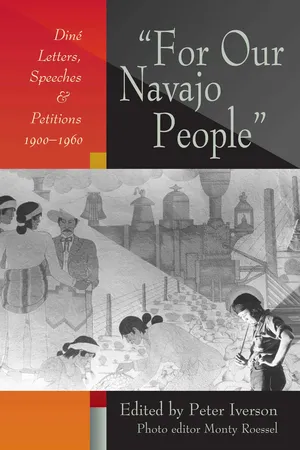
One hundred documents written by Diné men, women, and children speaking for themselves and on behalf of their communities are collected in this book. Discovered during Iverson's research for Diné: A History of the Navajos, these letters, speeches, and petitions, almost all previously unpublished, provide a uniquely moving portrait of the Diné during an era in which they were fighting to defend their lands and to build the Navajo Nation.
Six crucial, overlapping subjects are addressed here: land, community, education, rights, government, and identity. Brief introductions to each chapter and each document provide the necessary context, and historic photographs selected by Monty Roessel (Navajo), an outstanding photographer, supplement the words of the people.
Most of the vast literature about American Indians emphasizes the actions and words of non-Indians. Indians become the victims, the people to whom things happen. This volume furnishes a different view of the native past. It shows Navajos making their own history. It demonstrates how the Diné worked to keep their lands, develop their economy, build their communities, educate their young people, affirm their rights, govern themselves, and maintain their heritage while forging a brighter future.
Included are the words of such prominent leaders as Chee Dodge, Jacob Morgan, Tom Dodge, Annie Wauneka, Sam Ahkeah, and Paul Jones, and less widely known but significant spokespersons like Howard Gorman, Scott Preston, Roger Davis, and Lilly Neill. It also presents the words of students at boarding schools, soldiers fighting in World War II, and members of the Native American Church speaking out for religious freedom. This book celebrates the resilience of the Diné and salutes their resolve. It honors the men, women, and children who built the Navajo Nation.
Monty Roessel (Navajo), Executive Director of the Rough Rock Community School, has written and provided photographs for award-winning books for young people.
Six crucial, overlapping subjects are addressed here: land, community, education, rights, government, and identity. Brief introductions to each chapter and each document provide the necessary context, and historic photographs selected by Monty Roessel (Navajo), an outstanding photographer, supplement the words of the people.
Most of the vast literature about American Indians emphasizes the actions and words of non-Indians. Indians become the victims, the people to whom things happen. This volume furnishes a different view of the native past. It shows Navajos making their own history. It demonstrates how the Diné worked to keep their lands, develop their economy, build their communities, educate their young people, affirm their rights, govern themselves, and maintain their heritage while forging a brighter future.
Included are the words of such prominent leaders as Chee Dodge, Jacob Morgan, Tom Dodge, Annie Wauneka, Sam Ahkeah, and Paul Jones, and less widely known but significant spokespersons like Howard Gorman, Scott Preston, Roger Davis, and Lilly Neill. It also presents the words of students at boarding schools, soldiers fighting in World War II, and members of the Native American Church speaking out for religious freedom. This book celebrates the resilience of the Diné and salutes their resolve. It honors the men, women, and children who built the Navajo Nation.
Monty Roessel (Navajo), Executive Director of the Rough Rock Community School, has written and provided photographs for award-winning books for young people.
Frequently asked questions
Yes, you can cancel anytime from the Subscription tab in your account settings on the Perlego website. Your subscription will stay active until the end of your current billing period. Learn how to cancel your subscription.
No, books cannot be downloaded as external files, such as PDFs, for use outside of Perlego. However, you can download books within the Perlego app for offline reading on mobile or tablet. Learn more here.
Perlego offers two plans: Essential and Complete
- Essential is ideal for learners and professionals who enjoy exploring a wide range of subjects. Access the Essential Library with 800,000+ trusted titles and best-sellers across business, personal growth, and the humanities. Includes unlimited reading time and Standard Read Aloud voice.
- Complete: Perfect for advanced learners and researchers needing full, unrestricted access. Unlock 1.4M+ books across hundreds of subjects, including academic and specialized titles. The Complete Plan also includes advanced features like Premium Read Aloud and Research Assistant.
We are an online textbook subscription service, where you can get access to an entire online library for less than the price of a single book per month. With over 1 million books across 1000+ topics, we’ve got you covered! Learn more here.
Look out for the read-aloud symbol on your next book to see if you can listen to it. The read-aloud tool reads text aloud for you, highlighting the text as it is being read. You can pause it, speed it up and slow it down. Learn more here.
Yes! You can use the Perlego app on both iOS or Android devices to read anytime, anywhere — even offline. Perfect for commutes or when you’re on the go.
Please note we cannot support devices running on iOS 13 and Android 7 or earlier. Learn more about using the app.
Please note we cannot support devices running on iOS 13 and Android 7 or earlier. Learn more about using the app.
Yes, you can access For Our Navajo People by Peter Iverson, Monty Roessel in PDF and/or ePUB format, as well as other popular books in History & North American History. We have over one million books available in our catalogue for you to explore.
Information
1
LAND
INTRODUCTION
The traditional Navajo country of the American Southwest includes four sacred mountains. Navajo teachings hold that the Navajos emerged here into this region, that the Holy People determined this was the proper place for them to live. Although the Navajos could not maintain their control of this entire domain, they succeeded in holding on to most of Diné Bikeyah. Today the Navajo Nation comprises 25,000 square miles. Its very existence represents a significant triumph.
In 1868, the Navajos incarcerated at Fort Sumner in east central New Mexico signed one of the final treaties concluded by the United States with Indian communities. The treaty provided an initial land base. This acreage would be more than quadrupled over the next seventy years. At a time when many Indian nations in the West lost much of their land, the Navajos increased their base.
However, as the twentieth century began, the Diné confronted increasing pressure involving use of their country. Outsiders wanted to drill for oil. Federal employees sought to reduce the number of sheep, goats, cattle, and horses grazing on Navajo land. Long before the current Navajo-Hopi “land dispute,” the two communities clashed over access to and utilization of resources. At the same time, as did other Westerners, the Navajo often saw in their lands the opportunity to develop their economy and thus help residents of their communities. Not surprisingly, the Diné did not always agree among themselves about what to do. Local and regional interests conflicted with Navajo national goals. For example, Jacob C. Morgan of Farmington, New Mexico spoke for the concerns of people from his region who wanted to gain more from the development of oil resources, whereas Chee Dodge believed that such development should benefit all of the Navajo Nation. Even within a particular community, local residents could disagree over who had access to the land and how that land should be used.
If the Navajos by the start of the twenty-first century had become an urbanized people, for most of the previous century they had been a rural one. Certainly through the first decades of the twentieth century most Navajo children grew up with livestock. The livestock reduction program imposed by the federal government in the 1930s helped hasten the transition to a wage work economy and pushed many Diné off the land.
The documents in this chapter offer telling glimpses into continuity and change in Navajo land use. They reveal the importance of decisions made in regard to how the land would be employed. And they underline how much the land mattered. This, after all, is where the Holy People had meant for the Diné to live. This is where they would stay.
1. CHEE DODGE, FEBRUARY 2, 1914
Chee Dodge (ca. 1857–1947) or Hastiin Adiits’a’ii (“Man Who Interprets”) was a key political leader in Navajo life throughout most of this time period. There was significant pressure early in the twentieth century to divide the Navajo reservation into individually held parcels of land through a process known as allotment. With Arizona and New Mexico gaining statehood, pressure also increased for greater exercise of state authority over Navajo lives and lands. Here Dodge informs Secretary of the Interior Franklin Lane about these dangers and the current status of Navajo lands.
Washington Pass, Fort Defiance P.O. Arizona,
February 2nd, 1914.
The Hon. Franklin K. Lane,
Washington, D.C.
Honorable Dear Secretary:
I thank you for your kind inquiry of January 12th and in answer will say:
1-As to myself, I am among the very few members of the tribe who could get along if they had their property and were intirely independent of the Indian Bureau, but this condition would not be a good thing for the tribe.
2-My reasons for so thinking are as follows:
The tribe is uneducated. Aside from this children in the different schools there are not even 400 members of the whole tribe of about 25,000 who understand and speak the English language. Ten years ago they had but one Government boarding school for the whole tribe and, before that time, the children were not kept long enough in school to be benefited.
If placed under state government the Navajos would never be educated and civilized; what good people have been trying to do for us for would undone and the tribe would be ruined and pauperized within a very short time.
The character of our reservation is such that its division or allotment is not feasible and would prove our ruin.
3-We are pleased that the Government has begun building more schools for our children, but we have no trade school, and such a school is a very urgent necessity for our large tribe. A trade school would furnish efficient journeymen for the tribe who are necessary for the advancement of the Navajos, to build better homes, etc., and it would also enable them to compete with their white neighbors.
Whilst two large irrigation systems are being constructed for us, the tribe as a whole is more in need of development of water for stock purposes, and of small, inexpensive irrigation systems: hardly anything has been done in that line.
Last but not least, our reservation ought to be kept intact and land within the reservation ought to be secured for us; we need it and are willing to pay for it by pledging and selling our ripe timber.
These are my honest convictions, and I beg you to give these points your kind consideration.
Very respectfully yours,
Chee Dodge
Chee Dodge
2. CHEE DODGE, MARCH 2, 1923
Chee Dodge became the first chairman of the Navajo tribal Council in July 1923, five months after he wrote this letter. As this letter suggests, Dodge often clashed with Jacob Morgan. Dodge argued that proceeds from oil development in northwestern New Mexico should benefit all Diné, whereas Morgan contended that Navajos from this region should harvest more of the gain from this revenue.
St. Michaels, Ariz., March 2, 1923.
Honorable Charles H. Burke
Washington, D.C.
Hon. Dear Mr. Commissioner:
In view of the recent opposition brought to bear in some sections against the appointment of the Secretary Hon. A. B. Fall of Herbert J. Hagerman as special Commissioner of the Navajo tribe of Indians, allow me to express my sentiments to you in regard to this appointment as well as the sentiments of the greater majority of Navajos on the reservation. With the exception of a few misguided Navajos in the immediate oil section of the Shiprock jurisdiction, all the Navajos feel that this appointment is a great boon for them and that it is the only move on the part of the Government which will safeguard the rights of the Navajo tribe as a whole and we wish to express our appreciation to the authorities for this timely supervision of our interests.
It is not only the Navajo Indians who appreciate and acknowledge the wisdom of this appointment but all the leading citisens of towns surrounding the reservation who come in contact with the Indians and are interested in their welfare declare that this act on the part of the Government was to the very best interests of all the Navajos.
The rumored opposition on the part of some of the Indians of the Shiprock jurisdiction and the threatened uprising, if there is any truth in it, which is somewhat doubtful, is, no doubt, instigated by some interested Whites whose plans of grabbing the best leases for little or nothing, have been overthrown by this recent appointment. At the tribal Councils to be held in the future under the direction of the new Commissioner this opposition will be easily overcome and the Justice of letting all the members of the Navajo tribe share in the proceeds of this oil boom be made apparent to all.
Very truly yours,
Signed Chee Dodge
Signed Chee Dodge
3. NAVAJO TRIBAL COUNCIL, JULY 8, 1926
Here council members acknowledge the problem posed by surplus horses and address several other key issues. As most Navajos, in fact, did not believe there were too many horses, we can assume that this statement came only after considerable prodding from federal officials.
We, the members of the Navajo Tribal Council, meeting at Fort Defiance, Arizona, July 8, 1926, adopt the following resolutions:
I. We realize that our people have thousands of horses which are of no use to them and which they should get rid of. These useless horses eat grass, which would support many thousands of heads of sheep and cattle which would bring in to us a large revenue. We know now that we are greatly hurt in our dealings with Washington about extensions of our Reservations and money for the rental of outside land by having so many horses wasting the range. We propose to do our best and make our people see that this is true and to persuade them that they should get rid of a great many of these horses and secure better stallions so as to build up for freighting and for traveling around with. In this we ask the help of Washington and of our Commissioner and superintendents. We want to get as much as we can for these excess horses but are willing to sell or exchange them for the best price which can be had for them in order to arrange the matter and preserve our ranges. We ask that our Commissioner, thru the superintendents, find out where and for what consideration these horses can be sold in order that we may know how they can disposed of. We will go out among our people and try to them to agree to any plan along these lines.
II. We are in favor of setting aside for the next three years twenty percent of that part of the tribal fund available for distribution each year before the distribution is made to the different superintendents, that is twenty dollars out of every hundered, said money to be used for the purchase of or rental of lands or pastures outside and near to the Reservation, for the benefit of the Navajo Indians who live or range outside the Reservation. This, we think, is fair because it will help relieve the ranges inside the reservation.
III. We are not against paying the re-imbursable charges on the Hogback and Ganado Projects when funds are available for that purpose, but we think that for the present no more funds, should be used on these big projects. There are, thruout the Reservation, a good many small tracts of land irrigated by means of small streams, dams and ditches made by our Navajos themselves. These are on the Eastern and Western slopes of the Chuska and Lukachukais Mts., and in other places on the reservation. We ask the help of Washington in making better these little ditches, dams and projects before any more money is spent on the larger projects which benefit only a few of our people.
IV. We ask the President and the Congress at Washington to define the situation as to our non-Treaty lands and to arrange matters so that oil development can go ahead on the non-Treaty lands in the same way that it is going ahead on the Treaty lands. We see no difference between Treaty lands and non-Treaty lands, and we believe they are both alike and that the royalties on both kinds of land should be paid to us. Oil was discovered on the Hogback in the Treaty area of the reservation; thru this discovery much good is coming to us. There tracts were sold bringing a bonus and now royalties are being paid to our tribal funds. We want all the Bonus we can get for leases but realize that the main oil income will be from royalties. Oil has been discovered at a place in the non-Treaty area of the reservation but development has been stopped there because Washington can not agree about the situation on the non-Treaty lands. We want this development to continue so that if there is oil it can be developed and we ask Washington to see to it that the matter is settle so that we may know where we stand in order that oil, if it is there, can be taken out and our royalties paid on it, the same way on the non-Treaty as on the Treaty areas.
V. We are glad that the Chas. H. Burke school at Ft. Wingate is being built for the Navajos. We will be glad to send our children to that school. We hope and ask that the school be made, as far as it can be, a industrial school where our children can be taught trades which will be useful to them and help them to make a living as workmen, and also help them in the raising of stock and the making of homes and farms.
Signed and unanimously adopted by the following delegates.
J. C. Morgan
Desh...
Desh...
Table of contents
- Cover
- Half title
- Title
- Copyright
- Dedication
- Contents
- List of Illustrations
- Acknowledgments
- Introduction
- Chapter One: Land
- Chapter Two: Community
- Chapter Three: Education
- Chapter Four: Rights
- Chapter Five: Government
- Chapter Six: Identity
- Sources
- Index