This volume, edited by Grace Veach, explores leading approaches to foregrounding information literacy in first-year college writing courses. Chapters describe cross-disciplinary efforts underway across higher education, as well as innovative approaches of both writing professors and librarians in the classroom. This seminal work unpacks the disciplinary implications for information literacy and writing studies as they encounter one another in theory and practice, during a time when "fact" or "truth" is less important than fitting a predetermined message. Topics include reading and writing through the lens of information literacy, curriculum design, specific writing tasks, transfer, and assessment.
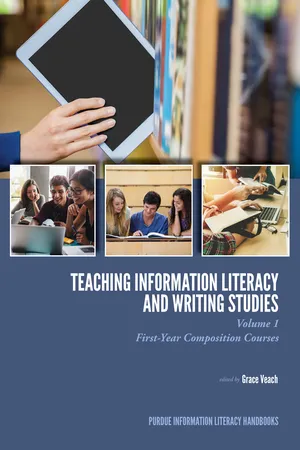
eBook - ePub
Teaching Information Literacy and Writing Studies
Volume 1, First-Year Composition Courses
- 314 pages
- English
- ePUB (mobile friendly)
- Available on iOS & Android
eBook - ePub
Teaching Information Literacy and Writing Studies
Volume 1, First-Year Composition Courses
About this book
Information
Subtopic
Teaching LanguagesPART I
Lenses, Thresholds,
and Frameworks

CHAPTER 1
COLLABORATION AS
CONVERSATIONS
When Writing Studies and the Library
Use the Same Conceptual Lenses
Jennifer Anderson
Glenn Blalock
Lisa Louis
Susan Wolff Murphy

At Texas A&M University–Corpus Christi (TAMU–CC), librarians and faculty teaching in the First-Year Writing Program have a history of collaborating on information literacy efforts. In 2014, a fortunate convergence of exigencies transformed this collaboration into an intentional and sustained conversation about effectively integrating information literacy with our first-year writing course and our First-Year Learning Communities Program. These ongoing conversations among writing faculty and librarians have expanded our views about how we might best enhance student learning in the first year and beyond by providing students with a conceptual framework for thinking about and using writing and developing information literacy.
In this chapter, we argue that librarians and writing faculty need to work together to understand the threshold concepts of our two disciplines, see the overlaps between writing and research processes and forms of knowledge, and help our colleagues reconceive their approach to instruction in both writing and research for the thousands of first-year college students who cross our doorsteps each year. We need to abolish the formulaic writing of the research paper and the mechanical searching for and use of sources in favor of more generative, productive, and transferable practice in exercising the knowledges and skills of research and writing. We recognize the difficulty, however, in crossing the thresholds of each discipline. Many of us, writing faculty, librarians, and students included, have more traditional or commonsense beliefs about both writing and information, and these can cause resistance to change. This chapter chronicles our experiences as we actively worked to bring our two disciplines together in the service of student learning, using the guiding documents of our professions and our own expertise. We uncovered a surprising number of intersections and points of agreement, and the results, we believe, can provide inspiration for similar efforts at other institutions.
EXIGENCIES
In 2014, our university approved a significant change in the Core Curriculum, to take effect in fall 2016: First-year students would be required to complete only one semester of first-year writing, instead of two. Facing the task of reducing two writing courses to one, the writing faculty began a yearlong process to design the new course. The faculty wanted the course to be based on the current disciplinary conversations about outcomes (Outcomes Statement for First Year Writing [Council for Writing Program Administrators, 2014]), threshold concepts (Naming What We Know: Threshold Concepts in Writing Studies [Adler-Kassner & Wardle, 2015]), teaching/learning for transfer (Writing across Contexts [Yancey, Robertson, & Taczak, 2014]), the “Elon Statement on Writing Transfer” (2013), and the Framework for Success in Postsecondary Writing (Council for Writing Program Administrators, 2011).
At the same time, the Association of College and Research Libraries (ACRL) was developing the Framework for Information Literacy for Higher Education. Librarians at TAMU–CC knew they would need to revisit the design of the library instruction program, which at the time was based on ACRL’s earlier guidelines for information literacy, Information Literacy Competency Standards for Higher Education (2000). They approached the writing faculty to discuss how they might transform the program, especially now that there was only going to be one first-year writing course.
BEGINNING CONVERSATIONS
Because of these exigent circumstances, four of us, two librarians and two writing studies faculty, began working together to integrate information literacy more effectively into our revised first-year course, and to undertake the larger project of integrating information literacy throughout our writing studies curriculum. We immediately recognized that the ACRL Framework was theoretically congruent with the texts that the writing faculty were using to guide the redesign of the first-year writing course. However, we also saw that more communication and collaboration between library faculty and writing faculty would be essential if we were to develop a more effective approach to helping students master information literacy. To begin, we needed to educate one another about what we were currently doing and why.
LIBRARY
Since 1994 (when TAMU–CC enrolled its first class of first-year students), the library’s instruction program has supported our First-Year Writing Program and First-Year Learning Communities Program, offering students new to the university an introduction to the resources and services that the library provides for them. Librarians and faculty in the learning communities have worked together to design research assignments and classes to help students learn about research strategies and tools. The library sessions, based on the one-shot model of instruction, were typically very skills-based and focused on using library databases to find credible information sources for writing assignments.
Librarians have been frustrated with this model. A single 50- or 75-minute session can only have a very limited impact on the educational experience of any student, especially when students’ mental models of research are almost exclusively defined by the use of Google and Wikipedia. These brief sessions give librarians very little time to discuss foundational concepts that might help students build new mental models and develop a more nuanced understanding of information sources and their uses.
WRITING
Since 1994, our First-Year Writing Program had evolved along with current approaches to thinking about and teaching writing. By 2014, we had framed our classes around the threshold concepts, Beaufort’s five kinds of knowledge, habits of mind, and the Writing about Writing textbook. Writing courses focused on rhetorical approaches for different discourse communities; recursive processes, including invention, drafting, revising, editing; and academic argument and research. We struggled with the complexities of learning and transfer and continually attempted to use student reflection to assist in metacognitive awareness (Beaufort, 2008; Russell, 1995, 1997; Yancey et al., 2014). The reduction of two classes to one put increasing pressure on the program to refine the course content to what was essential.
THE ELEPHANT IN THE ROOM
Attempts to emphasize a broader vision of information literacy have been stymied in part because our writing courses and librarians were connected primarily through the ubiquitous research paper (or term paper) assignment that is a staple of most first-year writing programs. Unfortunately, the research paper assignment itself can be a barrier to student success. For first-year, first-semester students, the research paper process is a minefield of opportunities for failure. Students can be stalled at any point by the tasks of finding a research question, visiting the library, using the databases, finding sources, reading those sources, and finally attempting to integrate and cite them in that research paper. Often, students have not done tasks like this before, do not understand the reasons for these activities, and are not motivated by an authentic audience, purpose, or genre (Fister, 2013; Head, 2013; Howard, Jamieson, & Serviss, 2011; Larson, 1982; Russell, 1995, 1997).
From the library’s perspective, the first-year research paper is somewhat of a straight-jacket. In classes built around the typical research paper assignment, librarians were seen as providing a service to the composition classes, helping students find sources related to a chosen topic. In this model, research was almost completely divorced from the process of question-generation and from the discovery process of initial learning about the subject of interest, and instead presented as a tool for identifying results (often with specific characteristics like “peer-reviewed journal articles”) that could then be cited in a bibliography to meet assignment requirements. This kind of class never gets to questions about why to use sources in the first place or where sources come from or a host of other important foundational concepts related to information creation, dissemination, and use, nor does a class taught this way inspire students to see research as a good in and of itself, an activity that can lead to learning and inspire genuine curiosity about the world and students’ place in it.
Writing faculty assign the research paper and librarians support with good intentions, because we are attempting to introduce students to academic research and writing practices. However, librarians and writing instructors need to reconsider how we might help students engage with research and writing using assignments with more potential for helping them cross conceptual thresholds and redefine these activities for their own purposes. By practicing authentic research and using writing for different situations, students can develop metacognitive awareness and will be more likely to extend their abilities and knowledge in meaningful ways to different contexts, to subsequent courses, and beyond (Ambrose, Bridges, DiPietro, Lovett, & Norman, 2010).
CONVERSATIONS AS COLLABORATION: TROUBLESOME KNOWLEDGE AND TROUBLING PRACTICES
The authors entered the 2015–2016 academic year with a shared conviction that we had, from our Frameworks and other guiding documents as well as our conversations to date, sufficient agreement among us to proceed with the transformation of our approach to teaching information literacy in the first-year program, a transformation to occur simultaneously with the first-year writing course redesign. We decided to begin with an examination of threshold concepts in information literacy and writing studies in collaboration with our Center for Faculty Excellence. We reintroduced the new ACRL Framework to the first-year program faculty at an August “Best Practices” session. The writing program faculty then started to meet regularly to discuss their course redesign with librarians invited to participate. The Center for Faculty Excellence purchased copies of Naming What We Know (Adler-Kassner & Wardle, 2015), so the group could read and discuss the threshold concepts for writing identified in that book alongside the other guiding documents. In addition to those readings, we read information about transfer of learning and librarian Barbara Fister’s 2013 LOEX talk, “Decode Academy.”
These early efforts focused on mapping the territory of writing and research, combining the important concepts from our several documents into an overarching matrix. We explored the overlaps and intersections. In those conversations, we recognized common terminology and shared views of how information (as text) is produced, disseminated, and used. Moreover, we recognized that similar theories of learning were informing our shared documents, all of which confirmed for us that our curricular partnership could be more ...
Table of contents
- Cover Page
- Halftitle Page
- Title Page
- Copyright Page
- Contents
- Foreword
- Introduction
- Part I: Lenses, Thresholds, and Frameworks
- Part II: Collaboration and Conversation
- Part III: Pedagogies and Practices
- Part IV: Classroom-Centered Approaches to Information Literacy
- Part V: Making a Difference
- Contributors
- Index
Trusted by 375,005 students
Access to over 1.5 million titles for a fair monthly price.
Study more efficiently using our study tools.
Frequently asked questions
Yes, you can cancel anytime from the Subscription tab in your account settings on the Perlego website. Your subscription will stay active until the end of your current billing period. Learn how to cancel your subscription
No, books cannot be downloaded as external files, such as PDFs, for use outside of Perlego. However, you can download books within the Perlego app for offline reading on mobile or tablet. Learn how to download books offline
Perlego offers two plans: Essential and Complete
- Essential is ideal for learners and professionals who enjoy exploring a wide range of subjects. Access the Essential Library with 800,000+ trusted titles and best-sellers across business, personal growth, and the humanities. Includes unlimited reading time and Standard Read Aloud voice.
- Complete: Perfect for advanced learners and researchers needing full, unrestricted access. Unlock 1.5M+ books across hundreds of subjects, including academic and specialized titles. The Complete Plan also includes advanced features like Premium Read Aloud and Research Assistant.
We are an online textbook subscription service, where you can get access to an entire online library for less than the price of a single book per month. With over 1.5 million books across 990+ topics, we’ve got you covered! Learn about our mission
Look out for the read-aloud symbol on your next book to see if you can listen to it. The read-aloud tool reads text aloud for you, highlighting the text as it is being read. You can pause it, speed it up and slow it down. Learn more about Read Aloud
Yes! You can use the Perlego app on both iOS and Android devices to read anytime, anywhere — even offline. Perfect for commutes or when you’re on the go.
Please note we cannot support devices running on iOS 13 and Android 7 or earlier. Learn more about using the app
Please note we cannot support devices running on iOS 13 and Android 7 or earlier. Learn more about using the app
Yes, you can access Teaching Information Literacy and Writing Studies by Grace Veach in PDF and/or ePUB format, as well as other popular books in Languages & Linguistics & Teaching Languages. We have over 1.5 million books available in our catalogue for you to explore.