Every year thousands of hopeful entrepreneurs decide to take the plunge. Many fail, but many go on to achieve great success and huge profits.
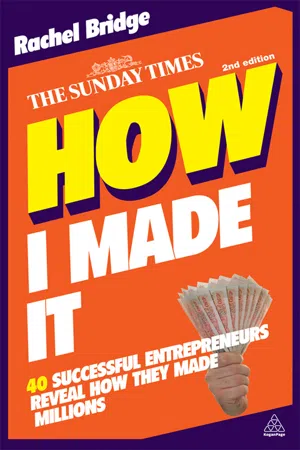
In How I Made It 40 successful entrepreneurs explain how they managed to defy the odds and turn their dreams into reality. Find out how they decided what to do, how they got started and how they found the money they needed. But they also reveal how they had doubts, made stupid mistakes, and encountered overwhelming frustrations along the way. This second edition updates their stories to reveal what happened next and how, in most cases, they finally sold their businesses and made millions.
Gutsy, inspiring, and life affirming - if you have ever dreamt of starting up your own business How I Made It is for you.
- 256 pages
- English
- ePUB (mobile friendly)
- Available on iOS & Android
eBook - ePub
About this book
Information
1
Lizzie Vann
Founder of Organix brands
When Lizzie Vann first hit on the idea of making healthy organic food for babies, she decided to draw up a list of the most nutritional ingredients she could find and then mix them together to create the ultimate superfood.
Unfortunately, the three foods at the top of her list were blackberries, lean steak and peanut butter. The experiment was not a great success. She says: ‘I ended up with this horrid, grey, slimy mess that looked like a squashed slug.’
Happily her subsequent attempts to create healthy food for children worked rather better. Sixteen years later her company Organix sells £36 million of baby food a year, the company has won numerous awards for food quality and campaigning and Vann has been awarded an MBE for services to children’s food.
Brought up in the Midlands, Vann first became interested in nutrition as a child when she suffered badly from asthma and eczema and had to be treated with steroids. She says: ‘I felt I needed to understand my illness and as I studied the way the body’s system works, I started to see there were links between food and health.’
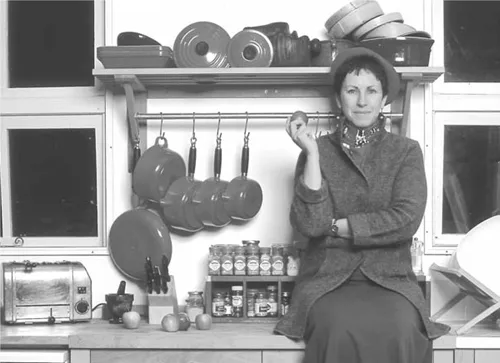
She went on to briefly study biology and ecology at Lancaster University, where she also became actively involved in campaigning for social justice. This included volunteering for housing action trusts and helping to set up a wholefood worker co-operative.
Her campaigning took a temporary back seat as she pursued a career as an investment analyst with a firm of actuaries in the City. But after eight years she realised she wanted to get back to the issues she believed in. She says: ‘I have always wanted life to feel like it has a coherent pattern to it and makes sense, instead of putting different aspects of your life in different boxes. But life in the City didn’t feel like that. It felt very glamorous and exciting and I felt very important earning lots of money but it just didn’t feel the right thing to be doing as I turned 30.’
She adds: ‘I had always had a very strong belief that society needed to be run in a better way and that ordinary citizens could change things. I started to think there had to be more to life than this.’
Vann decided that the best way she could contribute to making the world a better place was to give infants the best possible start in life by creating baby food using organic products and natural ingredients, without additives or chemicals.
She says: ‘Babies and children need good food because their bodies are developing and growing and I wanted to make food that would make a difference to their health. I wanted to be a standard setter for the industry.’
Confident that success was just around the corner she quit her job in the City and began experimenting with recipes in her kitchen with the help of a friend. She says: ‘I thought “Oh I can do this, it’s easy.” I decided I needed half a million pounds and thought “I know people in the City so I’ll just go and see them.” How naive can you be?’
Unsurprisingly her lack of any experience in setting up a food company did not impress. After being turned down by dozens of venture capitalists and merchant banks she was forced to scale down her ambitions. She started up the company with a more modest £50,000, raised through loans from banks and friends. She was not even able to persuade a British manufacturer to get involved and ended up having to get the first batch of baby food made in Germany.
She says: ‘I visited lots of companies that made baby food but they all said “Who are you? Have you ever done this before? What backing have you got?” So there was a bit of a credibility gap.’
Her belief in what she was doing started to pay off only when she took a stand at an exhibition for health visitors in Torquay. She says: ‘Baby food had a really bad reputation for being beige and adulterated with maltodextrin and cornflour, so none of the manufacturers would offer its food at exhibitions because people would turn up their noses at it. They gave away things like calculators instead. But we put out bowls of our baby foods for people to taste. They were bright orange and green and purple because they were made with carrots or spinach or blueberries, and people tried them and thought they were great. You could tell what they were by looking at them and tasting them rather than looking at the label.’
Orders from supermarkets quickly followed. Organix now produces around 50 varieties of food for babies and children up to 10.
Vann has meanwhile become a campaigner for better children’s food and in 2003 launched a drive for a children’s food bill after drawing up a code of practice for the food industry. She has also set up a Food for Life campaign to improve the quality of school meals which has generated a huge response among parents and schools. It is contributing to a major shift in the way the government sees the challenge of feeding children in school and the way that society more generally views children’s nutrition.
Fact File
Date of birth: 23 September 1958
Marital status: married with three stepdaughters
Highest level of education achieved: university (did not complete course)
Qualifications: three A levels, qualified investment analyst
Interests: organic farming and gardening, reading, politics
Personal philosophy: ‘Live life in the present. And never forget that information is power. The power of information can change the world.’
In 2008 Vann sold the business to one of its suppliers, Hero Foods, for a substantial undisclosed sum. She no longer works for the company on a day-to-day basis but has stayed on as president and a trustee of the Organix Foundation charity which funds research into food quality and child health.
Now 50, she says: ‘I really believe in the power of people. I believe we can change the world by putting out ideas and raising awareness, by showing different ways of doing things and by being noisy and loud.’
Vann says her outlook on life has always been driven by a combination of energy, passion and optimism. She says: ‘If I have a spare hour then I think I can do ten things in it. I’m constantly looking for solutions.’
2
Darren Richards
Founder of DatingDirect.com
Lovelorn sceptics seeking proof that internet dating really can work need look no further than Darren Richards, the creator of Britain’s largest dating service, DatingDirect.com. When Richards decided to try out the website he had created, he met the girl of his dreams on his second date. He says: ‘We got on really well, so at the end of the evening I told her I needed to tell her something. She didn’t believe who I was until I showed her my business card.’ They were together more than five years before amicably going their separate ways.
Bought up in Worcestershire, Richards always dreamt of setting up his own business. He admits: ‘I didn’t really pay much attention to getting good grades and certificates at school because I was so confident that I would be working for myself I thought I wouldn’t need to convince anyone else of my ability.’ When he left school at 16, however, he ended up getting a job as a waiter in a hotel restaurant for several years before going to work as a holiday rep in Gran Canaria. He continued to dream about setting up his own business, though, and was always coming up with potential money-making schemes, such as a loyalty card for high street shops.
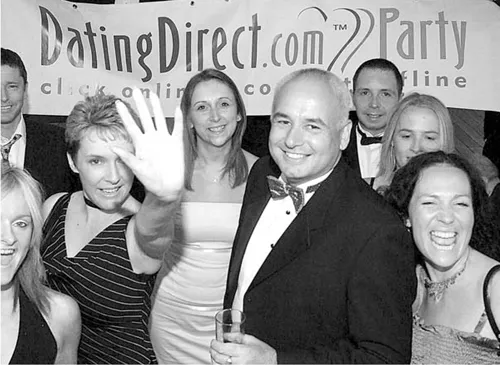
He says: ‘My mind was always elsewhere, even when I was waiting on tables in the restaurant. I tried so many different things that my friends would say: ‘Oh here comes Darren, I wonder what new idea he has today.’
He was trying to make a living importing electronic toys from Japan when he hit on the idea of setting up a dating service while idly surfing the internet one evening at home. Aged 33 and single, having recently come out of a long-term relationship, he suddenly realised that the internet could be the perfect way of meeting other singletons in his area. But when he searched for an online agency to join he could only find companies based in America. Even worse, none of the sites seemed to take the idea of meeting a new partner online seriously, encouraging members to use silly nicknames such as Sexy Babe and Hot Pants.
He says: ‘It was frustrating. I thought I couldn’t be the only person who wanted to use the internet to find a serious date.’
Richards drew up a blueprint of what he thought a British online dating service should be like. Then he spent the next three months researching the market, conducting straw polls with people in the street and asking his friends for their views. Encouraged by their response he bought some software and a couple of website magazines. Then he built a simple site where people could post details of themselves.
He says: ‘It was a very basic service and didn’t work that well. But it was getting a lot of hits and it proved to me there were a lot of people out there who wanted to use it.’ Inspired by the success of his prototype, Richards decided to create a fully fledged dating webs...
Table of contents
- Cover
- Dedication
- Title page
- Imprint
- Table of Contents
- Preface
- Acknowledgements
- Introduction
- 1. Lizzie Vann
- 2. Darren Richards
- 3. Maria Kempinska
- 4. Mark Mills
- 5. Penny Streeter
- 6. Derek Beevor
- 7. Rosemary Conley
- 8. Raymond Gubbay
- 9. Trisha Mason
- 10. John Mudd
- 11. Mark Roy
- 12. Mandy Haberman
- 13. Ted Smart
- 14. Mike Clare
- 15. Stephanie Manuel
- 16. Harry Cragoe
- 17. Rory Byrne
- 18. Jane Packer
- 19. Chris Gorman
- 20. Mark Ellingham
- 21. Sarah Doukas
- 22. Tim Roupell
- 23. Mark Wilkinson
- 24. Prue Leith
- 25. Christopher Wray
- 26. Heather Gilchrist
- 27. Richard Beggs
- 28. Duncan Bannatyne
- 29. Angela Wright
- 30. Daniel Mitchell
- 31. Emma Bridgewater
- 32. Gerry Pack
- 33. Zahid Kasim
- 34. Sharon Hilditch
- 35. Rik Hellewell
- 36. Jill Barker
- 37. Matt Stevenson
- 38. Sally Wilton
- 39. Charlie Bigham
- 40. Philip Hughes
- Full imprint
Trusted by 375,005 students
Access to over 1.5 million titles for a fair monthly price.
Study more efficiently using our study tools.
Frequently asked questions
Yes, you can cancel anytime from the Subscription tab in your account settings on the Perlego website. Your subscription will stay active until the end of your current billing period. Learn how to cancel your subscription
No, books cannot be downloaded as external files, such as PDFs, for use outside of Perlego. However, you can download books within the Perlego app for offline reading on mobile or tablet. Learn how to download books offline
Perlego offers two plans: Essential and Complete
- Essential is ideal for learners and professionals who enjoy exploring a wide range of subjects. Access the Essential Library with 800,000+ trusted titles and best-sellers across business, personal growth, and the humanities. Includes unlimited reading time and Standard Read Aloud voice.
- Complete: Perfect for advanced learners and researchers needing full, unrestricted access. Unlock 1.5M+ books across hundreds of subjects, including academic and specialized titles. The Complete Plan also includes advanced features like Premium Read Aloud and Research Assistant.
We are an online textbook subscription service, where you can get access to an entire online library for less than the price of a single book per month. With over 1.5 million books across 990+ topics, we’ve got you covered! Learn about our mission
Look out for the read-aloud symbol on your next book to see if you can listen to it. The read-aloud tool reads text aloud for you, highlighting the text as it is being read. You can pause it, speed it up and slow it down. Learn more about Read Aloud
Yes! You can use the Perlego app on both iOS and Android devices to read anytime, anywhere — even offline. Perfect for commutes or when you’re on the go.
Please note we cannot support devices running on iOS 13 and Android 7 or earlier. Learn more about using the app
Please note we cannot support devices running on iOS 13 and Android 7 or earlier. Learn more about using the app
Yes, you can access How I Made It by Rachel Bridge in PDF and/or ePUB format, as well as other popular books in Business & Entrepreneurship. We have over 1.5 million books available in our catalogue for you to explore.