21st century organizations, across all sectors and of all types, have to cope with an international marketplace where change is frequent and customer expectations continue to rise. The work of business analysis professionals is crucial if organizations are to succeed and grow. If change programmes are to be successful, stakeholder engagement and situation analysis are vital, and to achieve this, senior business people need to display competence in a range of areas, not least of which include the ability to challenge, lead and influence.
Business Analysis and Leadership is for anyone involved in business analysis working in any organization worldwide, from financial services to charities, government to manufacturing. It takes the reader beyond standard textbooks full of techniques and tools, advising on how to lead and gain credibility throughout the organization. It will help you with the tricky role of working with people from the shop floor to board directors and give readers the confidence to challenge the easy way forward and point out what will really work in practice.
This inspirational book consists of contributions from leading thinkers and practitioners in business analysis from around the world. Their case studies, practical advice and downloadable appendices will help the reader to develop leadership skills and become an outstanding catalyst for change.
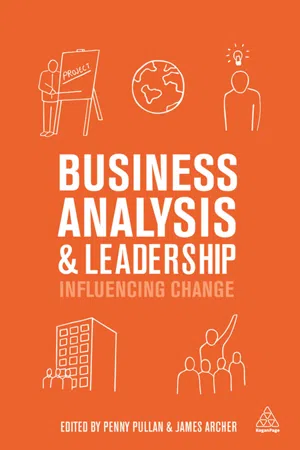
eBook - ePub
Business Analysis and Leadership
Influencing Change
- 288 pages
- English
- ePUB (mobile friendly)
- Available on iOS & Android
eBook - ePub
Business Analysis and Leadership
Influencing Change
About this book
Information
Introduction to Part I
Leadership comes at different levels, and this book reflects that reality. First of all, in Part I, we focus on leadership of self. Before people can influence, inspire and lead others effectively, they need to develop a leadership mindset. This means becoming aware of their own strengths and weaknesses, building up the courage to challenge, and honing communication and relationship skills.
What do we mean by leadership of self?
A historical view of leadership is that of a general leading troops into battle from the front, with followers who have to obey whatever the cost. While this view might have made sense in 19th-century battles, it is of limited use in the complex world of 21st-century organizations. The leadership described in this book is much less about formal power and authority. Instead, it is much more about making a difference through shared vision and understanding, influencing and inspiring others to enable effective change.
Part I focuses on the inner work that’s needed to build the foundations to become great at business analysis. To do so you’ll need to develop self-awareness, understanding your strengths and weaknesses, as well as the values you hold dear. From there, you can build on your strengths and find ways to cover for your weaknesses. Knowing your own values will help you to see how they relate to the values of the other people you work with and those of your organization. Leadership of self also needs a positive mindset that takes responsibility and is proactive, even when this means challenging the status quo. For all of this, you’ll need credibility, not on the basis of your professional competence alone, but also by paying attention to how others see you. Leaders are seen as honest, forward-looking and inspiring. Are you?
What does Part I cover?
Part I starts off in Chapter 1 by looking at the three sets of skills that business analysts need – professional, business and interpersonal skills – and how developing these is a never-ending job! It touches on the value of reflection in the life of a business analyst and how we most effectively learn by revisiting our basic assumptions rather than just polishing what we do.
Moving on, Chapter 2 looks at the imperative for those in business analysis to be able to challenge people, many of whom may be very senior inside organizations. It goes on to explore seven different ways build courage for these challenging situations.
‘The business analyst as a facilitative leader’ (Chapter 3) introduces the idea of facilitation being core to business analysis. This will appear again and again throughout this book. By offering process and structure, rather than the more traditional leadership of direction and answers, business analysis really encourages others to think and to find their own answers. The chapter works through a real example of how this inclusive leadership can work out in practice.
The rest of Part I looks at honing communication skills. Chapter 4 introduces a range of techniques from neurolinguistic programming (NLP) to support key aspects of communication, from building rapport to listening well and influencing. A positive mindset and a positive emotional state will help too.
Part I concludes with an opinion piece from the President of the UK Chapter of the International Institute of Business Analysis (IIBA). He asks if business analysts are waiting to be anointed as leaders, and encourages you to make the decision to step up to leadership now.
You can find additional resources for leadership of self at www.baleadership.com (archived at https://perma.cc/4MUW-P4V5). These include an ongoing study on the subject of credibility, contrasting results for leaders in general with business analysts in particular, and an article on negotiation, which looks at five questions that can make the process of negotiating much smoother.
How does Part I relate to leadership in your project?
Part I forms the building blocks for the business analyst who wishes to work effectively within a project. Part II provides a whole range of ways to develop further in a project context.
01
Skills for business analysis
There are three broad sets of skills and knowledge needed for business analysis: the technical skills of the profession, business knowledge, and a range of personal and interpersonal skills. This chapter concentrates on some of the key personal skills and developing approaches that pull together the three sets of skills and knowledge.
The role of a business analyst is to provide help to individuals and organizations. Edgar Schein first wrote about types of helping in Process Consultation, published in 1969. His distinction between ‘expert’ and ‘process’ consultant types of help, most recently articulated in his book Helping (Schein, 2010), indicates two very different approaches to business analysis. This chapter starts by explaining the differences from the perspective of business analysis and argues that business analysts should aim to be process consultants. The concept of process consultancy is particularly useful, as it describes the type of inclusive or facilitative leadership that we have in mind when we mention business analysis and leadership in the same breath.
The business analyst acting as a process consultant requires many different skills in order to provide help and leadership. Building on the concept of ‘T-shaped skills’, we propose the ‘T-shaped business analyst’ (see Figure 1.1) to show how even the biggest and baddest business analysis toolkit full of tools, techniques, models and methodologies is useless without the ability to work with people.
Business analysis involves listening to multiple voices, viewpoints and perspectives, analysing multiple situations, reflecting on all those voices, synthesizing them and pulling it all together into a proposed way (or ways) forward that meets both strategic needs and the needs of those on the ground.
This chapter covers a number of skills, approaches and ways of thinking. The three core skills of listening, reflecting and providing feedback are all explored. These skills are essential in being able to provide help, which ultimately is what business analysis is all about. Two different types of help and two types of learning are compared and contrasted. We conclude with a case study to show how the theory works in practice.
Providing help – expert versus process consultant
The consultant or business analyst can operate in one of two modes when helping people: as the ‘expert’, who provides information, diagnoses the problem and comes up with the solution, or as the ‘process consultant’, who works with the client to jointly understand problems and co-create solutions.
Business analysis can fall into either category. It is important to recognize which type of help is being provided. Most business analysts would like to think they are being the process consultant when often they are being the expert, a situation that may be caused by the actions of either the business analyst or the client. It may be explicit, for example clients may say they do not have the time to be involved, or it may just be the way things are done in that organization.
The term ‘client’ is one that is not used often enough by business analysts, who will frequently say they are working for ‘the business’. The term ‘client’ means a person or organization using the services of a professional. It is critical that on any piece of work the business analyst is crystal clear who the client or clients are that he or she helping.
Expert help
There is always a tension between the amount of time the business analyst wants the client and people working for the client to give to a project and the amount they actually give (see Chapter 11). This can increase the pressure on business analysts to become experts. The following situations need to be true for the expert role to be successful:
- The problem has been correctly diagnosed (see Chapter 8).
- The problem is straightforward, tame or simple (see Chapter 9).
- The client has effectively communicated exactly what they are expecting.
- The client has thought through the consequences of the business analyst gathering the information. This means the client must be prepared to give access to the relevant people and knowledge. The client must also ensure the people being asked for information are clear about why they are being consulted.
- The business analyst has the skills to discover and provide the information (see Chapter 26).
There are not many situations where the first four assumptions will be true. This means the expert role is usually extremely unhelpful, particularly at the beginning of a helping situation. There are further things to be careful of. First, t...
Table of contents
- Cover
- Praise for Business Analysis and Leadership
- Business Analysis and Leadership
- Business Analysis and Leadership
- Contents
- About the Editors
- About The Contributors
- Acknowledgements
- Foreword
- List of Figures
- List of Tables
- Introduction
- Leadership of self
- Introduction to Part I
- 01 Skills for business analysis
- 02 The courage to ask
- 03 The business analyst as a facilitative leader
- 04 Communication for success
- on Opinion piece
- Leadership within your project
- Introduction to Part II
- 05 Working with the project manager
- 06 Dealing with difficult stakeholders
- 07 Facilitating groups and individuals
- 08 Discovering the essence of the problem
- 09 Dealing with problems
- 10 Visual thinking for business analysis
- 11 Through the stage door: design thinking to refresh business analysis
- 12 Business analysis, leadership, and agile
- 13 The iterative business analyst – increasing insight, reducing waste, delivering value
- 14 Knowledge sharing and analysis with patterns
- 15 Dealing with uncertainty
- on Opinion piece
- Leadership within your organization
- Introduction to Part III
- 16 Operating effectively as a business analyst inside an organization
- 17 Context, climate and culture
- 18 Global working and virtual teams
- 19 Systems thinking for business analysts leading change
- 20 Dealing with power and politics
- 21 Partnering across organizations
- 22 Strategic thinking for business analysis
- on Opinion piece
- Leadership in the wider world
- Introduction to Part IV
- 23 Business analysis is a leadership role
- 24 Becoming a thought leader
- 25 Ethics and fair process
- 26 Professionalization and best practices
- on Opinion piece
- nd End piece
- Index
- Copyright
Trusted by 375,005 students
Access to over 1.5 million titles for a fair monthly price.
Study more efficiently using our study tools.
Frequently asked questions
Yes, you can cancel anytime from the Subscription tab in your account settings on the Perlego website. Your subscription will stay active until the end of your current billing period. Learn how to cancel your subscription
No, books cannot be downloaded as external files, such as PDFs, for use outside of Perlego. However, you can download books within the Perlego app for offline reading on mobile or tablet. Learn how to download books offline
We are an online textbook subscription service, where you can get access to an entire online library for less than the price of a single book per month. With over 1.5 million books across 990+ topics, we’ve got you covered! Learn about our mission
Look out for the read-aloud symbol on your next book to see if you can listen to it. The read-aloud tool reads text aloud for you, highlighting the text as it is being read. You can pause it, speed it up and slow it down. Learn more about Read Aloud
Yes! You can use the Perlego app on both iOS and Android devices to read anytime, anywhere — even offline. Perfect for commutes or when you’re on the go.
Please note we cannot support devices running on iOS 13 and Android 7 or earlier. Learn more about using the app
Please note we cannot support devices running on iOS 13 and Android 7 or earlier. Learn more about using the app
Yes, you can access Business Analysis and Leadership by Penny Pullan, James Archer, Penny Pullan,James Archer in PDF and/or ePUB format, as well as other popular books in Business & Management. We have over 1.5 million books available in our catalogue for you to explore.