- English
- ePUB (mobile friendly)
- Available on iOS & Android
eBook - ePub
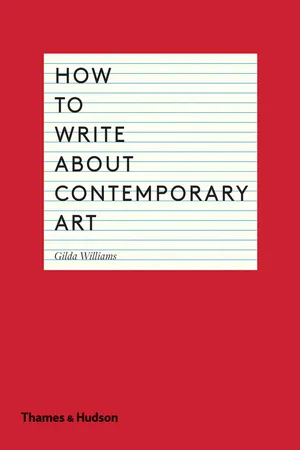
How to Write About Contemporary Art
About this book
This is the definitive guide to writing engagingly about the art of our time. Invaluable for students, arts professionals and other writers, it brims with practical tips that range across the full spectrum of art-writing including academic essays; press releases and news articles; texts for auction and exhibition catalogues, gallery guides and wall labels; op-ed journalism and exhibition reviews and writing for websites and blogs. Gilda Williams, a London correspondent for Artforum, points to the power of close looking and research, showing how to deploy language effectively; how to develop new ideas; and how to construct compelling texts. Includes a bibliography, advice on the use and misuse of grammar and tips on how to construct your own contemporary art library.
Information
Topic
ArtSubtopic
Art Theory & CriticismSECTION THREE
The Ropes
How to Write Contemporary Art Formats
‘It is only shallow people who do not judge by appearances’
OSCAR WILDE, 189074
One reason art-writers strain to find their own ‘voice’ is that the art-world today demands that we speak in tongues, adopting multiple registers—academic for an art-history journal; gossipy on a blog; ‘objective’ for a book caption; business-like for a funding application—to suit the panoply of evaluating, explaining, descriptive, journalistic, and other text-types required. This section will delineate the tone expected for each format and share tips. A big emphasis will be on structures:
+ the what is it?/what does it mean?/so what? trio of questions addressed when looking at artworks;
+ a basic essay outline for academic and multi-artist texts;
+ the inverted-triangle news format (big opener; tapering down with details of who/what/when/where/why; ending with a ‘sting’);
+ identifying a single key idea or principle to lead your writing through an artwork, project, or artist, which can even be no-frills chronological order.
As you progress, you can relax these frameworks, or mix them—or, better still, when these practised techniques have become habit, just write. But if you’re starting out, these guiding outlines are your new best friends.

> Getting started
Whether for class submission or publication in a specialist journal, an academic paper begins with a general area of interest. At worst, this is an anemic topic assigned by your teacher. At best, this is a gripping passion that has so ferociously seized your mind, you cannot sleep. Probably, your starting point lies somewhere in the middle. Ask your tutor for book/article recommendations. Or, begin by consulting pertinent anthologies, compendia, and series, such as:
+ Harrison and Wood, Art in Theory 1900–2000: An Anthology of Changing Ideas, Oxford and Malden, M.A.: Wiley-Blackwell, 2002;
+ Krauss, Foster, Bois, Buchloh, and Joselit, Art Since 1900: Modernism, Antimodernism, Postmodernism, 2nd edn, vols 1-2, London and New York: Thames & Hudson, 2012 (includes an exhaustive bibliography by topic);
+ ‘Themes and Movements’ series: (Art and Photography, ed. David Campany, 2003; Land and Environmental Art, ed. Jeffrey Kastner, 1998; Art and Feminism, ed. Helena Reckitt and Peggy Phelan, 2001, and more), London: Phaidon Press;
+ ‘Documents of Contemporary Art’ series: (Participation, ed. Claire Bishop, 2006; Memory, ed. Ian Farr, 2012; The Studio, ed. Jens Hoffman, 2012; Painting, ed. Terry Meyer, 2011; Utopias, ed. Richard Noble, 2009, and more), Cambridge, M.A. and London: MIT/Whitechapel;
+ Routledge’s ‘Readers’: Nicholas Mirzoeff, The Visual Culture Reader, 2012 (3rd edn); Liz Wells, The Photography Reader, 2003, London and New York: Routledge.
You cannot rely solely on these overviews, and may need to seek out original full-length versions of abridged texts. All your texts cannot derive from a single anthology. Your sources must vary, and your bibliography demonstrate some effort and originality. Your institution or local library may have access to reliable, searchable online sources such as JSTOR and Questia for specialized articles.
Be smart with Google; one intelligent search leads to the next, but use only trustworthy institutional sources.
You may find an excellent online course, or an academic essay, with a thorough bibliography to begin your research. Note: You may not plagiarize existing material! Only consult the best-quality bibliographies to begin compiling your own first-draft reading list.
Read three or four essential texts on the subject; take notes. Summarize each article or chapter in a few sentences: what was the main point? Write down key information in short snippets, pertinent to your question. You need to collect evidence to substantiate your ideas later on; ‘evidence’ includes:
+ quotes from artists, critics, and key figures;
+ artworks;
+ exhibitions;
+ market data;
+ and historical facts.
Such evidence is at the service of supporting your own substantiated ideas: not just marshaled together to produce a report on the subject, like a fact-driven encyclopedia entry. Remember: a quote is evidence only of one person’s viewpoint; it may be well-informed, but is not an incontrovertible truth. (See ‘Explaining v. evaluating’ on artist’s quotes.)
Tag evidence with complete bibliography as you go along, so you’re not hunting for footnote details at the end: author, title, date, publisher/city, page number; volume and issue (for a magazine); or website address and date accessed (from a reputable Internet page). Footnotes are not just technical trivia; they show that the author takes seriously the job of substantiating ideas, and acknowledges the work of others.
Jot down any good vocabulary that you come across while reading, listing useful terms or phrases near the section where they might fit—a handy crutch when you’re at a loss for words at three o’clock in the morning, the night before submission.
After this brief but solid research, you might draw a freehand flow-chart, or timeline, or idea-map to begin making connections visually, and start clustering and prioritizing your interests in relation to your back-up evidence. You should be able to write down, in 40 words or fewer, an initial, focused area of investigation; often this is in the form of a research question. This first stab at a query may prove flawed, because it:
+ is a leading question (that suggests a predetermined answer);
+ is based on unqualified assumptions;
+ is too broad;
+ is too narrow;
+ is out-of-date;
+ cannot be researched, because no thorough and reliable information exists or can be accessed;
+ would require powers of clairvoyance.
Your research question may require rewording or refining as you progress; the longer the research time, the more modifications. A PhD inquiry might change a dozen times; a quick, three-week assignment, max once.
> The research question
You should not anticipate the answer before you start, determined to ‘prove’ an idea in your essay. This is like a detective setting out to demonstrate that the butler did it instead of asking, who killed Roger Ackroyd? The job is not to find evidence to support a predetermined conclusion but to investigate an unknown. Take a look at the following examples:
Leading question: How have powerful galleries determined the course of art history?
This assumes that powerful galleries have determined art history, which may be true but needs to be adequately demonstrated. This question excludes innumerable other factors shaping ‘the course of art history’.
Unqualified assumption: How have private collectors today gained more power and influence in the art system than the commercial galleries?
This ‘question’ is an assumption in disguise, which asserts that collectors are stronger players than the p...
Table of contents
- Cover
- Title Page
- About the Author
- Other titles of Interest
- Dedication
- Acknowledgments
- Contents
- Introduction
- Section One: The Job: Why Write about Contemporary Art?
- Section Two: The Practice: How to Write About Contemporary Art
- Section Three: The Ropes: How to Write Contemporary Art Formats
- Conclusion
- Resources
Trusted by 375,005 students
Access to over 1.5 million titles for a fair monthly price.
Study more efficiently using our study tools.
Frequently asked questions
Yes, you can cancel anytime from the Subscription tab in your account settings on the Perlego website. Your subscription will stay active until the end of your current billing period. Learn how to cancel your subscription
No, books cannot be downloaded as external files, such as PDFs, for use outside of Perlego. However, you can download books within the Perlego app for offline reading on mobile or tablet. Learn how to download books offline
Perlego offers two plans: Essential and Complete
- Essential is ideal for learners and professionals who enjoy exploring a wide range of subjects. Access the Essential Library with 800,000+ trusted titles and best-sellers across business, personal growth, and the humanities. Includes unlimited reading time and Standard Read Aloud voice.
- Complete: Perfect for advanced learners and researchers needing full, unrestricted access. Unlock 1.5M+ books across hundreds of subjects, including academic and specialized titles. The Complete Plan also includes advanced features like Premium Read Aloud and Research Assistant.
We are an online textbook subscription service, where you can get access to an entire online library for less than the price of a single book per month. With over 1.5 million books across 990+ topics, we’ve got you covered! Learn about our mission
Look out for the read-aloud symbol on your next book to see if you can listen to it. The read-aloud tool reads text aloud for you, highlighting the text as it is being read. You can pause it, speed it up and slow it down. Learn more about Read Aloud
Yes! You can use the Perlego app on both iOS and Android devices to read anytime, anywhere — even offline. Perfect for commutes or when you’re on the go.
Please note we cannot support devices running on iOS 13 and Android 7 or earlier. Learn more about using the app
Please note we cannot support devices running on iOS 13 and Android 7 or earlier. Learn more about using the app
Yes, you can access How to Write About Contemporary Art by Gilda Williams in PDF and/or ePUB format, as well as other popular books in Art & Art Theory & Criticism. We have over 1.5 million books available in our catalogue for you to explore.