![]()
1 The Geology-Engineering Partnership
The engineer’s job is to design and build structures that interact continuously with the soil and subsurface. The goal of this book is to give engineers an academic understanding of earth science and the basics needed to conduct engineering activity appropriate to the various environments that exist on our planet. The objective is to provide:
• The knowledge and ability to analyze the geological processes that create, deform, and weather rocks;
• An understanding of the principal types of rocks and unconsolidated materials and their properties;
• An illustration of how geological conditions affect engineering activities, and how they can simplify or complicate these activities;
• An appreciation of the richness of underground resources and an understanding of how to manage them, geared toward modern engineers seeking sustainable development in an interdisciplinary environment.
This book is a presentation of the scientific basics for engineering geology. The discussion of geological fundamentals is simplified to meet the specific needs of engineers. Other more specialized texts cover the subject of engineering geology in greater detail.
In this introductory chapter, we discuss the areas of geology of interest to engineers and CO illustrate how geology contributes to the resolution of civil engineering and environmental problems. We will also examine the ancient origin of earth science as early man tried to answer questions raised by his observation of the land.
[24,177,205,288,386,396,401]
1.1 Areas of engineering geology
The International Association of Engineering Geology and the Environment (IAEG) gives a detailed definition of engineering geology:
“Engineering Geology is the science devoted to the investigation, study and solution of the engineering and environmental problems which may arise as the result of the interaction between geology and the works and activities of man as well as to the prediction of and the development of measures for prevention or remediation of geological hazards.
Engineering Geology embraces:
– the definition of the geomorphology, structure, stratigraphy, lithology and groundwater conditions of geological formations;
– the characterization of the mineralogical, physico-geomechanical, chemical and hydraulic properties of all earth materials involved in construction, resource recovery and environmental change;
– the assessment of the mechanical and hydrologic behaviour of soil and rock masses;
– the prediction of changes to the above properties with time;
– the determination of the parameters to be considered in the stability analysis of engineering works and of earth masses; and
– the improvement and maintenance of the environmental condition and of the properties of the terrain.”
This book will use concrete examples to illustrate the importance of geology in these areas.
It should be noted that the fundamentals of geology are one of the curriculum basics in the following branches of engineering:
• Civil engineering
• Environmental sciences and engineering
• Soil and rock mechanics
• Hydrology
• Hydrogeology
• Pedology
Beyond the scientific basis, the study of earth science influences the way an engineer thinks, both in the exercise of his profession and in his culture, as follows:
• Greater sensitivity to the siting of an engineering project (the relationship between the structure and its environment);
• An understanding of different scales of space and time;
• A broader qualitative vision of problems that need resolution, along with quantitative notions;
• Encouragement of an interdisciplinary focus;
• Critical thinking when using local measurements as a base for a regionalization and the construction of simulation models;
• An introduction to modern environmental challenges involving the subsurface (for example, the geological storage of wastes, contaminated sites. See Chap. 14.).
In this book, the areas where geology and engineering intersect are presented as four large groups, as shown below (§ 1.1.1 to 1.1.4).
1.1.1 Project construction
The geologist collaborates with the geotechnical engineer to determine if a piece of land proposed for construction has the necessary stability conditions. The two professions complement each other in the following ways:
• The geologist is a scientist who analyzes the subsurface structure of a site on the basis of his experience of the region and by surveys and borings. He then makes predictions about the nature of the subsurface materials to be encountered in the excavations and describes them in terms of characteristics that are useful to the engineer. He evaluates the risk the worksite poses to the environment.
• The geotechnical engineer is a civil engineer specialized in the measurement of mechanical properties of foundation soils. He orders laboratory tests and interprets their results. He calculates the dimensions of the foundation in collaboration with the design engineer.
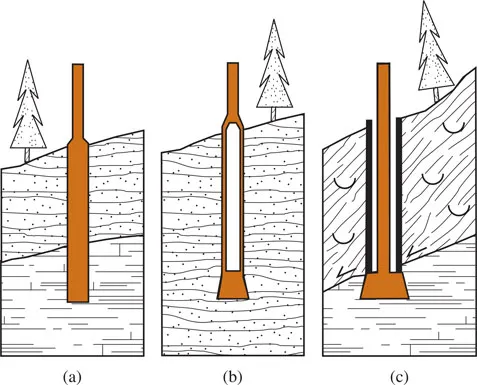
This distribution of tasks between the geologist and geotechnical engineer varies from country to country. In practice, geological conditions will play the major role in the choice of the foundation type for any project (Fig. 1.1).
[53,134,171,192,209,232,363]
Fig. 1.1 Bridge foundation piers; (a) simple concrete filled piers in stable overburden for a foundation on a substrate with good bearing capacity; (b) light pier, hollow, with an elephant-foot base for stable terrain but with low bearing capacity; (c) cased pier for overburden that is undergoing active sliding.
1.1.2 Natural hazards
Numerous natural hazards threaten man, his structures, and nature. They cause costly catastrophes that destroy prope...