![]()
Munir Ashraf
1Introduction
The word textile originated from Latin word Textilis which means woven, fabric, cloth. The textiles can be defined as the products which are formed by the interlacement of fibers or yarn. The broad definition covers any product intermediate or final made in textile industry. Therefore, the term textile includes fibers, filaments, yarns, woven, knitted and braided cloths as well as nonwoven fabrics.
1.1What is Textile?
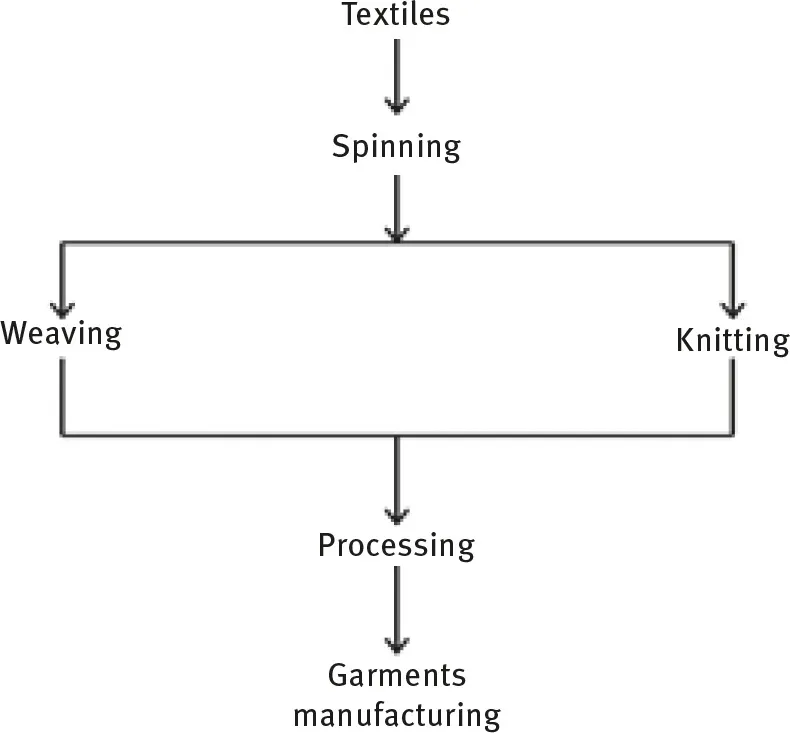
A textile product passes through several processes in its manufacturing before it becomes wearable. These processes include spinning, weaving, knitting, processing and garments manufacturing. The flow of these processes is shown in Fig. 1.1.
Fig. 1.1: Process flow of textile product manufacturing.
1.2History of Textiles
The usage of textiles can be traced back to the Neolithic Age (Tab. 1.1). The people around 4000 BC invented hand-operated spindles and looms in Europe and the materials used were wool and flax [1].
Tab. 1.1: Evolution of raw materials and machines to manufacture textile products [1].
The spinning and weaving processes changed considerably at the end of the first millennium AD. In the middle of the 14th century, cotton was introduced in central Europe [1]. Due to the growing world population, the processes developed needed drastic changes to meet the requirements. This led to industrialization. The post-industrialization era witnessed continuous improvement and innovation in textile raw materials, machinery and processes. Around the middle of the 20th century, significant developments in raw materials like manufacturing of polyamides, polyester, polyacronitrile and machinery like water-jet weaving looms and open-end spinning machines took place and this process of innovation and improvement is still in continuation.
The processing of textiles (dyeing and printing) also has its roots in the prehistoric era. The first solid evidence about dyeing of silk and brocades from religious and social records suggests that Indians were aware of the dyeing process in 2500 BC; however, it is also believed that the Chinese in 3500 BC practised dyeing but no solid evidence is available to substantiate it. Safflower was in use for dyeing textiles for red and yellow colours in 2500 BC. Egyptians were able to produce a whole range of colours for textiles by 1450 BC. After the collapse of the Roman Empire, no record is available on the developments of textile dyeing till 1371 when the dyers formed their own independent guild in Florence and made the information public about dyeing. Tab. 1.2 shows the significant developments in dyeing and printing at different times in history [2].
1.3Status of Textiles in World Exports
According to the statistics of World Trade Organization (WTO), the current world exports of textiles are equal to US$766 billion which has increased from US$455 billion in nine years since the return of normal trading rules in 2005, when the multi-fibre arrangement quota system ended. Even during years of significant economic crisis (2008–2009), the trade data points to the enormous success of exports oriented textiles and clothing [3] as illustrated in Fig. 1.2.
Fig. 1.2: World merchandise exports, 2004–2013.
Tab. 1.2: Evolution of dyeing material and processes [2].
| Period | Evolution of dyeing material and processes |
| 3500 BC | Dyeing Practised in China but solid evidence is missing. |
| 2500 BC | Religious and social records suggest that Indians used to dye silk and brocades. |
| 715 BC | Wool dyeing established as craft in Rome. |
| 327 BC | Alexander the Great mentions “beautiful printed cottons” in India. |
| 55 BC | Romans found painted people “picti” in Gaul dyeing themselves with Woad. |
| 2nd and 3rd AD | Roman graves found with madder- and indigo-dyed textiles, replacing the old |
| Centuries | Imperial Purple. |
| 273 AD | Emperor Aurelian refused to let his wife buy a purpura-dyed silk garment. It cost its weight in gold. |
| 700s | A Chinese manuscript mentions dyeing with wax resist technique. |
| 925 | The Wool Dyers’ Guilds first initiated in Germany. |
| 1188 | The first mention of Guilds for Dyers in London. |
| 1197 | King John (of Magna Carta fame) persuaded Parliament to regulate dyeing of woolens to protect the public from poor quality goods. |
| 1212 | The city of Florence had over 200 dyers, fullers and tailors. A directory of weavers and spinners was published as well. |
| 1290 | The only blue dye of the period, Woad, began to be raised extensively in Germany. |
| 1321 | Brazilwood was first mentioned as a dye, source from East Indies and India. |
| 1472 | Edward IV incorporated the Dyers’ Company of London. |
| 1507 | France, Holland and Germany begin the cultivation of dye plants as an industry. |
| 1614 | Dyeing cloth “in the wood” was introduced in England: logwood, fustic, etc. |
| 1689 | The first calico printworks was begun in Germany at Augsburg and was later to grow into a large industry. |
| 1745 | Indigo begins to be grown in England, after the Revolu... |