eBook - ePub
Anthropology and Art Practice
- 184 pages
- English
- ePUB (mobile friendly)
- Available on iOS & Android
eBook - ePub
Anthropology and Art Practice
About this book
Anthropology and Art Practice takes an innovative look at new experimental work informed by the newly-reconfigured relationship between the arts and anthropology. This practice-based and visual work can be characterised as 'art-ethnography'. In engaging with the concerns of both fields, this cutting-edge study tackles current issues such as the role of the artist in collaborative work, and the political uses of documentary. The book focuses on key works from artists and anthropologists that engage with 'art-ethnography' and investigates the processes and strategies behind their creation and exhibition.The book highlights the work of a new generation of practitioners in this hybrid field, such as Anthony Luvera, Kathryn Ramey, Brad Butler and Karen Mirza, Kate Hennessy and Jennifer Deger, who work in a diverse range of media - including film, photography, sound and performance. Anthropology and Art Practice suggests a series of radical challenges to assumptions made on both sides of the art/anthropology divide and is intended to inspire further dialogue and provide essential reading for a wide range of students and practitioners.
Information
1
WAYS OF WORKING
In this volume, we want to emphasize the importance of “the way we work”1 for the practices of both anthropologists and artists. Ways of working are central to the sorts of creativity employed within projects, the kinds of collaborations involved, and the production of outcomes whether those are artworks or anthropological representations of one kind or another. Partly, this signals a desire to explore and critically engage anthropologically with the practices of contemporary artists, but it also means approaching creativity and meaning as something often emergent, rather than prefigured or planned. Theory is now in the way of making, rather than outside it. This is a key area that suggests strong affinities between the work of anthropologists and that of many contemporary artists. Collaborations of various kinds are key to many of the encounters between art and anthropology that we present in this volume, and the kinds of productive dialogues we are concerned with are exemplified by contributors, such as Rupert Cox (anthropologist) and Angus Carlyle (sound artist), who produce co-authored works. But this is not just a dialogue between art and anthropology as disciplines, but concerns artists whose work—the material that is produced—consists of various kinds of dialogue and collaboration. This has always been the case for anthropologists with their long-term involvement with fieldwork. Whether left relatively open or staged within more controlled parameters, artists are increasingly using various kinds of social encounters as “the work.”
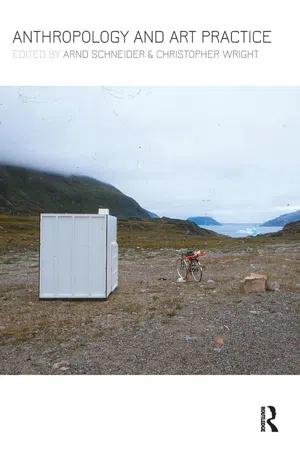
Pia Arke (1958–2005) was an artist of mixed Danish and Greenlandic origins whose work has only recently started to achieve the international recognition it deserves. The image of Arke’s massive pinhole camera at Nuugaarsuk in South Greenland in 1990 that is on the front cover of this volume and the black-and-white photographs that were taken with it (Figures 1.1 and 1.2) are both part of her long-term project to explore the notions of belonging through her own ethnic position, what she referred to as her “mongrel” status.2 Arke built the camera on such a large scale so that she could physically get inside the camera and remain there when the photograph was being exposed—a way of literally and figuratively including herself in the landscape in a corporeal way. This work forms a counterpoint to Arctic Hysteria, a video work she made in 1996, in which she struggles naked with a large map of Greenland, stroking it and touching it but in the process also gradually tearing it to pieces.3 Throughout her work, Arke struggled with trying to find a space in-between her Danish and Greenlandic identities and questioned not just the anthropological representations of Greenlandic peoples under colonialism but also the automatic anthropological connection of place, landscape, and people—ideas of homeland—and its effective romanticization in terms of arctic peoples. She used some of her large landscape photographs (such as Figures 1.1 and 1.2) as the backdrops for later portraits of modern urban Greenlanders—including her own cousin. In these, it is uncertain whether people merge into the landscape or are divorced from it. In her exploration of the histories of people from the settlement of Scorebysund/Ittoqqortoormiit,4 Arke treats Greenlandic and Danish inhabitants in the same way, recording oral histories in relation to old photographs. But she also records the points at which there is no information or where people are unwilling to provide information. The result of long-term interactions with people in Greenland, Arke’s work consistently sought to understand the complex trajectories of Greenlandic people in a world where the impact of the Internet might be as significant as that of earlier ways of hunting.
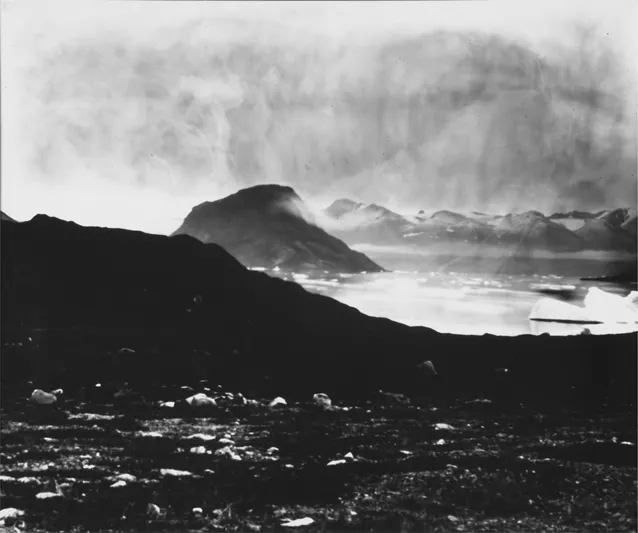
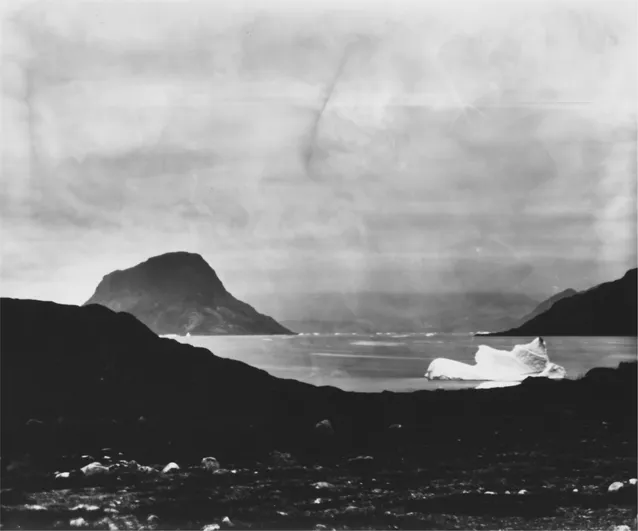
Figures 1.1 and 1.2 Pia Arke, Nuugaarsuk alias Hulkamerafotografialias Pointen (Nuugaarsuk alias Pinhole Camera Photograph alias The Point), 1990, silver/gelatine on baryte paper print of Nuugaarsuk Point, Narsaq, 49.5 × 59.5 cm; collection of Brandts Museet for Fotokunst, Odense.
Arke’s work is a powerful example of denarrating (in the sense used by curator and art critic Gerardo Mosquera5) the entangled colonial history of her birthplace, Scorebysund (in Danish)/Ittoqqortoormiit (in Inuit) on the east coast of Greenland.
Arke made a series of artistic investigations into thousands of family albums and colonists’ and scientific explorers’ photos of this remote place, to which an Inuit community (among them Arke’s maternal relatives, her father was Danish) was forced to settle in 1925, 1,000 kilometers north from their homeland, together with Danish colonists, in order to claim this part of Greenland (in effect all of Greenland) for Denmark.6 Much of the archival material was found by Arke in the colonial center, Copenhagen, and in painstaking work she identified Inuit individuals and spoke to descendants. The results, including her rephotographing of archival photos, were shown in exhibitions and published in a book, with critical chapters on cartography by Stefan Jonsson. In Arke’s polemical text “Ethno-Aesthetics,”7 she challenged the prevalent, well-meaning views of art historians on certain timeless qualities in Inuit art and, instead, situated the subject in its colonial and postcolonial context.
Arke is only one example of many contemporary artists whose work addresses anthropological themes, and as editors we have made a subjective choice of practitioners who for us represent particularly challenging and productive engagements with the shifting area between contemporary art and anthropology. A large and heterogeneous body of work is now being produced at this crossroads, but new work is sometimes presented simply as an assemblage by practitioners from different disciplinary backgrounds without really exploring in any depth what can be gained from such a juxtaposition. Richard Baxstrom and Todd Meyer’s 2008 book Anthropologies included textual and visual interventions from anthropologists, medical anthropologists, philosophers, and filmmakers through essays, images, and an accompanying DVD, and although the individual contributions are interesting in their own right, the book does not explore what is to be gained from such an encounter. The introduction to the volume suggests that “each contribution is informative and expressive, empirical and aesthetic, ethnographic and artistic; by refusing to choose between expression and interpretation, these works speak to the complex, unclassified, essential and yet approachable aspects of the world around us.”8 However true this may be, the joint and contrastive potential of the individual contributions—what bringing them into juxtaposition suggests—is not really explored further.
Arguably, much more could have been achieved in Anthropologies, through developing a sustained discussion or engagement with movie-making (as opposed to documentary filmmaking) in all its genre, and historical, diversity—not just another study of film but an engagement with film. Obviously, this was an ambition of the editors through including work on DVD, by directors Amir Muhammad and Ranja Ajami, but it is never overtly explored. Where such ambitions, informed by film’s creative-theoretical drive (here represented by director Robert Bresson), might lead can perhaps be discerned from another of Baxtrom’s interventions, this time into an interesting new student journal at the University of Edinburgh—The Unfamiliar: Blurring the Boundaries between Art & Anthropology. Here he writes:
Even within Geertz’s interpretive, literary version of anthropology, there exists a Cartesian partition between the concreteness of the world and the ideas that swirl around such a world seeking to contain it, understand it, change it. “Models of’ and ‘models for” the world fold back upon their own mistaken divisions, The Unfamiliar haltingly asserts… We insistently return to our Unfamiliar task of facing up. After all, as Bresson has shown us what is a model except pure face. The Unfamiliar discards Geertz’s interpretive duality for Bresson’s formal singularity.9
Vortex Travel
The working and research methods involved in the projects presented here are probing, exploratory, and often remain fragmentary and open-ended in their results. The process of working with people and materials in ethnographic situations becomes as, or even more, important than the finished product. Anthony Luvera—whose work and practices are featured in this volume—has worked for many years with people who are homeless; with some individuals this has resulted in relationships that have lasted for over eight years and that are constantly being renegotiated. This is a very long-term commitment and involves Luvera and his collaborators in an ongoing process in which artworks are always relatively provisional outcomes. Sometimes this involves dealing with collaborators who come and go, those leading a transitory existence in which the presence of the artist is a temporary, although recurring feature. This all sounds familiar to anthropologists, who frequently have to maintain relationships with their collaborators under very similar circumstances. Both anthropologists and contemporary artists have to come to terms practically, and theoretically, with some of the fragmentary aspects of experience in a globalized world. These experiences, ubiquitous and yet in an uncanny way also place- and site-specific, characterize the work of painter Franz Ackermann (see Plate 1). In 1991, Ackermann started to make a series of what he called “Mental Maps,” small drawings, watercolors, and gouaches of his visual experience and perception of large cities, in Asia, South America, Australia, and elsewhere around the world. These Mental Maps constitute a kind of personal cartography, using elements of street maps, different points of perspective that provide views of city fragments, and bits of brightly colored surface painting—all combined in vortex-like arrangements.
As Caoimhín Mac Giolla Léith has observed, “With Franz Ackermann we are no longer dealing with ‘anthropological place’—that is, as Marc Augé10 has defined it, a concrete, symbolic construction of space conceived as relational, historical and concerned with identity. Rather we are dealing with an ambitious attempt to articulate in visual form one man’s journeys through the non-anthropological, non-places of what Augé has called supermodernity.”11 While anthropologists have traditionally aimed to be site-specific in their fieldwork and the representations of their fieldwork, their actual practices and movements also involve Ackermann-like scenarios.12 The prismatic and kaleidoscopic qualities of Ackermann’s paintings, where some representations are naturalistic and in perspective but always fragmented, juxtaposed, and jumbled with patches of flat surface painting, are a good metaphor to think through the practices of the multisited anthropologist.
On the other hand, the work of Fiamma Montezemolo, both an artist and an anthropologist, speaks to the experience of urban dislocation, migration, and multiple border crossings in a global world from the perspective of those who are not so privileged. This gap—between those that can travel and those whose passage is restricted—is perhaps nowhere more visible than at one of its contemporary fault lines, the US-Mexico border. The book, Here is Tijuana, that Montezemolo produced jointly with an architect and a writer,13 is a fast-moving collage, juxtaposing in flash-like sequences—not unlike those Ackermann assembles in his paintings—a wide range of black-and-white and color photos of Tijuana’s vibrant and diverse street life and neighborhoods, grouped into chapters such as “Avatars,” “Desires,” and “Permutations.” The photographs are accompanied by statements from residents, writers, and artists alongside government statistics. In a more recent work, Tijuana Dreaming (coedited with Josh Kun), Montezemolo conducts another probing enquiry into the contradictory trance/transcience qualities of the border space that are thrown up in a kaleidoscopic way by the Mexican town, and its effective Other on the other side of the border, San Diego.14 Montezemolo’s own conceptual piece Bio-Cartography poignantly mixes and superimposes a uterine medical scan with statistical information to speak about Tijuana as both “mother” and “patient” (see Figure 1.3).
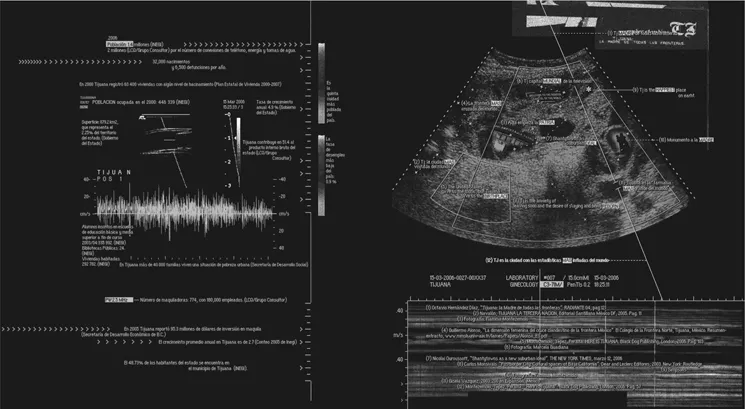
Figure 1.3 Fiamma Montezemolo, Bio-Cartography of Tijuana’s Cultural-Artistic Scene, inSite_05, 2006; cou...
Table of contents
- Cover
- Half Title
- Title Page
- Copyright Page
- CONTENTS
- List of Illustrations
- Acknowledgements
- Contributors
- 1. Ways of Working
- 2. Agit-Kino: Iteration No. 2
- 3. Entrada Prohibida (Forbidden Entry)
- 4. Speaking Nearby: Anthony Luvera in Conversation with Chris Wright
- 5. Traversing Art Practice and Anthropology: Notes on Ambiguity and Epistemological Uncertainty
- 6. Surgery Lessons
- 7. A Word is not Always Just a Word, Sometimes it is an IMAGE: Musings About the Film Yanqui WALKER and the OPTICAL REVOLUTION
- 8. Out of Hand: Reflections on Elsewhereness
- 9. On Collections and Collectivity: A Conversation between Brad Butler, Karen Mirza, and Chris Wright
- 10. Immersions: Raul Ortega Ayala in Conversation with Chris Wright
- 11. In-Between
- 12. An Imaginary Line: Active Pass to IR9
- 13. Dancing in the Abyss: Living With Liminality
- 14. Yvette Brackman Discusses her Project, Common Knowledge. Interviewed by Helene Lundbye Petersen
- 15. With(in) Each Other: Sensorial Practices in Recent Audiovisual Work
- 16. In Praise of Slow Motion
- 17. Skylarks: An Exploration of a Collaboration between Art, Anthropology, and Science
- Index
Trusted by 375,005 students
Access to over 1.5 million titles for a fair monthly price.
Study more efficiently using our study tools.
Frequently asked questions
Yes, you can cancel anytime from the Subscription tab in your account settings on the Perlego website. Your subscription will stay active until the end of your current billing period. Learn how to cancel your subscription
No, books cannot be downloaded as external files, such as PDFs, for use outside of Perlego. However, you can download books within the Perlego app for offline reading on mobile or tablet. Learn how to download books offline
Perlego offers two plans: Essential and Complete
- Essential is ideal for learners and professionals who enjoy exploring a wide range of subjects. Access the Essential Library with 800,000+ trusted titles and best-sellers across business, personal growth, and the humanities. Includes unlimited reading time and Standard Read Aloud voice.
- Complete: Perfect for advanced learners and researchers needing full, unrestricted access. Unlock 1.5M+ books across hundreds of subjects, including academic and specialized titles. The Complete Plan also includes advanced features like Premium Read Aloud and Research Assistant.
We are an online textbook subscription service, where you can get access to an entire online library for less than the price of a single book per month. With over 1.5 million books across 990+ topics, we’ve got you covered! Learn about our mission
Look out for the read-aloud symbol on your next book to see if you can listen to it. The read-aloud tool reads text aloud for you, highlighting the text as it is being read. You can pause it, speed it up and slow it down. Learn more about Read Aloud
Yes! You can use the Perlego app on both iOS and Android devices to read anytime, anywhere — even offline. Perfect for commutes or when you’re on the go.
Please note we cannot support devices running on iOS 13 and Android 7 or earlier. Learn more about using the app
Please note we cannot support devices running on iOS 13 and Android 7 or earlier. Learn more about using the app
Yes, you can access Anthropology and Art Practice by Arnd Schneider, Christopher Wright, Arnd Schneider,Christopher Wright in PDF and/or ePUB format, as well as other popular books in Ciencias sociales & Teoría y crítica del arte. We have over 1.5 million books available in our catalogue for you to explore.