- 304 pages
- English
- ePUB (mobile friendly)
- Available on iOS & Android
eBook - ePub
About this book
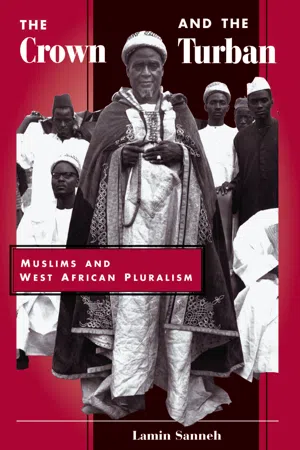
This book explores the clash of civilizations between the secular government and Muslim traditions in West Africa, appraising the challenge of separating the administration of the state from the beliefs of the Islamic peoples of the region. It is useful for students of comparative religion.
Information
Part One
Islam and the African Context: Social and Religious Synthesis
When Islam first appeared in African societies, people were intrigued, curious, puzzled, perhaps even bewildered, but seldom hostile. The welcome Muslims received allowed them to flourish as a minority community, usually strategically nestled along important trading arteries where their usefulness to their non-Muslim hosts was assured. In time such Muslim commercial enclaves would grow in size and influence, attracting converts from the local population. The converts would keep one foot in the old traditions and draw on their new faith in terms that are congruent with earlier custom and usage. Thus Islam begins in continuity with the old, demanding little radical change as a consequence.
However, as knowledge increases and practice becomes less lax and better informed, the reform impulse is stirred and a break is signaled with the old dispensation. This reform phase might take several generations to emerge, if it emerges at all, and when it does it draws attention to prescribed rules of practice and the appropriate sanction in Scripture, law, and tradition. In general, reform Islam breaks out only in spasmodic ways rather than with formal jihád. A charismatic Qur’án school master or sharif appears in the land and offers the community the opportunity of regular instruction for their children. The children then become better informed, and their success raises the general standard of observance and conduct. By the time a second generation arrives, the religious tone of society has been considerably raised, with the occasional pilgrimage to Mecca strengthening the reform impetus.
Over a period of time, important Muslim visitors start arriving in the community on visits, some long, some short. Their coming makes an important point of the worldwide nature of religious fellowship, and when they leave they bequeath requisite symbols of Islam’s cosmopolitan status, such as an illuminated manuscript of the Qur’án, a legal manual, an embroidered turban or prayer rug, a picture of the Ka’ba (though never of the Prophet), some prayer beads, a silk gown, and so on. Eventually a ruler emerges who decides to embark on the pilgrimage and returns in triumph as a titled, accomplished pilgrim. His personal example inspires respect for Islam and assures the religion the prestige of state backing.
I am interested in the intervening stages before any decisive political triumph of Islam, in how and where Islam engages traditional African religions and what imprint it bears from its close proximity with African materials. Thus behind the public profile of state sponsorship lies the ample terrain of religious accommodation, a terrain Islam elevates with its own prescriptions but one that has been thoroughly worked with traditional tools. Thus the prescribed Muslim prayer coalesces with local rituals to allow the structure of Islam’s five daily prayers to fix a regular pattern on local observance, which is brought into line with the unsettling thrust of Islam’s lunar calendar system with its antiagricultural bias.
The lunar calendar, not being based on the seasons, is thus free of the predictability and obligations of the farming cycle. Local Muslims might not directly interfere with the seasonal agrarian rites that are based on the solar calendar. Rather they would bring the experience of their daily and weekly prayer observance to dominate the extended intervals between the seasonal festivals, and the more frequent quotidian pattern in time will eclipse the quarterly agricultural cycle. The shift is eased with the retention of the names of the old rituals, with the New Year, rain, harvest, and storage rites, for example, continuing to be known by their local designation though their observance may now feature prayers based on the Qur’án. If we take a long-range normative view, we may say that Islam has rigged the old dispensation and will in due season supplant it. Conversely, if we take a medium-term social view, we can say that the old dispensation has co-opted Islam and domesticated it. Both views are plausible, although the social reality of a domesticated Islam will have become too indelible a part of the religion for it not to perdure into the long term. Thus dreams, dream interpretation, healing, and amulets belong as much to the Muslim religious tradition as they do to indigenous therapeutic culture, and they thus defy any rigid attempt at separation.
Slavery, in spite of its controversial nature, fits, or has been made to fit, into the social and religious life of Muslim Africans. The institution is regulated by Scripture, law, and custom, resulting in its full integration with Islam. However, given the pre-Islamic roots of slavery in Africa, there are indigenous forms of the institution that Islam has not introduced or disrupted and that have survived into the new religion. Thus the progress of Islam in Africa has not conflicted with the practice of slavery. On the contrary, slavery has facilitated the spread of Islam and given it greater range with slave dispersal. It has also been the occasion of some of the most painful encounters between Muslims and the European colonial powers who moved to outlaw slavery.
The clerical Muslim habit of slave-owning clashed with avowed colonial policy to abolish slavery and emancipate slaves, by force if necessary. In theory, Muslim jurisprudence could support emancipation and thus reconcile itself with colonial directives to that end. According to the religious code, slaves are made, not born, with the implication that circumstances producing slavery need not be permanent or unqualified. In practice, however, slavery was too deeply entrenched to dissolve from internal humanitarian impulses, and its persistence placed the clerics on a collision course with abolitionist colonial regimes.
Under normal circumstances, it would be difficult to reconcile slavery and its associations with violence, injustice, and dehumanization with the ethical sensibilities of religion, and when that difficulty is set in the context of pacific clericalism as is done here, then it creates a dilemma bordering on the scandalous. Something of that potential scandal was revealed when the clerics involved in the practice of slavery offered only passive resistance when faced with the colonial measures abolishing slavery. Even though such abolition struck at the heart of the clerical system, the clerics conformed to the demands of their colonial overlords with nothing beyond disgruntled murmurings. Slavery could not have subverted their moral scheme. Thus, if slavery survived among the clerics from the force of habit and circumstance, it could end with external measures without those discrediting the clerical vocation as such. As it is, Islam survived emancipation and adapted and flourished in the new colonial circumstances. Yet the survival of the clerical tradition, which slavery had done so much to promote and with which it was intertwined, suggests the survival of at least vestiges of slavery in aspects of clerical practice, such as in education and farming and in the norms of caste status that attached to the descendants of slaves. In other words, slavery has been of positive value for Muslims.
So to repeat: The dynamic medium-term view we get of Islam and traditional Africa combining, separating, and again coalescing confirms that Muslims are involved in a developing historical process of change and consolidation, of challenge and reaffirmation. Ultimately, Muslim Africa would exhibit much of the confidence and flexibility, the focus and diversity, the commitment and tolerance that have been constitutive of African societies themselves.
1
Muslims in Non-Muslim Societies of Africa
A story is told about the first Zoroastrians, called Parsees, who arrived in Bombay, India, where they still flourish as a commercial enclave. Their Indian hosts, jealous of preserving their religious traditions from the presence of the new immigrants, sent them a full jug of milk as a sign. Their meaning was that just as the Parsees could not add any more to the jug without spilling some of its rich content so would they be unable to add anything valuable to the content of Hindu religious custom without inflicting a serious loss. It was not, we can see, a friendly message. There was genuine fear about the incoming immigrants and their new religion. But the response of the Parsees to this message was equally significant. A committee of local elders, called the Panchayat after the Hindu model, was quickly convened and these elders formulated an appropriate reply, which they sent back with the jug of milk. When the jug arrived it was found to contain a gold ring or, in a variant tradition, sugar. The Parsees had slipped it in as a way of saying that they would still add something precious—or sweet—to the jug of milk, and by implication to the content of Hindu religious culture, without upsetting either. Whether there were also hints of the future renown of Parsees as successful commercial entrepreneurs is not clear, but obviously they had little doubt about the worth of their contribution to their adopted land.
The story, or at any rate its essentials, may act as a paradigm of less boundary-conscious Muslims meeting their non-Muslim African hosts within jealously guarded boundaries. The present writer was told a story about a wave of immigrant Muslims who arrived in Upper Gambia from Bundu, Senegal, in the nineteenth century. They settled among cattle and pastoral Fulbe. Every day at dawn the Muslims congregated at the local mosque for prayer, summoned there by the adhán, the canonical call to prayer. The town’s Fulbe inhabitants, constantly awakened by the early morning prayer ritual, became worried, for they feared that the Muslims were thus quarreling among themselves and seeking to compose their disputes at first opportunity. For, they reasoned, if the Muslims continued without fail to have “palaver” like this every day, then it was only a matter of time before their disputes spilled over into society and they became embroiled. By a unanimous decision they packed their belongings and, taking their Muslim guests by surprise, abandoned the town to “safety.” They had misconstrued the Muslim presence, and, ignorant of the Islamic religious code, they misunderstood the adhán as a call to arms. As a story it is today preserved among the Muslims concerned as an amusing historical anecdote, yet it shows with remarkable clarity the dramatic frontline in the encounter between the old tribal dispensation of the land and the new Islamic world order poised to play a defining role in the self-understanding of the people.
The central premise of this book is that Muslims took a favorable view of Africa’s religious openness, found affinity with certain practices, capitalized on shared understanding, exploited gaps in local techniques and resources, and then, after enough head of steam had built up, asserted the primacy of Muslim Scripture, law, and practice. It is this dynamic historical theme of affinity and challenge, of accommodation and primacy, that this book tries to develop with the transmission and establishment of Islam in African society. African pluralism and the Muslim outreach thus came to a natural convergence with the implantation of new and diverse Muslim communities, whose life also intersected with the colonial, secular, and Christian forces that were penetrating Africa. The crowning outcome of this complex process is far from assured, but the salient fact of turbaned devotees extending their influence in society by the progressive introduction of Islamic religious and political ideas gives the process its identity and direction.
Religious Impulse
Perhaps a fruitful way to describe and analyze historical stages in the evolution of relations between Muslims and non-Muslims in African society is to define precisely the shifts that have occurred from a social perspective. Two broad categories of Muslims should be studied. On the one hand we have foreign Muslim elements coming to Black Africa and staying there for various lengths of time. Some came clearly to trade. Others passed through as professional travelers, observing, advising, and even admonishing as they blazed the dust trails. Still others came as skilled craftsmen, offering their services to rulers, members of the nobility, and other leading citizens. Some others came in the spirit of the mendicant friars: solitary destitutes who flung themselves on the Samaritanly mercy of local populations. An important group of foreign Muslims also came for specifically religious purposes: missionary agents concerned with the spread of Islam or with its proper observance; traveling scholars and devout clerics who encouraged, and were themselves encouraged by, devotion to Islam. It is fair to say, as will be made clear presently, that these foreign Muslims constituted the minor theme of religious consolidation in African societies. On the other hand there are the local populations who were islamized with varying degrees of success and who subsequently adjusted the faith to the African situation with uneven thoroughness. The first group of Muslims we might call the transmitters and the second group the recipients. Thus we have two agents of Islamic diffusion, and the evidence indicates that the recipients were far more important in the spread of Islam than the transmitters and that something of the nature of the religious process in Africa can be learned from their method and outlook. Given that fact, I am less concerned with matters of technical chronology in this chapter than with an assessment of Islamic impingements on the indigenous process, and vice versa.
Until recently the view was widely held that Islam came to Black Africa by way of military conquest, a view that survives in the popular mind as the spread of Islam by the sword. Legends die hard, and this one has had a particularly resilient life, like the legendary seven-headed python of Soninké tradition. However, Muslims did not relate themselves to non-Muslim societies purely by military means. Islamic militancy is a fact in African societies that cannot be denied, but its dramatic nature should not mislead us into thinking that it was the only way.
Social Roots
‘Uqbah b. Náfi’ (d. A.D. 683), the military conqueror of North Africa, is regarded by some historians as an ephemeral presence in the islamization of Africa.1 In one sense this is true. There are, as far as we know, no enduring intellectual monuments to ‘Uqbah, and his achievements in matters of effective administration are even less assured. Nevertheless a considerable body of tradition exists in which ‘Uqbah is accorded pride of place. The traditions of the Tuaregs, for example, set considerable store by ‘Uqbah.2 The same is equally true of the islamized Ser-akhullé, known in other sources as Soninké.3 The Muslim Fulbe elite, the tcherno, similarly claim a notional affinity with ‘Uqbah.4 In all these traditions the military theme is absorbed into the religious irruption normally accompanying the establishment of the Pax Islámica. The standard device for representing that religious element is by claiming Sharifian contact, or even descent, and boosting it with appeal to the asháb, the companions of the Prophet, and their followers (tâbiún). Indeed ‘Uqbah is surrounded by that kind of distinguished company, a circumstance that finds eager parallels in numerous accounts of the origin of ethnic groups in Muslim Africa. In this way the genealogical system (nisbah) of ethnic groups in Africa became suffused with exotic material of ...
Table of contents
- Cover
- Half Title
- Title Page
- Copyright Page
- Dedication
- Table of Contents
- Acknowledgments
- Orthographical and Bibliographical Note
- Introduction
- Part One Islam and the African Context
- Part Two Islam, Africa, and Colonialism
- Part Three Education and Society
- Part Four Muslims and the Secular National State in Africa
- Notes
- Bibliography
- About the Book and Author
- Index
Trusted by 375,005 students
Access to over 1.5 million titles for a fair monthly price.
Study more efficiently using our study tools.
Frequently asked questions
Yes, you can cancel anytime from the Subscription tab in your account settings on the Perlego website. Your subscription will stay active until the end of your current billing period. Learn how to cancel your subscription
No, books cannot be downloaded as external files, such as PDFs, for use outside of Perlego. However, you can download books within the Perlego app for offline reading on mobile or tablet. Learn how to download books offline
Perlego offers two plans: Essential and Complete
- Essential is ideal for learners and professionals who enjoy exploring a wide range of subjects. Access the Essential Library with 800,000+ trusted titles and best-sellers across business, personal growth, and the humanities. Includes unlimited reading time and Standard Read Aloud voice.
- Complete: Perfect for advanced learners and researchers needing full, unrestricted access. Unlock 1.5M+ books across hundreds of subjects, including academic and specialized titles. The Complete Plan also includes advanced features like Premium Read Aloud and Research Assistant.
We are an online textbook subscription service, where you can get access to an entire online library for less than the price of a single book per month. With over 1.5 million books across 990+ topics, we’ve got you covered! Learn about our mission
Look out for the read-aloud symbol on your next book to see if you can listen to it. The read-aloud tool reads text aloud for you, highlighting the text as it is being read. You can pause it, speed it up and slow it down. Learn more about Read Aloud
Yes! You can use the Perlego app on both iOS and Android devices to read anytime, anywhere — even offline. Perfect for commutes or when you’re on the go.
Please note we cannot support devices running on iOS 13 and Android 7 or earlier. Learn more about using the app
Please note we cannot support devices running on iOS 13 and Android 7 or earlier. Learn more about using the app
Yes, you can access The Crown And The Turban by Lamin Sanneh in PDF and/or ePUB format, as well as other popular books in Theology & Religion & African Politics. We have over 1.5 million books available in our catalogue for you to explore.