eBook - ePub
Available until 27 Nov |Learn more
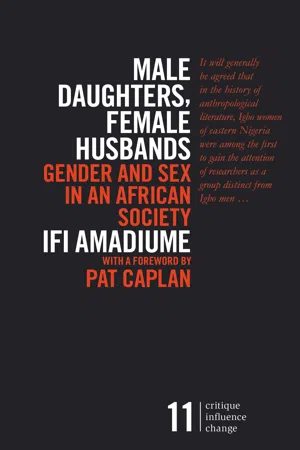
Male Daughters, Female Husbands
Gender and Sex in an African Society
This book is available to read until 27th November, 2025
- English
- ePUB (mobile friendly)
- Available on iOS & Android
eBook - ePub
Available until 27 Nov |Learn more
Male Daughters, Female Husbands
Gender and Sex in an African Society
About this book
In 1987, more than a decade before the dawn of queer theory, Ifi Amadiume wrote Male Daughters, Female Husbands, to critical acclaim.
This compelling and highly original book frees the subject position of 'husband' from its affiliation with men, and goes on to do the same for other masculine attributes, dislocating sex, gender and sexual orientation. Boldly arguing that the notion of gender, as constructed in Western feminist discourse, did not exist in Africa before the colonial imposition of a dichotomous understanding of sexual difference, Male Daughters, Female Husbands examines the structures in African society that enabled people to achieve power, showing that roles were not rigidly masculinized nor feminized.
At a time when gender and queer theory are viewed by some as being stuck in an identity-politics rut, this outstanding study not only warns against the danger of projecting a very specific, Western notion of difference onto other cultures, but calls us to question the very concept of gender itself.
This compelling and highly original book frees the subject position of 'husband' from its affiliation with men, and goes on to do the same for other masculine attributes, dislocating sex, gender and sexual orientation. Boldly arguing that the notion of gender, as constructed in Western feminist discourse, did not exist in Africa before the colonial imposition of a dichotomous understanding of sexual difference, Male Daughters, Female Husbands examines the structures in African society that enabled people to achieve power, showing that roles were not rigidly masculinized nor feminized.
At a time when gender and queer theory are viewed by some as being stuck in an identity-politics rut, this outstanding study not only warns against the danger of projecting a very specific, Western notion of difference onto other cultures, but calls us to question the very concept of gender itself.
Frequently asked questions
Yes, you can cancel anytime from the Subscription tab in your account settings on the Perlego website. Your subscription will stay active until the end of your current billing period. Learn how to cancel your subscription.
No, books cannot be downloaded as external files, such as PDFs, for use outside of Perlego. However, you can download books within the Perlego app for offline reading on mobile or tablet. Learn more here.
Perlego offers two plans: Essential and Complete
- Essential is ideal for learners and professionals who enjoy exploring a wide range of subjects. Access the Essential Library with 800,000+ trusted titles and best-sellers across business, personal growth, and the humanities. Includes unlimited reading time and Standard Read Aloud voice.
- Complete: Perfect for advanced learners and researchers needing full, unrestricted access. Unlock 1.4M+ books across hundreds of subjects, including academic and specialized titles. The Complete Plan also includes advanced features like Premium Read Aloud and Research Assistant.
We are an online textbook subscription service, where you can get access to an entire online library for less than the price of a single book per month. With over 1 million books across 1000+ topics, we’ve got you covered! Learn more here.
Look out for the read-aloud symbol on your next book to see if you can listen to it. The read-aloud tool reads text aloud for you, highlighting the text as it is being read. You can pause it, speed it up and slow it down. Learn more here.
Yes! You can use the Perlego app on both iOS or Android devices to read anytime, anywhere — even offline. Perfect for commutes or when you’re on the go.
Please note we cannot support devices running on iOS 13 and Android 7 or earlier. Learn more about using the app.
Please note we cannot support devices running on iOS 13 and Android 7 or earlier. Learn more about using the app.
Yes, you can access Male Daughters, Female Husbands by Ifi Amadiume,Professor Ifi Amadiume in PDF and/or ePUB format, as well as other popular books in Social Sciences & Gender Studies. We have over one million books available in our catalogue for you to explore.
Information
1. Gender and the Economy
The upland Ibo traditionally raised a variety of root crops and livestock, but those occupying the leached white lands of the Awka-Orlu area have long suffered chronic food shortages. The soil has in many places undergone such extensive deterioration that it cannot support the dense population, and in these areas textile weaving, oil palm tending and processing of palm produce, blacksmithing, and other specialized economic activities such as slave trading traditionally supplemented farming. In contrast, the lowland-dwelling Ibo have always been able to produce a surplus of yams and to collect enough fish and other river animals for an abundance of protein, but they lack iron, cotton, palm produce, and proper surroundings for livestock raising. Out of such ecological and economic differences developed a trade between these two populations in prehistoric times, and Onitsha has long been a prominent site of exchange in this trade. (Henderson 1972:36)
The Igbo in general and Nnobi people in particular trace the gender ideologies behind their sexual division of labour, and those governing the relations of production, to their myths of origin. This chapter deals with Nri and Nnobi myths of origin, and shows the relationship between ecological factors, sexual division of labour and gender ideology. As a result of ecological factors, agricultural production was not profitable in Nnobi, hence the development of a sexual division of labour and gender ideology which gave women a central place in the subsistence economy, while men sought authority through ritual specialization and ritual control.
The gender ideology governing economic production was that of female industriousness. Idi uchu, perseverance and industriousness, and ite uba, the pot of prosperity, were gifts women were said to have inherited from the goddess Idemili. Associated with this were strong matrifocality2 and female orientation3 in this supposedly ‘patrilineal’ society. The culture prescribing industriousness is derived from the goddess Idemili – the central religious deity. The name of the town itself reflects matrifocality in Nnobi culture or a matricentric principle in household organization; mothers and children formed distinct, economically self-sufficient sub-compound units classified as female in relation to the male front section of the compound.
There was, therefore, a dual-sex organizational principle behind the structure of the economy, which was supported by various gender ideologies. These principles and ideologies governed the economic activities of men and women. They also governed access to wealth, and prescribed achievement-based statuses and roles, such as titles and the accumulation of wives, which, in the indigenous society, brought power, prestige and more wealth. However, a flexible gender system mediated the dual-sex organizational principle.
Myths of Origin and Gender
Nri
According to Nri myth of origin (Henderson 1972:58–65), Eri, the man sent down from the sky by Chukwu, the Great God, finding himself surrounded by the Anambra River, called to the Great God, who sent down a blacksmith to produce fire and dry the ground. This blacksmith became the ancestor of the Awka Igboand from him they inherited the secret of smithying, in which they specialized.
Eri is said to have had two wives, by one of whom he had five sons, Nri, Agulu, Amanuke, Onogu and Ududu, who became founders of neighbouring settlements. Nri had come to settle among Igbo people, who were hunting and gathering communities, lacking kingship systems and the knowledge of farming. Nri became very hungry, and appealed to the Great God, who ordered him to cut off and plant the heads of his son and daughter (Henderson 1972:60). From the daughter’s head sprang cocoyam, a subsidiary crop managed by women.
Nri had been ordered to mark the foreheads of his children with marks of ritual purification, ichi:4 before planting them. From the scarification of his children, Nri gained certain ritual prerogatives: he held the secret of ogwu ji, yam medicine, so that Igbo communities went to Nri to obtain this medicine, and paid annual tribute for it. Yam, which sprang from the head of the son, was the Igbo staple, and is still the most valued crop in rituals and ceremonials; the penalty for stealing yam could be death (see Nwabara 1977:29–32). Men came to monopolize the planting and distribution of this highly prized crop. From Nri’s scarification of his children, Nri, the town, became a ritual centre which conferred emblems of ritual purification and ritual experts bestowed the ritual requirements of the ozo title. From Nri’s ritual relationship with the land, Nri ritual specialists gained the right to travel to other Igbo communities, in order to cleanse their towns of sins committed against the land (Henderson 1972:60–61).
Nnobi
There are two versions of Nnobi myths of origin. According to one account, the first man at Nnobi was Aho or Aro; the first at Abatete was Omaliko; the first at Nnewi was Ezemewi; and the first at Ichida was Otoo-Ogwe; they were all hunters. The one at Nnobi, known as Aho-bi-na-agu – Aho who lives in the wild (nature) – met a miraculous woman called Idemili (supernatural) near the Oji Iyi stream in Nnobi. They married and had a daughter called Edo. As she was very beautiful and highly industrious (culture), other hunters began to compete to marry her. Ezemewi was the most handsome, and he won her love and married her.
The influence of Idemili, a woman, was stronger than that of her husband Aho, and so she spread her idols everywhere. When her daughter set off to Nnewi to join her husband, Idemili took her idol, gave it to her and blessed her. As she loved this daughter very much, she also gave her ite uba, the pot of prosperity, and told her that she had taken back the pot of medicine, ite ogwu, which she had given to her earlier. So when Edo got to Nnewi, her popularity and influence, like her mother’s, rapidly spread. While Idemili established her shrines and influence all over the land of Idemili, her daughter Edo established hers all over the land of Edo, called Nnewi. It is thus that Nnewi inherited hard work from Nnobi, and both these neighbouring towns share their history and culture (Abalukwu, Vol. 1, September 1975).
As we have seen, the female gender had the more prominent place in myth and indigenous religious and cultural concepts – the supernatural, a goddess, is female. The stream, Iyi Idemili, is the source of divinity. The cultural result of the mediation of the natural (Aho, the hunter from the wild) and the supernatural5 (the goddess Idemili from the sacred stream) is a hard-working woman, Edo. Thus, both Nnobi and Nnewi inherit industriousness from females; the most highly praised person in Nnobi is a hard-working woman.
Nnobi traces its matrifocal concepts to another myth of origin. In Obiefuna (1976), Aho’s wife is called Agbala, an Igbo word for female deity. Their first son was called Obi, so Agbala was referred to as Nne Obi, mother of Obi, after the Igbo custom of calling mothers by reference to their first child. In Igbo, when going to visit someone, people say they are going to the place of that person. The Igbo expression for going to visit Obi’s mother would be going to the place of the mother, nne, of Obi, hence the origin of reference to the geographical location; the place of Nne Obi came to be known as Nnobi. The name of the town, Nnobi was, therefore, derived from the mother.
Ecology, Production and Gender Ideology
Both Nnobi and Nri men have manipulated certain gender ideologies implicit in their myths of origin in an effort to deal with the constraints imposed upon them by ecological factors. Nri communities also live in the Igbo areas of poor soil, land erosion and heavy population density, and hunger features in the Nri myth. Soil is poor, and therefore it is necessary to enforce fertility: hence the control of ritual knowledge, derived from the supernatural. In the explanation of the invention of agriculture and the sexual division of labour, yam, the prestige crop which requires expert knowledge for its production, both in the ritual and technical senses, sprang from the male head, and, as we have noted, was grown and distributed by men. Only ritual heads and male heads of families distributed yam medicine and performed the ritual which permitted the eating of yam. Yet, in reality, the role played by men in yam production in the Igbo areas where less food was produced was minimal.
Cocoyam, according to the Nri myth, grew out of the female head. This crop, grown by women, required less specialized knowledge than did the yam. To ensure a good yield of sizeable yam tubers a lot of work was necessary, first to thoroughly dig the soil with a large hoe. Then the soil dug out had to be heaped into huge mounds, both to survive erosion by the rains and to hold the growing tubers, some of which have been known to grow as large as a human being. Cocoyam is grown in small mounds or ridges which can easily be worked by women, and no special ritual secrets were associated with them.
Similarly, cassava, when introduced into Igboland, was regarded as an inferior crop, grown by women. Although it demanded a lot of time and hard labour to harvest and process into food, the actual cultivation required little specialized knowledge, as it can grow wild. In areas of poor soil and low yam yield, cassava became the main staple, while men monopolized the small yam harvest for ritual payments and other ceremonial exchanges.
There is, then, a clear interrelationship between ecological factors, economic production and gender ideas. Nri, for example, relies heavily on trade and craft production; the skill and secret of blacksmithing (a male prerogative), derived from the supernatural (male), and was jealously guarded by men in these areas. The cultural emphasis was, therefore, on male monopoly of ritual knowledge, craft specialization and external relations. This could explain the ritual link between the Omu, queen of Onitsha women and head of the Association of Women Traders, and Nri; Nri dwarfs crowned Onitsha ‘queens’ (see Henderson 1972:314).
In Nnobi myth of origin, Edo inherits industriousness from her mother, the goddess Idemili. Here, female crops such as cocoyam, plaintain and cassava compensated for the shortage of yam for staple food. Nnobi, therefore, depended very heavily on female labour in agriculture.
One begins to see a system of prescribed achievements and rewards. From it women in Nnobi might be expected to derive prestige and power from their control and successful management of, and effective organization around, this subsistence economy.
Wealth and Gender
What were the traditional scarce resources, the control and management of which the politics was about? How did men and women have access to them?
Economic resources include material and non-material things considered scarce in society, and therefore involve the principles of control, ownership and sometimes exchange. In Nnobi, immovable property included land and food trees; movable property consisted of domestic animals and food, agricultural produce, textiles, household goods and utensils, and human labour, especially women’s productive and reproductive powers including their sexual services. Ritual knowledge and titles were also bought.
Material wealth was converted into prestige and power through title-taking, the acquisition of more wives and more labour power, and more material wealth. Social wealth was redistributed through commensality and exchange associated with life-cycle ceremonies such as child-naming, marriage and funeral ceremonies. Interlineage exchanges were based on relationships traced through women as daughters, wives or mothers. Religious festivals and title-taking ceremonies were also occasions for the redistribution of goods.
Wealth for men consisted of the possession of houses, many wives and daughters (who would bring in-laws), livestock, voluntary and involuntary titles, yam and cocoyam farms and a huge oba ji, yam store, an extensive ani obi, ancestral compound, with surrounding lands, and osisi uzo, food and cash-crop trees.
Wealth for women included livestock, fowls, dogs, rich yields in farm and garden crops, lots of daughters, who would bring in-laws and presents, and many wealthy and influential sons. It included the ogbuefi title, the only voluntary title shared by men and women who have killed a cow for the goddess Idemili, and other involuntary titles taken only by women, and possession of wives by ‘male daughters’, first daughters, barren women, rich widows, wives of rich men and successful female farmers and traders, that is, the kind of women to whom I shall refer as ‘female husband’.
One might therefore ask to what extent there was evidence of ‘class’ differentiations on the basis of wealth in the indigenous society. Capital comprised land, wives and children; possession of these immediately put the owner ahead of others. Igbo say, inwe nmadu ka inwe ego, ‘to have people is better than to have money’. Numerous people was the greatest advantage large ancestral compounds had over smaller ones, which as a result of lack of wealth tended to be monogamous. It was therefore a question of a large workforce versus a small workforce. The wealthy had more agricultural produce, a larger number of livestock and people who would carry on the trading and marketing of surplus; material wealth would be converted into titles. Poorer people merely subsisted; diet demonstrated wealth differen...
Table of contents
- Cover
- About the Author
- Title
- Copyright
- Contents
- Foreword Pat Caplan
- Preface to the critique influence change edition
- Preface
- Acknowledgements
- Introduction
- Part 1 The 19th Century
- Part 2 The Colonial Period
- Part 3 The Post-Independence Period
- Appendixes
- Bibliography
- Glossary
- Index