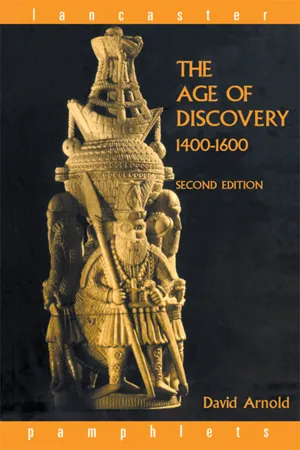
The Age of Discovery explores one of the most dramatic features of the late medieval and early modern period: when voyagers from Western Europe led by Spain and Portugal set out across the world and established links with Africa, Asia and the Americas. This book examines the main motivations behind the voyages and discusses the developments in navigation expertise and technology that made them possible.
This second edition brings the scholarship up to date and includes two new chapters on the important topics of the idea of "discovery" and on biological and environmental factors which favoured or limited European expansion.
- 84 pages
- English
- ePUB (mobile friendly)
- Available on iOS & Android
eBook - ePub
The Age of Discovery, 1400-1600
About this book
Part One
The Meaning of ‘Discovery’
It could be argued that there have been many ‘ages of discovery’ in history, involving many different peoples and civilizations, and that it is inappropriate to single out this period as being the Age of Discovery. Equally, it could be questioned whether this was anything more than an age of European exploration and aggrandisement, a phase in the history of the West that left many other societies around the world relatively unaffected.
It is hard, however, to doubt the overall significance of this period, by whatever name we call it. Though the era of maritime expansion could be pushed back to AD 800 to include the early voyages of the Vikings or carried forward into the seventeenth and eighteenth centuries when Europe gained a wealth of new knowledge about areas of the globe hitherto little investigated (such as the South Pacific and Australasia or the vast interior regions of Africa, Asia and North America), the essential geographical discoveries, including the exploration of the West African coast, the discovery of the ‘New World’ and the Cape route to the Indies, and the first circumnavigation of the globe, were all made between the early fifteenth and mid-sixteenth centuries. Writers as diverse in their opinions as Adam Smith in The Wealth of Nations in 1776 and Karl Marx and Frederick Engels in the Communist Manifesto of 1848 saw the discovery of America and the rounding of the Cape as among the principal events in history and as laying the basis, economically and politically, for the modern world. Many recent historians have endorsed this view and provided fresh evidence for the foundational importance of the Age of Discovery. In this remarkably short period, Europeans acquired an unparalleled knowledge of the rest of the world. Relying on a new capacity for longdistance voyaging, they crossed and re-crossed the oceans of the world, delineating the coastal outlines and principal features of the major landmasses of the globe and creating a knowledge about other continents that had barely existed (and in the case of the Americas was wholly absent) in former times.
Of course, in most parts of the world Europeans arrived to find not just lands that were new to them but also complex and long-established societies very different from their own. In a sense, the true ‘discoverers’ of these lands were much earlier generations of migrant peoples. The first inhabitants of Australia probably arrived overland or by island-hopping from Southeast Asia more than 50,000 years ago, at a time when sea levels were much lower than at present. The earliest Americans were probably migrating hunters from Siberia who, at the end of last Ice Age and probably well before 35,000 BC, crossed the Bering Strait into Alaska and so began to explore, inhabit and transform the continent, eventually reaching as far south as Chile. The descendants of those early migrants were the ‘native Americans’, the Arawaks and Caribs, whom Christopher Columbus found on his arrival in the Caribbean in 1492, the ‘Indians’ whom he fondly hoped presaged his imminent arrival on the fabled shores of Asia. But before Columbus and the other Europeans who quickly followed in his wake, the ‘discoveries’ of the Amerindians remained unknown except to themselves and they remained cut off from the rest of the world. Only in 1492 was the millennia-long isolation of the Americas finally ended.
It might possibly have happened sooner. Five centuries before Columbus, around AD 1000, Vikings from Scandinavia had also crossed the North Atlantic. Propelled by sails as well as oars, their long boats made landfall in the Americas, on Newfoundland and the neighbouring shores. But they did so without establishing a permanent presence there, possibly because the Amerindians drove them off, and without (as far as we know) realizing the vastness and novelty of the continent that lay before them, or even contributing substantially to Europe's knowledge of the wider world. It is just possible that Columbus and his contemporaries may have had some shadowy awareness of Viking voyaging in the North Atlantic, but most of what the Norsemen knew had become all but lost in the mists of time and the ambiguities of legend.
Much of the geographical and maritime knowledge that Europeans acquired during the fifteenth and sixteenth centuries was, like the footholds they gained on the continental margins of Africa and Asia, largely confined to the coasts. With the striking exception of Spanish possessions in the New World, this was less an age of territorial empires than of tiny European enclaves – forts, ports and islands. For the first time in human history the globe was circumnavigated (by Ferdinand Magellan and his crew in 1519–22), a feat that, for all its hazards and hardships, convincingly demonstrated Europeans' rapidly growing command of the sea. By opening up new maritime highways, Europeans came into direct contact with peoples and places from China to Chile, from Newfoundland to New Guinea, most of them hitherto unknown or seen only through the distorting lens of rumour and myth. While large areas of the interior of the continents remained beyond direct European knowledge, with ever more reliable navigational techniques voyages across vast oceans could not only be achieved once or twice but repeated on a regular and predictable basis. The Age of Discovery coincided with the birth of printing: the Englishman William Caxton printed his first books in the 1470s, while the Portuguese were still searching for a sea-route around Africa. Printed pamphlets and books, along with increasingly sophisticated techniques of map-making, disseminated with speed and accuracy the new knowledge of the world and its component parts. For the first time in human history, the earth could meaningfully be comprehended as a whole.
The Age of Discovery (or Discoveries as the Portuguese prefer to call it) was about more than geographical and navigational discovery: it represented the opening of a new book of knowledge. By pioneering new oceanic routes (as across the Atlantic and Pacific) or (as in the Indian Ocean) by capturing existing networks of maritime commerce, the voyages of discovery laid the basis for a global system of trade, much of it in European hands. The products of other continents – gold and silver, textiles and spices, timber, hides and furs – began to pour in through Europe's ports, augmenting its wealth and providing the economic basis for subsequent commercial and industrial expansion.
Part of the wider historical significance of the Age of Discovery was that it involved a long series of encounters between European and non-European peoples. These encounters varied enormously in character. Frequently they were characterized by European aggression, by massacre, kidnapping and rape, by wholesale plunder, enslavement and the brutal subjugation of indigenous peoples. But where the power of indigenous rulers was greater than that of the Europeans (as was the case across much of Asia from the Ottoman Empire in the west to Ming dynasty China in the east) Europeans found themselves in the role of supplicants and observers rather than of conquerors and settlers. However one-sided it might appear (and often was), this was an age of mutual discovery. Just as Europeans struggled to make sense of what they encountered in other continents, so too indigenous peoples around the globe tried to comprehend what the arrival of white men with mysterious ships and guns, with their strange religion, manners and customs, might signify. Few episodes in this period are more fascinating than the increasingly desperate efforts of the Aztec emperor Montezuma and his court to try to understand what the arrival of the Spanish invaders might mean for them – were they gods or just greedy men? European intruders variously met with curiosity or scorn, with outright resistance or some form of cooperation and attempt at accommodation, but, whatever the case, the result was an interactive history that left its mark, for good or ill, on both parties.
The search for trade was a major factor impelling Europe's expansionist drives in the fifteenth and sixteenth centuries, but the period also saw important cultural and social changes emanating out from Europe as well. European languages – Portuguese, Spanish and latterly Dutch, French and English – began to spread to other continents and to be adopted by non-European peoples. A Christian presence was established in the Americas and in parts of Africa and Asia where it had not previously penetrated. While the number of white migrants to other continents was relatively small (especially compared to the mass migration of Europeans after 1815), significant numbers of settlers had already established themselves, particularly in the Americas, by the early seventeenth century. Other demographic changes, whose full significance might only be apparent later, were also underway, again especially in the Atlantic world. Catastrophic mortality among the native Americans following the arrival of the first Europeans gave rise to a search for new sources of labour on estates, plantations and mines and to the forced migration of African slaves to New World. By 1600 there were about 100,000 slaves in eastern Brazil alone and more than three times that number of Africans are believed to have been sent in slavery to the Americas over the course of the previous century.
On the other hand, Europe's literature and sciences were stimulated and enriched by the opening up of the world through its discoveries. In the essays of Montaigne or in Shakespeare's play The Tempest, as in many other works of this and the immediately following period, one can see a growing literary fascination with the outside world and a readiness to explore the dramatic and philosophical opportunities of exotic extra-European locations. Global exploration brought with it a new botanical knowledge and helped lay the foundation for the modern study of plants. Along with this came information about the medicinal properties of plants hitherto unknown in the West, such as the bark of the cinchona tree, native to the Andes of Peru, used to treat or cure malarial fevers.
Changes in knowledge and taste did not affect Europe alone. Just as tobacco and chocolate from the New World and tea and coffee from Asia were beginning to find their way into Europe, so the Portuguese and other maritime states began to introduce into Africa and Asia foodstuffs hitherto confined to the Americas, such as maize, peanuts, potatoes, tomatoes and chillies. So widely did these become accepted in their new localities that it is hard now to imagine what the cuisine of India or Indonesia must have looked and tasted like before their introduction. Similarly, silver imported by Europeans from America and the new demand for locally-made trading commodities began to have a profound effect on many Asian economies. The economic, cultural and even (as we will see subsequently) the environmental impact of the Age of Discovery ranged far beyond the narrow confines of the Europeans' own trading posts and settlements.
Europe and the Wider World
It is not easy from a present-day perspective to imagine a time when Europe was still a relatively isolated and self-contained society, with little knowledge of what lay beyond its own boundaries, and when the map of the world, so familiar to us today, did not exist. But until the discoveries of the fifteenth and sixteenth centuries such awareness as Europe had of the outside world owed more to myth and fantasy than to actual knowledge.
Among the more reliable sources of information available to fifteenth-century Europe were texts surviving from classical antiquity and more recent travellers' accounts. In order to look outwards, Europe had first to look back. Ptolemy's Geography, written in the second century AD in the Egyptian port of Alexandria but only rediscovered in Christian Europe through a Latin translation of the Greek made in about 1406, was a compendium of geographical knowledge as it had existed at the height of the Roman Empire. While it provided a fairly accurate description of the nearer regions of Asia and Africa, it was an unreliable source for more distant lands and could give no clue to the existence of the Americas and other parts of the world unknown to the ancient civilizations of Greece and Rome. Among the most popular and influential of the works of travellers was the account of the Venetian Marco Polo who in 1271 had set out to journey across Asia with his father and uncle. They visited the court of the Mongol emperor Kublai Khan, where Marco was entrusted with a position of imperial authority in China and during twenty years in the East Marco travelled widely, including India and Southeast Asia. Through the story of his travels written after his return to Venice in 1295 and widely circulated in late medieval Europe, Polo helped establish in the European mind the idea of Asia as a continent of extraordinary wealth with advanced and powerful civilizations. More than a century later, his Travels were an inspiration to Portugal's Prince Henry (‘the Navigator’) and, along with Ptolemy, to the Genoese Christopher Columbus. But such sources had their disadvantages. The Mongol-ruled ‘Cathay’ (China) that was one of Columbus's objectives in sailing west across the Atlantic had long since disappeared, and medieval Europe's conviction that the ancients were right in everything (except their pagan religion) inhibited a more critical approach to their geographical texts and discouraged a spirit of practical enquiry.
However, deficient and out-of-date as Ptolemy and Polo might be by 1400, they at least provided a more dependable source of information than the myths, legends and spurious travellers' tales that otherwise shaped late medieval Europe's understanding of the wider world. One of the most widely circulated works, and no less influential than Polo, was Sir John Mandeville's Travels, an almost entirely fictitious account of the strange inhabitants (such as dog-headed men) and bizarre customs to be found in the East. In the popular imagination there persisted, too, a belief that ships venturing too far into unknown seas might fall over the edge of the world or perish in the boiling seas of the ‘torrid zone’. Such fears were a powerful deterrent to exploration and practical investigation. But there were other fantasies – of the existence of'lost' islands and a continent of Atlantis in the western seas, of a powerful Christian king, called Prester John, ruling somewhere beyond the Muslim lands in Asia or Africa – which, however unrealistic, played a significant part in motivating the fifteenth-century voyages of discovery.
The same mixture of half-truth and fantasy was evident in the maps of the medieval period. In the earlier ones Jerusalem, as the spiritual capital of Christianity, appeared at the centre of a flat and circular world with the known continents – Europe, Africa, Asia – arranged symmetrically around it, allowing little room for intervening seas. These mappae mundi (‘maps of the world’) were of no practical use to navigators and travellers, nor were they intended to be. Later ones, influenced by the rediscovery of Ptolemy, sketched in north Africa and western Asia with some accuracy, but could only conjecture how far south the African continent extended and whether, as many surmised, the Indian Ocean was a landlocked sea. Of the Americas, Australasia and the Pacific there was no trace. The map-makers compensated for Europe's ignorance of the interior of Africa and Asia by drawing in rivers and mountains of their own invention and setting mythical beasts or long-dead monarchs to rule over them.
Europe was not alone in its ignorance and isolation. The world in 1400 was divided into dozens of separate societies with little or no contact and communication between them. Some, like the civilizations of Central and South America, were entirely cut off from other continents and had only limited contact among themselves. Others, like the great Asian civilizations of China and India, had wider connections, partly through trade, but also through religion or the rise of pan-Asian empires like that of the Mongols. But, despite these fitful contacts, the Eurasian landmass remained very divided. In part this was a consequence of geographical barriers – seas, deserts, dense forests and mountain ranges. But it was reinforced by the problem of immense distance and the absence (or inadequacy) of means of transport, communication and administrative control to fuse diverse peoples and localities into larger entities. Often, too, there was simply a lack of curiosity or the material incentives to motivate long journeys of discovery by la...
Table of contents
- Front Cover
- Half Title
- LANCASTER PAMPHLETS
- Title Page
- Copyright
- Contents
- List of Maps
- Introduction
- Time Chart
- Part One
- Part Two
- Notes
- Guide to Further Reading
- Index
Trusted by 375,005 students
Access to over 1.5 million titles for a fair monthly price.
Study more efficiently using our study tools.
Frequently asked questions
Yes, you can cancel anytime from the Subscription tab in your account settings on the Perlego website. Your subscription will stay active until the end of your current billing period. Learn how to cancel your subscription
No, books cannot be downloaded as external files, such as PDFs, for use outside of Perlego. However, you can download books within the Perlego app for offline reading on mobile or tablet. Learn how to download books offline
Perlego offers two plans: Essential and Complete
- Essential is ideal for learners and professionals who enjoy exploring a wide range of subjects. Access the Essential Library with 800,000+ trusted titles and best-sellers across business, personal growth, and the humanities. Includes unlimited reading time and Standard Read Aloud voice.
- Complete: Perfect for advanced learners and researchers needing full, unrestricted access. Unlock 1.5M+ books across hundreds of subjects, including academic and specialized titles. The Complete Plan also includes advanced features like Premium Read Aloud and Research Assistant.
We are an online textbook subscription service, where you can get access to an entire online library for less than the price of a single book per month. With over 1.5 million books across 990+ topics, we’ve got you covered! Learn about our mission
Look out for the read-aloud symbol on your next book to see if you can listen to it. The read-aloud tool reads text aloud for you, highlighting the text as it is being read. You can pause it, speed it up and slow it down. Learn more about Read Aloud
Yes! You can use the Perlego app on both iOS and Android devices to read anytime, anywhere — even offline. Perfect for commutes or when you’re on the go.
Please note we cannot support devices running on iOS 13 and Android 7 or earlier. Learn more about using the app
Please note we cannot support devices running on iOS 13 and Android 7 or earlier. Learn more about using the app
Yes, you can access The Age of Discovery, 1400-1600 by David Arnold in PDF and/or ePUB format, as well as other popular books in History & Early Modern History. We have over 1.5 million books available in our catalogue for you to explore.