- 456 pages
- English
- ePUB (mobile friendly)
- Available on iOS & Android
eBook - ePub
About this book
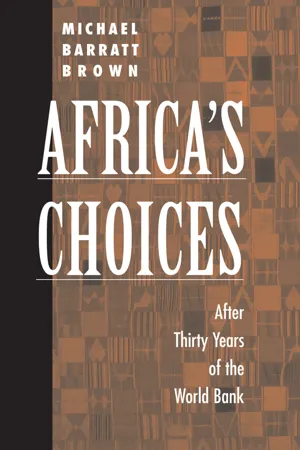
This book provides an account of actual African experience and African criticisms. It is designed to examine the actual viability of the World Bank's structural adjustment strategies for Africa, all of which were designed to encourage export-led growth.
PART I
WHAT WAS PROPOSED FROM OUTSIDE
‘When the axe of the wood cutter is heard in the forest, the trees that are standing whisper to each other: Remember that the handle of the axe is made of wood!’
African saying, quoted by Basil Davidson in The Africans
CHAPTER I
How Old is Africa’s Crisis?
Why does Swissair fly to as many as 17 African cities? – Because you can find there: oil, gold, diamonds, copper, iron, platinum, wood, cocoa, nuts, rubber, tobacco, spices, fruit, coffee, cotton, rare animals, magnificent sandy beaches.
Advertisement in Der Spiegel, October 1972, to which Terre Entière, September/December 1972, responded:
Imagine the surprise of the Swissair passengers, when they disembark, on discovering that there are also people in Africa …1
There are nearly 600 million people in Africa, of whom 450 million live in sub-Saharan Africa, which will be the main concern of this book. That is about one in ten of the whole world population, and numbers in Africa are growing faster than on any other continent.
No one doubts that Africa is in crisis. Living standards are falling. The people are not being fed. Township violence is endemic. Civil wars are spreading. According to the statistics, national income overall failed to grow as fast as population in the 1970s and 1980s, and that included food production, which in many countries actually declined.2 Even if you don’t believe the statistics – and there can be few who would swear by them3 – there are pictures of starving children and widespread reports of famine conditions, of wars and violence, enough to support the general supposition of a deep-rooted crisis.
Causes of Africa’s Crisis
Famine and wars are blamed upon a series of exceptional periods of drought – in 1973–5, 1983–5 and again in 1990–91.4 The Sahara is said to be moving southwards, but some say that it has been moving southwards for centuries. Hunger is only too frequent in the Sahel and can be borne, but famine is the result, they say, of bad land use and over-population.5 Misuse of the land is attributed to the increase in cash cropping, especially for export, at the expense of staple food production. The facts, however, do not entirely bear this out. While the area devoted to export crops was increased between 1960 and 1989, the area devoted to food crops was increased much more, so that export crops took up only 14 per cent of total cultivated land in 1989 instead of 18 per cent of the total in 1960.6 Export crops have certainly benefited most in the last two decades from increased use of fertilizer and the extension of irrigation, and land has suffered from degradation due to misuse and the destruction of tree cover.
A quite different argument would be put forward by the World Bank and the IMF and their associated advisers. This would be that excessive state regulation, and in particular the levies imposed on farmers by agricultural marketing boards, have acted as a disincentive to agricultural production. And this has been compounded by wasteful state expenditure from these levies and by the protection of inefficient industries seeking to produce substitutes for imported goods.7 The answer to all Africa’s problems is, they say, to open up national markets to world competition and free trade. Unfortunately for this argument, while the IMF and the World Bank have together persuaded more than thirty African governments to follow their advice, the result has been even worse economic decline in these countries than in those which did not adopt the Bank’s structural adjustment programmes.8
To find the explanation for Africa’s food crisis today, it is necessary to go back much further than two decades and to look into Africa’s colonial and pre-colonial heritage. Many readers will assume at this point that I shall either repeat the tired complaints of expatriate ‘old Africa hands’ that Africans have never emerged very far from their primitive, warring tribal societies and are not yet ready to cope with modern political and economic structures, or else that I shall blame everything on colonial rule in Africa and subsequent neo-colonialism.9 This means that authoritarian, even piratical, rule by African leaders like Mobutu in Zaire has been held in place by the United States and by the one-time colonial powers. There is a certain truth in the last proposition, but none at all in the accusation of primitive tribalism, any more in Africa than in Northern Ireland or in Bosnia.
Africa’s Pre-colonial Heritage
Nobody, perhaps, today would be prepared to subscribe to the 1920s’ Oxford professor’s description of pre-colonial Africa as ‘blank, uninteresting, brutal barbarism’,10 although one of his successors as Regius Professor of History at Oxford was still talking in 1963 of African history as ‘no more than barbarous tribal gyrations’.11 Nobody now questions that the great walls of Zimbabwe were built by Africans and that the Chinese Ming pottery found on the shores of Lake Nyasa was used by Africans, and not by some long-lost white tribe, descendants of the Queen of Sheba or of some Phoenician traders.12 Martin Bernal has demonstrated that Greek civilization had African origins and we all know that Hannibal, who nearly conquered Rome from his base in Carthage, was an African and that the great Moorish civilization in Spain was African in origin. What is perhaps less well known is that Francis Bacon, the founder of modern European science, had to go to Morocco to learn mathematics13 or that the gold which circulated as coinage throughout medieval Europe was mined and refined in West Africa.14 Why else would the standard British gold coin be called the golden guinea?
Historians of Africa have concluded from evidence on the ground that, following upon the great Bronze Age civilizations of the Nile valley, Iron Age societies spread throughout Africa at about the same time as they did in Europe. They tamed a hard and inhospitable continent, and many of the methods of cultivation they discovered are only now being recognized by European agronomists as more appropriate to African conditions than those that were imported later from Europe.15 Far from performing ‘barbarous tribal gyrations’, African societies developed strong and continuing institutions. These took the form of kingdoms covering more than one ethnic group, not unlike those of medieval Europe. Kingdoms rose and fell, and ambitious kings of warrior peoples absorbed new territories, as the Normans did in Europe. Settlements grew, more land was cleared and subject peoples were enslaved, but not as chattels and not without the possibility of manumission.16
The essential characteristic of the exercise of power in African society was an ‘acknowledged recognition of ties of mutual obligation and respect’.17 This is Basil Davidson’s conclusion from his studies; and a modern Malawi poet, Jack Mapanje, comments: ‘Pre-colonial chiefs and kings tolerated court singers and praise poets who had a double role: to celebrate the chief’s war victories and also point out his failings.18 Mapanje was not so lucky in his celebrations of the failings of Dr Hastings Banda, who confined him to jail for two and a half years for his poems.
In pre-colonial Africa, the unity and stability which government bestowed had to be balanced by accountability. ‘In “traditional” Africa,’ Davidson insists, ‘this concept of an indispensable partnership formed the hearthstone of statesmanship.19 He gives striking examples from one of the greatest and latest of the African kingdoms, that of the Asante, and quotes from a British observer in 1886, the year when the British colony of the Gold Coast was established in Asante lands:
The Asantemanhyiamu was a kind of Parliament, at which all matters of political and judicial administration are discussed by the king and chiefs in council, and when the latter answer all questions relating to their respective provinces, and are subject to the consequences of appeals, from their local Judicial Courts, to the Supreme Court of the King in Council.20
The Atlantic Slave Trade
Until the Atlantic slave trade began, trade between Europeans and Africans was a trade between equals, first by camel caravan across the Sahara, carrying salt and fine tools and swords from the north in exchange for gold and silver, nuts and ivory from the south; later, the trade was continued down the Atlantic coast from Portugal. Slaves, as household servants, had always entered into this trade, but not until 1510 – eighteen years after Columbus’s landfall in the Americas – were slaves exported from Africa as chattels for sale.21 On the orders of the Spanish king they were sent across the Atlantic to the West Indies to make good the decimation of local labour among the Indians in America. The cargoes of British slavers were soon to follow.
The results were world-shaking. The total loss to Africa over the three hundred years of the Atlantic slave trade is beyond computation. It comprised not only the loss of numbers of mainly young men, but also the lost skills. Miners from Africa were particularly sought after to work the mines in the Americas.22 Perhaps 23 million men and women in the prime of life were exported, about half of them crossing the Atlantic. An equal number are thought to have died en route or in the accompanying slave wars in Africa. In 1850, when the trade had largely ceased, the whole population of Africa was estimated at only 54 million.23
The loss of population was not more serious for Africans than the loss of confidence in their historic evolution. White people came to justify slavery by an assumed racial superiority. Black people were treated as inferior, their achievements scorned, their history buried, their resources plundered. Their supposed inferiority became the excuse for colonial rule by the European powers.
Africans themselves had always been involved in the Atlantic trade, as chiefs importing guns from Britain in exchange for slaves and as traders rounding up the human commodities for sale. One strange story from the last days of the Atlantic trade bears on the nature of Africa’s crisis. Basil Davidson has revealed for us the origins of the Creole traders on the West African coast, whose settlements were by the middle of the nineteenth century supplying a major market for British textiles and even doctors from their college at Fourah Bay for the British army medical service (James Africanus Horton reached the rank of Lieutenant-Colonel). These people had been slaves destined for the West Indies, but recaptured on the high seas by British gunboats patrolling the West African coast to stop the trade after Britain had banned it in 1807. The places where they were landed were not at all the parts of Africa where they had come from, but they were appropriately honoured by being named Freetown in the British colony of Sierra Leone and Monrovia (after United States President Monroe) in the United States colony of Liberia. These so-called ‘recaptives’ did not know the languages of the peoples among whom they were settled, nor were they at all welcome, but they developed their own language, a kind of Pidgin English, which they called krio (creole), and they prospered and attracted others from the Caribbean to join them.24
The importance of this story is not just that these people and their descendants traded successfully all down the West African coast and established their own schools with missionary assistance – forty-two primary schools in Sierra Leone alone – or that they formed learned societies and ran several newspapers – several dozen throughout West Africa. What mattered was that they became ardent Christians and champions of the emanc...
Table of contents
- Cover
- Half Title
- Title Page
- Copyright Page
- Table of Contents
- Acknowledgements
- Maps
- Introduction: Something New out of Africa
- Part I What Was Proposed From Outside
- Part II What Africans Are Seeking
- Part III A Framework For Cooperation
- Notes
- Index
Trusted by 375,005 students
Access to over 1.5 million titles for a fair monthly price.
Study more efficiently using our study tools.
Frequently asked questions
Yes, you can cancel anytime from the Subscription tab in your account settings on the Perlego website. Your subscription will stay active until the end of your current billing period. Learn how to cancel your subscription
No, books cannot be downloaded as external files, such as PDFs, for use outside of Perlego. However, you can download books within the Perlego app for offline reading on mobile or tablet. Learn how to download books offline
Perlego offers two plans: Essential and Complete
- Essential is ideal for learners and professionals who enjoy exploring a wide range of subjects. Access the Essential Library with 800,000+ trusted titles and best-sellers across business, personal growth, and the humanities. Includes unlimited reading time and Standard Read Aloud voice.
- Complete: Perfect for advanced learners and researchers needing full, unrestricted access. Unlock 1.5M+ books across hundreds of subjects, including academic and specialized titles. The Complete Plan also includes advanced features like Premium Read Aloud and Research Assistant.
We are an online textbook subscription service, where you can get access to an entire online library for less than the price of a single book per month. With over 1.5 million books across 990+ topics, we’ve got you covered! Learn about our mission
Look out for the read-aloud symbol on your next book to see if you can listen to it. The read-aloud tool reads text aloud for you, highlighting the text as it is being read. You can pause it, speed it up and slow it down. Learn more about Read Aloud
Yes! You can use the Perlego app on both iOS and Android devices to read anytime, anywhere — even offline. Perfect for commutes or when you’re on the go.
Please note we cannot support devices running on iOS 13 and Android 7 or earlier. Learn more about using the app
Please note we cannot support devices running on iOS 13 and Android 7 or earlier. Learn more about using the app
Yes, you can access Africa's Choices by Michael Barratt Brown in PDF and/or ePUB format, as well as other popular books in Economics & Development Economics. We have over 1.5 million books available in our catalogue for you to explore.