- 464 pages
- English
- ePUB (mobile friendly)
- Available on iOS & Android
eBook - ePub
About this book
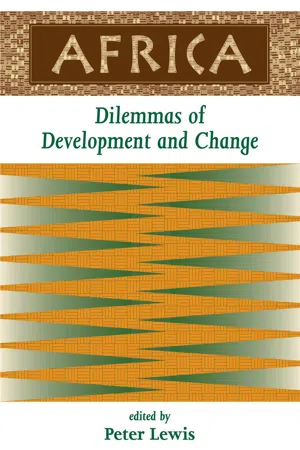
This book focuses on the historical construction of African states, the modes of political control in the region, and the character of political elites. It examines the nature of political legitimacy and the avenues of participation or withdrawal pursued by various popular sectors.
Information
Part One
States and Leadership
The study of African politics has shifted in light of changing perspectives on development and new assessments of governance. At first, theories of modernization and political development prompted attention to central institutions and discrete political processes. Throughout the 1960s and 1970s, writers sought to understand African bureaucracies, military establishments, and political parties in tandem with a focus on corruption, civil-military interactions, political participation, and patron-client relations. The role of ideology was also accentuated during this period, as analysts gave considerable attention to the distinctions among various political regimes and doctrines.
With the growing prevalence of state-centric approaches, there was an effort to build upon these earlier studies by elaborating broader comparative features of political power and capacity in Africa. This new generation of political studies centered on the general aspects of politics that cut across ideology and regime type, including the social foundation of ruling groups, the qualities and capabilities of political institutions, and the strategies of political control pursued by various governments. This work is guided by two assumptions: that there are specific and enduring elements that are fundamental to politics in the region and that an appreciation of these characteristics is essential to understanding processes of continuity and change.
During much of the postindependence era, weak authoritarian regimes have been prevalent throughout Africa. Despite the variety of leadership forms, ideologies, and political institutions, most of the region’s governments have been politically restrictive and autocratic. African leaders have exercised considerable leeway in the use of power, and they have not generally been accountable to electorates or other organized constituencies. At the same time, African states have reflected very limited capacities in fulfilling basic functions or advancing developmental goals. The concentration of authority and the frailties of government control are integrally related.
The legacy of colonial state creation and the challenges of political consolidation provided the foundations of African political development. The colonial state was an alien imposition on African societies, authoritarian by nature and usually distant from its subjects. At the same time, colonial administration was often thin on the ground, and there was not an intensive bureaucratic presence in many territories. While colonial authorities did exercise stable rule and provided some basic public goods, they were commonly experienced by their subjects as illegitimate and predatory. Not surprisingly, Africans typically regarded the colonial state as an intrusive presence to be evaded or exploited whenever possible.
This inheritance created basic problems for the establishment of effective governments after independence. The new leaders faced manifold difficulties in gathering stable governing coalitions, fostering durable institutions, and extending substantial control over the mass of their populations. The emergent governing formulas typically blended traditional modes of authority with institutional forms inherited from the colonial regime. These strategies often stabilized nascent political elites, yet they were less effective in building sound governing structures.
The readings in this section address basic features of political authority and control in the postindependence era. The authors elaborate several important themes, including the nature of leadership and institutions in African political systems, the construction of the region’s ruling groups, and the relation of governing elites to their supporting constituencies. These analyses provide insights into the ways that African regimes have been constituted and sustained and the implications of political domination for other spheres of development. This focus on the politics of the center provides a starting point for exploring the broader scope of relations between citizens and rulers.
Robert Jackson’s and Carl Rosberg’s discussion of personal rule in Africa highlights the tendency toward the concentration of authority into the hands of individual leaders and the corresponding erosion of institutional sources of power. The region’s political leaders have pursued different modes and styles of governance, but the relative autonomy of individual leaders and the comparative weakness of formal organizations and the rule of law have been hallmarks of African politics in the decades since independence. The syndrome of personal rule has fostered a basic dilemma of political institutionalization in the region.
Richard Joseph provides a further vantage on the nature of elite control and the disposition of state resources. Observing the ambiguous boundaries between the public and private realms in Nigeria, he outlines a pattern of “prebendal” politics, in which nominally public resources are appropriated for personal and community ends. As both a mode of political coalition-building and an attitude toward state assets, prebendalism has had debilitating effects on both political stability and economic growth.
In the section’s final reading, Richard Sandbrook considers how ruling groups have been comprised in Africa. He explains the ubiquitous role of patron-client relations in building political networks and solidifying regimes. The article also stresses the importance of factional division as a source of dissension in African governments. While patron-client linkages often provide the building blocks of political control, this form of alliance carries inherent weaknesses and hazards.
1
Personal Rule:
Theory and Practice in Africa
Robert H. Jackson and
Carl G. Rosberg
Carl G. Rosberg
When I say “politics”... it [is] not a question of the art of governing the State for the public welfare in the general framework of laws and regulations. It is [a] question of politician politics: the struggles of clans—not even [ideological] tendencies—to place well oneself one’s relatives, and one’s clients in the cursus honorum, that is the race for preferments.
—Leopold Sedar Senghor
The Image of Personal Rule
Personal rule has been a compelling facet of politics at least since the time of Machiavelli. It is the image not of a ruler but of a type of rulership.1 Personal rule is a dynamic world of political will and activity that is shaped less by institutions or impersonal social forces than by personal authorities and power; it is a world, therefore, of uncertainty, suspicion, rumor, agitation, intrigue, and sometimes fear, as well as of stratagem, diplomacy, conspiracy, dependency, reward, and threat. In other words, personal rule is a distinctive type of political system in which the rivalries and struggles of powerful and wilful men, rather than impersonal institutions, ideologies, public policies, or class interests, are fundamental in shaping political life. Indicators of personal regimes in sub-Saharan Africa are coups, plots, factionalism, purges, rehabilitations, clientelism, corruption, succession maneuvers, and similar activities which have been significant and recurring features of political life during the past two decades. Furthermore, there is no indication that such activities are about to decline in political importance. Whereas these features are usually seen as merely the defects of an otherwise established political order—whether capitalist, socialist, military, civilian, or whatever—we are inclined to regard them much more as the integral elements of a distinctive political system to which we have given the term “personal rule.”2
It is ironic that in the twentieth century a novel form of “presidential monarchy” has appeared in many countries of the Third World. The irony consists in the contradiction of what is perhaps the major tendency in the evolution of the modern state during the past several centuries: the transformation of political legitimacy from the authority of kings to the mandate of the people.3 What has happened in the Third World and especially in Africa was not expected to happen. When colonial rule was rapidly coming to an end in the 1950s and 1960s, it was hoped that independent African countries would adopt some form of democracy, be it liberal-democratic or socialist or some indigenous variant.4 Instead of democracy, however, various forms of autocracy appeared.
Fifteen years ago, scholarly writings on the New States ... were full of discussions of parties, parliaments, and elections. A great deal seemed to turn on whether these institutions were viable in the Third World and what adjustments in them ... might prove necessary to make them so. Today, nothing in those writings seems more passe, relic of a different time. Marcos, Suharto, Ne Win, al-Bakr, Sadat, Gaddafi, Boumedienne, Hassan, Hou-phouet, Amin, Mobutu may be doing their countries good or harm, promoting their peoples’ advantage or oppressing them, but they are not guiding them to democracy. They are autocrats, and it is as autocrats, and not as preludes to liberalism (or, for that matter, to totalitarianism), that they, and the governments they dominate, must be judged and understood.5
There is a related methodological irony in this unforeseen historical development of presidential monarchy. At about the same time that students of politics were discarding the traditional tools of political theory, biography, and history that had proved of some value in the study of statecraft and were adopting the modern tools of sociology—thereby acknowledging that modern politics are mass, social politics in which governments interact with national populations or large classes or groups within them—political systems appeared in the Third World in which social politics were practically nonexistent and ruling politicians were remarkably free from the constraints of democratic institutions or social demands.6 Therefore, despite the crucial importance of sociological explanations of politics—in which society is at least as important as the state; quantity or political weight counts for more than quality or political skill; impersonal social process is more significant than individual political practice; and little room, if any, is left for the analysis of rulership or leadership as such—in the Third World, and certainly in Africa, we continue to encounter prominent politicians who act as if the principle of popular legitimacy had not been invented and national societies did not exist.
Political sociologists are justified in their criticisms of the “great man” theories of some historians, and we do not wish to suggest either that rulers are wholly independent actors or that biography is the most suitable approach in studying rulership. But the “little man” and certainly the “invisible man” theories of social politics can also be criticized, especially in those societies, as in Africa, where the image of the “big man” is deeply embedded in the political culture and politics is often a vertical network of personal, patron-client relations.7 If we are to deal with rulership in sociological terms—that is, in theoretical and not merely descriptive terms—we are obliged to regard political life as “a dialectic of power and structure, a web of possibilities for agents, whose nature is both active and structured, to make choices and pursue strategies within given limits, which in consequence expand and contract over time.”8 Therefore, in terms of methodology the image of personal rule draws our attention not only to rulers and their activities, but also to the political networks, circumstances, and predicaments in which they are entangled and from which they can never entirely extricate themselves.
Political images can often be sharpened by the careful selection of terms with which they are designated. If the terms “social politics” or “public politics” are apt for designating the political life of nation-states in which a popular mandate is the principle of legitimacy and politics is a “sociological activity ... of preserving a community grown too complicated for either tradition alone or pure arbitrary rule to preserve it without the undue use of coercion,” then perhaps Bernard Crick’s term “palace politics” captures the largely personal, private, and elitist characteristics of political life in the autocracies that have emerged in Africa and elsewhere during the past several decades.9 In this essay we present a theory of personal rule and its integral practices in independent African countries.
A Theory of Personal Rule
In the introductory remarks we have hinted at the main characteristics of personal rule. To understand its distinctive character we must first set aside some central sociological assumptions about the nature of the modern state, including the following: (1) the modern state’s legitimacy ultimately rests upon, and its government interacts on a continuous basis with, an underlying national society and its constituent groups and classes; (2) the relations of society and government concern primarily group demands or class interests, ideal or material, calling forth public laws and policies which in turn provoke policies which in turn provoke new demands and so forth; (3) the institutional and policy biases of government reflect the power and privilege of classes and groups in society; and (4) the activity of government policymaking is at once social (in attempting to address societal demands) and technical (in attempting to apply the knowledge of the policy sciences, including especially economics, to deal with policymaking problems).10
The assumptions of personal rule are quite different, and an instructive way to approach them is to recall the concept of rulership in Machiavelli’s masterpiece, The Prince.11 Machiavelli assumes that the Prince is a self-interested, rational actor who desires to acquire and hold a principality. But the principality is not a national society of mobilizable groups and classes whose interests command the attention of the Prince; and the Prince is not primarily concerned to promote the welfare and conciliate the conflicts of an underlying national society upon which his legitimacy depends. Rather, the principality is a political entity which is acted upon—ruled—by the Prince and may be capable of occasional political reaction—such as rebellion—but it is not integrated with the government and has few political interests other than to be left unexploited and in peace. “As long as he does not rob the great majority of their property or their honour, they remain content. He then has to contend only with the restlessness of a few, and that can be dealt with easily and in a variety of ways.”12
Personal rule is an elitist political system composed of the privileged and powerful few in which the many are usually unmobilized, unorganized, and therefore relatively powerless to command the attention and action of government. The system favors the ruler and his allies and clients: its essential activity involves gaining access to a personal regime’s patronage or displacing the ruler and perhaps his regime and installing another. As an elitist system, personal politics concerns cooperation and rivalry among leaders and factions within the political class only and not among broader social classes or groups.13 Consequently, the political process in personal regimes is primarily asocial insofar as it is largely indifferent to the interests, concerns, and problems of social strata beyond the political class. Personal politics is not public politics: it is not a “sociological activity” in Crick’s meaning of the term, nor is personal governance significantly technical in practice. Although it may employ technocrats and proclaim socioeconomic plans and policies—including national development plans—its concrete activities are rarely guided by such impersonal criteria. Rather, government and administration are likely to be highly personal and permeated with patronage and corruption.
As already indicated, personal rule is a form of elite politics. However, it does not rest upon established constitutional rules and practices (including traditions) that effectively regulate the activities of the political class—especially the ruler—and is therefore distinguished from constitutional rule. Established and effective political institutions are largely absent from regimes of personal rule. In defining a political “institution” we follow Rawls.
By an institution I shall understand a public system of rules which defines offices and positions with their rights and duties, powers and immunities, and the like. These rules specify certain for...
Table of contents
- Cover Page
- Half title
- Title Page
- Copyright Page
- Acknowledgments
- Introduction
- Part One States and Leadership
- 1 Personal Rule: Theory and Practice in Africa
- 2 Class, State, and Prebendal Politics in Nigeria
- 3 Patrons, Clients, and Factions: New Dimensions of Conflict Analysis in Africa
- Part Two State, Society, and Participation
- 4 Colonialism and the Two Publics in Africa: A Theoretical Statement
- 5 Disengagement from the State in Africa: Reflections on the Experience of Ghana and Guinea
- 6 Political Transition and the Dilemma of Civil Society in Africa
- Part Three Class, Ethnicity, and Gender
- 7 The Nature of Class Domination in Africa
- 8 The Making of a Rentier Class: Wealth Accumulation and Political Control in Senegal
- 9 Reconfiguring State-Ethnic Relations in Africa: Liberalization and the Search for New Routines of Interaction
- 10 Gender, Political Participation, and the Transformation of Associational Life in Uganda and Tanzania
- Part Four Democracy and Political Transition
- 11 Africa: The Second Wind of Change
- 12 Neopatrimonial Regimes and Political Transitions in Africa
- 13 Democratization: Understanding the Relationship Between Regime Change and the Culture of Politics
- 14 Africa: An Interim Balance Sheet
- Part Five Political Economy: Crisis and Reform
- 15 Trends in Development Economics and Their Relevance to Africa
- 16 Between Scylla and Charybdis: The Foreign Economic Relations of Sub-Saharan African States
- 17 Adjustment with Growth: A Fragile Consensus
- 18 The Structural Adjustment of Politics in Africa
Trusted by 375,005 students
Access to over 1.5 million titles for a fair monthly price.
Study more efficiently using our study tools.
Frequently asked questions
Yes, you can cancel anytime from the Subscription tab in your account settings on the Perlego website. Your subscription will stay active until the end of your current billing period. Learn how to cancel your subscription
No, books cannot be downloaded as external files, such as PDFs, for use outside of Perlego. However, you can download books within the Perlego app for offline reading on mobile or tablet. Learn how to download books offline
Perlego offers two plans: Essential and Complete
- Essential is ideal for learners and professionals who enjoy exploring a wide range of subjects. Access the Essential Library with 800,000+ trusted titles and best-sellers across business, personal growth, and the humanities. Includes unlimited reading time and Standard Read Aloud voice.
- Complete: Perfect for advanced learners and researchers needing full, unrestricted access. Unlock 1.5M+ books across hundreds of subjects, including academic and specialized titles. The Complete Plan also includes advanced features like Premium Read Aloud and Research Assistant.
We are an online textbook subscription service, where you can get access to an entire online library for less than the price of a single book per month. With over 1.5 million books across 990+ topics, we’ve got you covered! Learn about our mission
Look out for the read-aloud symbol on your next book to see if you can listen to it. The read-aloud tool reads text aloud for you, highlighting the text as it is being read. You can pause it, speed it up and slow it down. Learn more about Read Aloud
Yes! You can use the Perlego app on both iOS and Android devices to read anytime, anywhere — even offline. Perfect for commutes or when you’re on the go.
Please note we cannot support devices running on iOS 13 and Android 7 or earlier. Learn more about using the app
Please note we cannot support devices running on iOS 13 and Android 7 or earlier. Learn more about using the app
Yes, you can access Africa by Peter Lewis in PDF and/or ePUB format, as well as other popular books in Politique et relations internationales & Économie politique. We have over 1.5 million books available in our catalogue for you to explore.