- 224 pages
- English
- ePUB (mobile friendly)
- Available on iOS & Android
eBook - ePub
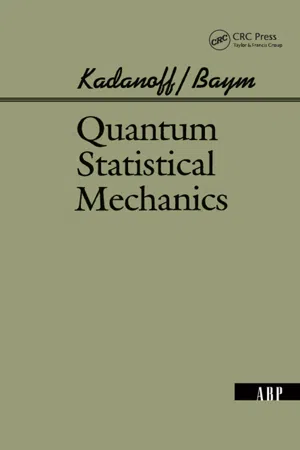
Quantum Statistical Mechanics
About this book
This book is a very early systematic treatment of the application of the field-theoretical methods developed after the Second World War to the quantum mechanical many-body problem at finite temperature. It describes various techniques that remain basic tools of modern condensed matter physicists.
Information
1 | Mathematical Introduction |
1-1 BASIC DEFINITION
The properties of a quantum mechanical system composed of many identical particles are most conveniently described in terms of the second-quantized, Heisenberg representation, particle-creation, and annihilation operators. The creation operator, ψ†(r, t), when acting to the right on a state of the system, adds a particle to the state at the space-time point r, t; the annihilation operator ψ(r, t), the adjoint of the creation operator, acting to the right, removes a particle from the state at the point r, t.
The macroscopic operators of direct physical interest can all be expressed in terms of products of a few ψ’s and ψ†’s. For example, the density of particles at the point r, t is
(1-1a) |
since the act of removing and then immediately replacing a particle at r, t measures the density of particles at that point. The operator for the total number of particles is
(1-1b) |
Similarly, the total energy of a system of particles of mass m interacting through an instantaneous two-body potential v(r) is given by
(1-2) |
In general we shall take
Table of contents
- Cover
- Half Title
- Title Page
- Copyright Page
- Table of Contents
- 1 Mathematical Introduction
- 2 Information Contained in G> and G<
- 3 The Hartree and Hartree-Fock Approximations
- 4 Effect of Collisions on G
- 5 A Technique for Deriving Green’s Function Approximations
- 6 Transport Phenomena
- 7 The Hartree Approximation, the Collisionless Boltzmann Equation, and the Random Phase Approximation
- 8 Relation between Real and Imaginary Time Response Functions
- 9 Slowly Varying Disturbances and the Boltzmann Equation
- 10 Quasi-Equilibrium Behavior: Sound Propagation
- 11 The Landau Theory of the Normal Fermi Liquid
- 12 The Shielded Potential
- 13 The T Approximation
- Appendix
- References and Supplementary Reading
Trusted by 375,005 students
Access to over 1.5 million titles for a fair monthly price.
Study more efficiently using our study tools.
Frequently asked questions
Yes, you can cancel anytime from the Subscription tab in your account settings on the Perlego website. Your subscription will stay active until the end of your current billing period. Learn how to cancel your subscription
No, books cannot be downloaded as external files, such as PDFs, for use outside of Perlego. However, you can download books within the Perlego app for offline reading on mobile or tablet. Learn how to download books offline
Perlego offers two plans: Essential and Complete
- Essential is ideal for learners and professionals who enjoy exploring a wide range of subjects. Access the Essential Library with 800,000+ trusted titles and best-sellers across business, personal growth, and the humanities. Includes unlimited reading time and Standard Read Aloud voice.
- Complete: Perfect for advanced learners and researchers needing full, unrestricted access. Unlock 1.5M+ books across hundreds of subjects, including academic and specialized titles. The Complete Plan also includes advanced features like Premium Read Aloud and Research Assistant.
We are an online textbook subscription service, where you can get access to an entire online library for less than the price of a single book per month. With over 1.5 million books across 990+ topics, we’ve got you covered! Learn about our mission
Look out for the read-aloud symbol on your next book to see if you can listen to it. The read-aloud tool reads text aloud for you, highlighting the text as it is being read. You can pause it, speed it up and slow it down. Learn more about Read Aloud
Yes! You can use the Perlego app on both iOS and Android devices to read anytime, anywhere — even offline. Perfect for commutes or when you’re on the go.
Please note we cannot support devices running on iOS 13 and Android 7 or earlier. Learn more about using the app
Please note we cannot support devices running on iOS 13 and Android 7 or earlier. Learn more about using the app
Yes, you can access Quantum Statistical Mechanics by Leo P. Kadanoff,Gordon Baym,David Pines in PDF and/or ePUB format, as well as other popular books in Physical Sciences & Condensed Matter. We have over 1.5 million books available in our catalogue for you to explore.