- 656 pages
- English
- ePUB (mobile friendly)
- Available on iOS & Android
eBook - ePub
About this book
Computational Physics is designed to provide direct experience in the computer modeling of physical systems. Its scope includes the essential numerical techniques needed to "do physics" on a computer. Each of these is developed heuristically in the text, with the aid of simple mathematical illustrations. However, the real value of the book is in the eight Examples and Projects, where the reader is guided in applying these techniques to substantial problems in classical, quantum, or statistical mechanics. These problems have been chosen to enrich the standard physics curriculum at the advanced undergraduate or beginning graduate level. The book will also be useful to physicists, engineers, and chemists interested in computer modeling and numerical techniques. Although the user-friendly and fully documented programs are written in FORTRAN, a casual familiarity with any other high-level language, such as BASIC, PASCAL, or C, is sufficient. The codes in BASIC and FORTRAN are available on the web at http://www.computationalphysics.info. They are available in zip format, which can be expanded on UNIX, Window, and Mac systems with the proper software. The codes are suitable for use (with minor changes) on any machine with a FORTRAN-77 compatible compiler or BASIC compiler. The FORTRAN graphics codes are available as well. However, as they were originally written to run on the VAX, major modifications must be made to make them run on other machines.
Information
Chapter 1
Basic Mathematical Operations
Three numerical operations — differentiation, quadrature, and the finding of roots — are central to most computer modeling of physical systems. Suppose that we have the ability to calculate the value of a function, f(x), at any value of the independent variable x. In differentiation, we seek one of the derivatives of f at a given value of x. Quadrature, roughly the inverse of differentiation, requires us to calculate the definite integral of f between two specified limits (we reserve the term “integration” for the process of solving ordinary differential equations, as discussed in Chapter 2), while in root finding we seek the values of x (there may be several) at which f vanishes.
If f is known analytically, it is almost always possible, with enough fortitude, to derive explicit formulas for the derivatives of f, and it is often possible to do so for its definite integral as well. However, it is often the case that an analytical method cannot be used, even though we can evaluate f(x) itself. This might be either because some very complicated numerical procedure is required to evaluate f and we have no suitable analytical formula upon which to apply the rules of differentiation and quadrature, or, even worse, because the way we can generate f provides us with its values at only a set of discrete abscissae. In these situations, we must employ approximate formulas expressing the derivatives and integral in terms of the values of f we can compute. Moreover, the roots of all but the simplest functions cannot be found analytically, and numerical methods are therefore essential.
This chapter deals with the computer realization of these three basic operations. The central technique is to approximate f by a simple function (such as first- or second-degree polynomial) upon which these operations can be performed easily. We will derive only the simplest and most commonly used formulas; fuller treatments can be found in many textbooks on numerical analysis.
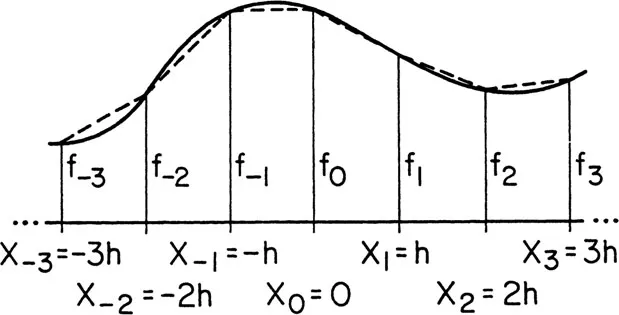
Figure 1.1 Values of f on an equally-spaced lattice. Dashed lines show the linear interpolation.
1.1 Numerical differentiation
Let us suppose that we are interested in the derivative at x = 0, f′(0). (The formulas we will derive can be generalized simply to arbitrary x by translation.) Let us also suppose that we know f on an equally-spaced lattice of x values,
and that our goal is to compute an approximate value of f′(0) in terms of the fn (see Figure 1.1).
We begin by using a Taylor series to expand f in the neighborhood of x = 0:
(1.1) |
where all derivatives are evaluated at x = 0. It is then simp...
Table of contents
- Cover
- Half Title
- Title Page
- Copyright Page
- Table of Contents
- Preface
- Preface to the FORTRAN Edition
- How to use this book
- Chapter 1: Basic Mathematical Operations
- Chapter 2: Ordinary Differential Equations
- Chapter 3: Boundary Value and Eigenvalue Problems
- Chapter 4: Special Functions and Gaussian Quadrature
- Chapter 5: Matrix Operations
- Chapter 6: Elliptic Partial Differential Equations
- Chapter 7: Parabolic Partial Differential Equations
- Chapter 8: Monte Carlo Methods
- Appendix A: How to use the programs
- Appendix B: Programs for the Examples
- Appendix C: Programs for the Projects
- Appendix D: Common Utility Codes
- Appendix E: Network File Transfer
- References
- Index
Trusted by 375,005 students
Access to over 1.5 million titles for a fair monthly price.
Study more efficiently using our study tools.
Frequently asked questions
Yes, you can cancel anytime from the Subscription tab in your account settings on the Perlego website. Your subscription will stay active until the end of your current billing period. Learn how to cancel your subscription
No, books cannot be downloaded as external files, such as PDFs, for use outside of Perlego. However, you can download books within the Perlego app for offline reading on mobile or tablet. Learn how to download books offline
Perlego offers two plans: Essential and Complete
- Essential is ideal for learners and professionals who enjoy exploring a wide range of subjects. Access the Essential Library with 800,000+ trusted titles and best-sellers across business, personal growth, and the humanities. Includes unlimited reading time and Standard Read Aloud voice.
- Complete: Perfect for advanced learners and researchers needing full, unrestricted access. Unlock 1.5M+ books across hundreds of subjects, including academic and specialized titles. The Complete Plan also includes advanced features like Premium Read Aloud and Research Assistant.
We are an online textbook subscription service, where you can get access to an entire online library for less than the price of a single book per month. With over 1.5 million books across 990+ topics, we’ve got you covered! Learn about our mission
Look out for the read-aloud symbol on your next book to see if you can listen to it. The read-aloud tool reads text aloud for you, highlighting the text as it is being read. You can pause it, speed it up and slow it down. Learn more about Read Aloud
Yes! You can use the Perlego app on both iOS and Android devices to read anytime, anywhere — even offline. Perfect for commutes or when you’re on the go.
Please note we cannot support devices running on iOS 13 and Android 7 or earlier. Learn more about using the app
Please note we cannot support devices running on iOS 13 and Android 7 or earlier. Learn more about using the app
Yes, you can access Computational Physics by Steven E. Koonin in PDF and/or ePUB format, as well as other popular books in Physical Sciences & Computer Science General. We have over 1.5 million books available in our catalogue for you to explore.